 19:25
19:25San Diego · 2026

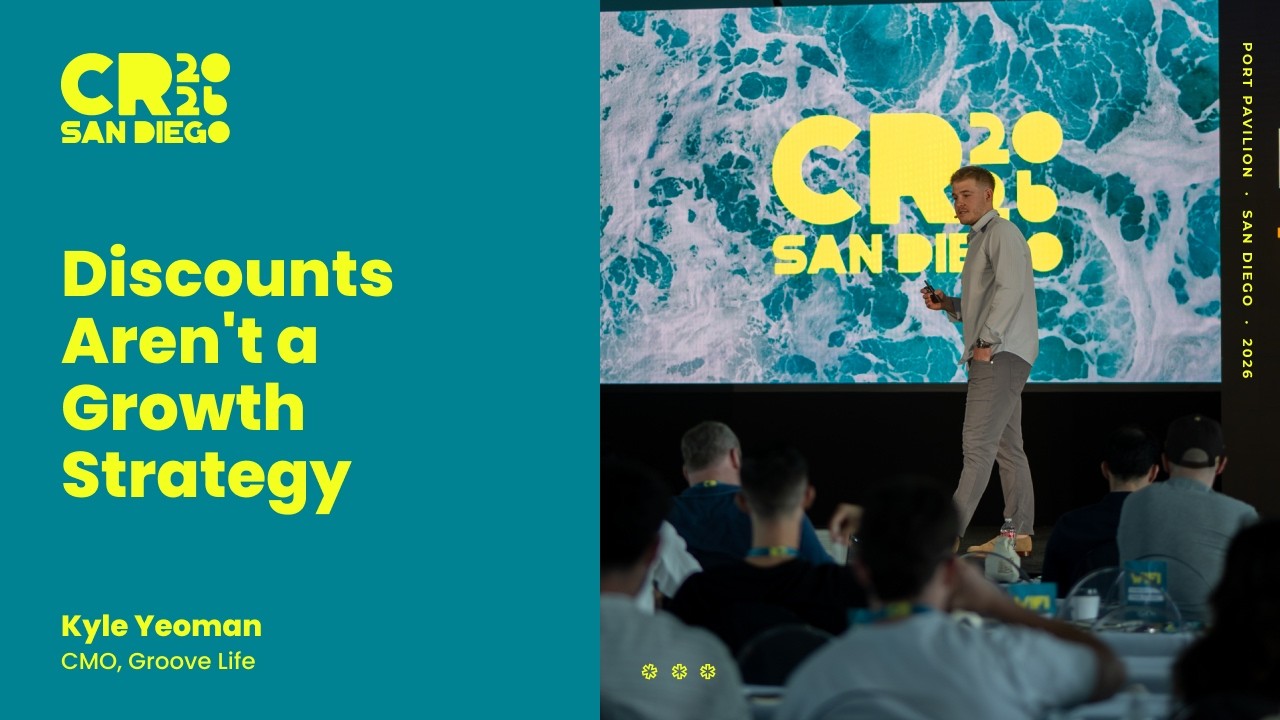
Kyle Yeoman shares how Groove Life reduced discounting, rebuilt its product pages, and tripled profit. Learn his approach to auditing promotions, improving conversion, and building a stronger non-promotional revenue base.
Kyle Yeoman shares how Groove Life reduced discounting, rebuilt its product pages, and tripled profit. Learn his approach to auditing promotions, improving conversion, and building a stronger non-promotional revenue base.
For ecommerce founders, growth marketers, and brand leaders assessing discount dependence, product-page performance, and profitable growth.
Recorded at Commerce Roundtable San Diego 2026. Results are Groove Life’s reported experience; the promotional math depends on the assumptions shown in the talk. Kyle recommends adapting the approach to your own business. Chapter times follow the publisher’s YouTube description.
Speaker roles and platform examples reflect the session’s original context. This is an archived conversation.
Divide total discounts by gross sales over the last twelve months, then review the offers contributing to that number.
Read this part · 06:05 ↓Include normal baseline revenue, advertising costs, margin, and the post-promotion dip when assessing whether a sale helped the business.
Read this part · 09:50 ↓Groove reduced operating expenses first so the team had room to move away from promotional revenue.
Read this part · 13:20 ↓Clarify the product’s value through imagery, selection, education, copy, comparisons, and social proof before defaulting to a lower price.
Read this part · 17:14 ↓Use the repeatable full-price baseline and profit alongside top-line sales to understand whether the business is becoming stronger.
Read this part · 20:32 ↓A quick editorial guide to the key ideas. Read the complete transcript below for the examples, details, and discussion in the recording.
Original recording on YouTube ↗Kyle describes how Groove Life’s discounts escalated as the team chased revenue growth. Each promotional spike created a harder comparison for the following year, while deeper discounts and advertising spend compressed margins. Repeated promotions also taught shoppers to treat the discounted price as the normal price.
Kyle recommends calculating discounts divided by gross sales over the last twelve months. His diagnostic buckets distinguish mostly full-price selling from increasing dependence on promotions. He asks brands to look beyond the headline offer and review incentives across the customer journey, including evergreen signup and recovery offers.
Kyle uses a hypothetical product, margin, discount, and advertising scenario to show how a promotion can require much more unit volume to preserve contribution. The numbers depend on those assumptions. His lesson is to run the calculation with your own economics rather than equate a revenue increase with a profit increase.
A useful promotion review includes the baseline, sale duration, discount depth, gross margin, ad spend, and the revenue dip after the sale. Kyle also recommends auditing evergreen discounts and coupon leakage. The aim is to understand incremental contribution rather than count every sale during a promotion as incremental revenue.
Groove reduced operating expenses before changing its discount strategy. Kyle describes reviewing people and software costs and rebuilding some tools internally. He emphasizes the sequence: lowering fixed-cost pressure gave the team room to accept the uncertainty of changing how the business sold its products.
Once the discount constraint was in place, Groove redirected work from promotional assets toward communicating product value. Kyle says the team needed alternatives to using price cuts to lift conversion. This meant improving the customer’s understanding of the product rather than continually changing the offer.
Kyle walks through improvements to imagery, product selection, related upsells, product education, comparison content, copy, and social proof. Groove replaced the old page, then tested refinements to the new version. He reports a 61% conversion lift and lower Meta CPA with the same ads and account structure; the complete page replacement itself was not an A/B test.
Kyle reports that Groove tripled profitability after the broader changes. He also highlights growth in non-promotional revenue on slightly less advertising spend. His definition of revenue quality emphasizes what can repeat over future periods, and he encourages teams to celebrate their evergreen baseline alongside headline sale results.
Kyle recommends auditing the business, reviewing past promotions, and rebuilding one page around one core customer and a high-volume category. He argues for changing the message before changing the price. In the closing recap, he describes taking successful site messaging into Amazon A+ content and retail materials, with results specific to Groove’s experience.
From the transcript supplied by Commerce Roundtable, with filler words removed and paragraph breaks retained for readability. This source does not include paragraph timestamps. Refer to the recording for exact wording and the session guide above for chapter times.
The supplied transcript includes the replay sponsor message. Brand names, figures, and other transcription variations are preserved from the source; refer to the recording for exact wording.
Original recording on YouTube ↗Everybody hear me? Good. All right. So like Shaq said, we cut our discount rate from thirty-three point seven percent to two point nine percent this year, and we tripled our profit. So today I wanna tell you Groove's story. I want to convince you that discounts are not a growth strategy, and I want you to see why you should pursue quality of revenue over top line, right?
So I'm gonna define quality of revenue as repeatable revenue. If you can repeat it over the next period or the next year, that to me is quality of revenue. We want to avoid spikes. So today we're gonna talk about a few different things. One is the trap of discounting, two is how to audit where you're at today, and three is what to do to fix your discounting if you're in trouble.
But before I get into that, I wanna introduce myself. My name is Kyle. Like Shaq said, I'm the president at Groove. We are a bootstrapped and profitable business. We have been from the beginning. I am the brand side, so I have nothing to pitch you. You can relax. And, we're mid eight figures, and w- we're known for our premium accessories, so men's belts, rings, wallets, that sort of thing And I've been at Groove now almost five years this, this second round.
The first round I was more of an entry-level employee in 2019. I did paid social specifically, so I'm one of you. And I was there for about eight months, and I realized I could probably make some more money doing this for more people. So I left and, and did kind of the freelancer agency model for a little bit.
Ended up working a few other places, and then came back to Groove as chief marketing officer in 2022. Ended up taking over brand and wholesale and some other things. Moved to chief revenue officer role, and then two years ago moved into the president role. so I'm still a, a marketer very much at heart, like, like Nick said, still run a lot of the actual paid, very much in the weeds, understand what's going on with the business as it's our main growth engine.
But I've had enough exposure to know that top line is not all it's cracked up to be, and chasing it is a bad outcome for the business and for you as a marketer. So let me tell you about the trap that we were in at Groove. So up until 2023, growth felt pretty easy for us, candidly. We had new product introductions in 2020.
We saw lots of market share coming from that. We were coming off of the pandemic, so you had people spending money like crazy, right? And we were still using discounts even at this time to accelerate growth. So we would still run a twenty percent off or a thirty percent off, and it was justifiable because we had good gross margins, and we saw a big bump in top line.
Even then, we knew we probably shouldn't do it, but we stayed the course because it wasn't something we had to fix. Fast-forward to 2025, and we were giving away a third of every dollar we sold. So we found out, we really weren't aware of this until 2025, we had slowly escalated our discount rate to essentially thirty-three point seven percent on average throughout the course of the year.
So promos were driving more and more of our revenue, and while top line was growing, profit was not. Right? So this is the problem. Most marketers turn to a discount too quickly. When in doubt, that's the lever we pull, and we all are rewarded on that, right? If you want revenue quickly, pull the promo lever, revenue spikes, and that kicks off what I like to call the vicious spi-- cycle.
So we run a promo, you get the revenue pop, everybody pats you on the back, right? Like I don't, I don't know a single time we ran a promo, had more revenue, and someone was upset inside the company. It's a dopamine hit that you want over and over again. So you're in-incentivizing your team to discount more because they're rewarded for it, and this is what was happening at Groove, right?
You just get onto that more and more. And this is fine for now, except that it starts this portion of the cycle, which is more comp pressure, right? So we all wanna grow this year, next year, the year after, and now you're doing it based off of artificial top line. So what this creates is that you hit comp pressure.
This might take a couple years, but at some point you're going to have to either increase your discount rate, you're going to have to spend more on ad spend, right, to get the same top line or some version of those. And Then you're gonna repeat, and you're gonna keep going. So this is what, what ends up happening.
Revenue keeps climbing, but gross margin gets crunched, right? So the more you discount, the more your gross margin's gonna crunch. At the same time, you're spending more, right? So you're compressing your contribution margins. You're still getting top-line growth, but contribution margin is shrinking, which puts more cash pressure on the business.
You're also probably hiring people because you have more top line and you need to do more things. So that doubly impacts profit. Is everybody tracking how this is like a really bad cycle? And even at this stage, this isn't great, but at least revenue's still going up. The worst is when your revenue starts to stall, and now this is all compounding, right?
So when things get tighter, they get exponentially tighter. And then you've created a scenario where your everyday price is really just the price you're running on discount. For example, if you, if you sell a hundred dollar product and you're consistently running twenty-five percent off, over a certain period of time, your customers do not think of you as a hundred dollar product.
They think of you as a seventy-five dollar product, right? The challenge is that this happens really, really slowly, and you inside of the brand don't notice until it's too late, right? By the time everybody in the company's aware, you're already in some trouble. If you don't believe me, go look at your Reddit threads about your business, and you will see people call out, "They're running a discount.
This is the price. I got it for forty-six bucks, thirty percent off." So now this belt that we're talking about is sixty-five dollars. How are you gonna convince anybody to go pay full price? It's like a real question, right? That becomes a problem So we realized at, at Groove that something had to change and it had to change fast.
We're omni-channel, so it, it wasn't immediate pressure. The business could have continued going forward, but we knew something needed to change. And I think one of the biggest elements of this is just knowing where you stand. So for us, it was a lack of awareness of our discount rate. That was a big problem.
So I, I have a question for everybody. Do you know what your discount rate is today on average? Not like what you give in an entry pop, your aggregate total stack discount, what are you giving up in margin? Can I get a show of hands on this one? Does anybody know off the top of their head? One, two, three.
Okay. So almost nobody, unless you're all just super shy. That's my takeaway. So if you haven't pulled it before, it's just the simplest way inside of Shopify or wherever you sell is discounts divided by gross sales, and do it for the last 12 months. And you're gonna fit into one of four buckets, essentially.
There's only a couple buckets you'll fit into. One is you're, you're discounting less than 10% and you're essentially at full price. You're charging full price most of the time. You're probably using discounts intelligently to move people through the funnel. We're still marketers at the end of the day.
But you should protect this, and there's nothing else for you in this talk. You should go get a beer, do something else, brag to someone next to you, move on. Then there's 10 to 20%, and this isn't bad, right? This is, this is still could be very productive for your business. But there's usually a couple habits that you're doing that you haven't double-checked in a while, right?
So think about free shipping. Think about 20% off entry pops. Think about these things that have just been on in your business, and as you scale, they start to stack, and you're just kind of leaking margin. It's not catastrophic, but it's something that you should look at
This is where it starts to get bad. The next bucket is twenty to thirty percent discounts. And I'd say at this point, you are a discount-driven brand, whether or not you want to say it, whether or not you would acknowledge that. Your customers are aware you discount, and they're waiting. Even worse is thirty percent off.
We were here, so, so don't take this offensively. We were here. you have a promotional business. You, you are discount dependent. If you stop discounting, your volume will shrink aggressively, right? This is a problem. So I have a few hypotheticals because I think some of this is very actionable for Q4, and we're gonna get, gonna get into that.
But some of it's just thinking through as you run your business, what are the outcomes that you want? Do you want a healthy business that drives more profit? Do you want short-term top line? What's the outcome? So the first one is, if you run thirty percent off, do you know how many more units you would have to sell in order to break even on a contribution margin level?
And the assumption is this. There's a couple-- you know, you have to have some frameworks in there. So assume it's a hundred dollar price point product, assume you have sixty percent gross margins, you're running thirty percent off, and you spend thirty percent on ad spend Raise your hand if you think it's more than 30%.
I hope everybody raises their hand because how would you... Okay, half the room. I'm worried about you all. the answer is actually 233% more units
All right, I hope you're enjoying the replay from Commerce Roundtable. I wanted to stop you for just 30 seconds and tell you all about the sponsor that made this happen. I see too many Shopify brands overpaying for big email tools and using only a fraction of their features. They're tired of complexity and never-ending price hikes too.
That's why Seguno Email is different. Lives inside of Shopify and uses your shop live data, not a sync copy of that. Plus, the integrations with Sidekick, ChatGPT, Claude, and Canva saves you time. And get this, Seguna is the only email app to win a Shopify Build Award. Sounds interesting, right? Switching is easy, and you get twenty percent off for being a part of the Commerce Roundtable community.
Link in the show description. Now, back to your replay. Which probably surprises you. We're all marketers, right? We're not finance people, so we're like, "Thirty-one percent should do it, one percent more." It's two hundred and thirty-three percent. This works in the inverse as well, right? So let's say that you are discounting all the time and you're essentially at seventy dollars.
You only need to sell sixty-seven percent of the units to attain the same contribution margin. This is a huge deal because it's, again, like we said, compounding, and your numbers might be different, right? The better your gross margin, the better this is. You don't have to have quite the attainment. But again, it's all variable.
And I have, a QR code I'm gonna share with you guys in a minute that you can pull this up on and, and run your own numbers. But I have another question. Did your last promo make you any profit? Genuinely. I think all of us probably think it did, right? That's why we do them. Otherwise, we wouldn't do it.
But my challenge to you is, have you actually checked? Like, have you actually looked at your numbers and seen if this was a productive use of time, money, energy, anything? My gut is that it's not as good as you think. And there's a lot of numbers here, so don't get lost. I have a, again, a QR code I'm gonna pull up in a minute.
You can pull your numbers. But there's a couple assumptions in here, right? That you could fill in and basically get an idea of whether or not your promotion was actually net productive, net useful for you as a business. The assumption would be how long it ran, how much revenue was driven during the, the promo period, how deep was your discount, right?
What was your baseline before? 'Cause that's really important. We want incrementality. We don't just wanna pump revenue, that, that w- you know, it was gonna come anyway. What your revenue is after the promo, right? We all have the promo hangover. So anytime you ask your team, "Why is performance down?" "Well, you know, we just came off promo."
So you have to take that into account. Your gross margins and your ad spend. And what's really, really fascinating is because of the amount of lift required from these promos, most of them are not actually contributing to your bottom line. Now, I talked to a few different people, and they're seeing top line grow and margins eroding, and you're going like, "What's going on?"
And it's this. Add in that you have tariffs that hit a bunch of us last year. You have fuel costs surging. The pressure on the business is growing. This is really, really important. So if you wanna do this, you can scan this QR code. It'll pull up a Google sheet. You can just make a copy, run your own numbers, do whatever you want with it.
You can throw in different assumptions and play around. And, and just remember, this is not prescriptive, right? This is more of a hypothetical exercise just to get you thinking about it There's one other thing in this chart, and that's a revenue leak. So I talked about how you have these different things that stack.
Again, another... I'm not gonna spend a ton of time on this, mess with it, but take all the things that you guys have running evergreen, like pop-up discounts or, you know, abandoned carts or coupon sites that hold all your stuff. You're giving up margin across the board that's probably not all that additive.
So this is a really easy cleanup that will just inject margin into your business and won't require much change. Again, that's the QR code if you want any of those
So once you know where you're at, which I think is really, really important, you need to ask yourselves a question, which is like, "If I cut every discount today, would my business survive?" Right? 'Cause some of these things are good in theory, but you can't just yank all these levers around. You're gonna have real problems, right?
But for, so for us, the answer was no. Like, if we stop these discounts, we're gonna have some big, big, big issues. The trend doesn't look good, and especially with the OPEX we had, we were stuck, right? Like, we are going to have to continue juicing top line in order to cover our fixed cost, and that's gonna be a challenge.
So I wanna talk to you about how Groove went about fixing this. Here's what we did Before we did anything discount related, any other change to the business, we cut our OpEx. So this started in twenty twenty-five Q4. We knew that this wasn't sustainable. We're founder-led, we're bootstrapped, we're profitable.
We knew we wanted to change. We prepared ourselves by fixing our OpEx. There's a couple things that go in there. Anybody who's in finance knows all these things, but the big ones for us were people and software. Those are the two. Like, those are really the only two big levers besides ad spend, and that's above contribution margin.
And this is a really uncomfortable conversation, but my challenge to you would be that if you actually have to make people adjustments, then you overhired for your true demand level and your true revenue amount
We did a bunch of stuff that I'll talk to you about afterwards. We built a lot of our own stuff internally. We cut a bunch of... Yeah. So I mean, software, I know there's some softwares here, so I'm not... Use their software. But we cut a lot. We saved, I want to say at least, our CFO's back here, maybe seven figures this year in software costs by just rebuilding internally.
So it's a mixture, right? It wasn't like we just cut the team full, full, fully. It was more an idea that you got to find ways to save on your fixed costs so you have the space, right, to make better decisions for your business. It's uncomfortable, but this is why you're in leadership. These are the things that no one else is going to do in your company because it, it sucks.
Then we cut our discount rate. And I think the order is very important. If you do this in the inverse, you will bail immediately. It won't stick because you can't do it. Like, we're, we're all humans, and we don't like pain. So when we did this, this mandate was discounting is not an option. Like, th- there is no world in which we now go back to 20% off because you feel like it.
This was something that from top down, no more discounts. So what's really interesting is how much time you're gonna find your team spends facilitating promotions. And so we stopped discounting. We told the team immediately, "Focus on selling." Right? So the team currently spends time updating pages, new ad creative, making new emails, so on and so forth.
We pivoted them to say, "Become better at selling." And I'm gonna show you a couple examples. But the main thing I mean here is we all use discounts to juice conversion rate, right? I mean, that's what essentially what we're doing. So you-- there's other ways to do this. They're just slower and more painful
How many of you live... This is Meta CPA for us in 2025. I told you we'd get into the weeds a little bit. This is our CPA in Meta in 2025. How many of you experience these peaks and valleys currently? Pretty common, I think, for a lot of us, right? So, and if you look at this chart, any of these really good-looking dips were promo-driven, right?
So you have some ad spend, you're able to juice volume, it goes down. This is all seven-day click, by the way, no view-through, no attribution. Then when you get rid of the promo, it spikes back up, and then the team panics, and then you go back to discount, right? This is the path that we were on So we made this change And then this is the first part.
This is where we were before, as I was talking about. You can see basically our CPA, you know, if you average it out and remove promos, would live somewhere above $100. After we cut discounts, our meta CPA stabilized this year, and you can see it still has some variance. It's still meta, but you're talking about between currently forty and sixty dollars on average, seven-day click attribution inside of meta
So down 52%. And I don't think what happened is what you think. This wasn't anything... These are all the same ads in Meta. These are all the same account structures, same level of spend. Nothing changed on our ad side. Distribution's great, right? But it's just one part of the puzzle. This is all site updates.
So this is what our site looked like before, and I'm gonna talk through a couple elements, before we cut discounts. You had our flagship product, right? This is a patented, very cool product, lots of people like. We've-- I mean, this says, you might not be able to see it, 22,000 reviews. We have our SKU selector, which doesn't have a full assortment.
We had bundles, right? So if you buy two, evergreen, get 30% off, right? Increase average order value. We also had a three-belt, even deeper. Go for it. Knock yourselves out. And then we had an upsell for a product that was like 85% of the price of the main product and no education. And then if you look, this was the rest of the PDP.
There's-- We had an, an accordion that was shoved together, and this still converted at like over two and a half percent. But when I look at it now, I go, "No wonder we had to discount to drive more volume." Like, what's compelling about this at a high price point for the category?
This is the new page. So instead of discounting, we turned the team to this. There's a lot that happened here, but we increased conversion rate by sixty-one percent. That changed everything else. And you can see there's a lot of elements here that changed. Imagery, now you can see this carousel down here of what else you can look at.
You have better selectors to see the different colors available. The upsell, we're still giving a small discount. If you aggregate these two products together though, it's still sub six percent, is connected to the product. We have this accordion expanded out with more content. We have better imagery. We have good comparison.
All these things that like Ezra and everybody else are talking about. And then we took this page and A/B tested this page. So we didn't A/B test the new... the old page. We just cut and ran. And then what we A/B tested was stuff like this and copy, right? And so like single copy changes here still made huge adjustments.
This used to be, you know, why it's the best in the world. We changed it to why it'll never quit on you. That was a huge increase in conversion. Nate Lagos wrote that one for us, so hit him up if you need copy. yeah, social proof, all that stuff, right? So that's the OG page today. And we sent all of our traffic here.
I know there's lots of thoughts on sending to landing pages. Do all that if this is great. But what I see is we basically just pump out volume, right? Everybody's teams just do a lot of volume on stuff, and none of it's very good quality. So none of this copy was written by AI. None of the briefing was written by the team.
We basically sat down and said, "What if we forgot everything we knew about our business, what would we do to sell this product?" And while all this was happening, we collected thirty percent more per unit, right? So you can see that starts to get better. Additionally, non-promotional revenue increased by fourteen percent on one percent less ad spend.
This is super important for Q4, by the way, because your baseline determines your Q4, right? Your daily average evergreen revenue basically operates at a multiple in Q4, whatever your discount rate is. Plus, you can limit your discount rate and still drive the same top line if this is moving in the right direction.
So I actually would encourage all of you, no matter what you do, start tracking this more than you track your promotional revenue. It's a better baseline. And celebrate with your team on this. It's less sexy than a huge top line number, but it's a lot more important
And this was the most important result for us. We tripled profitability. We've always been profitable, but we had slowly seen it go from 20 to 18 to 16, right? It's, we could have gone on for a while, but it wasn't gonna be good. So this was a huge, huge deal for us. And there's two reasons why this is important.
If our founder wants to keep the business, super profitable. He makes a lot of money. He sleeps better at night. I sleep better at night. Our team is happier. There's all these benefits. But if he wants to sell the business, it's also better. He's selling to finance people, right? And finance people like predictability.
I'm looking at our CFO, he's smiling. Pre- predictability, they want to know what future revenue's gonna look like, right? And they discount revenue that was bought with a discount. It's not as valuable. It's not repeatable. So either way, you're better off running your business at full price, and our obsession as marketers in e-com for top line growth at the expense of everything else is foolhardy, and I don't think it works in this future environment.
I think the, the landscape's changed a lot and we need to, to, to change the way we run things. So if you're sitting here and you're going like, "Great. That's awesome to hear. Good for you guys," fair. But what I want you to leave here with is feeling encouraged that it's possible to do because I think one of the things we felt was that like this isn't doable.
You can't cut discounts and like survive, right? This is just what it takes to be in e-com. So I'm really glad you asked, "What should I do next?" I have a couple thoughts. Firstly, get a handle on where you are today. So use those tools. I'll show the QR code again at the end. Get an idea of where you're at because I think knowing where you sit in space is probably the most important step.
You can't fix what you don't know. And every business is different, so only do what's appropriate for you. You guys have to take into account I'm telling you things that we saw, right? But your business is different, so take it as contextual And then I want you to get into the virtuous cycle. So if the first one was the vicious cycle, this is what I call the virtuous cycle, and this is where you charge full price most of the time.
Hold that as a non-negotiable for your team because constraint drives innovation, right? As soon as you limit options for people, they find other ways to do things. This fo- forces you to become better at selling, right? And when you become better at selling, you can improve the conversion rate of whatever page you're running to, which is all we are using discounting for in the first place, right?
We are just trying to jack conversion rate up. And then what happens, like you saw, what we saw in meta CPA and everything, is your CPA will go down, which means your margin will go up. And the fun thing about that is that you can reinvest that into growth. And the nice thing is it's self-funding. So this is a much better cycle to be in in your business.
And every single dollar you quit giv-- you know, you stop giving away is coming back in, and this helps you drive demand creation, which a lot of other people talked about that today. So this, I think, helps fund a lot of those really great initiatives. But, and when you're in a downward spiral, you can't spend time on it.
Another one, stop wasting time on bad AB tests. Crap in means crap out, so if you have a terrible page and you're doing-- using AI to create whatever you want and throwing it on there, of course it's not gonna work. That first page that I showed you was six years of AB testing. Like, we do enough revenue, we, we AB test, it whittled it down to nothing, and it sucked And then rebuild one page from scratch.
Just test it. See if you can be creative, intuitive, think about what people want, and write a page that's compelling to you or your core customer, right? Pick one persona, your highest volume category, and just test that. We started with our OG belt. If you go through our site now, you'll see we've, we've made it through all of our other produ- product categories.
And change your messaging, not your price. Try to get out of the habit of going to price first. It's easy, but it's not, not lo- not long-lasting. I think that's it on what I would do next. And I, I really do want to encourage you, this will change your business dramatically, and your team will be happier.
Our team is happier now than they were last year, even though they had to do more work, strangely enough. So here's the quick hits. Quick recap. Know your discoun- discount rate and where it sits. Make sure you're pro- post-morteming your promos, so you know if they're actually working, and rebuild the page from scratch.
And then a bonus little tip, if you sell on Amazon, update your A+ content. So a lot of us don't do what we do on Amazon, what we do on our site. We took everything we've done on the site that worked well and then just mirrored it on Amazon, and we saw a forty-two percent increase in conversion rate over there.
So there's these things, like this is true for retail as well, so we're in some retail. If you're in retail, take the messaging that works everywhere else and put it at all of your point of sale. That-- it's just, it's pretty linear. So I did want to show you this because I think this is another really, really easy hit for some, some big bumps And that's it.
So this is the QR code again, if you want it for those tools, if you're interested in running a better business. And then I love talking about this stuff. I like nerding out about it. This is my personal- K- Kyle, go back, go back one more one. Yeah. There was some, some stuff
Tell me when. I'll just wait until you tell me
I trust you more than my own eyes. Oh, awesome. You're good. Yeah, go on to the next one. This is my personal cell. You can text me or call me, seriously, anytime. Pretty laid back. I like talking about this. I think this is a hard space to be in sometimes. It's really fun, but it's also hard because it's, it's pretty competitive.
It can feel a little lonely at times. so it's just nice to have people in your corner. If you wanna reach out, feel free, and that's, that's it for me. So thanks for the time and thanks to Shaq.
Thank you, brother. I'm not gonna have, you're gonna go all the way to the back and answer some questions. Great. Thanks for having me. Keep going. You nailed it, buddy. Thanks everybody. Thank you
Join Commerce Roundtable in 2027 for focused learning and conversations with people working through the same challenges.