 1:13:26
The Retention Roadshow · 2026

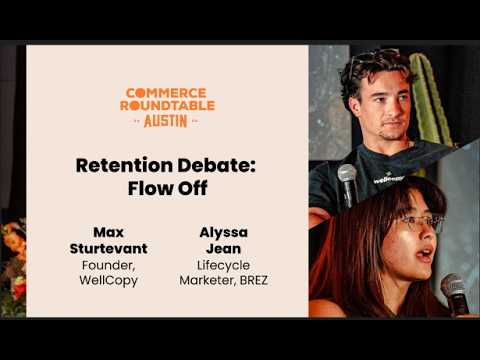
Max Sturtevant and Alyssa Jean debate welcome and post-purchase flows, with Bryan Starck moderating a discussion about offers, incrementality, onboarding, and customer trust.
Max Sturtevant and Alyssa Jean debate welcome and post-purchase flows, with Bryan Starck moderating a discussion about offers, incrementality, onboarding, and customer trust.
For retention teams choosing where to invest their next round of flow improvements.
Speaker roles and platform examples reflect the session’s original context. This is an archived conversation.
Evaluate pop-up and welcome-flow offers as one path from visitor to purchaser.
Read this part · 02:52 ↓Look at incremental orders and margin before declaring a flow the winner.
Read this part · 11:40 ↓Use a simple preference question when it meaningfully changes the welcome experience.
Read this part · 21:37 ↓Audit post-purchase emails for useful guidance before adding another sales message.
Read this part · 24:09 ↓Review campaigns, flows, and subscription reminders together from the customer’s perspective.
Read this part · 33:47 ↓A quick editorial guide to the key ideas. Read the complete transcript below for the examples, details, and discussion in the recording.
Original recording on YouTube ↗Max makes the case for the welcome flow as a high-impact opportunity to convert the traffic a brand has already paid to acquire. The pop-up, offer, and early emails work together. Improving one part without looking at the others can leave a weak link in the journey.
He discusses offer tests where different presentations of value produced different purchase behavior. The lesson is to judge the acquisition path through orders and economics, rather than celebrate a signup rate without knowing what the new subscribers do.
The discussion asks whether a flow caused a purchase or simply received credit for one that would have happened anyway. That distinction matters when comparing the apparent value of welcome and post-purchase messages. Platform-attributed revenue is useful, but it is not the whole answer.
Offer tests also need margin and subsequent customer value in view. A stronger first-order response can be worthwhile, but the business should understand what it paid to get that response and whether the resulting customers continue to buy.
Max discusses adapting welcome messages to the funnel or a simple question asked in the pop-up. An apparel example separates shopping interests, then adjusts imagery and language while keeping the basic sequence consistent.
The question should make the experience easier rather than turn signup into a long form. Only collect information you can use to change the message. This keeps segmentation connected to the customer’s needs instead of creating complexity for its own sake.
Alyssa’s case for post-purchase flows centers on trust, education, and the experience that produces another order. A new buyer has different questions from a prospect. Onboarding should help them use the product and feel confident about what happens next.
She favors messages that add value without always attaching a discount. Constant promotions can teach customers to wait for an incentive. Product guidance, answers, and a useful plain-text message can strengthen the relationship between purchases.
The conversation broadens from individual flows to the volume and relevance of everything a customer receives. More tools and automations can create more interruptions if no one reviews the combined experience.
Subscription reminders are part of that trust question too. The discussion considers transparency and expectations alongside revenue. The two sides of the debate meet in the same place: acquire customers effectively, then give them a good reason to remain customers. Neither sequence can do all of that alone.
From the recording’s auto-generated YouTube captions, with filler words removed and paragraph breaks added for readability. Names, numbers, and wording may contain caption errors; refer to the recording for exact phrasing. Chapter links jump to the text below.
Original recording on YouTube ↗0:09[music] >> All right, all right, all right. Last talk of the day. Can we just give a quick round of applause and a thank you for Nick and the whole Commerce Roundtable team? >> [applause] >> Amazing event so far. Amazing event.
0:28Well, guys, really quick, my name is Brian. I'm a subscription growth consultant and I've had the privilege of working with both Max and Alyssa on a number of different projects, a number of brands. they are some of the best email marketers that I know. And like Nick said, today we are going to get into the question that is keeping you all up at night, which is the most important e-commerce email marketing flow. And I think we've got two very different and very cool perspectives.
0:58And my hope is that [clears throat] the principles underlying what they talk about today is going to be helpful not just with these flows, but just generally your email marketing and retention strategy. So, to kick things off, I'm going to have Max and then Alyssa introduce themselves real quick, and then I think Max is going to kick us off. >> Oh, I'm kicking us off. All right, what's up, guys? Can you hear me? Yes? Perfect. What's going on? My name is Max. I do email marketing. Sounds super fun because it is super fun. So, over the past few years, I've helped generate over $250 million from email, email attributed revenue. take with that what you will. I've had the pleasure of working Right now, I'm actively inside over I just actually checked both of my accounts, Klaviyo and Omnisend.
1:43I'm inside 287 different e-com brands' email accounts right now, and I actively work with over 140. So, I get a lot of data on email, and I'm a nerd about it, and I love it, and I'm excited to share some email knowledge with you guys today. >> Amazing. Thanks, Max. Alyssa? >> Damn, those are crazy numbers. my name is Alyssa Wallace. I've been in the space for about 5 or 6 years and have worked with Thank you.
2:08>> [laughter] >> Worked with like 30 email brands. You know, next year my goal is at least 1 million, you know, just to make her >> Face. Awesome. Well, Max, you're going to kick us off. I want to remind us this is a friendly battle, okay? So, you're going to go through, make your points, make your make your claims. But, Alyssa, feel free to interject. >> Feel free to interject. >> Audience, feel free to interject if you want to yell at Max.
2:36>> Do you want to yell at him? >> I'll ask some questions and we'll take it turn it over to Alyssa. And then at the end, I think we're probably just going to go like a Plazzo-meter for who who had the best points, who you agree with the most, but Max, kick us off. >> All right, let's rock and roll. Okay, so
2:52today I'm making the case that the welcome flow is the most important flow and I'm going to show you guys how big of an impact it can have for your brand if done right. So, let's rock and roll. Let's get into this. I've never used a clicker before. so, just getting used to this. All right, so the case for the welcome flow. I'm going to go over a few points here. So, bear with me. these are some of the older slides and so I don't Okay, here we go. Okay, point
3:18number one. Welcome flow is the first impression to your brand. Your welcome flow is your brand's first impression. You guys know how important first impressions are. 58% of first impressions do not change after 6 months. And so, it's very important that you set your brand up the right way and you're presentable. Like we can see in this example here, like you want to be perceived as official. It's going to help with your long-term conversions and your customer relationship. Also, there was recent study on 33% higher brand engagement with a built welcome flow. People will interact with your brand more if you start the relationship off right and you hit them up in the email inbox. And it is the ultimate decision when people click on your ads and they go into your funnel, the welcome flow is what sets everything up and nothing else matters if you don't get that first purchase. So, the post-purchase flow doesn't even matter if you don't have the welcome flow to get that person to buy.
4:11>> That's a big claim. >> Big claim, and it is the right claim. All right, number two,
4:16decreasing your CAC. We all want small CACs here. Size does matter here, and so that's going to be point number two in the welcome flow contributing to that. Pop-up forms and getting people's email addresses. As you guys know, you go into your manager, your accounts, your ad accounts, CAC has risen 40%, which I think is pretty conservative, in the past 2 years. And especially like with Meta and how advanced it's getting, Meta knows exactly what your brand is, what category it's in. If somebody clicks an ad, say you sell phone cases, a user clicks on an ad for your phone cases, they leave, you don't get their information, you don't get them into the email welcome flow, Meta's going to start serving them other case brands. And then you might get left, but with the proper welcome flow, you actually can you get these people's attention and you can convert them and get an advantage over your competitors.
5:03And so, we actually did a couple of tests for some of our brands. This is going to vary brand-to-brand. This is not the holy grail, but we saw it was roughly a 15% decrease in CAC with proper pop-up flow and welcome flow systems. And obviously you guys know that it's very, very important. So, if I was done with my speech, I would drop my mic, but let's go to the next point.
5:24Number three, retention starts at acquisition. Now, >> Ooh. >> I'm sure that my and that that's a quote from Mr. Brian. He's he's been helping me helping me with this. I I believe my counterpart is going to touch on the post-purchase flow for retention, but I believe that the reten- retention starts at acquisition and the biggest lever you can pull for retention is the the that you use in the front end. so the frame that you set somebody up with in the welcome flow and in your front end messaging is really what determines if somebody's going to stick with your product in the long run. For example, if you feature testimonials of your product, and you force messaging down people's throats about like, "Hey, try our product once, you're going to change your life." You're going to get people who try your product once and if they don't if it doesn't change their life, they're going to churn and never come back. And so I pulled this example just of like AG1 and how if you go
6:13to their website, you look at like their messaging, you look into some of their email flows for example, all their messaging leads with ritual, it leads with testimonials and users who've been using the product for years. And when you buy something and when you're given that information, you you go in it with a different frame where it's not like, "I'm going to try this product once and then I'm going to back out." You go into it with the idea that you're sticking with it. and so that's just what the that's where you can lead with retention on acquisition by having proper messaging. So, with that, I want
6:44to go for through bad examples and good examples. I'll give you guys some tactical insights on kind of what we see across all the money that we're generating with flows today and what's bad versus what's good. So, a bad welcome flow, this is kind of what most brands are running them, something like this and it's costing them a lot of customers. It's super easy low hanging fruit. You can see the value, the design, low value, branding, it's not aligned with the website. discount codes for example, most often you're giving some sort of offer in the welcome flow. You guys can't even see where this discount code is within these flows. So, that's obviously going to hurt your conversions. No conversion rate optimization. Look at how small you got to get a magnifying glass to see these buttons. There's minimal education on the product. There's only two emails.
7:29That's just not what we want. And so, now let's go over what a good example might look like. Okay, so here's just a closer look at this. now let's go over a good welcome flow. I'll go I'll go through email by email and kind of like what what see is kind of like a standard base sort of setup. You have upgraded design and branding. It helps with increasing customer trust. You got discount codes in your hero sections. You got conversion rate optimizations. Your product is tied to identity and routine as well, kind of like what I showed you with AG1 and retention starting and acquisition. You want risk reversals everywhere, social proof, mix in text based emails from the founder, and even a survey based email for feedback so you can get feedback on your product from people who don't buy.
8:07and so this is what it might look like bad versus good. Nick with his Chinese peptides definitely got a bad welcome flow. Leave you in the hospital. Leaves customer guessing with improper usage. A good welcome flow is going to prime customers and set them up for retention. And these slides got messed up so it doesn't have the all the email examples. So you guys can have to just zoom in right here. Essentially, I'll just point this out with my cool clicker.
8:34There we go. Discount code right up at the top of welcome email one. This is a risk reversals right here with guarantees. Use infographics right here instead of blocks of copy. Feature all your best products. Mix in some social proof in here. More education. Discount codes in the top of every single hero section. And right here we finish with a note from the founder. And then a survey if somebody didn't buy. We ask them, "Hey, click this button. What was the main reason why you didn't buy?" We've been actually able to use this and then adjust our messaging in ads and then in the emails as well. So we actually turn this into a feedback machine as well.
9:06Which is obviously very insightful. So that's what we want to have set up with this flow. There we go. You guys can look at Nick
9:18again. All right, if you're not convinced yet, I want to talk about just like the X factor with offer testing. Like this is something where I've never seen some sort of post purchase flow be able to deliver an impact like this. Testing front end offers within your pop up forms and your welcome flow. Literally, you can you can go in, test your different offers, test different offers, literally get a 10X in place stores and get a lot of incrementality as well of extra revenue off of your same traffic. Here was like for example a brand that was running a free gift offer. Now this is difficult to look at, but the free gift offer that they were running it was a 3.3% placed order rate.
9:49Just wasn't very enticing. and then testing that with a ton of different offers, doing a mystery discount that's $25 off, $25 off right here, and then 10% off. This brand their AOV is around $300. and so it all 10% and $25 kind of like played out the same. Then the free gift as well compared to their cogs for it. So it was all pretty much the same value for the brand you can see. For this one it was actually $40,000 right here and before $4,000 right here. And I have never seen a post purchase flow deliver impactful results like that.
10:21In summary, so to summarize my case for the welcome flow, the welcome flow mogs, you cannot contain what you never converted. First impressions matter. 58% of first impressions don't change. And users who receive a properly built that welcome flow engage at a 33% higher rate down the line. Fighting a rising CAC, the welcome flow is going to help you decrease your CAC by capturing people's information, educating them into a purchase before they go buy from a competitor. Your retention actually starts at acquisition. And the biggest levers that you can pull in your retention is the messaging you use in the front end. And just the 10x potential and the high levers that you can pull by doing things like offer testing within the welcome flow. Thank you. That is my case.
11:01>> Woo. >> Snaps. >> Good stuff. Good stuff. >> That's pretty good, Max.
11:07>> Before we go to Alyssa, I feel like it might be good to open up for like a couple of questions, a couple poked holes from the audience. I don't know if if that's if that's cool. I've got one. >> Hit me. >> Okay. So if you were to open up Klaviyo for most brands in this in this room, what flow is going to be the top attributed revenue generation flow? Oh, welcome flow by far. Welcome flow by far, right? Why is that?
11:30>> Well, because most people even if they're going to come off ads, they're opting into the pop-up form to claim that discount, and then they receive that first email, they use the discount, and then that welcome flow that email gets attributed to it.
11:40>> Right. So, if we're thinking about what flows generate the most amount of revenue, I feel like that's a question a lot of people have is like I can't trust what Klaviyo or Omnisend is showing me. So, how do I know that this is actually incremental revenue and not just like cannibalizing a bunch of margin with these discounts that people would have already bought? >> Yeah, 100%. So, there are a couple ways that you could do that, like with incrementality tests. Like, the easiest way that we found to do it for brands is just drive ads to a specific landing page or home page, and then you can tag different profiles based on what You send people to a landing page two different variations of landing pages. One of them does not have a pop-up form or welcome flow, and another one does have a pop-up form and welcome flow, and then you can just track the sales from each one. you can have different products, different product setups set up in Shopify, and just track
12:29the sales, and then just look at the end of, you know, a few weeks what the numbers are. That's the easiest way to test it right there. >> Doesn't sound very easy. >> Yes, it's not very easy. It's not very easy, but it's the only way to do it. >> Yeah. >> And a question that I have for the welcome flow, I feel like majority of brands do not have the correct exclusions on their welcome flow. So, when we're looking at the highest attribution on a campaign in the welcome flow, it could be attributed to a campaign they sent after the fact.
12:58>> Yep. 100%. Yeah, it it does it can happen. >> Yeah. So, for brands that are out there, just make sure the exclusions are correct on your welcome flow, because it will be completely inflated, including the campaigns that you send out on a daily basis. >> Yeah, most often you want people to go through your welcome flow first before they start receiving campaigns. And so, that's typically what I recommend. Then also, if people are in You can set exclusions where if somebody abandons a cart, you can have them just receive the cart abandonment flow. Set an exclusion if somebody adds an item to their cart while they're in the welcome flow, exclude them from that and they'll just receive the cart abandonment flow. It's up to you with how aggressive that you want to be. If you want to have the welcome flow and if somebody abandons a checkout, also have them receive them both at the same time, you can do that. I typically recommend, depends on how aggressive you want to be. I usually have them both running at
13:46the same time, but I only enter people into campaigns, so the blasts that you send into the list, after they get through the welcome flow. That's That's typically what I recommend.
13:55>> I also had different question, too, with the offer testing. Cuz you did say that even with the offer of $25 off versus $10 off versus a free gift could which some brands could have valued over $100 depending. How is that cuz I heard you say, and I could have been mistaken, that it's the same margin on like how much of a cost to the brand it is depending on the offer. >> Yes, it depends It depends on like your free gift and what you're doing. If you have a free gift, like obviously in an ideal world, I see a lot of brands they do like $29 free gift or something and it cost them like $2 to produce and that could be very, very nice to do.
14:34and if you get the same conversions on that as like a 10% off discount, then obviously that's ideal. but really for one for for that product specifically, it was roughly $10 COGS and we're giving away $25 for each discount that we give away, but then the revenue was around like a 5x in revenue. And so when you looked at the net profit, it was technically higher for the discount because of all the extra sales that you're getting. So, but if you looked at ROI, probably the free gift is what performed better, but you're also getting less net pro gross profit at the end of the day.
15:09>> Yeah. Just something to keep in mind if you're talking to other email marketers, agencies, or anyone in-house to think about the margin on your discount on the welcome offer cuz that could affect the cost that you're accruing, but also the value of that customer ongoing. >> For sure, because that's something that we could go even deeper on as well is the actual retention of different customers based on what offer you use. Because sometimes different offers might look better on the front end, but if you actually look at the cohort charts and 6-month LTV, 12-month LTV, actually that offer ends up killing you compared to, you know, one of the other ones. So, it's important to look at that as well and not just look at the front end.
15:48>> Can't tell you how many times we see [clears throat] brands running their pop-ups in their welcome flow for like a 20% discount. And that discount does not apply to subscriptions and it applies only to one-time purchase. So, it's like they're discounting the types of customers that are way lower value and they're they're they're like causing a bunch of cart abandonment cuz people will get to flip get to check out try to check out on subscription and get hit with an error message right there. You know, so you really have to have a lot of congruency in your welcome flow and really understand like what kind of customers do we want to get and what offer produces the best long-term value not the best short-term, right?
16:26>> Yeah, 100% and that's probably the highest lever that you can pull is your offer. You can have a blank welcome flow with just shop now buttons and then just like the offer and it's still going to convert. and so the biggest thing that you can do is test your offer. There's going to be no there's no subject line split test. There's no headline split test that's going to get you a 2x to 3x in conversions or potentially any anything more impactful than testing your offer. So, that's the biggest thing that I would recommend. A lot of people they get really in the weeds with it.
16:56I don't You don't need to get in the weeds with it. If you're going to test anything, test your offers. >> Thank you, Max. Do we have any questions for Max before we transition over to Miss Alyssa?
17:10We got one. >> What do you see have higher submit rates for like mystery discount versus percent off? And are you tracking it at all like Do you have volume of like one, two, or three bottles or units on your welcome offer? Are you testing like those different volumes over as well or is that like you said too much work? >> Yeah, so are you saying like different volume in terms of how many orders the person places or what?
17:34>> No, I mean like if your welcome offer is for one unit or three units or two units, are you actually like breaking it up into different tests or is it like same landing pages like someone who receives that basically? >> Yeah. it's going to be equal honestly. It would depend on how you set up the test. as far as like submit rates for different offers like you see a lot of brands doing the mystery discount which works really well right now.
17:57but you have to look a little bit deeper at like the data and the types of customers that you're bringing. but like in the pop-up form specifically you see a lot of brands doing hey mystery is mystery discount. It's just 15% off. We see a lot of success with that. It gets a lot of people in but also you have to look at do those people convert cuz a lot of times you just look at the pop-up submit rate and then it's like get it's next year by doing it like hey a mystery discount. but those people don't always convert so you have to look a little bit deeper but we just sat we don't we just sat based on the regular volume like when we set up that test it's just like whatever it is 50/50 sample and then the people who receive that pop-up form the mystery offer they they get one track of the welcome flow versus mystery discount for the others they get a different track and also tag them with a
18:36property as well so you could go look at Shopify data if you want to. You bet. >> Max, cool. First off, great content on Instagram. >> Thank you. >> I've been following you for a while.
18:51>> Hell yeah. >> so I have a question, you know, so you know, I own Montana Knife Company. obviously we have a lot of ad restrictions cuz we sell weapons online. You know, even though I don't you know, really consider it a weapon. so we're very heavy on email and we've built this company off of you know, like predictable successes of every week you know, having drops every Thursday and you know, secret drops every Saturday, things like that. So, we're super heavy email campaign. I mean, we launch five custom emails every single week. our internal team, like we're always battling the you know, the welcome flow because if someone joins our email list, they're going to get hit with our five campaigns that we send out every single week. So, our our welcome flow has always been this you know, it's this thing that's like, you know, like kind of like pretty much what happens they kind of get tossed into the machine of like of our campaign cadence. have you ever dealt with any
19:48brands that are very, you know, campaign focused every week versus, you know, managing like a good welcome flow? >> Yeah, for sure. No, that's fine. I mean, it's like benchmarks are there for a reason cuz they're benchmarks and they're like there's like nuances. Every brand's going to be different. So, like ideally you want like 50/50 split of flows and campaigns, but you know, we have some I I work with some brands where it's like 80/20 and it's like we've already maxed out everything. I've I've maxed I've literally stayed up all night every night trying to max out these flows.
20:15This is the most I can get. It's just like a drop heavy brand and like the campaigns are what what convert. So, what I would recommend for that, like if it's working, it's working, but I would I usually recommend I like to let let people go through the welcome flow before I add them to the campaigns just because there's certain information that you want your customer to have and be framed on before they start receiving campaigns.
20:35and so, I would recommend exclude people from campaigns if they're in the welcome flow. So, you could just add a simple simple property or create a segment that's anybody's received a welcome flow email in the last two days and then exclude that from all your campaigns. I would recommend doing that. Something that you could do as well is if you're like, "Eh, screw it. Let's just go. Our campaigns convert well. So, let's just send one welcome email and then just send them into campaigns." And then you could add, if you wanted to get advanced, you could add like a a dynamic block in your in every single campaign that only shows to people who have never bought from you before. And that could be like, "Hey, reminder you have this offer on your first this discount on your first offer." That's something you could do, but I would recommend just for simplicity exclude anybody who's in the welcome flow from receiving campaigns. Just let them go through that.
21:24>> No, that's great. It's definitely worth testing. >> Sweet. >> We can take maybe one more question and then we'll transition to Alyssa. >> Yo. >> Okay. I was just making sure. All right,
21:37so we on our welcome flow, it's an interesting thing. We have vastly different audience demos for each product. >> Yeah. >> and so, you know, whether that be female, kid, male. And so, one thing that's always been a unique challenge to us is kind of how to structure that flow if we're going to try and do more segmentation on that or what exactly is kind of that first impression to the brand that they're seeing cuz let's say they come for, you know, an iced coffee product and they're seeing a koozie that's very male-focused or now we're also throwing in, you know, sports licenses.
22:15So, how would you approach something, you know, a brand that has vastly different audiences? >> For sure. For sure. No, that's a really good question. So, there are a couple different things that you could do.
22:24you could either have separate welcome flows that are set up with different cuz I assume like you're running different ad funnels for like the different products as well. You could have custom pop-ups that fire on those pages based on that and then have a custom welcome flow for that. Like if you're doing running stuff towards like a collection of iced coffee shakers, like have a specific pop-up for that. and then fire them towards a welcome flow. Identical welcome flows to your others, but, you know, with more like girly pop language. I don't know.
22:50Like that that sort of thing. Show those Show the >> Like how? >> What? >> Like how? Girly pop? >> Girly pop. Yeah, something like that. so, you could do do that. Also, what you
23:00could do is just have a general pop-up and then do a quiz-based pop-up. So, ask a question on the first step, if you know what I'm talking about. We do that quite Usually, that's what we do in most cases. so, like for clothing brands, for example, it's usually just like men's, women's, or all styles. You just ask them in the pop-up straight up, just like, "Yo, are you shopping for men's, women's, or or all styles?"
23:18and then and then you just segment your welcome flow based on that. Identical welcome flow, different imagery, slightly different messaging. That's typically what we do, and it works really well. So, I do custom pop-ups based on the different funnels with slightly different welcome flows. Or pop-up form, gather the information from them. But, make sure you do it the right way. Ask them the question first. Like, you see a lot of brands, they do like a whole form with they ask, "What's your gender and email and phone number?" all in one step. That's terrible for conversions, cuz you just overload the customer with information.
23:47You want to like carrot stick them. Add a first question, "Hey, you've got this offer. All you have to do is tell us what you're shopping for, and then ask for email." And that So, that's what I would do. >> Appreciate it. >> If you didn't already do that, you might already do that, but cool. >> Okay, Alyssa. >> All right. So, >> Let's hear it. >> Okay, so
24:10being an email marketer myself, I will never be the person that tells you like, "Just ignore the welcome flow altogether." But, I will I do want to level set with you guys. Just imagine a scenario where a brand has a welcome flow and no post purchase. This person comes in with a discount, buys a product of yours, and doesn't get hit with the order confirmation, doesn't get hit with the order delivered, or any of that information. Doesn't And often times even gets hit doesn't get hit with the post purchase series that onboards you to like how to use the products, and how to make the most of what you get, making it if it's a supplement, like a ritual or habit. Or if it's an apparel brand, like how to care for your garments to begin with.
24:54Just imagine that brand, they're going to die. There's no transparency, there's no follow-up, and there's the CS team, if you have one, is going to be hit a lot. Whereas, you look at the opposite situation, you have no welcome flow, but you have a post-purchase flow. And I think a lot of people don't know that you can accrue emails through your checkout form. So, you're still getting, maybe not non-buyers or customers, but once they're in, they're in.
25:22And I think that can compensate if you're a brand just starting starting first with the post-purchase. So, I just want to level set with that if you're imagining one or the other. >> there. Really awesome points. >> Yeah, especially that checkout form, cuz I think a lot of people default to the pop-up being the only way to get any form of list growth, but something something to keep in mind. The first point I want to say is like, while the welcome series pays for attention, and it does, there's a cost to it, the post-purchase compounds it. You can kind of see like bracket by bracket how much money you're losing at each stage of the process.
26:01Post-purchase, majority of them don't have a post-purchase offer unless you're using that as an incentive of a review request, etc., or have it for a cross-sell or a win-back. However, I've tested with Breeze on the post-purchase series. Ironically enough, we had a plain text campaign with an offer, and I tested that against the same plain text copy without an offer, and it converted better. Like, all of this is not an absolute answer, but a question for you to ask yourselves to test, cuz you'll be surprised by what you find.
26:40And the money made at the first purchase is just the tip of the iceberg. Now Now, my argument for the post-purchase is like, welcome, there is a static amount of time that you're able to get that first purchase. And it's only a really attributed to that first. Whereas the post-purchase, there are opportunities to purchase over and over again. Now, which one are you going to take? The one that's just the tip of the iceberg or the depth of the iceberg? And I added some pretty stats here that maybe some of you don't know, but 37% of email sales are from just 2% of sends in the post-purchase. 67% more spent per order by repeat customers. And 65% of total revenue from existing customers. I don't think this is new information to all of you guys, but just to like reinforce that idea, if you spend
27:30I think that you should spend most of your time on creating the best experience for your current customers. And as we go into implementing the post-purchase flows on behalf of your customers, I need everyone to nail this down. Customer service, shipping experience and timing, proactive and transparent communication, aka create an experience worth coming back to. I think we get lost in the sauce of like how much money that we can get when the relationship that builds high LTV customers is one built on trust, integrity, that follow through. You don't want to ship something out or like give them a shipping order confirmation and then run out of inventory randomly and never send that email through of like, "Hey, you're actually not going to get that product through." That's going to ruin a relationship forever. And as a consumer myself, if a brand does that to me, I'm never going to purchase from them again.
28:30Even if I love their product, I will find an alternative. And what's considered a bad post-purchase series? It's when you let your apps run comms and spam your customer into hating you forever, aka removing the connection forever for them to even be interested in you again. It'll take a lot more to earn their trust, earn their purchase if you do this. versus a good post-purchase series is personalized based off of your customer's experience. It sounds like a person or better yet a secure person.
29:08And this slide will be available for you in like after this conference, but here
29:13are just some resources to inform the timing and also what you're cross-selling, upselling in your post-purchase to make the best experience possible is how to leverage your customer's average buying cycle. And this could be dumbed down to like categories, specific products, types, etc. And also reverse engineering, what are the leading indicators of a high LTV customer? And when I talk about the post-purchase specifically, we're comparing the welcome series towards an immense amount of post-purchase. So I also have that in my favor where you have the transactional series of like confirmed, shipped, in transit, delivered in addition to the thank you, onboarding.
29:56And this is the same for subscription or non-subscription, cross-sells, upsells, review request, and the replenishment. And if any of that fails in getting that repeat purchase, getting that win back to win back Slap's customers. Here are some examples from Breese, which I've seen some of you guys drank over here. Yes, for Breese. And examples of like subscription activation, which is technically the post-purchase, but also is reframed as a welcome, too. So the welcome theme is not just in the welcome series that we all know, but it's also in the post-purchase to reiterate their relation to the brand.
30:39And I want to end it here on a little Cards Against Humanity game, and I'd love to hear your thoughts on this. And it's I keep buying from this brand because one, is it a welcome email that says, "Hey, welcome to the family." and nothing more after that? Imagine a brand without a post-purchase. Or two, a post-purchase email that actually told me what to do with the thing that I bought. Or three, a product that just works, which could speak for itself.
31:08AND THAT'S IT. >> WOO! GREAT POINTS, BOTH. >> [applause] >> All right, before we open it up, Max, anything to say to Alyssa on this? Any questions? Any thoughts? Holes to poke? >> I applaud you. What a fantastic job that you did. I applaud you. I don't have anything right now. You You overcame all my objections. >> Yeah, they're both important, right? I've got some thoughts, but maybe I'll hold it off till we till we get some questions and thoughts from the audience. I think I see Mr. Eric back there.
31:45>> Eric. >> What did the DJ What did the DJ name his son? >> What? >> Eric. >> Oh my god.
31:55>> Well, first of all, love the email marketing and beautiful hair design. >> Exactly. >> Well, he's he's not looking, bro. What do you think is the most overrated >> Please speak up loud. >> Please speak up loud. >> Overrated. >> That's a good one. Post-purchase. No, I'm >> It's the welcome series, for sure. No, I'm just kidding. >> Most overrated. Give me >> Ooh, I know. >> Hit me. >> Site abandonment. >> Oh, come on. Give Show some love to site abandonment.
32:28>> I mean, it's good, but it's like, you know, you could live without it. >> My I I would say the win-back flow for one reason. As long as your campaigns are just like actually Like if you're consistent with your campaigns like a lot of people have win-back flows. That's like if somebody hasn't bought in months, they're brands will send like we miss you. Like >> Yeah. >> These people have been receiving campaigns from you. They've been receiving all your sales, new product launches. Like a we miss you email is not going to get them to buy. And so like a lot of brands freak out like why is our win-back revenue so low? Like I want my win-back flow to be making more revenue. That's actually a good thing if your win-back flow is not producing a lot of revenue cuz that means people hopefully are buying from your campaigns. If you're consistent, you're producing good campaigns. So I'd say the win-back flow.
33:07>> I actually agree with that. It's a bit indicative of a terrible welcome experience. But I will say depending on how you're segmenting your I guess they would naturally flow into the abandoned flows. I I was going to make an argument where like majority of campaigns are highly segmented so a huge cohort of your active profiles won't get hit with kind of the best campaigns, but yeah, I would say it's overrated. >> it. What would you say, Eric?
33:38Nice. Double it, give it to the next. >> I'll ask him after this. >> [laughter]
33:47>> we're talking a lot about a lot of emails, I guess I would say. at what point do you look at just I mean effectively giving somebody value versus just spamming the out of them over and over again with so many different emails, flow welcome flows, post-purchase, and then obviously campaigns. do you guys look as much as like how do we actually provide value to a customer as opposed to just like here's another product, right? Here's another product.
34:14Just I'm just generally curious of your thoughts on that. >> Spam the out of No, I'm kidding. Here, you you can go. >> No, I'm biased towards emails that add value first. Like I try to keep the Everyone's becoming so discount what's the word for it? Like >> Reliant? >> Reliant, yeah. Discount reliant. And adding them more in your campaigns kind of reinforces that behavior. Like we're all humans, regardless of what intention that you have, it's going to reinforce the behavior and perception of the brand that is going to be discount. So, I like to be the devil's advocate in most of my brands in doing content testing without discounts and being value driven. And even like with Breeze, we've been sending a lot of plain texts over the last, I say, 2 months where the only discount mention is in the PS section. And those versus the ones where the discount is at the top of the plain text perform a lot better. There's a lot more engagement in the click-through rate and conversion
35:15rate. >> Yeah, I would agree with that. And I also think that, you know, email a lot of email and people buying from email, it's not necessarily like you Not obviously it plays a huge role like your messaging and what you say and making sure it's good. But a lot of times, people buying from emails like being the right place at the right time. you catch somebody while they're like waiting for the line at the bathroom or they're waiting for their kid at soccer practice and you you could send an empty email with just a shop now button and people will see your brand name in the inbox and they'll buy. Like you can literally send emails that are blank with just a shop now button. And people will just be reminded of your brand be like, "Oh, yeah, sure, I'll go check them out right now." So, a lot of times it is just kind of like be top of mind and so that'll happen. and so that's where like a lot of it a lot of email
36:01sales will come from. so, that's why you don't necessarily have to like discount discount discount. But always value first. People naturally will buy. And so, if you put like, for example, one of my favorite things is and always just like a low-hanging fruit for any brand is like add category buttons in the footer of your email where it's just like, "Hey, so if like you're Breeze, for example, you can have In the footer it'd be like focus versus weed." I don't I don't know.
36:26>> [laughter] >> Like Like you have you have the different product categories. >> Before you have bliss. >> Yeah, and then and then you can just have value-based emails, no call to actions, and people will naturally like scroll to the bottom and then click because you catch them like that's how you can get a lot of a lot of money from value-based emails. You just provide value to them and then in the footer you subtly sell just cuz people will naturally get to the bottom be like, "Oh shoot, yeah, I guess I'm I guess I'm down to keep browsing." But typically like for example like if there there's no benchmark for it like there there are brands who discount every single day and they perform great.
36:57But like typically for most brands what I recommend is like 80% value-based emails compared to like 20% like direct response based. >> Hey.
37:11for subscription, how do you think about the billing reminder email to reduce churn on that email? >> I'm of the biased idea of transparency at every point of the process even if it inspires churn because is it churn because of the email or churn because they have no use of the product in their life? So, I think the billing reminder at least within our own company we do use billing reminder order upcoming reminder, subscription activation reminder. There is a a balance that you have to meet with the campaigns that you're sending to that will reduce churn as much as possible. But I think it's the experience, the offer, the frequency that will be the make or break to that issue.
38:06>> Yeah, and then are there any other actions you're trying to take that you prioritize on that email besides cancel? >> Oh, 100%. I mean, Brian is actually like kind of my mentor on on subscription front and we did do an AB test that like on the order upcoming testing quick actions on focusing more on delaying by like 1 week, 2 weeks, 3 weeks, like a very fixed amount of time. Depending on your frequency, that could change versus a another subscription order upcoming that only has the manage subscription button.
38:44And the quick actions won by far. And we've actually, if you have the money to scale this up, we have started using like Zemo for quick actions cuz you can within Stay, and I'm not sure within other platforms, but when you click on an email, you're redirected to the portal, and that adds another click onto it, and that just gives enough friction to hurt a bit. but with Zemo, it's like within the email, it reconciles the action altogether.
39:12>> Brian, Brian, what >> Brian's the guy for that. >> Brian, what do you think about the billing reminder on the back end stuff? Cuz I know this is your >> Yeah, I mean, I I agree with Alyssa, and I think Max would probably say the same thing. It's nuanced, right? Like it's it's a business conversation. you send billing reminders, your order through retention your order through retention is typically going to go down a little bit.
39:34But you really you really should you really need to and it doesn't mean that they have to suck, right? Like they can actually be really positive touch points. They can be expansion touch points. So, you could look at like most people look at subscribers like ah I got the subscriber, but now I have to hold on so tight and make sure that they don't cancel. When I think the better way to approach you know, in customer engagement, subscriber engagement, you know, email for these people is a revenue preservation and expansion channel and not a revenue creation channel.
40:06Most people focus a lot on revenue preservation by just not sending stuff, but they don't think about how you can actually expand the relationship with your customers and with your subscribers, and I think that is going to be like the next wave of opportunity for a lot of sub brands. >> Thanks. >> I think there's another question on that side. Last question over there and then I think we're going to we got to vote. We got to know who who mogged or who didn't mog.
40:30>> to get the wook meter going. >> We all know who mogged. >> You guys hear me?
40:34>> Yes. >> if you have a brand and you have a contractor who's doing your email, how would you recommend like maybe just doing a general cadence to kind of gauge how we're bench marking, you know, like so we're in the beauty space. We have a gummy supplement brand. Like I think my guy's good. He's been running our our our email for 8 months. And I trust him, but like how do I what would you recommend for that? Like where we can kind of keep our eye on the the blind spots?
41:02>> Yeah, honestly like what I recommend and I've been tell it to our partners as well. Like get get outside audits. Get outside perspectives. So I I would recommend low-key like and be transparent about it. Just like hey, we we like to keep you accountable. so we're going to get some reviews. Just like hey, we're rocking with you, but we want to have some outside opinions as well. Because if you don't know email, how are you going to be able to judge this guy?
41:22and so that's kind of what I would go based off of and I recommend always have outside people take a look because you'd just be guessing. so that's honestly what I would recommend, but you know, kind of like standard is make sure you get, you know, email campaigns at least like four times per week up. Make sure your flows are being updated at least like quarterly. You have all your core flows. and yeah, I mean honestly like that's really the only way if you if you don't know ball extensively about email, I would say just like have have somebody else take a look and get their opinion.
41:54>> So maybe like a quarterly or half audit from an outside opinion? >> Yeah, I I think quarterly would be a bit much. maybe like you know, have them also they're going to be doing their reports and obviously you want to see things going up. I would say at the bare minimum again, make sure your campaigns are going out four times per week. You're updating flows like quarterly. I would say like maybe once a year get an audit from an outside person or every six months would probably be a good cadence.
42:19but I mean, I just have somebody you trust. Some some other e-com owner who has like a strong email channel just to like compare and contrast. I think that's probably the best way to go about it, but again, just making sure it's not You don't want to like be breathing down their necks cuz I think that hurts performance as well. >> Right, right. And then last question here, is there Do you guys have any
42:39benchmark data that you look at for what you expect out of attributed revenue and and things like that or what to expect from revenue per open or things like that? >> It's attribute like setting benchmarks is so difficult cuz it also depends industry, brand, subs- like if you're a subscription brand as well and then it's like what are your attribution settings and it's like, "Oh, well, attribution settings by standard are like super wide." Typically, like kind of like the the benchmark that people throw around is like 40% of total revenue from email and SMS, but even then like there brands that are at 40%, but they have a terrible system. There brands that are at 20% that have a really good system. And it it all it all really just depends and it depends on the niche. I'd say that if you're on standard attribution settings on Klaviyo and Omnisend, it's 5-day opens, 5-day clicks, which is very wide.
43:26Somebody could open an email four days later, see an ad, and then buy. and then email's going to get credit to that. Usually, if you have an engaged email program, that's usually how I look at look at it. If you have an engaged email program, and people are actively like receiving your emails, typically that 30 to 40% is to- usually a spot that you want to be at. Opens, you want to make sure you're above 50% consistently with most of your sends to your engaged list, to your 90-day engaged list. flows and campaigns, ideally 50/50, but again, there's going to be some nuances. but that's roughly I'd be happy to to give some insights as well, but kind of depends. What do you think?
44:00>> Yeah, like within our brands, with the brands that I do have control over the attribution, I do it super conservative conservative like one-day click, but majority of brands do operate off of the five-day click. So, we're working off of ideally a brand comes with returning customer revenue targets, and we work that against Clavio either Triple Whale or Google Analytics, if you have it, just to make sure that we're piecing together the story correctly. And if there's anything like outlier in one of one or the other channel, normally I would anchor in Google Analytics or Triple Whale and use Clavio as like a directional >> Yeah, indicator.
44:41>> indicator. >> Thanks. Okay.
44:46Let's find out who wins. On the count of three, I want to hear an applause, whoops, make some noise if you think that the welcome flow is the most important e-commerce email marketing flow, okay? 3 2 1 >> 3 2 1 >> [screaming] >> SOLID. >> [cheering] >> THERE WE GO. PRETTY GOOD SHOWING. >> On the count of three, let's hear it for Alyssa and the post-purchase experience. 1 2 3 >> [screaming] >> OKAY. I DON'T KNOW.
45:17>> Thank you, guys. >> It's pretty even, but this is really good. All right, thank you so much, guys. >> I think she got it. >> Thank you, guys. >> Well done, guys. >> [applause] >> Well done.
1:13:26 46:21
46:21 32:58
32:58Join Commerce Roundtable in 2027 for focused learning and conversations with people working through the same challenges.