 31:16
31:16Austin · 2026

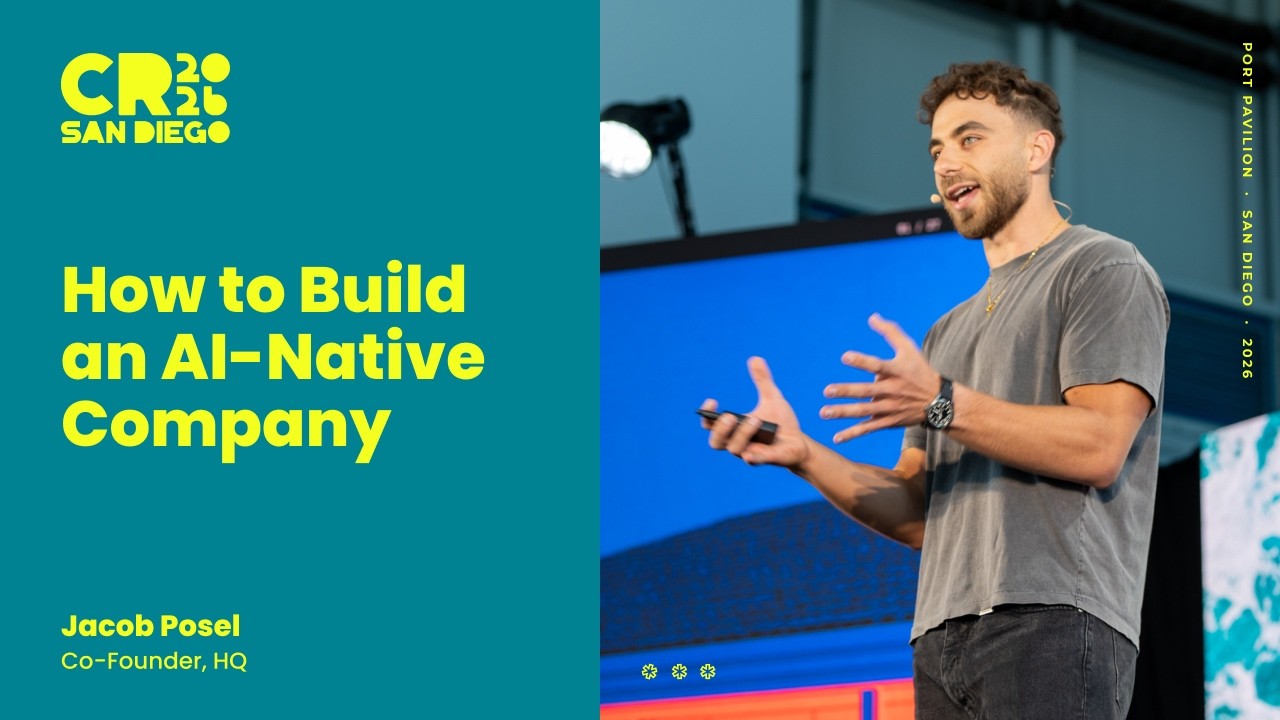
Jacob Posel, co-founder and co-CEO of HQ, explains how ecommerce teams can connect AI to their tools, save effective workflows as skills, and build a shared company brain. Learn how business context, leadership, and human review help turn individual experiments into team-wide capability.
Jacob Posel, co-founder and co-CEO of HQ, explains how ecommerce teams can connect AI to their tools, save effective workflows as skills, and build a shared company brain. Learn how business context, leadership, and human review help turn individual experiments into team-wide capability.
For ecommerce founders, marketing leaders, and operators who want to move from individual AI experiments to reusable workflows across their teams.
Recorded at Commerce Roundtable San Diego 2026, including the audience Q&A. Product capabilities and company examples reflect the speaker’s experience at the time of recording.
Speaker roles and platform examples reflect the session’s original context. This is an archived conversation.
List the tools and information a task depends on, then connect the capabilities needed to complete it.
Read this part · 04:11 ↓Turn a successful workflow into reusable instructions, including business constraints that would otherwise need to be explained again.
Read this part · 08:18 ↓Organize brand guidance, approved examples, operating rules, and skills so new work can build on the company’s existing knowledge.
Read this part · 11:42 ↓Let the team benefit from proven workflows while making clear who maintains the underlying knowledge and who can change it.
Read this part · 15:31 ↓Clean up stale or conflicting instructions and review outputs. Jacob’s approach focuses on helping people do better work rather than removing them from every step.
Read this part · 32:07 ↓A quick editorial guide to the key ideas. Read the complete transcript below for the examples, details, and discussion in the recording.
Original recording on YouTube ↗Jacob recommends agentic workspaces such as Claude Code and Codex as a starting point for more than software development. His first exercise is to list the systems a person uses every day and connect the tools needed for their work through connectors, MCPs, or APIs. The goal is to give AI the context and capabilities to complete a workflow instead of answering an isolated question.
Jacob warns that connecting tools does not make a workflow reliable immediately. He describes repeated attempts, corrections, and learning how to guide the system. Once a process works, save its instructions as a reusable skill so the next attempt can build on what you learned. His purchase-order example shows why practical constraints, such as a supplier’s minimum order quantity, need to become part of the saved context.
A company brain, in Jacob’s explanation, is a collection of files containing the business’s knowledge and instructions. Brand voice, approved campaigns, supplier rules, and successful workflows help an AI tool produce work that fits the company. He uses Ridge as an example of organizing brand knowledge and skills so each new task can start with relevant context instead of a blank conversation.
Jacob describes moving from individual productivity to shared capability: a strong workflow developed by one person can become a starting point for others. He also distinguishes between maintaining company knowledge and using it. As the organization grows, he recommends designated owners and appropriate access rather than expecting every employee to edit the shared source of truth.
Jacob describes a new HQ employee producing a range of marketing and onboarding materials by working from existing company context. Her design improvements then became useful to other team members. In the Bogey Bros example, he contrasts duplicate reports and disconnected AI experiments with a shared foundation connecting inventory, wholesale, and marketing. These are examples from his experience, not guaranteed productivity outcomes.
Jacob argues that company-wide adoption needs leaders who can change workflows, connect systems, and give people authority to act. He cautions against handing the entire effort to a junior employee without that authority. He also discusses employee concerns about AI and frames the opportunity as increasing the value and capacity of the team’s work.
The audience asks about adoption, cleaning up a company brain, moving knowledge between tools, and sharing context. Jacob compares maintenance to gardening: remove outdated instructions and duplicate material so the shared knowledge stays useful. He recommends portable files as a source of truth and argues for keeping people involved in reviewing work rather than aiming for a fully autonomous business.
From the transcript supplied by Commerce Roundtable, with filler words removed and paragraph breaks retained for readability. This source does not include paragraph timestamps. Refer to the recording for exact wording and the session guide above for chapter times.
Original recording on YouTube ↗today I'm gonna be showing you how to become unreasonably effective with AI, and I have the word unreasonably in there for a reason because I wanna be honest with you guys, I feel like I'm doing something unreasonable right now with AI.
Like, I feel like the power that I have and the power that my team has is... Like, it- I'm just waiting for the rug to be pulled out under me. It feels like I have these superpowers, these unbelievable superpowers, and, like, I just can't believe I was born into this timeline where this is possible for me. And it feels like I have to convince people, like, you can have this too.
Like, you can be a superhero too, and I'm seeing it every day where slowly I get people, I get them on AI, and they're like, "Holy shit, you've..." I don't know if I'm allowed to swear. They're like... But I'm gonna anyway. They're like, "Holy shit, you've just given me fire, and I feel like I'm fundamentally changed as a person and what I can do."
And so what I wanna show you today, is step by step tactically what I would do to actually get there, and I promise you, if you commit yourself and you follow the steps that I'm gonna show you today, you will get there. And if you're not feeling like how I described right now, you will feel like that, and it is a completely empowering and changing experience.
So, quick calibration before I start because I just wanna see where everyone's at. So put your hand up if you've used Claude or ChatGPT before. All right. Cool. Put your hand up if you... or keep it up if you've used Claude Code or Codex before. All right. Good. Good. A lot of you. put your hand up if you know what an MCP or an API is.
All right. Beautiful. Okay, you guys are doing well. I thought, I thought it was gonna be more basic than that. Okay, cool. see if this works. Beautiful. Okay. Little bit about me. my name is Jacob Posel. I added that thing in the beginning because I was recently described as an OG AI pro, which I thought was kind of funny for a 26-year-old, but I've been around for a long time in the AI world as far as AI's been around for about four years.
I've done a lot in AI and e-commerce. I started my career building fulfillment operations, inventory management AI systems. I was the director of AI at Common Thread Collective. Taylor Holiday, the great and powerful, kind of gave me my start in my career. I worked with Google Labs to help them build their AI creative generation tool called Pameli, which some of you may be aware of, and now I'm the co-founder and co-CEO at HQ, which you may have seen me being an absolute menace about on Twitter recently.
And if you're curious about what, what HQ is, we'll go into that afterwards. also another quick calibration. Put your hand up if you've used HQ before. Cool. Pretty good. Beautiful. Okay. okay, so this is my promise to you, and this is becoming more and more real literally every single day. Claude released a new model today if you guys are feeling a little bit of antsy urgency.
I, I am. I'm itching to get on my computer. But with a capable person in the seat, AI can basically handle any task. AI is-- the models are there. Like, the models are really there now. This reality of the models not being able to do certain things is not existent anymore, and that limiting belief should be completely wiped from your brain and your company's brain.
AI can basically do anything now, okay? With a capable person, who I'm assuming is everyone sitting here in the driver's seat, AI can do basically anything for you now. And just keep that in your head as we approach this. so the first thing I'm gonna do is show you how to become extremely effective for yourself, and then I'm gonna show you how to, as a business, become unreasonably effective, which is a whole 'nother challenge in and of itself.
But I'm hoping that the tactical insights I give you actually compound and allow you to then, share that and spread that out to the rest of your business. So okay, my first recommendation, and I have a screenshot of it right there, is you are now making Claude Code, not Claude Cowork, not Chat. You're making Codex, not Chappy- ChatGPT, not ChatGPT Work.
You're making that now as the main entry point for your work. And unfortunately, the big labs have decided to co- put code in the name of these tools like Codex and Claude Code, but they're really not coding tools. Like, they're not fundamentally engineering tools. They are just the most powerful way that you can allow AI to interact with different systems and the rest of your business.
So when I say everything, I mean everything. Like, look at-- this is my Codex. I have it building my deck for me for Commerce Roundtable. I have it investigating what this new JEV model is. I was checking why my computer's constantly running out of space. I was investigating why we were missing sign-ups for the day.
Like, these are not fundamentally engineering tasks, even though I-- my background is engineering. I use these tools for everything. Like, literally everything I do, if I can't enter into that work using Claude Code or Codex, then I don't really wanna do it. so that is now the main entry point for your work.
the next thing is you want to allow AI to connect into all of the systems that you use. So I want you to imagine when you leave this talk, when you leave this room, imagine you are no longer allowed to open any other app except for Claude Code and Codex. Someone locked your computer, you are not allowed to open Figma, your email, the browser, anything.
What are all the systems that you would need these AI tools to connect to in order for you to da- to do your day-to-day work? I want you to list these down, and then I want you to go to your AI tool of choice that you decide to use. hopefully both. Hopefully you use HQ to connect these, but we'll go into that afterwards.
And you say, "Okay, do you have a connector? Can I use an MCP? Can I use an API connection into all of these tools?" So for example, let's just say I wanna connect Parker, the creative strategy tool. I say to Claude, "How do I connect Parker to Claude Code?" And Claude will go, "Okay, Parker has an MCP." And then you'll connect to MCP, and now you should be able to do all of your work using Claude Code as the primary interface.
And the reason why is because this now gives you an unbelievable amount of leverage to do more, to do more productive work, to do more automated work in a way that you would never be able to physically do by clicking through the browse and whatever that tool has given to you. If you can't connect t- through a API or MCP to one of these tools, your third op- or your-- A connector is kind of just a wrapper over the API and MCP, so think of that as the same thing.
But your final option is browser. certain AI models are now really, really good at using the browser for you. But what I would do is I would message my support or whatever for that tool and tell them, "I'm not renewing my contract next month if you guys don't build me an MCP or API." 'Cause you don't really wanna use that tool long-term anyway.
But if that's not an option for you, you can go through the browser. But what you wanna do is you wanna give these AI tools the ability to connect to all of your systems automatically
All right, I hope you're enjoying the replay from Commerce Roundtable. I wanted to stop you for just 30 seconds and tell you all about the sponsor that made this happen. I see too many Shopify brands overpaying for big email tools and using only a fraction of their features. We're tired of complexity and never-ending price hikes, too.
That's why Seguno Email is different. Lives inside of Shopify and uses your shop live data, not a synced copy of that. Plus, the integrations with Sidekick, ChatGPT, Claude, and Canva saves you time. And get this, Seguno is the only email app to win a Shopify Build Award. Sounds interesting, right? Switching is easy, and you get 20% off for being a part of the Commerce Roundtable community.
Link in the show description. Now back to your replay. so you think about it. You think about what those tools are. All right, I need to connect Meta. I need to connect my WMS. I need to connect my creative strategy tool. I need to be able to connect those into AI for me. Now, I want to introduce you to something called the struggle, 'cause probably what you're gonna do is you're gonna connect these tools, and you're gonna be like, "Cool, Jacob told me I can now do all of my work using Claude code, Codex, whatever, with these tools connected," and it's not gonna work straight away for some of them.
And a lot of people, if you don't come from, like, a development mindset or development background, you're gon- you need to realize that you need to struggle your way through with these tools to eventually get to the point where it's able to do the work for you because it's not always gonna happen straight away.
Think of it like a teammate. Like, if you got your teammate and you connected th- you gave them access to your ERP and you were like, "Submit a PO for me," it's not gonna do that. They, they're not necessarily gonna do that every time straight away. You have to teach them, and you have to struggle with them, and it really is gonna be really fucking annoying sometimes.
But you have to assume that at the end of this, and it sometimes takes 20 times, 30 times. It happens to me all the time. Like, I'm struggling with this all the time. But eventually, I'm gonna break through, and I'm gonna be able to do it, and it's worth my time, and it's worth my effort because, one, every time I struggle, I get better at it, and so it reduces the amount.
It improves my intuition and my ability to interact with these tools and get them there sooner next time. But also, once I've done it, like, now I know how to do it. Now we've figured out how to do it together, and now I have the leverage and the ability to do it again and again and again. I don't have to struggle every single time, given you have some kind of self-improvement loop.
So just like this photo of Taylor looking silly that I chose, I don't know why, but you have to think about, as you go through, through this thing, think about Taylor looking at you like that and think, "We're gonna struggle, but we're gonna get through it." And the struggle is normal. It's normal so what you're gonna do is you're gonna s- connect your systems, you're gonna struggle through, and when you do it, you need a place where you save what actually worked, and you're gonna do that in a file.
So ultimately, the way that you teach AI things, m- working memory, is by saving things into files. So what sh- I want you to do is I want you to say, "Okay, cool, I'm gonna save-- I want you to save what we did together as a skill, in a markdown file." Or at the end I'll show you how you don't have to really worry about saying that explicitly, but you need to have a way of saving those learnings so you don't have to go through that struggle again.
And what we're really trying to do here is we are trying to harness AI. You may have heard of the tool-- of the name harness, the, the word harness that goes around. It's like a buzzword in AI. Think of AI as this, like, extremely powerful wind, this extremely powerful force. It's hyper-intelligent. It's more intelligent than you and me, but we need to be able to harness it in the direction that produces valuable outcomes for our business, and we do that by connecting it to our tools and teaching it reliably how to do the things that we wanna do by saving these memories.
And that's what-- that's-- it's not the, like, the true definition of harness, but when you hear that, I want you to think of this is our goal together. We're trying to harness that together. And the easiest way to do that is by creating a company brain. Like, the easiest way to connect all of your-- to bring these learnings together is to create a company brain.
And what a company brain really is, like, you're gonna see these LinkedIn posts and these Twitter posts that try and confuse you. It's just a folder on your computer. It's a folder on your computer with instructions for AI to follow and use or context for AI to use to harness it and pull it and move it in the right direction to be able to do more th-- consistent, reliable, and valuable work for you.
So for example, you can have your-- Actually, let me see really quick. No. Let me go back. you can have your brand guidelines in there, so it produces better copy. You can have the skills in there, so it can follow the instructions, like those learnings that we did together. let me go th-- let me actually go through this example really quick.
So let's just say you want to prepare a purchase order for next month using AI, and you've connected GoodDay, your ERP, you've connected ShipHero, your WMS, into these connections, and you have, filed a skill that you've produced with Claude Code, and the output of that that you want is a purchase order.
So you go ahead and you do that, and then Claude makes a mistake. It, recommends that you purchase 240 units, but really your MOQ is 500 units. Super simple mistake that it may make. It does its own linear regression and says you should do 240. You're like, "No, I have to do minimum 500." Okay, so how do you save that?
Well, in your company brain, which is a folder, you can have another folder, which may be supply chain, and inside of that you can save supplier rules inside of there so that next time when Claude tries to create a purchase order, it then references, okay, what are my rules about p- creating purchase orders or what are my supplier rules?
It's like, okay cool, the MOQ for the supplier is 500 for the SKU. All right, great, and it doesn't make that mistake again. So you struggled in the beginning, you no longer struggle again. And I know that sounds super simple. Like, I know it sounds like just too sim- like, whatever, like... But as you do this throughout your work every single day, and you compound these learnings every single day, every single task that you do, eventually you get to the point where you're like, 'Holy shit, this AI really understands me and my business.'
And not only does it understand me, but it allows other people to understand my business as well, and we'll get into that afterwards another example, we're building creative briefs. Cool, we've connected our systems. I'm not sponsored by Parker, I'm not affiliated, but I'm friends with Alex over there.
You guys should talk about Pa- you guys should go talk to him about Parker. Whatever. You've connected Parker, and you're trying to create a, a creative brief. And you're like, "This sounds generic. That claim is unsupported." great, let's save that into our company brain under brand context, and the next time we create a brief, it won't, it won't make that same mistake.
So this is a real example. I asked for permission to show this. It's a little bit of a simplified version. But this is Ridge, and Ridge, uses our tool HQ to build their company brain, and they have things like brand knowledge in there. I mean, brand copy e- examples. They have a voice.md to describe what their voice is.
They have a corpus of approved campaigns. They have their go-to-market workflows in there, and they have a directory of skills. Ridge has this company brain, which has all of this compounded knowledge that AI uses to understand their business to allow them to more reliably harness AI and produce the outcomes that they want for individuals and across their team.
So I just threw this in there. I asked Connor, and he said, "Ridge loves HQ," and we'll go into HQ a little bit afterwards. okay, cool. So part one. I- like, it, it probably didn't sound that complicated, but that's really all you need to do. You have this hyper-intelligent being, and you need to connect it to the systems to do your work, and then you need to teach it how to do work.
And if you can do that reliably every single day, you will have the most intelligent, productive, efficient assistant at your side who will do work for you and make you feel like a superhero. That's basically it. Next step is, okay cool, we've done that for me, we've done that for the individuals in my team, and this is what happens.
I see this all the time. an executive, the CEO, the founder, they do this, and they come up to me and they're like, "Jacob, I just can't f- get this to my-- I can't figure out how to share this with my team." Like, first of all, functionally, I've connected my systems. How do I connect them to my team? I've saved these rules.
How do I give them to my team? But I also can't really figure out how to get them excited about it. so how do we actually make that compound throughout the entire organization? So this is the reality that you have now. You have your best, which may be you or someone else. They're up here. They're now unreasonably effective, and everyone else sits below them.
And what you want is you want to lift everyone up. You want to lift the floor. So you want to bring everyone up with you. And the way that that works is, like- As you co-compound these learnings, if you're able to share them with your team, you have now lifted the floor of what everyone can do. Now everyone is getting better because they're all interfacing with AI.
Their, their AI is now reading from this repository, and now their floor of where they are able to work from is basically the f- the floor of the most capable person in your team, which is an extremely powerful thing. It's like, what if we could just connect all of our brains together? Like, what if we were all in a company and we could all just connect our brains, and now I was able to do everything you guys could do?
That would be insane. That would be incredible. But that's what you can do with a company brain. Like, you can't do that in a company, but with like actually we can't connect our brains until we have Neuralink. But you can do that with AI and a company brain. You're able to connect the abilities of everyone together, and it's this incredibly powerful thing when you have it across the organization.
So what basically happens is one person, they have a useful discovery, and now it just becomes a capability of the entire team. So one person creates this skill to prepare a PO. Literally anyone now on your team can execute that skill, and they can prepare a PO as well because they've got all the learnings in there, they're connected to the systems, they have examples of the 50 other POs that you guys have created.
They're connected into your, your ERP. Now everyone is able to do this. The floor has been lifted if you're able to share this company brain across your organization And I understand that people may contribute to this in different ways. Like, as you start to think about this, you may get a little bit cautious about having everyone in your organization constantly writing into this company brain, cautious about using-- everyone using Claude Code.
I get questions like, "Jacob, what if, what if someone says something wrong, and something wrong makes my way into the company brain?" In which case, I usually answer, like, "Maybe it's good that you know that people are saying the wrong thing to AI, now this surfaces it to you." But it's a fair concern, right?
Like, you don't want everyone-- everyone's good things go into the company brain, but everyone has pretty bad things as well, and you don't want your ma- way making it in there. But what you can do with this company brain, with this folder, is that you don't have to just use this in Claude Code. Like, AI has been hyper trained and optimized to be able to read from file systems.
So if you use a Hermes agent, the Hermes agent can read from this file system. If you use Victor, Victor can read from this file system. If you use HQ agents, HQ agents can read from this file system. And now you can put this agent in Slack, and you can allow everyone to just read from it. Not everyone needs to necessarily be updating it all the time.
And the way that I see, the direction for larger organizations, maybe like fifty plus, if that's you guys, is that you will have a core set of people who are responsible for updating this tool, responsible for writing to it and updating the knowledge, the core knowledge of your organization. And then you'll probably have people who are just inheriting what everyone else has done.
And these people are more executional. they're interacting with it in different ways. They may be using Claude Chat or ChatGPT. They may be using a Slack agent or like a Muse or an Instinct. Now we have these really cool agent products. But not everyone necessarily needs to be writing to this thing.
But this is very dependent on the structure of your organization, and it's something that we can, figure out together if you wanna think about the best way to design that, because I've thought about many of the different ways to design this. So one of the... And I wanna give like a real example of how this happens in practice.
So our business, HQ, we have a company brain, and we have this system that I've described, and we use it as the fundamental way to run our entire business. Every single person in our team runs using HQ. Every single person in their team is updating this company brain, which is HQ. Everyone's connected to all of our systems.
And we recently had this incredible experience where I, I wanted to walk you through what happens when you bring on an incredible team member and they're empowered in a way using a company brain. So we recently hired, someone, Cherie. If, if Cherie's here, maybe she can put up her hand. There she is.
Cherie is absolutely incredible, and she joined our team, and, within three weeks she had created sales enablement decks, emails for us, landing pages, social posts, product video, website edits, a weekly newsletter. she was like shipping to our onboarding flow. She created a customer impact survey. She created a training series.
She creating a Slack community. She u- updated our knowledge base. And I was like, "Holy shit, I have never seen someone be so effective so quickly." And Cherie is absolutely incredible. That's, why we love to work with her. But what happened is Cherie just had... As she joined our team, and you can ask her, we did not do a good job onboarding her.
We, we were just like, "Hey, Cherie, can you make a community?" And like she was like, "Yeah, sure. I got it." But she was just connected into everything immediately. She knew everything about everything that we had done in our business. She knew how we structured emails. She knew how to write to our code base to update our marketing website.
She knew what the product was, what specific details about the product were, because every single feature that was created had been written and updated inside of HQ. And she is now able to help us across CX, ops, marketing, everything, and she is so h- unreasonably effective because she is just inheriting all of this knowledge, all of this context immediately, and she is enabled to do anything, anything that we have done.
But even better than that, Cherie has created a positive impact on the rest of our business. Like when I said one person's baseline basically becomes everyone else's floor, like this is a pretty good looking deck, right? Like this is a, this is a nice deck. I think it looks pretty good. I'm personally incapable of making decks that look this nice.
I'm like not artistic. I'm not a designer I'm li- I, I failed art in primary school. Like, it was really embarrassing. My teacher embarrassed me in front of everyone, but I was terrible. But now, like this is a really simple example, but now Cherie, and other people in our team, they make decks, and these decks look great because they are tasteful, they ha- they're aesthetic, their design is...
And now when I wanna make a deck, I just go in and I'm just like, "Okay, cool, make a deck that look like that one." And it just does, and the deck just looks great. And then I'm like, "Cool, can you just share it with Cherie?" And Cherie's like, "Yeah, cool. That looks good." But now, because we have someone in our team who has lifted the floor of a certain vertical capability, everyone just inherits that.
And so not only is she benefiting from what we have, but she is contributing to this and she's making us all better. And think about this across your business, like with creative, like think of a deck as a creative. If you have someone in your team who is able to produce creative reliably using, AI, and they develop good workflows to do that, and now anyone else on your team is just in a- able to immediately inherit that, and now everything that they produce just looks 10 times better because you didn't have that capability before, but now it's been injected into your brain.
Just think about how that compounds across the organization and how powerful and enabling that is as a team. and we have a super lean team, and we're able to do a ton because everyone's best is just basically now everyone's floor So another example, a customer of ours, Bogey Bros, they're a golf apparel brand, and they've, they've done some pretty crazy, incredible things.
funny story. When we first tried to get them t- on HQ to build their company brain and connect into it, they were-- they weren't using Claude Code. They weren't really-- they hadn't really figured it out yet. they'd built some reports using Artifacts and Claude Chat or Claude Cowork. And they were really struggling because they had the sprawl of everyone just trying to make reports, everyone...
They were trying to do like wholesale inventory-related reporting, and they had the sprawl of everyone just making reports, a ton of redundancy, a ton of repetition, and they weren't able to consolidate and move in the right direction to produce one valuable report for their business, and it just felt messy.
And then they built their company brain, they connected all their systems, they used HQ, and now they have this operating system that, like, is honestly better than any individual, software tool that I have ever seen. It's hyper-optimized for their business. They have an operationally very, complex business because they're a, they have many different SKUs.
They're an apparel brand. And they've been able to build this like ERP-esque inventory management system tied to their marketing numbers. And the reason they were able to do that is because they built all of these tools, in their company brain. And when one person decided, "Okay, now I want to build a report," Claude was able to find, "No, that already exists in the company brain.
Do you wanna build on top of that?" and they were, and they're able to share with other people in their team and be like, "Cool, like, I've built the inventory piece. can you build the marketing piece on top of this?" And AI inherited all of the context on what was built before, and so now they have one central operating system rather than 50 individual reports, which becomes completely, unruly and difficult to manage.
So it consolidates everything as well. And if you ever find, Kevin or Ryan from Bogey Bros, you should ask them to see what they've built because, like, I got goosebumps when I saw it. I worked for years, trying to build these things myself, and I wasn't able to. And what they have is just unbelievably, effective and efficient.
cool. Last thing I wanna say, it looks like I have four minutes left. if you're watching this and you're like, "Great, that sounds great. I wish I could do that, but I've been trying to get AI in just, in my business for the past, two years, and I just can't. I just can't get my team to do it." The one thing I'll say is what I've seen, I've been part of almost 900 of these at this stage, trying to get people to do, build this in their team, roll out AI inside of their team.
And what I've seen, you have to drive it from the top. If you are not driving this from the top, if you are not the best at AI in your entire team, as the executive, as the CEO, this doesn't really work. And you have to incentivize this. You have to be excited about it, and you have to be the one driving it.
Like, functionally, you have to because you have to be the one empowering people to make change. For example, let's just say we're fundamentally changing the way we submit purchase orders inside of our business. If you just tell that to a new employee on your team, you're like, "Cool, that person's... We just hired them.
They're 21, they're young, they're probably good at AI, let's get them to do it." They don't have the authority or the confidence to fundamentally change how, a key workflow in your business works. You have to be the one driving that. You have to be the one telling people and authorizing that change. And then practically, like, when I say connect the systems, like, you have to be the one, 'cause you are probably the one with administrative access to everything inside of your business.
You have to be the one letting everyone connect to the systems and be comfortable opening that up. So You have to be effective yourself. You really do. It's unfortunate, but, like, you have to be the one that is leading and driving this change. You have to give people the authority and empower them to make the change.
and also, finally, you need to explain to-- People are very fearful. Like, I acknowledge the sentiment that people are very fearful of AI, but I've looked inside of many, many, many different businesses, and I've never seen someone who is good at AI get fired from their job. Like, that just doesn't happen.
In fact, those people become more valuable in the market. They become incredibly valuable. like if I was anyone here, I'd be desperately trying to hire Cherie right now because she could revolutionize your business, but you can't have her. But if I was-- Like, these people are the most valuable people, and so you need to explain to these people, incentivize to them that, like, if you don't do this, that's when you're in trouble.
If you do this, like, I'm not getting rid of you. You're, you're incredibly valuable to me. If you just automate one thing-- Like, there's this assumption that a lot of people have that the business is fully optimized. Like, my business is fully optimized, and if I automate one thing, then I'm gonna get rid of everyone in my business because, like, I'm fully optimized.
There's nothing else for me to do. That is not the reality of any business. And so you have to explain to these people that if you are able to optimize one thing, that doesn't mean they're now replaceable. That just means they are more valuable, they're more important, and there's more things that you are able to do, and you are able to optimize your business further, become more productive, and then they are now more important.
So, like, that's a mindset shift that I try to give to people. expl- give them the confidence and explain to them that them getting good at this and doing this is what they need to do. Them not doing this is when they should actually be worried. - And yeah, so this week, if you do what I said, if you are able to get on Claude Code, connect all your systems, connect every single system, and just go through that struggle yourself, I would be extremely, extremely, extremely surprised if within a week or two you don't feel like something has fundamentally changed for you.
If you've been trying to do this and you're not able to break through, feel free to find me after with this and we can kind of go into what's missing and what's not been working for you. find a way to compound changes. That may have been what you are missing. find a way that you can compound changes.
And then if you want a way to compound that across your business, I highly recommend you check out our tool, called HQ. You can use discount code COMMERCE30 to get a month free. and you can come and chat with me afterwards to figure out how we can best set that up for your business. But this has changed our business.
All I'm trying to do is create as much value in our customers as possible, because that's how I win, is if as many people kind of feel this fire and feel this thing that I've been feeling. That's all we're trying to do. So come chat with me if you want afterwards. I-- we can help talk through it. And finally, I just want to say thank you to everyone.
the D2C community, the e-com community, you guys have been massive, massive supporters of me personally and of my business. You guys have changed my life, and it's an absolute honor to be up here talking at Commerce Roundtable, meeting all of you in person. So thank you so much. I appreciate it, and thank you for listening to me talk for half an hour.
How do you think that went? We'll find out, we'll find out next to you. Let's see. I think you did great, dude. Thank you. Yeah, well, I mean, the, the cool thing about this is we get to ask... You'll get a couple emails. The emails will all be like, "Did you like Jake? Do you not like Jake? Did he do good? Did he not do good?"
And all the questions. It just, it's a good thing. We wanna know how people did, especially with the education. I think this was the perfect way of delivering, like, getting people to understand that it's not as scary as it needs to be. You've seen a handful of brands. Do you see an industry adopting, adopting this more than other industries?
Like, is it health and wellness doing it, or is it, like, home decor? Where are you seeing it really blow up at? I mean, I, I haven't been able to find a correlation between businesses and vertical that have been, that are, like, more likely to adopt AI. It all just comes from the personality of the leader, and that's not...
That's, like, the number one predictor of AI success that I've seen. If you are a strong leader excited about it and be able to roll it out, that's the number one thing that I've seen. I feel you on that one. Okay, now the questions are starting to come in. What are some closed loop agent workflows that you have actually seen work?
I'm assuming by closed loop here you mean no human interference. I wanted to stress this in my talk that I don't want anyone to try and do anything yet with no human interference. Like, the whole-- The initial premise of the talk was, like, with a human involved, you can basically do anything, and so trying to get a human out of the loop is a little bit too advanced for most people.
That said, like, automated reporting works. Like, automated, a lot of automated dev flows work. But I have not seen many examples of no human in the loop, so I'm assuming that's what you mean by closed loop, end-to-end working workflows, and that's not the expectation that I want people to have going into this This one's nice at the top.
Do you run some kind of monthly maintenance to clear out all the, quote-unquote, "bad" of the company brain? Yeah. company brains, it's almost important what you clean out as what you put in there, and so you need to build workflows to be able to, get rid of certain things. So the way that we do it is it's developed into the workflow itself, like things will try to be cleaned out in the workflow once you find redundancy or once you find repetition, but also automated workflows to get those things out based on some kind of scheduling.
We call it gardening at HQ, in HQ world. Gardening. I like that. Yeah. If you've been using GPT exclusively for years, what's the best way to kind of migrate everything to Claude? well, you need to have-- There's gonna be a little bit of a, of a migration gap, like it's not just gonna happen automatically, but you need to try and build your-- what you think about migrating as like the-- what it understands about you.
You need to put that, try connect that into one of these file systems, these company brains that I, that I was explaining, and then you need to try and maintain that as your primary source of truth rather than any of the individual company system, company memory systems. and then you need to connect that into Claude, and then Claude will understand you.
if you have-- If you download the ChatGPT app on your computer, you can get it to read all of your sessions and f- extract the memories and do that for you, if you do that on the desktop app rather than the web. So that's an efficient way to do it. Dude, there's so many questions. I literally have 30 questions here.
We're not gonna get through all of them. So I'm gonna, I'm gonna try and- You guys can find me afterwards if you need to. You'll come to the back. Okay. If we wanted to do it ourselves, how do we get the brain to be accessible to the whole team versus one computer? That's, that's, that's literally the HQ, right?
Yeah. Yeah, yeah. Okay. Well, if you want to do this in the easiest possible, most efficient way, you should use HQ, hqforwork,30 to sign up for a month free. But, GitHub is a solution, but I found GitHub to be a little bit too much friction for your whole team. getting someone to understand what branching means and committing, adding, pushing is not a necessary thing.
other solutions that I've seen work is like a shared Dropbox or Google Drive, but those fall apart if you care about any kind of access control, version control, people overriding one another. There honestly isn't a great solution for this. That's why we built our one. but I wouldn't recommend GitHub unless you have an inherently technical organization.
I like this one at the top. It goes, "What's the biggest distraction in AI right now?" It was the first question. Like, what are the closed loop systems that I can build with agents? agents are not the answer for ninety-nine point nine percent of people. Autonomous-- Like, agents are not gonna autonomously run your business.
I had a slide in here, but I actually removed it, which is the maths of fully autonomous systems just don't work. Like, even if something has a ninety-nine percent chance of working for any single step, if you compound that across many, many different steps, you would just watch the probability of success drop dramatically to where, like, even across 100 steps, which most systems take, like reading and writing, updating, 99% chance of success, the probability of success falls almost down to 37% after 100 steps.
So don't try fully au- or fully automate things. You are the driver's seat in the F1 car, and you're the one, doing the work. Then it just keeps coming. I can't even stop it. So I'm gonna ask you this last one. Yeah. Are you saying that using Claude+Cowork versus code for any business automation is doing a disservice?
Yeah. Yeah. I do. I do. using Claude and Cowork, they basically just try to take Claude Code, simplify it a little bit, remove the complexity, and by removing the complexity, they kind of removed a lot of the power, and you're just doing yourself a little bit of a disservice. So use the most advanced tools.
use Claude Code. Eventually, they're gonna rebrand this. They're gonna remove code from this. They just... They have to. That's why ChatGPT went from Codex to the ChatGPT app. use the most powerful tools. At the end of the day, like everyone, it is just a magic text box. All of these tools are just a magic text box where you put in what you want, you struggle with it for a little bit, and then you get, then you get the answer out of it.
So use the most powerful magical text box that they give you, basically. Jacob Hosel. All right. Proud of you, buddy. Thank you. Thank you, sir. Appreciate it.
31:16 29:14
29:14 30:55
30:55Join Commerce Roundtable in 2027 for focused learning and conversations with people working through the same challenges.