 29:14
Austin · 2026

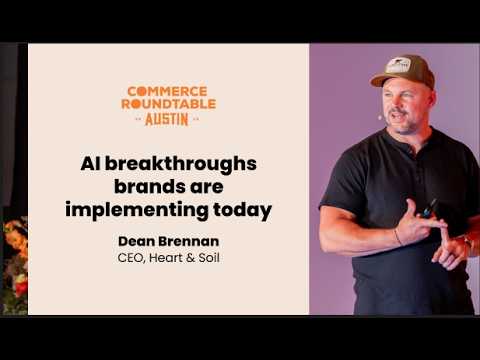
Dean Brennan shares how Heart & Soil used an internal AI system to examine leadership behavior and identify constraints behind missed targets. The session focuses on context, accountability, and building useful internal systems.
Dean Brennan shares how Heart & Soil used an internal AI system to examine leadership behavior and identify constraints behind missed targets. The session focuses on context, accountability, and building useful internal systems.
For ecommerce founders, marketers, and operators working on ai & automation.
Speaker roles and platform examples reflect the session’s original context. This is an archived conversation.
Use business context to examine leadership patterns as well as marketing tactics.
Read this part · 00:00 ↓Review commitments, ownership, and open loops instead of treating an AI score as the end result.
Read this part · 11:31 ↓Start with a clear purpose and a manual workflow before connecting everything.
Read this part · 20:00 ↓A quick editorial guide to the key ideas. Read the complete transcript below for the examples, details, and discussion in the recording.
Original recording on YouTube ↗Dean describes a period of missed acquisition targets that prompted him to turn AI inward. His system reviewed internal working context to surface patterns in leadership and communication. The exercise reframed the problem from simply finding another marketing tactic to understanding behaviors that were constraining the team.
The first leadership scorecard was uncomfortable, but that reaction became part of the lesson. Dean describes using recurring reviews to examine whether actions matched commitments. The value came from changing behavior and following through, not from collecting a flattering assessment or treating the model as an unquestionable authority.
Dean recommends defining what the system is meant to accomplish and getting the context and standards right first. He manually processed information before adding automation. Keeping ownership of the underlying data also matters, so that the usefulness of the system does not depend entirely on one model provider.
From the recording’s auto-generated YouTube captions, with filler words removed and paragraph breaks added for readability. Names, numbers, and wording may contain caption errors; refer to the recording for exact phrasing. Chapter links jump to the text below.
Original recording on YouTube ↗0:01[applause and music] >> All right. Let's sit here. Okay. All right, so we're going to paint a little picture here. Saturday, January 24th, 2026. I'm sitting on my laptop at my kitchen table Saturday night. Eight months of missed acquisition targets. Facing the first year of potentially contracting as a brand. You know that time after Black Friday, Cyber Monday, when you just want to take a break? It's one of those times. And I'm doing what most CEOs do.
0:54I'm diving into the weeds with everything, channels, accounts, vendors, creative, everything. And I could feel the lid. Who's familiar with the lid? Do we know what the lid is? The lid is that thing that you keep hitting when you can't break through, and you don't know what to do, but everything that you've done historically isn't working anymore. And many leaders, myself included, in these eight months, you look you go hunting in the market, you go hunting at the team, you're looking externally.
1:33You're trying to figure out, hey, what tactics aren't working? Which tactics can we try out next? And so, in this moment, I had a feeling that my challenge was a little bit different. So, I did something a little bit different. I built a system and I fed it everything. When I say everything, I mean every meeting transcript, Slack message, Asana task, if it literally had a digital footprint and I had access to it, I processed it.
2:09And I asked it one question. Where's the lid? And here's what I found.
2:20So, we're hearing a lot of stuff, most of the AI talk anyway, is about content ads. They're all external things. And all these things are great. but this talk today is about pointing AI inward. And one thing I've learned as a CEO is that sometimes the screen goes black on you when you're trying to do a presentation. No. Compared to previous positions that I've had, this one no one sees the full picture that you see.
2:56Your shareholders don't. Your team doesn't. Your wife doesn't because you only got so much time, you know, you don't want to spend it all talking about work. and you don't necessarily have a mentor who you can call 24/7 and talk to. who has all the context. So, I needed something that had full context, something that's always on, and collaborated to the fundamentals. Cuz one thing I do know is if you've ever listened to any interview with Tom Brady or who's read one of John Wooden's books about fundamentals?
3:31when you hear successful people talk, people that have actually made it to the highest levels, what do they talk about? They always bring it back to the fundamentals. Always. It's kind of like in in your family, when you talk to older folks who are who are at the end of the road, they always they never really talk about work. They talk about family. So I wanted to root something in the fundamentals not necessarily to automate tasks but to find the real constraint underneath the tactics.
4:08And so I built a system and I call it LS. It is the enlightened leadership system. Might have to work on the name. And I'll make it concrete for a little while cuz I know there's a lot of builders in here. I'm not going to spend too much time on how this is made up the technical aspects because you can always just ask Claude or ask GPT how do I do this and it will tell you.
4:38To simplify it I got a couple things going on here. There's a bottom layer that's the context. The context is literally everything. It's everything that is ingesting it's meeting transcripts. Again it's tasks it's my daily notes. I had taken notes for years on decisions that I've made operating philosophy all these kinds of stuff. So that's going in through the context layer. The top is the action layer. This is what it flags and recommends and then in the middle we have what I call the standard or the identity of the system and this is really what great looks like. It's what great looks like when I'm operating at my best not at the current level where we're at at the company but the next phase it's what great looks like for the company. And without that middle layer you really have a smart assistant and that's really what when you pop open a new message with chat GPT without any context that's what you have. You you have a smart assistant but if you build a system like this you have a system
5:41that refuses to let you operate below yourself and it runs daily. it surfaces patterns across the business, across my work. It rolls up all the domains, like I said. projects, teams, individuals, events. And who who here who does performance reviews? Raise your hand. Okay. do you ever get to that place in your performance review when it's coming up and you're like, "Shit. What happened in the last 3 months? I've no idea." And then you got to like let me go look through my email. Let me look through my Slack. Let me try to find something. this eliminates that.
6:25This pretty much because it's always on. It's always up to date. And the good thing is you don't have to wait for a performance review because you are flagging things before maybe before you didn't even know it. so it's evidence happening against the standard. Mostly graded at me. And I don't point it only at myself. I have our leadership L10 meetings plugged into here, functional level Slack channels, channels at the Slack channels at the channel level, the team level. if it's public, it it runs through the system. And then we have our weekly KEIs. Who here knows what a KEI is? Raise your hand. Maybe a few of you. Shout out to CTC. Dane Sanders at CTC has this incredible framework called Key Employee Index.
7:15Highly recommend. Just you could probably YouTube it. Anyways, that's all fed through the system.
7:22And a lot of people ask me, "What how's this system made up? Like what is it What is it actually looking for?" It's a really good question. And again, to bring it back to fundamentals, fundamentals, they're they're they're always simple, right? They always sound so simple to do. It's kind of like we're in the health business and most people know like I should sleep well, right? Should probably eat real food. Should probably exercise. Really easy things to say, but they're so difficult to do.
7:53So, Ellis, the one thing that it watches is the say-do ratio. So, with what I'm saying, whether it's in meetings, in Slack, in Asana, am I doing the thing? When I say it, am I doing it? when I commit, is it happening? And we all know when when this ratio kind of falls apart, then it breaks down trust within your team. The second thing it looks for is open loops. these are decisions started, not closed.
8:27I'll get into this a little bit, but when I process all this footage, I think like probably most people that lead a team or a company, if you're to really actually look at the data and understand it and see how many open loops are being talked about and energy is consumed on them, and they don't get closed, at that point, it's not a debate. When you've had the same conversation over and over about an open loop for 3 weeks or 3 months, it's a decision that you're avoiding.
9:01And so, the third thing that Ellis looks at is ownership versus externalities. And this is a a language thing. This is how are we talking about friction at the company? How are we talking about friction in our role in the numbers? Are we taking ownership over that or are we using kind of passive language or pointing at external factors that we might not have control over. I think in a lot of cases, sure, the algorithm changed, but what What you doing about it? So, the ratio between these two things matters and Ellis looks at that.
9:42And then the fourth thing here is communication clarity. I'm guilty of writing three, four paragraph messages to the team and saying thoughts with a question mark at the end. Who's done that? And then you expect something to happen. You're like, "Why isn't that happening?" Well, you weren't clear. And so, it's looking at this stuff. If there's a message, if there's delegation, is there a decision, an owner, a deadline? And the last thing here that I'll kind of cover that it watches is the what I call the wobble detector. And this is measuring strain and stress at the organization, the the wobble, the wobble underneath the surface.
10:25And there's four families of wobble. One is the hedge. We all probably know, we've heard this, right? Let's see how it plays out. We'll circle back. we got the strain signal. It's been a week. Calendar is insane. things like that. The stuck loop. Didn't we talk about this? Where did we land last time? And then the ownership ghost. I think somebody's on that. We think? Do we know? Anyways, I think this is really interesting.
10:59you know, the opportunity to take technology and look across all your domains and have it recognize patterns in language because I believe that the stories that we tell ourselves in our head sometimes determine the words that we speak, which determine the actions we take, which determine the performance. And so, I think if we can get ahead of the language and find out when the language breaks, then we can get ahead of when the metrics break and when the team breaks.
11:31So, every week I run this exercise and Ellis Ellis grades me as a CEO. They don't have a boss in my office every day saying, "Hey, this is how you did." Right? I guess we got the P&L to tell me that. We got the team to tell me that. So I I mentioned the kitchen table. I fed it all this stuff. And it was February 2nd, and that's when I got through a ton of data.
11:57And I got my first scorecard as a CEO. And I got a C- minus. And I was pissed. >> [laughter] >> And this is not even a This is not even a joke. I My first reaction, I didn't even read what it sent me. I saw the grade and I went right into the configuration files and started like trying to figure out where it was wrong. >> [laughter] >> So I wanted to argue with it.
12:26And then I reminded myself that if the system only gives you good news, then that's a bug. not a bug, it's a feature. Rather. And so I took time to understand the patterns behind my grade and behind the grade that it was spitting out for the organization. And so what I realized is that the gap [sighs] the gap wasn't between the standard I talked about. It was really the standard I was reinforcing and the action that was occurring, the performance that was occurring. I talked about a lot of things.
13:06And it showed me three patterns that I was semi-aware of, but I wasn't I wasn't aware of the extent of it and the impact. the one thing I was doing is I was
13:20stepping into decisions that my team should own. So it kind of go like this. We'd struggle to hit a target and then I'd jump in and I'd say, "Hey, well, what about this? What about that? Let's try this." And I was more or less making decisions for them. And the idea at the end of the day when it was executed was mine. And so when it succeeded, they built my plan and my plan worked. And when it failed, my plan failed.
13:50And so that really will water down it kind of steals your team's sense of agency. And it also makes it so, "Hey, every time a problem comes up, it's like I I'm going to I'm going to bring this to the CEO so he can make a decision on it, right?" Adds latency in things getting solved. the second thing, second pattern, is I was rewarding the problem way more than the outcome. every meeting, you know, is talk about diagnosing a problem. and I and I'm a collaborative individual and I love problem-solving. And so whenever there's a problem, I'm like, "Squirrel." You know?
14:32So I I was rewarding this with my time, which eventually you know, we were kind of mistaking the conversation about these problems for progress. And meanwhile, the outcomes just continued to drift. It wasn't getting solved. And then the third pattern was I was making too many commitments without a really good system to close the loops. And I think this happens in a really good opportunity for AI cuz AI can pay attention across multiple domains and it can actually capture these things, but I was making a lot of, "Yeah, I'll get back to you on that.
15:08Yeah, I'll do that next week." "Good idea. Let's meet on that in 2 weeks." a lot of things too that aren't that impactful that I shouldn't have been spending time on. So >> [snorts] >> it's a good quote there, yeah. Credibility doesn't die in the big moments, it dies in the ones nobody's counting. And I actually would change that last one. It It dies in the one that you're not You're not counting. Cuz I guarantee you somebody else is counting if you're committing to doing something for them.
15:38So, I thought I had three problems. I was stepping into decisions. I'm valuing the discussion about the problem, not the outcome. And then I'm not closing loops. I'm creating too many open loops.
15:52And what I realized is after going back and forth with Ellis is that all three of these at the root of them, it's about ownership. It's about who's taking it. It's about who wasn't taking it. And most importantly, it was about what I was signaling to the team. And every time when I think back to this time, every time something broke, this was the question I was asking myself every time. And I I it it's kind of actually wild to sit here on stage and actually say this, but this is what's going in my head. I'm like, "Why isn't my team owning this?
16:31Why?" But the question behind the question that's more useful, is what am I modeling for them about ownership? And this is what This is what my system helped me help me kind of think through and identify. cuz I I believe in a simple standard and I talk about it all the time with the team. 100% accountability, 100% of the time, no excuses. >> [snorts] >> But when there's pressure, I was acting in a different way. I wasn't holding the line on accountability, on the standard. I was jumping into the discussion, into the problems. And I was training a pattern and conditioning a pattern in my team to have that conversation more than something else.
17:27And I will say this is not on them first, it's on me cuz this is a a pattern that I created with the way that I lead. And if you're not self-aware enough, these things can can happen very very easily. and so in this moment, I wrote a new standard and it's decide and inform. Don't wait for my permission. And lead with what, when, and the expected result. Not options, but decisions. And this is what this looks like.
18:04When there's a challenge, when there's a problem, when there's a gap, it's what are you doing about it, when, and what is the expected result? And so, kind of an uncomfortable way, I do I leaned into this over and over again.
18:23And in January, towards the back half of January, the end there, we got some traction. And in February, we got back on track and we made up some of the loss in January. And in March, we had a solid month. And the only thing there were a number of things, but the the big thing for me from a leadership standpoint, what I learned is that I held a line on that standard. >> [snorts] >> And I look at this like this is really it's not the finish line, right? Like this is one this is one example. And this was in January, so building new habits in yourself is hard enough.
19:06Building the habit at an organizational level where everyone's operating to the standard is even harder. but with this one moment, the team did get clear. the standard was a little bit more aware. And the platform EOS didn't really solve the issue, but it made sure that I couldn't hide from it because every day I'm logging into EOS and EOS is saying, "Hey, what about this? Hey, what about this? Hey, what about this?" So, it was extremely helpful in that it held it held me accountable.
19:43And if you want to build something like this, I got a couple couple pieces of advice. one is know yourself and know your company. Like I said, the most valuable portion of the system that I created is the identity layer. It is the standard. You have to be able to articulate your standard, your process, how you operate, or how you desire to. And if you can't articulate that, I'd be willing to bet your team is probably operating in chaos. So, that's probably step number one.
20:13and then it's really difficult to build a system around that if you're not clear on what you're trying to accomplish and how you operate. So, couple questions you can ask yourself is, can you articulate the standard in one sentence? Try to do that right now in your head. Who's got it down? Who doesn't? Okay. So, you got a gap. If you can do that, then I guarantee you your team isn't thinking the same thing you're thinking.
20:48So, that'd be a good place to start. And for me, this is what EOS helped me understand that I couldn't do this. I couldn't articulate it. and certainly across the whole org, we weren't on the same page with that. And in my opinion, it's at the root of why we actually were missing the acquisition targets. It's the behavior. All right. So, tip number two is start with the foundation and build from there. I see a lot of and I love it. Jump into vibe coding, do your thing. but with this I I had a clear goal. And before I jumped ahead and built like these automated dashboards and and everything, I manually processed all this information and just started there. And once once I was like kind of getting that down, manually inputting stuff into the system, and I got the identity layer working the way I wanted to, then I built some MCP automation into it. and so highly highly highly suggest starting with something like this. Start Start
21:54with a good foundation. think through what you're trying to accomplish first. And it will eliminate a lot of AI slop if you do it that way as well. I think that's why a lot of systems turned into chatbots. the third thing I'll say is own your own data layer. This is really important. my long-term vision of Ellis is to have it essentially operate like the company operating system that every employee could use to help level themselves up and keep just everybody on the same page and aware of the patterns that it's surfacing.
22:29I think that would be an incredible thing. But all these models, Claude, GPT, they they're all businesses like like our businesses. They want you to stay on the platform. So, they want to eat as much of your context as possible and make it so painful for you to leave that you never will. And so, if you pigeonhole yourself into one platform, you're also missing some of the benefits of the other models. Gemini, Claude, GPT, they all do different things well and and things not so well. so, a big proponent of owning your own data layer.
23:09Cool. And then once you do that, you want it to do these four things. You want it to disagree with you. You want it to catch things you missed or that you might have been impossible for you to see in the first place. You want it to point the lens back at you cuz it starts with you. And you want it to improve your decisions and not just your speed.
23:34So, we'll take a step back real quick. AI is leveling the tactical playing field. I think we all feel that and know that. it's getting very good very quickly. operations, marketing, it's all being transformed. But the other layer, the people layer, leading with people, rallying with people, building with people, I think that's where if you point AI in that direction, that's where I think you're going to have the biggest impact. Now, I might be wrong, but I think I think the thing that has really always made people successful, again those fundamentals, and being able to create value with people, those are the those are the things that made us successful 20 years ago, and I think it's the same thing that's going to make us successful 20 years from now.
24:33It's about value created for people by people who are accountable for creating it. And if I'm wrong, and even if 90% of the entire world is eating from feeding tubes, living in their 1984 metaverse, it's not going to be me. I I want to build with people and I always want to do that and I think AI in my opinion it's a it's a tool to make me a better leader for them. It's a human experience.
25:10And when everything tactical is abundant and free I think the only thing left that determines whether a business wins is whether the people inside of it are actually creating value. And that starts at the top. Your business doesn't reflect the standard the CEO talks about or you if you're a team lead. It doesn't reflect what you talk about. It reflects the standard that you actually live. And your business is a mirror. And it's your opportunity to go first.
25:52Ellis made me more accountable which is coincidentally the entire job at the end of the day. And so to bring it back to Saturday
26:02January 24th 2026 at my kitchen table on the laptop. I was looking for the lid and I found a mirror. Thank you. >> Dane [applause] Brennan.
26:23Appreciate it. There's a lot There's a lot of like introspective work that has to get done on this stuff. You had to start there, right? Like when how do you get your leaders to start doing the same exact thing? It's easy for the CEO to be like I'm going to reflect on my own cuz kind of have the most skin in the game. How do you get the other like level two leaders still with you but they got to do their own look to make sure this gets implemented, right?
26:45>> Yeah. I mean you just have them log into Ellis and I'm just kidding. No, you have a a conversation. You it takes time and effort and you have to sit down and you have to I'm a likable guy and so like the difficult conversations thing has always been kind of hard for me. but that's really what it's taken and and I I've found when we've had these conversations I mean you got good people on your team.
27:10They want to do their best work. It's not like I don't know. It's not like they're going to fold from that kind of conversation or pressure. I felt like everyone has stepped up but it has taken conversation. It's taken pressing a little bit and and just moving in a different type of way. >> Have you seen when you're trying to motivate cuz I'm going through this right now is like as we look to bring more autonomy but also more responsibility to the leaders in the core area of the business and go I need you to learn or I need you to have more implementation of the tools that we now at hand that no one has ever had access to but that might mean you're going to have to stop working with XYZ who they were great employees they were contributing effectively but we do think that there are going to be tools that replace them. Have they walked or talked through you how they feel about making those decisions?
28:01>> they haven't no. we've generally taken we haven't had a ton of those conversations but like for example our front line team that could be a concern right? Like we implemented this AI layer there. but man we're excited to get our front line team in front of our customers. And and and have calls with them and write them letters and send them in the like so we're we're trying to leverage those folks in a different type of way that adds more value than they could doing the transactional stuff. but yeah we haven't we haven't I haven't experienced a ton of concern around that at least at Hard and Soil.
28:40>> Got you. >> Yeah. >> Anybody else going through this internally at your own brand maybe for yourself? A little bit of a deeper conversation and it's a great way to transition and obviously to to food to maybe like break off and have these great chats, but this is why I wanted him to speak about it cuz it's it starts with you and it's a it is a direct mirror on the type of organization you're trying to lead and run.
28:59Maybe you can lead us off with like a couple questions to ask. As you're flying back home, as you're going back into the work day, Wednesday, Thursday, Friday, anything that you would motivate some of the CEOs or at least some of the decision makers in here to reflect on before they kind of go back to the team. >> Questions to reflect on. >> [sighs] >> I think most people here know where they're falling short. I think think if you really sit down with yourself and and you ask yourself the question if there was one thing that I could do to push my team to get better results or to serve my team to get better results.
29:44I think if you did that exercise, I think you'd figure it out. So that'd be my advice. Just I don't think we think about that a lot, right? I mean, most of us are we're daily responding in the weeds. We're we're moving fast. So it it's hard to sit down and think about these kinds of things. And I think that's why this isn't part of the the conversation cuz it's not obvious, right? It's like it's very easy to to get into tactics and strategy and everything else.
30:11But at the end of the day, you know, it's how all relationships are. You need to go through those growth moments and sometimes when you challenge yourself a little bit, you can make step function growth and breakthroughs. Anyway, that'd be my advice. Just just sit down with it and you know, go to the fundamentals. Am I actually good with my word? If I commit to things, am I closing them, right? What type of language am I using with my team?
30:43Think about it. Maybe take your transcripts when you're on the plane and go feed them through a model and just say, "Hey, put them the give it the the wobble detector. say, "What type of language in here might like create uncertainty or like a lack of confidence or any type of lack of ownership language, those kinds of things." Yeah. >> Dean, be happy birthday and thank you again, brother. >> Appreciate it. >> Thanks, Dean. [applause] >> Thank you.
31:10Thank you. >> [cheering]
29:14 35:26
 32:33
Join Commerce Roundtable in 2027 for focused learning and conversations with people working through the same challenges.