 38:20
38:20San Diego · 2026

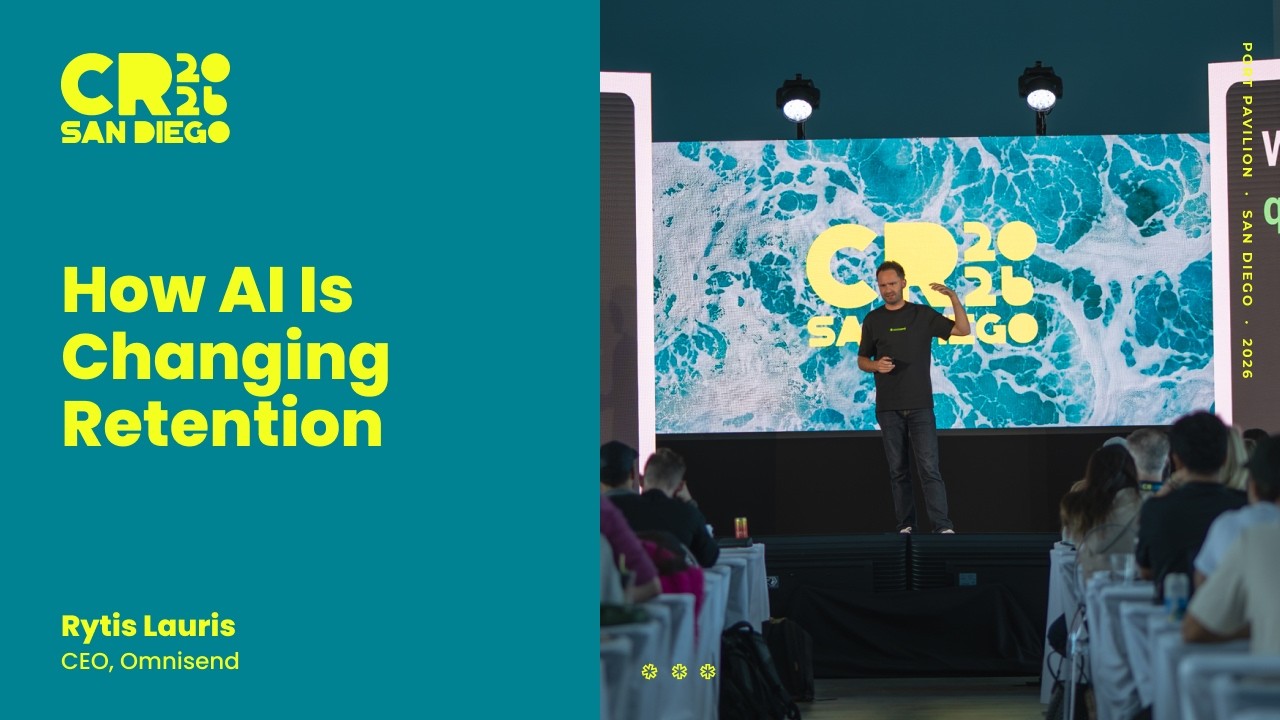
Omnisend co-founder and CEO Rytis Lauris shares three levels of AI in email marketing: analyze, recommend, and act. Learn how to use campaign data, build smarter segments, and improve flows while keeping human approval in the process.
Omnisend co-founder and CEO Rytis Lauris shares three levels of AI in email marketing: analyze, recommend, and act. Learn how to use campaign data, build smarter segments, and improve flows while keeping human approval in the process.
For ecommerce retention marketers, founders, and email teams who want practical ways to use AI beyond writing copy or pulling reports.
Recorded at Commerce Roundtable San Diego 2026, including the audience Q&A. Examples and product capabilities reflect the speaker’s experience at the time. Chapter times follow the publisher’s YouTube description.
Speaker roles and platform examples reflect the session’s original context. This is an archived conversation.
Look beyond monthly seasonality. Order timing within a month can reveal opportunities your existing campaign schedule misses.
Read this part · 07:37 ↓Identify products with repeat demand, then use their reorder intervals to decide when a reminder should arrive.
Read this part · 10:42 ↓Give the tool your tone, assets, and campaign history so it can draft work that fits your business inside your email platform.
Read this part · 16:06 ↓Check how much of your customer base qualifies before relying on a segment. Use the data to refine your assumptions.
Read this part · 18:10 ↓Review copy, discount codes, audience rules, and test emails before activating an AI-built campaign or flow.
Read this part · 21:04 ↓A quick editorial guide to the key ideas. Read the complete transcript below for the examples, details, and discussion in the recording.
Original recording on YouTube ↗Rytis describes three levels of AI use in retention marketing. At the first level, AI answers questions about your data. At the second, it recommends what to do next. At the third, it builds campaigns, segments, or flows inside connected tools. He keeps human approval in the process rather than treating automation as permission to publish without review.
An agency initially assumed an accessories brand was seasonal. An analysis of three years of orders found little monthly seasonality, but a strong concentration of sales in the fourth week of each month. The team shifted its campaign calendar toward that period. Rytis distinguishes the observed sales pattern from AI’s proposed explanation that payday might be responsible.
For a supplements brand already running welcome, cart abandonment, and browse abandonment flows, an agency asked which automations to add. AI identified three frequently repurchased products and their different reorder intervals, then recommended sending replenishment messages before those intervals. The agency built the resulting automations manually.
In a skincare example, an agency ranked past campaigns by click rate and asked for subject-line recommendations. Shorter wording, direct references to the customer, and emojis appeared among the stronger campaigns. Rytis presents these as clues from that brand’s history, not universal rules or proof that one subject-line feature caused the result.
A small online meat business connected Omnisend to Claude through MCP and supplied its brand assets, tone, and voice. Claude could combine that context with campaign data to create a campaign inside the email platform, including a subject line, preheader, body content, and visuals. The marketer still reviewed the work and pressed send.
An agency asked for a loyalty segment based on three or more purchases in six months. In Rytis’s example, AI challenged whether the resulting audience was too broad to represent the most loyal customers. After the agency agreed to reconsider, it proposed and created nine segments instead of the original three. The useful step was testing the assumption before implementing it.
In the Badass Coffee example, an agency asked AI to analyze an existing welcome flow and create an alternative with a distinct label. Missing discount codes, test sends, and tool limitations still required attention. Rytis describes human involvement before the new automation replaced the old one, making review and activation separate steps from drafting.
Rytis sees the retention role moving toward asking sharper questions, prioritizing recommendations, and reviewing work. He cautions against handing over an entire email program without oversight. Connecting more tools can add useful business context, but marketers remain responsible for deciding which changes belong in the live program.
The discussion covers training AI with feedback and brand voice rather than forwarding generic output. Rytis discusses reusable email templates and design-tool integrations as ways to reduce production work, while acknowledging that custom design still needs human judgment. He also distinguishes building an email interface from maintaining delivery infrastructure, and describes combining a trigger with a segment for more specific flow entry conditions. Product recommendations and pricing claims reflect the recording’s original context.
From the transcript supplied by Commerce Roundtable, with filler words removed and paragraph breaks retained for readability. This source does not include paragraph timestamps. Refer to the recording for exact wording and the session guide above for chapter times.
The supplied transcript includes the replay sponsor message and audience Q&A. Product offers and comparisons are preserved as part of the original recording.
Original recording on YouTube ↗Hello, hello. It's really great to be here in this, great crowd. Very curious crowd. I had quite a bunch of conversations in the backstage there with a lot of you already, so it's really nice to see that you are coming here to learn things. Of course, like network as well, it's very important, but, to learn new things.
And hopefully I can share some examples here today with you that will be very practical for you, and you can bring it back home and start using if you are a retention marketer. If you are not a retention marketer, share with your colleagues and, maybe share with your team if you are a business owner or a manager of, a- an online store.
Okay, so we will be talking about how to analyze, how AI can recommend, and how AI can actually act on behalf of us, with very practical examples that I will be sharing today. Yeah, just a little bit about myself. I'm co-founder and CEO of Omnisend. So we do email marketing, we do SMS marketing, and web push notifications.
bulk campaigns as well as automated campaigns, just like, you know, a bit of less advertising, but very targeted, very on spot to help you run your businesses better. And, okay, a little bit before going into very practical examples, a little bit of theory now. So we as marketers, as retention marketers, we have so much data.
We have data about campaigns, about automations, about customers. We have so many signals. at the same time, we have a lot of questions that we ask ourselves. Sometimes we do, sometimes we don't just because we have our routine and we just have no time to improve things. But at the same time, actually, each time we run new campaign, each time we have new season, we want to learn, okay, so what changed?
how much customers at risk? which campaign should we repeat? Maybe there was, like, some very great campaign that we ran in the past, and we should be repeating and not should, should not be reinventing the wheel. And basically, what happens for us, up until today, we have a lot of tools, a lot of dashboards, a lot of reports that we...
Some reports we build for ourselves, so-some reports we build for our managers, for owners of our, DTC brands, et cetera. We bring it for them. And the worst thing that some of that knowledge, it's even in someone's head. Sometimes it's our head, but sometimes it's our colleague who is maybe on PTO now and who is maybe on, like, maternity paternity leave, and ba-basically nobody, remembers what we did and how did it actually work, and there is no this institutional knowledge.
It sounds kind of boring, but it's very important in any organization. So basically, what to do and how to ask those questions in the way that we would get answers, and not only ask those questions, but actually act in a more efficient way. So basically, the idea is bring those existing tools into the interface that you use.
How many of you use ChatGPT or Claude? Opa! Someone of you do not use, or you just did not raise your hand? Okay. Okay. Last minute. Yes. Yes. I use it as well. So I believe all of us use either ChatGPT or Claude. Yeah, Gemini sometimes, but those two tools, AI, LLMs probably are the most used for business purposes.
And the best way to actually build and bring your existing tools like Omnisend, AWS, PO, and other retention marketing tools, just connect them to Claude or ChatGPT via mCP. So who of you use mCP in general? Okay. Who all use, use mCP to build reports? Quite a lot of hands. Reports, yeah. Just to analyze things, to build reports.
Who of yous use MCP to actually create things on behalf of you, like build segments, build templates, et cetera? Thanks. So kind of we just went from a lot of hands, all of us, we use AI. Few of you use MCP, and way fewer of you use it to build things on behalf of you. But I think this is a great opportunity for you to save so much time and to be so much more effective than you are now, and I will be sharing very practical examples.
So basically, whenever you connect your, email service provider or the retention platform via MCP to your Claude or ChatGPT account, basically what happens, instead of having a lot of different platforms that you have to analyze, those platforms are coming into your interface. It's called a ChatGPT. yeah, and then you can just ask questions and put tasks, and LLMs work on behalf of you instead of, of you doing the job
All right, I hope you're enjoying the replay from Commerce Roundtable. I wanted to stop you for just 30 seconds and tell you all about the sponsor that made this happen. I see too many Shopify brands overpaying for big email tools and using only a fraction of their features. We're tired of complexity and never-ending price hikes, too.
That's why Seguno Email is different. Lives inside of Shopify and uses your shop live data, not a synced copy of that. Plus, the integrations with Sidekick, ChatGPT, Claude, and Canva saves you time. And get this, Seguna is the only email app to win a Shopify Build Award. Sounds interesting, right? Switching is easy, and you get 20% off for being a part of the Commerce Roundtable community.
Link in the show description. Now back to your replay. And there are three levels. That's why I ask question, who of you has MCP connection? Who of you built things with MCP? So there are three levels of AI usage within retention marketing or em- email marketing. First level is basically analyze. You just analyze the data, and that explains for you something.
Yeah, you just ask questions, and AI brings you answers. And after that, you make decisions, and then you implement it. Second level, it's when you ask questions and AI comes with a very specific recommendations what to do next. And it's more than you just asked. It says, "Okay, based on your question, this is what I found, and this is what I recommend you to do next."
But you still implement on your own. And there is a third level of that, AI acts on behalf of you. So you ask question, it analyzes the data it has about your business, about your past campaigns, past automations. It recommends you something, and it acts. I put it here that it acts with approval just because I will say why it's important still.
You, human, it has to be in the loop. You have to be in the loop, but still it can help you save bunch of time And now let's jump into some practical, very practical examples that I believe you will find useful for yourself and for your businesses in your daily job. So first level, analyze. So whenever we have questions, we just ask LLMs.
Initially, we connect, and then we ask questions. So in this practical example that is coming from our agency partner, agency Unfloored Digital, and all the examples will be coming from our agency partners or the customer. So basically, in this case, agency got a new customer, and fr- on the surface, the brand is like accessory brand, and it looked like, this business should be seasonal.
But let's analyze. Is this right? So sh- when shall we be running campaigns? Is it really seasonal or not? So they prompted like this. They analyzed data from three years in the past, which again, you can do it manually, but it's not very easy to do that. And they asked the question, "Okay, so what is the calendar distribution by orders?"
And then answer AI provided to them that there is basically no seasonality. There are one month, which is like July and November are the best-selling months, but we don't see any deep seasonality. So, okay, our assumption was wrong. We got the answer in minutes or maybe even in seconds, not in hours, in building our own comprehensive dashboards.
They got a bit further and said, "Okay, but I still see that there is kind of disbalance in sales." And AI made another analysis, and this is what we found, and that's what is important. Yeah, there is no monthly seasonality, but there is very hard, sales skewed towards the week four of each month. And basically, what did they change upon this learning?
That we should be way more active. We should be running our campaigns on week four. And the why is it week four? So AI just made an assumption be- in the market where this brand operates, week four is usually a payday. So basically, instead of running like heavy campaigns in first three weeks of the month, we just, like, bring it to the week four, and on week four, we run all the campaigns.
We can send instead of sending like one or two emails, maybe it's worth sending four emails, five emails. Automations are running in that week. And again, so what happened here? So instead of like initial assumption, initial assumption did not prove, but then AI helped us to find another thing, another finding, and it was like very fast.
We as humans, we should not like be downloading a lot of data, building new reports, et cetera. AI just did it in minutes. And what actually agency did in that case, so they rebuild their marketing calendar, put all the heavy load on week four of each month. So, you know, retention is a set of questions and not reports and this is how after connecting to AI via MCP you should be changing your behavior.
So that was one example from level one. There will be more examples from level two and level three. So level two is recommend. You not only ask questions, but you ask, okay, what would you recommend me to do next as an email marketer, as a retention marketer? The same agency, just a different client. This, in this case it's foot supplements brand and in this case, like, the prompt was, okay, we do use free automations, welcome, cart abandonment, and browse abandonment.
We run those free automations. What would you recommend? What kind of other automations shall we build? So it's not only we are asking to build a report, but we are asking exact question what we should be doing next. And AI comes with very nice insight that there are free SKUs that repeat purchase is happening way more often in comparison to all other ESK-- SKUs.
And we could identify it manually, but it would really take so much time to analyze all the SKUs, to download a lot of different reports, to connect them, et cetera. And again, so this is the, what I would recommend you to run as well. Are there any SKUs that are being, repeated purchases are being, like, way more than other SKUs?
So AI identifies three products, three SKUs that are being repurchased way better than others. Second thing, what AI recommend us, what exact day we should be building the automation to upsell those, to, like, re- to drive repeated purchases. And what do we see? That in this case, this is day four 34, day 41, day 47 is where those products are being repurchased.
So it recommends us to run our repurchase campaigns a bit earlier. What does that mean? That we will get our money sooner, and we will increase the repurchase rates for the already good reselling products. And again, so you could do it manually, but with AI it is way easier, and you just ask, it finds something that you could not even think about it.
And in this case, the agency builds those automations manually. So they ask question, AI finds something that is not that super intuitive, it recommends what to do next, but you still build things manually. Another example, just, yeah, another agency, Commerce Boost, and in this case, like, Karen Herzog, this is customer, they are Skincare, skincare products in this case.
So basically they asked to un-rank like 30 campaigns in the past by click rate, so basically by initial engagement rates. Opens are not that important, but clicks are very important. And of course, purchases are, conversion is the most important. But clicks is already showing a lot about campaigns. And basically in this case, they asked to, what is the best converting, subject lines?
And AI comes with a list of top five campaigns, and AI comes with a list of recommendations. So your next subject line should be, if you want it to engage well, should be pretty short. Should you, like, w- use words like you or your something, so it's direct to the consumer, talking directly to the consumer.
and yeah, emojis are very important for this brand. Apparently, all top five performing campaigns, somehow their subject lines had emojis in it. So I mean, maybe just co-incidence, but that's exactly. So what happens here, but basically you get a brief here. AI recommends what your next subject line should be looking like.
It analyzes a lot of data, and it comes with recommendation. You act, either you go to Claude or ChatGPT or build a new subject line. you can do it manually, but the brief is already here written by AI. So again, what happened in this case? They asked for, to analyze things. They asked to come up with a brief, with a recommendation, and you, marketer, still act on your own yeah.
So in this case, in this case, yeah, it finds what to fix and what to repeat, and you, marketer, choose what to build and do it manually Getting to level three, so act with approval. AI can not only analyze things, not only can recommend things for you, but it can actually act on behalf of you and save so much time for you
And then I ask you, okay, how many of you use LLMs, use Claude Chat or ChatGPT to build things? There were very few hands, and that's what I would recommend all of you to try. And, I will share three examples here how agencies and brands use AI to act on behalf of them. So first example is coming from the brand Mudgy Meat.
As name states, they are selling meat online, which is... I mean, maybe not doesn't sound like a real, ... Often what happens is not another supplement business, it's not clothing business, but you can sell meat online as well. But it's a pretty small brand, and the owner and the marketer is the same person, and they really struggle.
They don't have just time to write good copyright, and I'm not a copywriter by myself, so what can they do? So what basically they did, they connected Omnisend via MCP to their Claude. They also build a project inside Claude. So pre... They pre-trained Claude with their tone and voice, how they wanna speak to their customers.
They u-uploaded all their brand assets to Claude and also connected to Omnisend. So Claude not only knows your brand assets, tone, and voice, it also knows what works the best within Omnisend. So it connects those two, it connects those two, and it not only helps you to write good subject lines, good body text, but it does it within Omnisend in this case.
You can do it the same with other ESPs if you are not on Omnisend. So basically, what does it do? It creates the campaign inside Omnisend. Subject line, preheader, all the body content, visuals, copyright is being built by Claude in this case. You save so much time. And of course, in this case, customers still pu- push the send button manually.
So that's what we recommend still. Review it, 'cause, you know, AI sometimes hallucinates, and you have to push the final button. That's what we recommend, but again, it does the job for the customer. So what did it do? So basically it create entire campaign with subject lines, with body text, with visuals, et cetera.
It saved a lot of time. Just because they connected their brand assets, tone and voice with a data coming from Omnisend another example, another agency, Jiangjin Di- Digital. This is a, like, wellness brand as well. They were willing to build a loyalty segments to communicate with, and basically they prompted, "Can you, can you identify customers with three or more purchases in the last six months?"
And yeah, it's pretty, pretty kind of, straightforward prompt. AI knows what to do. But basically in this case, what happened? AI build this segment, but it identified that 40... almost 4% of your customers is in that most loyal customer segments. And what is better that Claude in this case pushed back It does not follow your instructions and your prompt just blindly, but it pushed back and it said, "Look, yes, I, I can build this segment, but what I see that 44% of customers being treat- treated as the most loyal customers doesn't make much sense for me.
It's just the group is too big. Are you sure that you want me to act like you prompted on the first prompt?" And it offered that, okay, maybe I can build alternative segments, and basically what is the final outcome in this case? The customer or agency in this case agreed, and the final outcome instead of building three segments, AI built nine segment and created all those segment within Omnisend.
Not just theoretical recommendation, but it actually acted on behalf of the customers. So what happened in this case? So the customer started with a prompt, but assumption was not correct in this case. So AI analyzed the data. It pushed back, that it challenged you, that, "Okay, you say that, this is three plus purchases is the best, loyal customers, but actually I would not recommend treat them like that because the group is just too big in this case.
So what would you think if I would suggest you something else?" And the customer agreed, "Yes, okay. Your cha- your challenge sounds reasonable, so what would you recommend?" AI recommended nine segment, and not even recommended, but actually build all those nine segments within Omnisend in this case. So just, you know, it saves bunch of time, especially if you are more creative marketer.
Usually building a segment is not that straightforward. Finding all those logical junctions, is it like and, is it, or, et cetera, et cetera. So saves a lot of time for the marketer. third example I have here, so it's, Badass Coffee, so, and agency Talenta. So in this case, they, they even went with more comprehensive task for LLM and asked, "Can you propose a new plan for a welcome flow?"
They had welcome flow running, but can you propose something new? Just analyze our performance, analyze best practices, and can you build something new for us? And yes, so basically this is a prompt. You can, you can copy-paste. You can use it. You will receive this presentation after that. And, yeah, so it build it.
It build it. and what also they, they said that, "Okay, can you label it with unique labeling that I would know that, okay, if something go wrong or maybe something, I want to fix something, I could be able to identify that this is a new flow?" Just to You know, to understand which is the new and which is, like, the old flow.
And in this case, I mean, it build it, but it did not switch. Why? Just because AI identified that, okay, I build this, but there are a few missing pieces, like discount codes are missing. So, and you have to add those manually. I cannot do it for you fully automatically. So you can... You have to be still involved as a marketer.
You can add something manual. But again, it saves so much time for you. You should not be doing everything manually. You just need to add discount codes. The second thing, it's recommended that maybe it would be smart sending some test emails. And even third thing, ah, two limits. It faced some limits. And working with AI, working with LLMs, with MCP connection, it sometimes happens, and that's okay.
It's not ideal, but this is what you should start using because after six months, after 12 months, it will be saving a bunch of time of you. Although it's not maybe ideal and flawless at the very beginning okay, so we challenge a bit. Human had to be in the loop, human had to add some things, manually, and finally, AI build everything.
So it enabled new automations, welcome flow with copyright, with text in it, et cetera, and it stopped the old campaign, old automations, and it replaced with a new automations just for you and saving so much time for you. So yeah, basically what happened, yeah, you could do it manually, but what do we usually see?
That brands review their welcome automation just once per year, so because it's a time-consuming thing. With AI, with MCB connection, it can save so much time, and it can be so more efficient. You can rerun it way more frequently than you used to do in the past. Yeah, so AI can build for you. You still make a final decision if it belongs, and if you want to enable it, if you can...
if you want to make it actually live. And, you know, it's not only ESPs. You can connect other tools like Google Analytics, Meta Ads, Shopify via HP. And the more tools you connect, the more data Claude or ChatGPT has about your customers, about your business, et cetera, and the more efficiently you can operate and build autonomous agents just step by step, but that's how the future looks like, I believe.
And basically, what we believe, the retention marketing role is really, really changing as we speak. So now we still kind of... We are finding some reports, looking for reports, making some decisions, copying data, you know, writing copy, et cetera, but our future role as a retention marketers, as email marketers, is really asking more questions, sharper questions, challenging our AI agents.
we will be still prioritizing actions. AI will come up with recommendations, but we will have to make final decisions, and we can move way faster than we are moving currently yeah. So three rules of using this. Yeah, so AI reduce the workload, that's for sure. I would not still recommend AI to fully autonomously run your marketing.
Yeah, we, we hear sometimes, and we read and, like, listen on podcast, and they do the same that, you know, there are companies that state, okay, the entire retention marketing or email marketing is being run by AI fully autonomously, et cetera. Sounds good, but sounds a little bit too good to be true. So human still has to be in the loop.
Keep yourself in the loop, make final decisions, but ask AI to analyze things, ask AI to recommend things, ask AI to build things on behalf of you, and just make this final approval, keeping yourself in the loop and keeping yourself the final decision, the right for the final decision. and, you know, you will get more comfortable when you start doing this.
Yeah, so if you want to learn more about MCP, if you want to learn more about how to use AI, I welcome you to look for webinars. We have a bunch, like tens of webinars with different topics, how to effectively use MCP, how to effectively use AI. Either you're Omnisend or not on Omnisend, the general rules are more or less the same.
Okay, and for the very last slide, if you are not on Omnisend yet, this is a good chance for you to migrate. A little bit of ad here for very ending. Yeah, if you can s- if you scan this QR code or if you use this discount code, you will get 50% off for the first three months if you migrate. And I promise that we will migrate you from your current ESP in five days.
It's white glove. We are not, like, we're not an agency, but migration, we promise you we to migrate all your segments, all your, workflows, all your templates within five days. Okay, so thank you for listening. Appreciate your time, and maybe we have any questions.
So, Rytis, the one thing that is so frustrating to me is, like, when I get something from the team and I just know it's all AI. Like, it's, it's just like, did they even read it? Do you have a rule internally to, like, they have to have some sort of entry or it has to be, like, human words versus it just being full AI report, "Hey buddy, here's my AI writeup."
'Cause nothing is more frustrating than just getting- Yeah ... like, you just know, like, you just asked GPT and you're fucking cut and pasting it. Yeah. That- that's true. That's true. So I've read in one, like, post on LinkedIn, I really liked it, you know, that, someone was telling, "I read this text and I feel it's written in a brown language."
Why it's brown language? Because if you would mix all the colors in the world, you would get brown. So it's kind of AI text sounds like brown. But, the example I just showed, if you pre-train AI agents with your tone and voice, it will not sound brown anymore. And if you review prior to sending, prior to publishing, it will not sound brown anymore.
So basically you have to keep training, and that's the thing with AI, and that's the lessons that we learned from, like, Omnisend as a company, not as a tool, but as a company. So you start using AI, but you have to keep training it. It's like a junior employee. It's not ideal. So, but you still hire a junior employee, and you keep training, and they will become better and better each time.
So that's very important. Just, yeah, don't rely on default, ChatGPT or Claude texts because they don't sound, good, and people will recognize and people will disrespect that. Yeah, but pre-train with your tone and voice and keep training them, review it, give, advice, give comments, challenge it, et cetera.
And that's how you train. And after, you know, a month or two, Nick will not be able to identify if it's actually you or if it's a second you, your AI agent. It's just frustrating 'cause you're like, you want to have a real thoughtful... 'Cause they're getting information much quicker, but it's never... You're like, dude, I know...
The issue is some of these guys are not as smart, but they give me something, I'm like, oh my gosh, that's incredible. Like, who wrote that? And it's definitely not the employee. When you're talking about, like, which AI to, like, when do you let AI make the recommendation versus you going like, "No, I'm just gonna do this myself"?
When do you use AI for the recommendation first? out of those tools? LLMs? Yeah. So- And- I see the question, yeah. So better results for copy subject lines. So, ChatGPT for copyright is, is a bit better. For other, analytical tasks, for, for, for recommendations, Claude is better. But, like, for copywriting, we found that ChatGPT is, is better, and you can train it better.
Yeah. Beautiful. We got a couple more coming in. So this top one, how much should I expect to save Klaviyo to Omnisend? People, people always ask this question. This is the m- number one reason why I'm sure people come and chat with you, huh? Yeah. So I'm, I'm not exact, about 45, thousand subscribers. But on, on average, people are saving or business are saving around 35%, switching from Klaviyo to Omnisend And you, we, you get way better support on top of that Believe that This is our hard promise.
For sure. Tier one support, account managers from 400 bucks per month and, a lot of, like, educational material, et cetera. 'Cause Omnisend is being built a brand for midsize and smaller businesses, not for corporations. Is there any tips for speeding up email design creation? This is the p- I have a question about this too.
It's still the most time-consuming part for using MCP for the flow and campaign strategy. That's true. Okay. So it depends on the quality you want to get. So I think, like, Canva and Figma, using those design tools as, Omnisend and, as far as I know, other ESPs have direct integration as well with Canva and Figma.
So if you want to be on, like, more professional side, so using those tools, and then basically pushing, pushing the design and the templates directly into ESP Omnisend or other ESP is probably kind of the, the time-saving, solution. but of course, just, you know, it depends on, how, how custom you want to be with your designs.
But usually, what, what we see that if it's, like, a smaller brands, we have just, good-looking templates, and they just don't design each campaign uniquely. They just put images from their stores, et cetera, and they write copy and we- they use templates. They reuse the same templates, and that's good enough.
It drives sales. We should not be, like, over-designing. It depends on the size of your business and, the skills of the marketers that you have in-house, and if you have outside agency, if you don't. Yeah, and there's so many spy tools. Really Good Emails, a couple other ones you can rip some great designs from.
Some stores are vibe coding their own email ESPs, but there's a lot of horror stories. Yeah. Are domains getting blacklisted? Is that real? 'Cause I've heard that as well. Mm-hmm. so no. When we started, like, Omnisend 13 years ago, that was, like, situation was very similar. I remember when I start pitching and selling, and everybody said, "But look, I have a developer in-house, so I will build my own email tool."
then apparently, so people were building their own email tools when they were not doing that. Now with AI, they are vibe coding. but look, so we can vibe code a lot of things, but, email and SMS, 'cause we do both, it's- it has this infrastructure layer, which is really, really, really complicated, and that's...
We keep hearing those horror stories as well, that, you know, deliverability, whitelisting, IPs, you have to warm them up. We have, like, entire infrastructure that it's not being replicated, and thanks God, AI is not even close at this stage where it can really, really comprehensively run that, and you have to own this infrastructure, so it's not about vibe coding, and vibe coding is really far away.
Yes, it can help you design good-looking emails. That's great. But if you want really to, to have your inbox placement, so it's, it's impossible to vibe code. Yeah. I got three, three last questions, which are great questions. This first one. "Why is it not possible to have two triggers in a single flow, such as an email signup and checkout started?"
Great question. Thank you. so you can have like, ... You can combine and you can, like, trick a little bit, so you can have one trigger and one segment. So if someone is in your segment, like in this, like, as email signup and checkout started. So basically, you can have a segment, those who just signed up to my email campaigns in the past four days or maybe one day or five days, whatever your use, specific use case.
So you can trick. You can combine one trigger plus one segment, 'cause seg- segments are being built automatically. your customers come into segment, we leave a segment. So that's how you can basically use almost two triggers and, yeah, that's the, shortcut, yeah, that you can use. Last two. "What's a good AI workflow to use for graphic emails design instead of text only, text-heavy emails?"
Max, Max has a good video on this, by the way, so. Yeah, yeah. What's a good AI to use for graphic email design? I'm not sure if I like 100% get this question, but basically, so you have to, yeah, to, to design. So to what I said that, yeah, so you can either use your existing template, so you have to design. And look, design, to be honest, with AI is the biggest challenge so far.
So writing a good copy, not even brown text copy, is easier than creating a really, really good-looking designs. That is a bit more challenging now, et cetera. So with AI, you can build like- Good, okay-looking designs depending on the stage of business. But yeah, so if, if you are, if you are really willing to build, like, custom, custom-looking, each campaign custom-looking, still human has to be in the loop and design this.
Again, we can use Fi- Figma, we can use Canva and push it directly to ESP, but, yeah. There's no kind of golden bullet in this or silver bullet in, in designing yet. Rytis, thank you for the time, brother. We'll see you next time. Thank you, Nick. Thanks, everyone.
Join Commerce Roundtable in 2027 for focused learning and conversations with people working through the same challenges.