 43:39
43:39San Diego · 2026

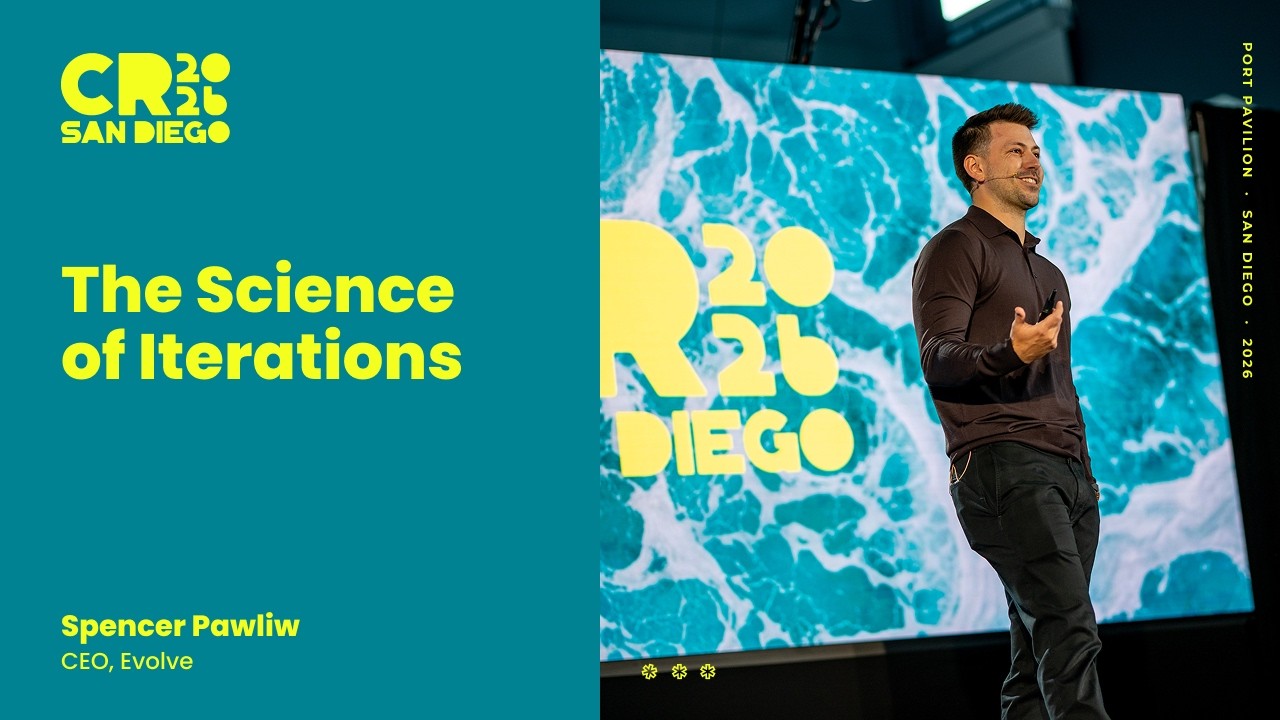
Spencer Pawliw explains how to label winning Meta ads, identify the creative components driving results, and turn those learnings into intentional iterations. Includes ad breakdowns, format ideas, and audience Q&A.
Spencer Pawliw explains how to label winning Meta ads, identify the creative components driving results, and turn those learnings into intentional iterations. Includes ad breakdowns, format ideas, and audience Q&A.
For ecommerce founders, paid media teams, and creative strategists who want a repeatable process for analyzing ads and developing the next creative test.
Recorded at Commerce Roundtable San Diego 2026, including the audience Q&A. Client outcomes are Spencer’s reported experience. The Uproot Clean teardown is an outside analysis using public signals. Chapter times follow the publisher’s YouTube description.
Speaker roles and platform examples reflect the session’s original context. This is an archived conversation.
Judge an ad by results, spend, contribution to account growth, and durability rather than a simple winner-or-loser label.
Read this part · 04:40 ↓Write a short creative memo before production so the team can connect the result to an intentional hypothesis.
Read this part · 11:18 ↓Identify the angle, audience, desire, mechanism, authority, awareness, emotion, positioning, and urgency instead of copying surface details.
Read this part · 12:56 ↓Carry a useful insight into a coherent new execution. An iteration can change multiple elements when they need to work together.
Read this part · 22:55 ↓Review your best recent ads for angle, authority, mechanism, and urgency, then test a proven concept in another format.
Read this part · 28:45 ↓A quick editorial guide to the key ideas. Read the complete transcript below for the examples, details, and discussion in the recording.
Original recording on YouTube ↗Spencer evaluates ads by their performance against the target KPI, the spend they attract, their contribution to account growth, and how long they perform. He separates losers, KPI winners, spend winners, and breakthroughs. A low-spend ad hitting its CPA target is different from an ad that also earns meaningful spend and helps the account scale.
A consistent naming scheme makes it easier to connect an iteration to its original concept and see whether the team is building on its winners. Spencer recommends combining the volume of a creator engine with an internal creative team that deliberately develops and tests ideas. The goal is more breakthroughs, not simply more ads.
Every ad should have a short memo explaining what the team will make, why it should work, and how it will be executed. Spencer uses this to distinguish intentional iteration from random changes and give the team a hypothesis to revisit once results arrive.
Spencer’s framework examines angle, avatar, desire, mechanism, authority, awareness level, emotion, positioning, and urgency. He describes avatars through experiences and behaviors rather than demographics alone. Identifying these components gives the team a more specific explanation of what an ad is doing and what it could test next.
Spencer breaks down an Uproot Clean ad using its laundry-odor angle, pet-owner audience, grandfather repairman authority, emotional cues, and urgency. He explains how the mechanism connects to the product benefit and how positioning can make an offer different rather than merely better. This is an external example analyzed through public signals, not a client result he independently verifies.
An iteration is a new ad that inherits a learning from an existing ad. Spencer’s examples retain an authority device or move an urgency idea into the opening while changing other elements to fit a broader audience or a different awareness level. He argues that the whole ad must remain coherent rather than forcing every iteration to change only one variable.
For a quick starting point, Spencer recommends reviewing the best ads from the last thirty days and identifying angle, authority, unique mechanism, and urgency. Teams can then carry a useful concept into different formats. Founders can create a weekly habit of asking the creative team what it learned and how it will apply that learning.
In the Q&A, Spencer describes two weekly calls involving writers, editors, strategists, and media buyers. The person who makes or writes an ad also analyzes it. AI can help organize the discussion, while the team remains responsible for interpreting why a creative worked and deciding the next action.
Spencer recommends establishing the evergreen page first, then carrying proven angles into landing-page tests. Start with the headline and consider what the visitor still needs to learn after seeing the ad. Later questions cover AI creative, hook testing, and finding an initial breakthrough by exploring broader angles before iterating more deeply.
From the transcript supplied by Commerce Roundtable, with filler words removed and paragraph breaks retained for readability. This source does not include paragraph timestamps. Refer to the recording for exact wording and the session guide above for chapter times.
The supplied transcript includes the replay sponsor message, example ad dialogue, and audience Q&A. Brand names, figures, and other transcription variations are preserved from the source; refer to the recording for exact wording.
Original recording on YouTube ↗Check, check. You guys hear me? All good? Beautiful. so as, as Shaq mentioned, we're gonna jump into the science of iterations, which is probably one of the most nerdy talks you guys are gonna hear today. but for the sake of time, I'm gonna jump straight in. I've got 100 slides and 30 minutes to try to explain five years of iterations.
If the next 30 minutes feel a little bit like this, just bear with me. I got some goodies for you guys at the end. So the point of the talk here is to try to make you guys aware, and then I'm gonna give you everything to make it actionable. Cool? So Taylor just talked about it. I'm, I'm sure everybody here has heard of Andromeda.
if you don't know what it is, it's a great way to get a lot of views on YouTube. but more importantly, it's really about this creative diversification. Net new, right? The questions were just coming in about that. The main thing that a lot of people think is that iterations don't really work anymore.
But six months ago, I actually decided to turn our iteration process into a playbook, and as a result of doing that, we were actually able to take a brand here, and this is a telehealth company, which is why they have a custom purchase, but they were spending about thirty thousand dollars a month with a six hundred dollars CPA in February.
If we fast-forward to basically the last thirty days, we've increased their ad spend to two point five million dollars a month with a two hundred and forty-five dollars CPA. And you'll notice there's no media buying magic happening here. It's just creative. If you do the math on this, that's an eighty-six x increase in spend and a fifty-nine percent decrease in CPA.
Two hundred and eleven times more new customers every single month. And they're not the only brand. we have brands in our community like Johan, who's consistently doing over a hundred thousand dollars a day. He was able to think differently about copywriting and iterations. Suraj over here learned how to get better at feedback loops and is doing over a hundred thousand dollars a day.
We have Fi, who's a kid from Canada. He's said the copywriting module is GOATed, usually means good, and he's doing over a hundred thousand dollars a day. Jeffrey's doing five million a month. He's cracked unique mechanisms and formats. And we have tons of these guys and, and when I say kids, like Mickey over here is doing a hundred thousand dollars a day and he's still in school.
So the reason why I show this is because a lot of these guys, literally based off their age, you know, they don't have more experience than you. They're not smarter than you. They just learned how to stop guessing. And my goal today is to show you guys how to stop guessing, right? Science. We're gonna try to do some educated guessing here.
Okay? For those of you that don't know me, my name is Spencer. here's like my timeline in e-com. I had a great business idea in twenty twenty to start reaching out to gyms during COVID. You can imagine how that went. So I pivoted to e-com and actually ended up signing my first client in twenty twenty-one.
And then basically from twenty twenty-two until twenty twenty-four, I realized media buying, just like all the stuff that I learned from these agency guys and these business guys saying media buying is the thing, it just wasn't really working. And so by the time we got to twenty twenty-four, we had started to develop a bit of a creative process.
And I came to an event similar to, to this, and I saw a guy get up on stage, and he was doing over a million dollars a month, and I was like, "I want that." And so to scale an agency, as Taylor would say, you know, or a lot of agency guys know, you got to build a lot of teams. And so my idea was, hey, I'm gonna build a lot of teams, and I'm gonna build a training program to scale the agency.
The complete opposite actually happened. The training program outscaled the agency, and it actually became the number one community on all of Skool, and a lot of people here now know it as Evolve. And as a result of that success, we've actually started to throw our first Evolve events. we actually started building a brand.
we launched something called ecombounty.com, and we're getting ready to launch something called ecomuniversity.com. If you wanna talk about that, you can, find me later. But in Shaq's words, I'm, I'm really just a nerd, okay? This is what most of my days look like. I'm just trying to figure out how to scale e-commerce brands, and this is what I love to do.
So the goal for today, again, is to show you guys how to stop guessing. There's three things that we're gonna cover, and in the playbook at the end is all of the goodies, okay? We're gonna learn how to label, and then we're gonna learn how to learn, it'll make sense, and then we're gonna show you guys how those two things can help you do better iterations.
Sound good? Yeah. All right. Thank you. Okay, so step one to iterations is label, okay? And what we're gonna do is redefine what a winning ad actually is and show you guys how to track it. Now, it's funny that this was the question that got asked right before I come up. it is, like Taylor said, very hard to define winning ads.
But if you can't define winners correctly, it makes it extremely hard to iterate. And like, you know, Taylor was kind of talking about, it's like I love his definition, but when you look at winning ads, they actually exist on a scale, okay? There is no, like, winner or loser. And I know this because we have access to a decent amount of ad spend.
This is $160 million so far this year, and last year we had about $100 million. And when I went through it, all I was looking at was winning ads. I was like, "Where are the best ads from every single account, and what do they have in common?" And so what I notice is that there's basically four variables that determine how winning an ad is.
The first one is KPI, and I think everybody understands this one. It's ROAS or CPA. It's pretty obvious. The next one is spend, and I think more people are realizing that spend is very important. And so again, the more spend an ad gets, the more winning it is. The third variable is one that not a lot of people for some reason think about, and that's scale.
And so that's more that the ad... the more the ad helps the account scale, so increased budget, makes it more of a winning ad. And then the final one is time. So the longer the ad runs, the more winning it is. And when I went through these variables, like I, like I just said, it became very clear that winner and loser is just not going to work.
And so what I've done is I have essentially created four definitions for, for ads. The first one is a loser, okay? These are ads that do not get 10% to 30% of spend, and I'll explain that in a second, and they do not hit KPI after seven days. These are your complete flops, okay? They do nothing. The second is KPI winner.
These are ads that hit KPI target after seven days, but they don't get a significant amount of spend. And a lot of you guys, this is your definition of a winning ad, and I look at these as losers. I don't care for these at all The next one is spend winner. So these are ads on the inverse that get a lot of spend, but they don't hit KPI, right?
So it's spend without results. And then the final one, it gets a green highlight, is breakthrough. And funny enough, this is the same thing that Taylor's saying is focus on this. Focus on the ads that actually get a lot of spend and scale your ad account. This is all I care about at our, at our agency, and I tell everyone in our community, you need to start tracking breakthroughs.
So if you don't like this definition, that's fine, just make sure that you care about breakthroughs because these are ads that scale your account. Okay? And as it says at the bottom, each box tells you how you should iterate. If you're wondering where I got the ten to thirty percent of spend from, I spent four months and had to create a custom Python script, some super nerdy shit, to be able to like go through all of the winning ads.
And essentially the way that it works is the less that you're spending on ads, the more spend your breakthrough ads and winning ads are gonna get. The more that you're spending, the less spend that your ads are gonna get. If you wanna know the difference between a million dollar a month in spend ad account versus like a fifty thousand dollar a month ad account, it's just the number of winning ads or number of breakthrough ads.
Okay? So that's definitions. Next one is naming schemes. Who here has a naming scheme? Just put your hand up if you have a naming scheme. Oh boy, okay. All right. I'm guessing a lot of your naming schemes might look like this. You know, you got the new sales ad, Facebook comments video. if you want to know how your iterations are doing, and more importantly, if you should do more, you need to track them, okay?
I'm gonna give you guys our naming schemes at the end, but the bare minimum that you guys need to start doing is tracking the iteration on what batch number it is. So the way that it works at our, at our agency and in Evolve is we track batches of ads, basically concept number or test number, and then we just add whatever iteration number we're on of that batch.
So this reads iteration number two of batch number three. And now I know if I say, "Hey team, how many iterations have we done on our breakthroughs?" It's two. I'm like, "Well, let's do way more." Right? So that's label. That's the first step. Pretty easy. Now we're gonna get into the beefiest part of the presentation here, which is learnings, okay?
essentially what we're gonna try to do here is identify the components of winning ads. But before I do that, I'm gonna try to get everybody a little bit involved here. I wanna better understand how many ads you guys are actually testing to kinda take a look at this volume versus intent debate, okay?
So if you guys could help me out here. If you test more than ten ads a month, put your hand up If you test more than fifty ads a month, keep your hand up. More than two hundred and fifty ads a month. A thousand ads a month. Five thousand ads a month. Ah, I'm coming to find you later. All right. The truth is, is that they both work, right?
And what Taylor even just talked about and what everybody's waking up to is the creator engine should be your volume engine, and then you should ideally have a creative team that is like your intent engine, okay? Now, the big thing and the big misconception is people automatically think that, "Hey, if I just make more ads, I'm gonna scale."
But that's not true. What's true is that you need more breakthrough ads. Obviously, the theory is if I make more ads, I'm gonna make more breakthroughs, but at the end of the day, you have to optimize for what actually scales the account
All right, I hope you're enjoying the replay from Commerce Roundtable. I wanted to stop you for just 30 seconds and tell you all about the sponsor that made this happen. I see too many Shopify brands overpaying for big email tools and using only a fraction of their features. We're tired of complexity and never-ending price hikes too.
That's why Seguno Email is different. Lives inside of Shopify and uses your shop live data, not a synced copy of that. Plus, integrations with Sidekick, ChatGPT, Claude, and Canva saves you time. And get this, Seguna is the only email app to win a Shopify Build Award. Sounds interesting, right? Switching is easy, and you get 20% off for being a part of the Commerce Roundtable community.
Link in the show description. Now back to your replay. And so before I talk about intent, I just want to define it. Thankfully, we have Google. Intent means a purpose, a plan, or a mental goal behind an action, okay? You're thinking about what you're doing. This is what our org chart looks like on our creative team.
You guys are gonna get all the slides as well at the end. The org chart doesn't matter. What matters is, is I have seven editors, two creative strategists, and a growth strategist. They do three hundred ads a month. If you have a creative strategist and one editor and you're also doing three hundred ads a month, you're probably lacking in intent, okay?
Now, it says ads with a memo. Most of you probably have no idea what a memo is. A memo is very simple, and this is how we measure whether or not we do an ad with intent. Before any ad becomes an ad, it starts as an idea, and we have to answer three questions: What is the ad? Why are we doing this ad? And then how are we actually gonna do it?
If you can answer those three questions, that means you probably thought a little bit more about your ad. And the reason why this is important is because most people don't actually understand why their ads work. Like if you... And if you guys have a marketing t- team or a creative strategist, what I want you guys to do is go and ask them, "Pull up your best ad.
Why does this work?" And you'll probably get answers like, "Oh, well, it's a UGC video. UGC crushes for us." Or, "It has a great hook," or, "The cost per click is really low." Those are all surface level learnings, and if you do surface level learnings, you get surface level iterations, and Andromeda does not like that.
Okay? At this point, it says hundreds. I've probably analyzed thousands of ads, and what I wanna show you guys are the nine components that actually matter for making winning ads or making breakthrough ads. Okay? I'm gonna sprint through this part, but we're actually gonna break down an ad together where I talk about each one, but I'm gonna go kind of one by one here to show you the components.
The first one is angle. My definition of angle is the main reason you're giving someone to buy. The next one is avatar. This is who the ad is actually speaking to, and I'm gonna get a little bit more into this as well about how in Evolve we do it a little bit differently. Then we have desire. This comes from Breakthrough Advertising.
If you haven't read that book, it's kind of mandatory if you're in marketing. But these are the wants and needs of the customer. And then we have the mechanism, so this is how the product actually works. And then the middle one here, which gets a green highlight, is authority. This is the reason why people are going to believe your ad.
If you wanna get really good at marketing, learn how to make people believe your claims. That's it. People believe your claims, they'll buy. And authority is one of the most effective ways that we've seen of making that possible. And if you guys remember Johann in the beginning who's doing over $100,000 a day, somebody in our community said, "Hey, Johann, how did you go from $50,000 a day to $100,000 a day in a week?"
And he said, "I did an ad iteration with an authority switch, and it got $15,000 a day in spend." And that brand that I showed you in the beginning, we have been doing authority switches and doing iterations with authority constantly, and that's how we've been able to scale so fast. So this is really important.
The next one is awareness level. This is the product aware, solution aware. This is... Again, I'll-- we'll, we'll get a, a little bit into this. It's also from Breakthrough Advertising. Then we have emotion, which... Where's Sarah at? Sarah, are you here? I don't see Sarah. She's not here. This is Sarah Levinger's valence and intensity model.
I'm gonna talk a little bit about this as well. then we have positioning, which is why you and not everyone else. And then we have urgency, which is why now and not later. And this is gonna be authentic urgency, not just, like, sale ends tonight urgency. So what we're gonna do now is we're gonna break an ad down into these components.
We're gonna play it. Hopefully, there's volume. There should be volume. The first clip's a little gross, so if you have, like, a weak stomach, maybe don't watch it. But here we go. Let's watch this first clip Oh, we got no sound. Check
Sound check. No sound? Underwear. Nothing smelled clean anymore. At first, I blamed the detergent. Switched brands twice. Then I blamed the dog because honestly, what else do you blame when your house smells like damp fur? Okay, cool. Well, if you guys missed the first part, we're gonna... I'll show you a screenshot of it.
But remember, step one, we have to label. Now, this is not actually a brand that we work with. This is a brand called Uproot Clean. They absolutely crush with their marketing. I highly recommend checking out some of their ads. but shout out to Alex. I think Alex is here. we go-- we use a tool called AdSpy, and we sort by shares, and that usually shows us the best ads for an account.
Now, Meta also has impressions, which is helpful for seeing winning ads, but I'm ninety-nine point nine percent confident this is a breakthrough. And then what we're gonna do is, again, we're gonna break this down into the components. So the first one is angle. What is the reason they're gonna buy? Well, it's gonna fix their bad-smelling laundry.
That's it. The second one is the authority, and this is the part that you guys didn't hear, but the authority is actually right in the hook. It says, "My grandpa used to fix washing machines for a living." Who are you guys gonna believe more? A brand that wants to sell you something or a grandpa that used to fix washing machines for a living?
Probably the grandpa, right? Now, the emotion here is low valence, low intensity. If you don't know what this means, essentially, valence and in-intensity exist on a chart like this. On one side, you have high valence. On the other side, you have low valence. High valence is like happy feelings. Low valence is not so good feelings.
And then this axis is how intense it is. So this ad is low valence, low intensity. How do I know that? Well, just read it. "My grandpa used to fix washing machines for a living." Doesn't make me feel anything. "This is what he told me to do about the smell." Ooh, smell is kinda gross. That's not so good feeling, so that's low valence, but it's not that intense, so it's low valence, low intensity.
We've got-- Sarah's got amazing trainings on this as well, so go find her after too. And then the final one is desire. I'm not gonna spend too much time on this, but really desires are just about, like, our... You know, we kinda call them core desires in Evolve, but it's, like, our internal kinda, like, tribal, like, what do we-- what's our instinct?
And the instinct here is essentially health, okay? We're ta- we're tapping into what's called a health desire, and I'll show you an example of a desire switch as well when we get into the iteration. Okay? So that's it. So we've watched this first clip. We've got four of the nine components identified. Let's go ahead and watch the next clip.
Forever. I tried extra rinse cycles. I tried running hot water with vinegar. I tried wiping down the rubber gasket with bleach. I even bought Affresh from Target and ran it once a month like the box said. Nothing worked Cool. We've got two more components from this clip. The next one is awareness level, okay?
A lot of people get really confused on this. Awareness level is just basically where your customer's at and kind of what they've been through. This is a solution-aware ad because it doesn't agitate the problem. Agitating the problem makes it problem aware. Talking about, "I tried Afresh, I tried this, I tried that," that's solution aware, okay?
The next one here is avatar. Now, you'll notice this doesn't say Jessica, who's 42, lives in California, is married, and has a dog. Why? Because I don't care about anything other than the fact that she has a dog. That's it, and it doesn't even need to be a girl. It could also be a guy. What I care about is the experiences that she's gone through, the behaviors, the things that she's doing right now, and how she feels about it, or how this person feels about it.
Because if I have that, it helps me write way better ad copy that is actually relatable, and if there's one thing that a lot of people have learned from Evolve is that they know how to write ads that feel like people are reading... Like, it feels like someone's reading your mind, because they've already been through all of this, right?
So experiences and behaviors and emotions are how we actually do that, and you can go on Reddit, go on YouTube comments, you go a bunch of different places to find this stuff. This is what helps you write really good ad copy. Okay? We got avatar, we got awareness level. We got two more clips. Let's watch the next one here.
He walked into the laundry room, opened the door, leaned in, and took one sniff. Then he looked at me and said, "You're not washing your clothes. You're slow cooking them in mold." Pretty gross. I don't know about you guys, but if I found out that I was actually slow cooking my clothes in mold, I probably wouldn't leave that problem to fix till later.
I'd probably act now. That's urgency, okay? And a lot of people don't understand that part yet, but that is what will get people to actually take action. And then you'll notice again, there's the authority. The grandpa is such an authority, he took one sniff and, and he knew it was wrong, okay? We're enhancing the authority, and again, the authority is the one that's telling them what is actually wrong, not the brand We already have authority, so there's urgency.
One final clip, this is gonna be the mechanism and positioning, and then we're gonna get into iterations The only way to truly clean the source of what is happening inside a washing machine is with enzymes, and this tablet is the only one he has found that has all the necessary ones to truly destroy the buildup.
He said the tablet has three specific enzymes that do three different jobs. Cool. So I cut the clip here. I'm gonna explain what the rest of the ad says, but again, you'll notice it's, it's point number three down here. The grandpa is the one that recommends this specific mechanism, not the brand. It is the authority that is recommending this, okay?
And then the mechanism itself is the three-ingredient enzyme tablet. Your customers don't really care about that. What they care about is how alpha-amylase, which is one of the enzymes, dissolves detergent, and how protease breaks down pet hair, and how lipase strips away the grease. Whenever you have a mechanism that you're explaining to someone, you need to tie it to what they actually care about.
This, for one of our brand, that brand that we scaled in the beginning to two and a half million a month in spend, all of our ads that got us from like 3K a day to like 30K a day in spend was just explaining what our mechanism does. That's it, and we just made people understand how the ingredients or how the actual product delivers the thing that people want.
So that's very important. The next one here is positioning. Now, when you put positioning in with mechanism, you get something what people call unique mechanisms. I think positioning's more than that, so I separate it, but the positioning here is it's the first and only enzyme-based cleaning tablet. That's why all those other solutions failed.
This one is different. And the biggest thing, I have a positioning video I'm gonna give to you guys at the end as well, the biggest thing is stop saying that you are better. You don't have to be better. My favorite example of this is IM8. IM8 has red powder in a market full of green powders. Is red powder better?
No, but it's different. So try to be different more than you try to be better. Okay? There's the mechanism, there's the positioning. Everybody gets a gold star. You guys still with me here? We all right? You guys good? Okay, cool. All right, I know it's a lot. I told you it's some nerdy shit. All right, once we do that, now we can do iterations.
Now iterations are easy, okay? And iterations are about turning one winning ad into more winning ads. But again, for the sake of having a conversation, I wanna define iteration. If you look up on Google, iteration means the act of repeating a process, usually to improve a result or create a new version of something.
I have an iteration of that definition. My definition is a new ad that inherits a learning from an existing ad, usually to improve a result. A new ad that inherits a learning. Those nine components, as you guys can hopefully tell by now, are where those learnings live. So what we're gonna do is we're gonna inherit some of those learnings and make a new ad.
We got two iterations. Here's the first one. I'm gonna change the avatar desire and awareness level, and I want you guys to think there's a very obvious thing that we inherit here, and I want to see if you guys can catch it, okay? Here's the clip. If you've never cleaned your washer, this will be uncomfortable to hear.
So my grandpa is a retired washing machine repairman, and he always told me that washing machines are actually a filthy mess. I gotta say, I didn't believe him. You run detergent through it every time. How dirty could it get, right? But then the laundry started to smell, and not just a little musty. I mean, my friends at work were asking, "Do your clothes always smell like this?"
I was beyond embarrassed. Cool. That, to a lot of you guys, might look like a completely net new concept. This is an iteration. What we did from an awareness level standpoint is now we bumped it to problem aware. We started to agitate the problem. How did we do that? Because we said, "This is gonna be uncomfortable to hear.
All of these things are gonna happen to you." And then we tap into the desire, which is now status focused, and we say we, we tie desire and awareness level together to basically say, "Hey, look, if you don't clean your washing machine, your friends at work are gonna think you stink. That's what's gonna happen to you," right?
Welcome to marketing. But that-- those two things changed, and then the avatar itself also changed. We went from this very specific pet avatar to just someone who doesn't actively clean their washing machine. That's it. And you'll notice that if you go higher in awareness levels, your avatar is gonna get more broad, and that's fine.
Avatars exist on a scale, and I don't have, two and a half hours to talk about it, 'cause I, I, I have done that before. just know that they exist on a scale, and if you have a broader avatar, that's fine. Just make sure you're really good at copywriting Hopefully you guys caught it. The grandpa, she said the grandpa, right?
My grandpa's a, you know, a retired repairman, right? All we did was inherit that learning of, hey, this grandpa authority is working. Let's try a different concept with that, and this also became another breakthrough for them. Okay? Obviously, the angle, mechanism, emotion, positioning are, are the same too. The urgency changes, but I don't have time to play a two-minute ad.
So, you know, the thing that changed here that I wanna call out is we went from you're slow cooking your clothes in mold to, hey, people are starting to realize how nasty their washing machines are, so it's starting to sell out. So if you are gonna use sales urgency, try to tie it to the ad so it actually makes sense.
Okay? Second iteration, and then we're gonna wrap up. We're gonna change a lot of things here. We got angle, emotion, authority, and awareness level. These are all gonna change, but again, we are going to inherit a learning from the original ad. Hopefully, it becomes obvious How your dirty washer is slow cooking your clothes and mold, especially if you have pets.
Let's fix three of the most common mistakes people make with their washing machines. Mistake number one, using too much detergent. More soap doesn't equal more clean. It le- Cool. Hopefully you guys can see what was inherited. but what we changed was the angle. We've gone from this is gonna stop the smell to this is just gonna keep your washing machine clean and mold free.
We've gone from solution aware of getting rid of the smell to unaware. And if you wanna know how unaware ads work, it's... I have a very simple way of thinking about it. Just add, did you know? Did you know you're slow cooking your clothes and mold? What? That is how you go to an unaware audience where anybody can essentially watch the ad, as long as they have a washing machine.
Then the emotion here goes from low valence, low intensity to high intensity. Slow cooking your clothes and mold is pretty intense. That's a lot different than, hey, this smells bad, right? That's the intensity. It's about how it makes you feel. And then the authority here, this will make sense, and I have an authority training for you guys, but it's actually the format.
The format is the thing that creates an authority bias because if I'm saying, "Hey, here's three common mistakes most people make," you're gonna assume that they're about to educate you on something. Now, do I think they should add grandpa here? Yes. And they actually have an iteration of that as well that is also working in their account.
But the final thing that I have down here is for some copywriting sauce, is what the kids say. Mistakes and, like, kind of... You guys have probably heard of three reasons why, or, like, the three best ways to do something. I'd highly recommend that you guys try inversing it. Three common mistakes, three red flags.
It works better because people might not wanna be the best at something, but they definitely wanna make sure they're not messing up. So this is really great way to retain an audience and actually get them to watch the entire ad. And hopefully you guys caught that. But again, all we did was we took the urgency and we brought it to the front.
When grandpa took one sniff and said, "You're slow cooking your, your clothes," all we did is put that in the front, and if you go to their ad library right now, this is their top ad. It's an iteration So there we go. Now the final part here is I'm gonna give you guys literally all of this, because I don't have time to talk about how to tu- turn losing ads into breakthroughs or spend winners or KPI winners, and I don't even have time to touch on formats.
But if you want a layup, just take whatever your best ad is and just start putting it in different formats. Like this is a UGC ad that they put into an AI animated ad, and then they also put into a podcast ad, and then they also put into an AI voiceover. Formats are like one of the freest ways 'cause creative diversification is about concepts and formats, so if you change the format, Meta likes that, okay?
But again, I don't have time to go through all this, so I'm gonna give you guys this entire iteration playbook. People pay a lot of money, and sorry Evolvers if you're, if you're in here. People pay a lot of money every month to get access to this stuff, but I'm giving it to you guys for free. I'm also gonna give you all of the videos, so how to iterate on losing ads, how to iterate on KPI winners, spend winners, scripts, formats.
I'm gonna give you guys the breakthrough advertising videos, so if you don't understand desires or awareness levels, there's videos there for you. I'm also gonna give you guys my winning ad definition doc, and the videos that explain it. I'm gonna give you our naming schemes. I'm also gonna give you a positioning book recommendation and a positioning video.
I'm really big on this stuff right now, so I'd highly recommend checking that out. And then I'm gonna give you an authority deep dive video, as well as I have some free breakdowns on my YouTube as well. And then the quick win that I want everyone here to take away, 'cause if you feel like that guy in the beginning that, you know, is drinking out of a fire hose, all you guys are gonna do is take your best ads from the last thirty days and run it through the process that I just ran through.
But instead of trying to find nine components, just look for four. I call 'em the big four: angle, authority, unique mechanism, and urgency. That's all you need. And my goal is that after you do this, you can make an ad with intent. And if you're a CEO and founder, which I believe a lot of this room is, this is what I would wanna do.
All you guys need to do is create a Slack channel with your creative team. You're gonna scan the QR code that comes up in a second, and you're gonna give them this resource, and you're gonna say, "Hey, tell me what you learned from this every Friday and how we're gonna action it for our brand." Done. That's all you guys need to do, okay?
So there's the playbook. Like I said, my goal for today was to help you guys stop guessing. Hopefully, my talk made you aware and these resources make it actionable. Thank you, guys.
It's, it's, you did say firehose. Oh. You did say... It was, it was- The hardest part about doing some of these things is how much content you have to put into it, and then you're like iteration, iteration, iteration. You made a couple changes last night on this, yeah? I did. Yeah. Yeah, I noticed. But this is the depth, and this is, like, where I want things to get to.
So I'm going to, we're gonna let some of these questions start coming up. I have two or three on my own- That's good ... 'cause I'm still in the process of building this. So I'm gonna ask you mine while a couple of these guys kinda get answered, so. Sweet. Remember slide, scan the Slido. We can ask those questions there.
Actually, can you... Let's go back to the goodie slide. Back in, guys. They'll, they'll do it. They'll do it. Oh, it's double. There you go. Cool. We'll show that. This is the goodies. Again, if you guys missed that last one- Yeah, there's no opt-in ... there's only, there's only 30... It's hard to go 30 to 40 minutes on, like, iterations and structure and strategy, so, like, this was necessary.
And I, and I asked. I was like, "I want something for the group." So thank you. Of course. All right, we can go back to the Slido. So my first question I had for you
So when you're testing iterations inside the meta ad account, is this... Does it matter if it's an ABO? Does it matter if it's a CBO? Do you have a general approach to this? So the way that we do it is we test everything in CBO. and the reason why, and, like, that ten to thirty percent of spend is usually in a CBO.
But you can test an ABO as well. It really does not matter. The main thing I would tell you guys is, again, if you're testing an ABO, if an ad hits your KPI after seven days and it... But again, it's always gonna be missing the spend component, then label it a breakthrough once it goes into your scaling campaign, and then once you see it full spend there, then you know it's a legitimate winner.
So yeah, everything that we do is always CBO, but it really, it really doesn't matter. No, that's preference. Is it, like, dealer's choice? I think I lean towards CBO because I just don't like wasting money on ads. and Taylor even talked about that too. Meta's getting really smart with AI. but yeah, it really is just preference.
Okay. So. Fair enough. On your team, who actually does, like, the learnings and the overall breakdown? 'Cause this is the thing that I'm trying to find with mine is we have creative strategists that do analysis, but I also have my media buyer that's deploying all the creative that needs to be having an opinion or insights, and then I have the actual creators of the content that the guys that are creating this stuff- Yeah
looking through it. I feel like it's a shared responsibility, and I don't, I don't know if that's wrong or right. I don't want it to be that way. I want one person to kind of organize it. 'Cause we used to have a, like, his name is Allan. Allan is very, very smart dude. He's in the background somewhere, and he'd be like, "Here's all the creative learnings for this week."
Mm. "Let's discuss." Do you have a structure for the, the conversation? So we actually, like, we try to get everybody involved. So we do two calls a week, they're an hour each, and, we get everyone on there, and everyone just talks about why they think the ad is working or why it's not. but what we also do is we have a system where if you made the ad, if you wrote the ad, you should do learnings on it and do that yourself.
And the way that you guys can do it as well is just literally get WhisperFlow and Claude and just yap to Claude about, like, "I think it's working because of this," or, "I think it's not working because of that." And then Claude will organize all of your learnings, and then you can bring that to the call or just share it with the team.
But another big one is include your editors on everything. Your editors should also be doing learnings to, like, figure out and, and, and learn what marketing really is. Ever since we did that, our editors have just become killers, so. Yeah. 'Cause at the end of the day, they're the ones that are, like, submitting and getting it through.
So I do hear you. Yeah. And media buyer-- And to your-- Media buyers are al- are also in it, but they kind of bring a different approach where it's like, "Hey, this hook rate's really good. Like, what do you think about this, creative strategist?" And then they kind of communicate together. Cool. So everybody does it all together.
Cool. This first question, it goes, "Do you send different iteration ads to the same landing page or different? What's the key of success more or less?" I love this one because we're, we're on this shit right now. Like, a-angle to ad- Yeah ... to page. What's your thought? Yeah. Page, page congruency is a huge thing.
I think a, a lot of people know of Gruns that sold for over a billion. Chad preaches this all day long, and this is something that we also preach because it c- it just kinda makes sense. It's like, hey, if I'm coming to an ad where, hey, my, my washing machine is making my clothes smell bad, I should probably have a page that talks about that.
So yeah, for, for iterations, I always say, like, if you can make a new page relatively quickly to test a new angle, you should, but it's not mandatory. The way that we kind of run it for the sake of time is, like, we have an evergreen page that we'll always kind of, like, send all ads to, and then if an angle starts working, we'll usually optimize a specific landing page for it.
Cool. At what point does an iteration become ideation, though? Like, as if you change too many variables, isn't that just a net new concept? That's a really, that's a really good question. The thing that I've realized is that there's usually never one variable or one component that actually makes an ad win.
And what happens is, is when you try to just change, like, one specific component, and it does depend on the component, but when you try to just change one, it can mess up the whole ad because, like, you're trying to force this scientific testing method into something that... Like, a- marketing is not supposed to be super scientific in that way, at least if you ask me.
I believe it's about, like, creative flow. There is science to it, but that's why we're comfortable to change multiple components, and at the end of the day, if you do learnings, you're gonna have a general idea of the components that are actually making it win. And the more ti- the more that you can isolate-- or not isolate, the more that you can create ads with components and it makes more winning ads, then you'll get more, like, proof that, hey, this is a component that is actually leading to a winning.
Does that make sense? It does. I think you did great. Do you use this when working with creators for volume or only with internal creative team? I love this question. So I think your creators, if you... I actually had somebody tell me yesterday at, at the Evolve dinner that he uses Tribe, and his creators all talk about Evolve, and, like, so now they're in Evolve, like, trying to figure out how to do this stuff.
The thing with creators is, like, they are their own little creative strategists, editors, everything, and so if they do their own learnings, then-- and they can learn this stuff to know how to do their own iterations, like, they're just gonna be killers. I would say... What, what was the, what was the other part of the question?
About... Oh, yeah, sorry. The, the volume and intent. So the way that we also approach it as well is, like, we, we treat them as different engines. So we have a volume engine where it's like, "Hey, everybody go and do," like Taylor said, "Go do whatever you want," or our intent engine will also communicate, like, "Hey, guys, this angle's working," or, "Hey, guys, this authority is working.
Do this," and then everyone will just go crazy on it. So they kinda work hand-in-hand. Feel you. Top question: Is it effective to test AI-generated ads version before investing into the production and content itself? I have my own opinion on this. This is my, like, smoke test approach to things, but I'm curious what you feel.
So I think it depends on what the AI-generated content is. I'm personally not the biggest fan of AI people, but I think if you're gonna make, like, AI-animated ads or if you're just gonna use AI to generate clips to do, like a, like a B-roll ad that we just saw, I'm, I'm a-- I think that's fine, and I, and I'm, I'm a fan of that.
I think it- So you, so you draw the line at AI human? So we have tested AI people. It just, it makes me feel a little weird. What about AI animals? AI animal. I, so here, here's, here's what I'll say. If the ad is obviously AI, I think that's fine. If the ad is, like, trying to deceive someone and, like, make you think it's this real person or this real thing, it starts to get a little questionable.
But I mean, you know, it's... I, I think AI animals, if you, if you don't have anything at all and you're, like, just ground zero trying to test some stuff, I think it's fine. My hot take is that I think Meta is gonna start taking ads saying, "Hey, this is made with AI," and we're gonna see a big boom in more UGC rather than just AI.
I feel you. Question right here. Question for you, my man. so let's, you call them breakthrough. Yeah. I, I like to call them home runs, right? Once you get a home run. I'm a baseball guy. I love that. Yeah. once you find that home run, right? It, it's tricky, like, to actually take it into... Everybody says take it into the landing page, make it congruent.
What do you do to make su- like, what's your flow to make that happen, right? And it sounds to me like you are more focused on the creative side, so maybe some agency clients you have, you don't really manage the landing page for them. How do you execute on that? Like, how do you close that gap? 'Cause I think once you get that congruency, oof- Yeah
you can find... You can make some home run sweaters and the whole thing. So again- hundred percent ... what's your flow to go from home run ad to actually in the landing page? So we do actually do CRO as well for our brands. I would say it really depends on what your control is. So, like, if you already have a really good control page, sometimes it's hard to, like, squeeze more out of it.
Yeah. But what I think you just have to do is you just have to think, "Okay, what does the customer need from this ad?" And 'cause ads are... It really depends on the ad. Like, some people run ads where it's like the goal is just to get a click. And so if that's what the ad is doing a really good job of, then you could build an advertorial or a listicle that just, like, does all the conversion cycle.
But if you have an ad that is, like, you know, the one that I just showed that, like, covers everything, sometimes just a simpler page will do better. But it really is... It's, it's the same as creative. It's just trial and error. Like, you just have to keep testing. 'Cause I think what a lot of people will do is they'll build one page that they think is congruent.
It doesn't work, and they're like, "Ah, that didn't work." But, like, if you think about it, if I, if I did one ad creative test and it didn't work, I'd be like, "Ah, creatives don't work." It's like, no, that's not how it is. So pages are kind of the same. I know that doesn't fully answer your question. Like, to be fair, I haven't gone as far into pages.
That's kind of the next phase that I'm getting into, 'cause I've been away from it for a little bit. But I think if you do learnings and extract those components, and then you get really good at copywriting, and you work those components in or just think, "What else do I need to add?" That'll make your page convert.
And offer. Offer is massive as well. I have a... I'll show you a very, very simple page that we do. It's basically, like, literally the ad and the whole top part is basically, like, cortisol issue. Like, we're talking about cortisol from a magnesium standpoint. And it's literally just the top part when they land on it, just the first scroll, is, like, pretty specific.
Everything else beneath that is the normal brand claims, the normal brand positioning. But it's like ad, as soon as they land, whatever that top part is, it's a full callout. It's like, "You're losing your hair because you're going crazy cortisol premenopausal." Mm. That's like, boom. That's like pretty... as, as straightforward as I possibly could be on a first land.
Hundred percent. I think so. I think it really is, like, congruency in headline is the easiest place to start. And, like, dude, that's a, that's a Replo build. That's a format build. That's a speed of- Cloud code ... that's a cloud code build. It's as straightforward as you possibly can. I'm gonna give you these top three.
For smaller brands with less than fifty Gs in spend, is it worth doing small iterations like hook testing? The one thing that I would say on this is try to get out of like hook test-- Well, actually, that's-- If you're spending less than fifty K, I think you should always be testing hooks. So the way that we actually test ads is we'll do one concept, so the concept's like the overall idea of the ad, and then we'll do three hooks, so three variations of that concept.
And so I think, yes, you should always do hook testing. But when I s-- when you say small hook testing, like even that brand that's at way more scale, we're not really doing small hook testing. Like, we're breaking down into the components and being like, "Okay, this hook is doing this. How could we do this differently?"
And so we don't focus on it being small or big, we just kind of do. I don't know if that makes sense. Well, and also the smaller-- the difference between a, a bigger brand and smaller brand is the speed of testing and the deployment of capital. So if you're like, "I only have this much money," that's fine. You just take a little bit longer to, to get to the, the answer, but there's no major, major difference.
I still think you should follow the same programs. If you're starting with a new brand, how do you find your first breakthrough ad? Yeah. Ad spying on competitors, test different angles. What do you think first or? I love this question. I think you, you-- So we have something in, in Origin, it's called Marksman, where it's like we just try to test a bunch of different angles, and then the goal of like net new, or we call it Marksman, is to get direction.
Once you have some kind of a direction on an angle that is working, do learnings and then be like, "Okay, how can I go sniper approach now or go really deep and try to make like the best version of this ad?" That's kind of how we approach it. But at the end of the day, that is the hardest stage. Like that zero to one stage, zero to first breakthrough is really hard.
So another thing that you can do as well is take a lot of inspiration and do what we call imitation ads. So look at your top competitors and just see if you can apply that same learnings process on their top ads to be like, "Oh, that's their authority. That's the angle. How could I do this differently?"
And like try to do an iteration of your competitor ad. We've seen that work really well. Yeah, brother. Spencer. Thank you very much, brother.
Join Commerce Roundtable in 2027 for focused learning and conversations with people working through the same challenges.