 43:39
43:39San Diego · 2026

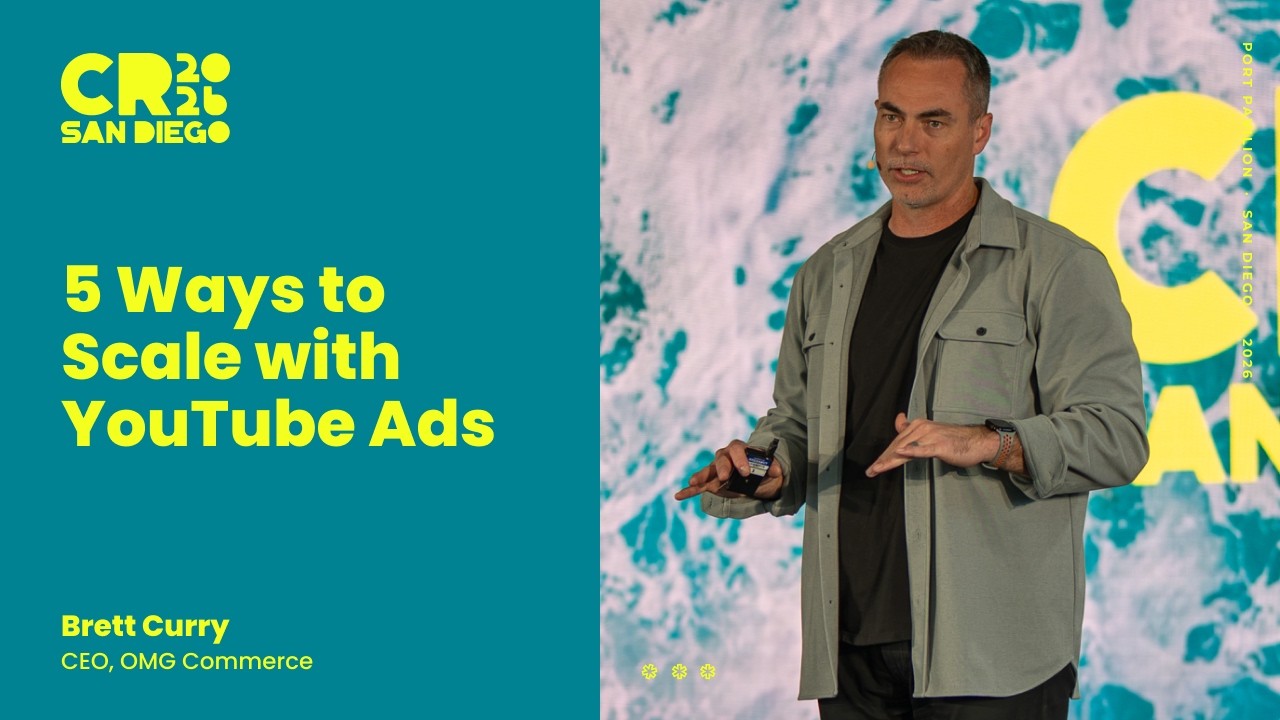
Brett Curry, CEO of OMG Commerce, shares five ways to scale YouTube ads. Learn his creative formula, targeting approach, testing process, and how to evaluate results beyond in-platform conversions.
Brett Curry, CEO of OMG Commerce, shares five ways to scale YouTube ads. Learn his creative formula, targeting approach, testing process, and how to evaluate results beyond in-platform conversions.
For DTC founders, paid media teams, and ecommerce marketers considering YouTube or trying to make an existing YouTube program work.
Recorded at Commerce Roundtable San Diego 2026, including the audience Q&A. Results and platform recommendations reflect the speaker’s experience at the time. Chapter times follow the publisher’s YouTube description.
Speaker roles and platform examples reflect the session’s original context. This is an archived conversation.
Combine a hook, product demo, social proof, objection handling, and a clear next step instead of relying on attention alone.
Read this part · 07:40 ↓Test custom segments built from useful search terms, comparison queries, competitor URLs, or complementary brands.
Read this part · 19:46 ↓A DTC purchase goal and a retail sales-lift goal call for different campaign and measurement choices.
Read this part · 23:11 ↓Review the hook, demo, offer, and placement results, then improve a specific part of the creative rather than restarting without a hypothesis.
Read this part · 25:40 ↓Compare results across repeated tests and consider search, marketplace, and retail effects alongside platform conversion reports.
Read this part · 28:17 ↓A quick editorial guide to the key ideas. Read the complete transcript below for the examples, details, and discussion in the recording.
Original recording on YouTube ↗Brett explains why importing a Meta or TikTok mindset can lead brands to abandon YouTube too early. Viewers may watch on a television, learn about a product, and search for it later without clicking the ad. Creative, campaign learning, and measurement therefore need to reflect the way people use YouTube rather than copy another platform’s playbook.
Brett’s formula combines a hook, product demonstration, social proof, objection handling, and a clear call to action. In his experience, ads with enough time to explain the product have scaled more reliably than very short spots. He recommends testing a mix of branded creative, creator content, demonstrations, and UGC mashups rather than relying on one format.
The RTIC example repurposes a longer creator review into a concise demonstration with taste, temperature, and leak tests. Other examples combine product imagery with several creators or founder footage. Brett’s point is to show the product working and help different viewers recognize themselves in the ad. In the retail-focused RTIC example, he reports lift in exposed markets, a result specific to that campaign.
Brett recommends testing custom segments informed by converting search terms, competitor URLs, comparison queries, and complementary brands. He explicitly distinguishes competitor-based audience signals from directly retargeting a competitor’s visitors. As accounts scale, his team often expands toward broader targeting.
For a DTC-only business, Brett emphasizes conversion-focused Demand Gen campaigns. When the goal includes marketplace or retail sales, he discusses adding reach and view campaigns and considering the role of television screens. He warns that strong in-platform results from lookalike audiences have not always translated into incremental growth in his team’s tests. His later campaign advice favors consolidation around a product or audience profile, with creative testing at the ad-group level.
Review ads by placement using measures such as view rate, click-through rate, and watch time. Brett uses those patterns to decide whether to test a different hook, demonstration, or offer. He also describes adapting existing paid-social or TikTok Shop content when it includes spoken audio, a product demonstration, and a clear offer or call to action. Vertical clips can become widescreen layouts or ingredients in a creator mashup.
Brett cites geo-holdout research and client examples to argue that YouTube’s effect can extend beyond directly tracked conversions. He recommends repeated tests across seasons, creative, and offers, alongside measures such as search lift and sales lift. A single test is a snapshot, not a permanent answer. Reported multipliers and client results are examples from the talk, not assumptions to apply to every brand.
Brett describes smaller daily-budget tests as possible but slower to produce useful evidence. He recommends looking for proven video angles, offers, and a landing page that converts cold traffic before adding YouTube. The Q&A also covers Shorts, branded-search measurement, repurposing creator content, and why an established organic YouTube audience is not a prerequisite in his agency’s experience.
A successful mashup may run longer than a short creator license allows. Brett recommends prioritizing footage with suitable usage rights and tracking expiration dates and renewal options. Naming conventions or a spreadsheet can help the team avoid losing track of which clips it can continue using.
From the transcript supplied by Commerce Roundtable, with filler words removed and paragraph breaks retained for readability. This source does not include paragraph timestamps. Refer to the recording for exact wording and the session guide above for chapter times.
The supplied transcript includes the replay sponsor message, example ad dialogue, and audience Q&A. Brand names, figures, and other transcription variations are preserved from the source; refer to the recording for exact wording.
Original recording on YouTube ↗So I think what I heard Nick say is that I'm the replacement speaker. Is that right? Like the real speaker couldn't make it, but we got Brett Curry. He's here. but man, I'm so excited to be here. I love San Diego. I love talking YouTube ads, and so I know you've been waiting a long time. I know there's gonna be drinks out there.
They're not ready yet, I don't think, and there's gonna be a big giveaway, so stick with me. It's gonna be time well spent. By show of hands, how many you guys are running YouTube ads right now? It's a pretty low percentage, handful. Guessing 15%. How many of you tried YouTube ads, crashed and burned? That's about the same number.
How many are like, "Nah, I don't even wanna give it. I don't even wanna try," or haven't wanted to try up to this point? Okay, great. so I ran my first YouTube ad in 2017. Now, D2C years, retail years, that's like a lifetime ago. A lot has changed. A whole lot has changed. I get to speak pretty regularly at, at Google offices and events like this, and what's interesting is I always ask that question, "How many people are u- you know, using YouTube ads?"
The percentages have not changed because it's hard, right? And one thing that has remained constant though in all those years, most brands are pretty bad at running YouTube ads. I wanna fix that today. I wanna give you a roadmap. We're gonna talk about five ways to scale with YouTube ads. I got some killer free stuff I wanna give you at the end that will kickstart that journey and make it much easier from a creative standpoint to get going, and so we're gonna rock and roll.
Now, I, I run OMG Commerce. We're a performance agency. Work with a lot of top D2C brands like Native and Arctic and Dude Wipes and Jones Road Beauty, Baseball Lifestyle. And a lot of those we either took from zero on YouTube or very little on YouTube to next level on YouTube, and I wanna show you how to do that as well.
Spent a lot of money on YouTube and spent a lot, you know, have a lot of clients spending multiple seven figures a month on YouTube, so all of this will be based on data and real world experiences. And so this is what I believe. YouTube is the most powerful channel you're missing. It might not be the next best thing to do right now, but I'm confident there will come a time when you'll wanna unlock a new growth channel as you get more distribution maybe.
At some point, you're gonna need YouTube, and most of the big brands that are multi-channel, omni-channel, YouTube is a staple of their growth. We'll talk about those here as we go. But why are we not investing more in YouTube? It's because it's misunderstood. It's kind of difficult, but I wanna demystify that a little bit.
So let's set the stage a little bit. Let's talk about what is YouTube. We'll frame it and make it much more approachable. How many of you guys watch YouTube on TV, on a TV screen? That's a lot of you, right? How many of you guys replaced your cable subscription with YouTube TV? It's a whole lot in the room as well.
So for like four years in a row, YouTube is the number one streaming platform on TV. In terms of time spent, it beats Netflix, it beats Disney Plus, it breats-- beats Amazon Prime. It beats- All of those, right? And they're getting more and more live programming like the Oscars and NFL Sunday Ticket and things like that.
So there's no sign of slowing down. YouTube is growing on TV screens. But it's not just screens, right? There's really four distinct modes or activities or behaviors that people engage in on YouTube. One of them is streaming, but also searching, right? YouTube is still the number two search engine, although this is probably changing with, with, ChatGPT and, and whatnot, but still more searches done on YouTube than on Bing or other search engines not named Google.
We're still scrolling, and we're also shopping. Anybody here use YouTube when you're making a big purchase? Mattress, vehicle, refrigerator, something like that? I bought a new truck a few years ago. I went deep on four-by-four channels. I'm not really sure why. I don't watch any of those channels now. But it did shape my buying decision when I finally bought-- I bought a Toyota Tundra, very happy with the decision, but I went deep on YouTube for that purchase decision.
But in a word, really, YouTube is about trust. So I, big fan of TikTok shops, right? Great presentation earlier. My buddy Jordan is gonna be speaking at the end of tomorrow, talking TikTok shops. TikTok can go viral quickly, from zero to viral very quickly. But we spend time with our favorite YouTube creators, right?
And actually, YouTube videos can get better over time. That's what Rich Wallets did for a number of years, placing, you know, ads inside of YouTube videos that maybe those videos will get views for five or six or eight years, right? And so we trust our favorite YouTubers, and that impacts the way we approach the platform.
But it's different, man. It's a, it is a different beast. If you come at YouTube with a TikTok mindset or the Meta mindset, you're gonna be sorely disappointed, you're gonna be frustrated. And so first of all, the creatives are different. I'm gonna break down creatives. I'll show you a bunch of examples.
That's the best way to learn. But usually longer is better. We've never seen, we have never seen a YouTube ad scale and hit any kind of CAC or ROAS target that was under 30 seconds. Generally, 45 seconds to a minute and a half, sometimes longer. But these ads, they can be like part TV, part social, part online video.
They just... They feel different. Part search in some cases. And, and actually, YouTube, sometimes like a TV ad, a direct response TV ad can smash on YouTube. So a little bit of polish can work. But also that authenticity, UGC or creator influencer content works well as also, but you got to get-- kind of get the right mix.
We'll talk about that. campaigns are different. The way you look at campaigns in-platform, very, very different than Meta. And usually campaigns take a little longer to cook on YouTube than they do other platforms, which make it-- makes it frustrating. But if you can hang on, there are rewards on the other end of patience.
I'll show you how. also measurement is different. So half of all views, half of all YouTube views now are on TV screens. And guess what we don't do with our TV? We don't click it, right? now there are a few activities like send to phone or scanning a QR code. That counts as a click. But by and large, we're not clicking on TV.
We see the TV ad, we're inspired, we're moved, we're interested. We go search for that brand later. We don't click. And so measurement looks different. YouTube has half the click-through rate on a good day of Meta, so it just looks fundamentally different. But If you can be patient with it, it can create dividends.
Dr. Squatch was an early example. Actually, the early media buyers for Dr. Squatch took my YouTube course that I did with Ezra Firestone, and that's kind of how they learned, to run paid media. But they went from three million to one point five million. Grunes is a more recent example. We partnered with Raindrop.
Raindrop did all their creatives. They just exited, you know, for a couple billion or whatever, and, and they lo- they spent money on YouTube very, very early. And then Native, we worked with them for about seven years and helped them go from a hundred million to now they're kind of in the one to two billion, dollar a year range on, on really good EBITDA margins, according to Moiz Ali and his tweets.
And, but we, we unlocked YouTube for them. They never used it prior to that. So the first thing, though, and your success will hinge on creative. You got to get this right. It is different. Let's break it down. So this is the formula. Now, there's a lot of room, a lot of room to be creative with YouTube. But YouTube ads need these five things.
We got to hook people because there's that skip button that they're looking for, and they're ready to press it, but you got to convince them not to. We do need a product demo. We need to see the product in action. This is where some of your social content can feed this aspect of YouTube. Product demo, we need some social proof.
that's just the way that we're convinced to take the next step with something. And then we got to overcome objections, and there's got to be a clear CTA. And so I wanna, I wanna break down several examples in a minute. I got five examples I'll show you. We'll break them down, and that'll help a lot. But you also need creative diversity.
Now, the good news is, unlike what Taylor talked about this morning and others talk about with Meta, where you need five hundred ads a month or a thousand ads a month or whatever, you don't need that on YouTube, right? You maybe need a handful to launch, and then you're maybe creating a handful of new ones each month from there.
Sometimes you create a banger YouTube ad, and that will run for one or two years and scale because the audience is refreshed. It's just the way the platform works. But ideally, you've got these types of ads. So brand formats, that's kind of like what you saw do- with Dr. Squatch or some Grunes ads, Manscaped, things like that, Native.
got some polish to it. Maybe they're funny, but still direct response in nature. UGC and influencer mashups, I'm gonna show you some of those. We work with brands that are spending, you know, between one and five million a month, on YouTube. We work with a lot of smaller brands as well. But, across almost all brands, in their top five spending ads- One of them is going to be a UGC mashup almost, almost without fail.
And so I'll show you a couple examples there. You can actually... I used to, I used to tell audiences, "Don't take your top paid social ad. Don't even try it on YouTube, you'll be disappointed." Actually, we're seeing some of those work really well on shorts and mobile non-shorts, but I'll show you which ones because don't test all of them.
A lot of them will be a waste of money. And then, we like, you know, explainers and, and, and demos and things like that. But let's, let's look at a few, let's look at a few examples. So this is Arctic. Do I have any Arctic fans in the house? Arctic coolers, Arctic cups? Not very many of you. Maybe you'll be a fan after you see this ad.
So this is an influencer, a guy named Chase Fly, creates content on YouTube. This was like a twenty-minute demo, where he's like reviewing Arctic products. We took this, cut it down, sped it up a little bit, ad- added some music, changed the pace, turned it into about a ninety-second ad that's just smashing on YouTube.
And we'll play all of it. We'll play the first part of it so you kind of get a, get a feel for it
All right, I hope you're enjoying the replay from Commerce Roundtable. I wanted to stop you for just 30 seconds and tell you all about the sponsor that made this happen. I see too many Shopify brands overpaying for big email tools and using only a fraction of their features. They're tired of complexity and never-ending price hikes too.
That's why Seguno Email is different. Lives inside of Shopify and uses your shop live data, not a sync copy of that. Plus, integrations with Sidekick, ChatGPT, Claude, and Canva saves you time. And get this, Seguno is the only email app to win a Shopify Build Award. Sounds interesting, right? Switching is easy, and you get twenty percent off for being a part of the Commerce Roundtable community.
Link in the show description. Now back to your replay. This is a ceramic mug. This is a ceramic-lined stainless steel mug from RTIC. One breaks, one doesn't. RTIC now uses ceramic coating in all their drinkware. The idea is to keep your drink tasting pure without that metallic tang some cups have. We're gonna test these for heat retention, ice retention, taste, and leaks, and find out if this ceramic coating is the real deal or just marketing fluff.
I filled each RTIC with the hot water and recorded the starting temp. Then I set them all in a cooler chilled with ice. Taste is where ceramic makes its case. So I did a blind taste test with the team. One old stainless RTIC and one new ceramic-lined RTIC. Now for cold. I filled each drink receptacle to the brim with ice, then I added tap water.
With lid screwed on and shut tight, I tipped each cup over on the table. Sure enough, none of them leaked. The mug didn't leak at all, neither did the twenty-ounce tumbler. After- I'm gonna pause there for sake of time. Is it a little echoey? Could you still hear that okay? A little echoey? Thumbs up. Okay, great.
So, yeah, has anybody ever drank out of a tumbler and you're like, "Man, that tastes kinda like a penny," right? You get like that coppery taste. Yeah, I just-- I don't like it. Ceramic lining, huge, huge difference. I'll cut to the, the chase. I'll, I'll, I'll tell you what happens at the end. Everybody chose the ceramic line in the taste test, right?
But you see the product in action. He does the heat check, he does the cold check. He's chucking these things across the yard. He is doing blind taste tests, things like that. And at the end, you're like, "You know what? That looks like pretty good stuff. May-maybe I am interested. Maybe I do wanna check that out a little bit more."
And so that ad is a smash. That's one influencer. You can see how it kinda... it fills the screen well. That did very well on TV, but it also did well on mobile. you could also reframe it. It could do well on kind of vertical m- mobile as well. This is another ad that's more of a-- more of just a branding play.
But this type of ad might not work. This, this ad I think would probably suck on Meta, but it works really well on YouTube. I'm gonna play this one. It's only thirty seconds
What do you love about being outdoors? Lighting the barbecue? Hitting the trail with a few friends? Cheering your team on at the tailgate? However you spend your time outside, Arctic is made for it. Made for real life adventures. Made for real life budgets. Made with quality materials and innovative designs that lock in the cold.
Engineered the right way. Built to last. Never, ever overpriced Now, generally speaking, if you're launching on YouTube, I'm gonna tell you to launch an ad about one product, right? One hero product. Go deep on th- that product. Hook, demo, overcome objections, social proof, all about that one product. This was a little bit different.
The objective of this ad was to try to get buyers to go to Walmart. They'd just gone kind of coast to coast in Walmart and they said, "Hey, can we use YouTube to drive a lift in retail stores?" We said yes. This was one of the ads we used. We actually drove a twenty-five percent lift in stores and in markets where we ran this ad versus where we did not.
And you kind of saw, like, there was a Walmart bag in there at the end. It, you know, shows the family coming out of Walmart. That was the whole objective there, and that ad really worked. Again, that would-- ad would not work on other platforms, I don't believe. Now, this is one for Native. This is not Native's top category.
Deodorant is number one, haircare number two, but this is for lotion. But this style, we have used this style so many times across so many brands. I'll play the first part of it
Native's moisturizing lotion helps my skin to feel so hydrated and smooth. I just love the fact that it keeps your skin moisturized all day With a new and improved formula And I just love how rich and creamy the formula is They provide a deep hydration with a lightweight feel Like, just super hydrating, but also lightweight and sinks into your skin super fast You're going to love it.
The formula absorbs in the skin so easily without leaving a residue. And don't even get me started on how good they smell. Just smells so yummy. And not to mention, it comes in seven of their best scents. You smell good. It's quite literally the best compliment Okay. Have you ever watched an ad and thought to yourself, "That person really isn't like me, so I don't know if this product will work"?
I don't know if any of you have ever done focus groups. Like, way back in the day, we did focus groups, right? I remember working on this product, it was a haircare product, and one of the ladies who was in the focus group said, "I don't know. Like, her hair's not as thick as mine. I don't, I don't think... I don't know.
I just... I, I, I wouldn't buy it, 'cause her hair is different than mine." And, and so what that really taught me then was we need to see ourselves in the ad, right? Our hair color, our body type, our personality even. Like, we need to see ourselves in the ad. We need to see ourselves using the product. And so that type of ad, and that was like a, a, a three-column ad, right?
Three different, frames there. One of those frames was always branding. One of those always had the product, the logo. You could... You knew it was Native. The other two were different creators kind of moving around. And so there was a lot of action, hopefully not an overwhelming amount, but a lot of action.
That ad was a smash, and again, we've created so many of those for other brands, and usually that style is, like, a top five spender in almost all ad accounts. Now, this is Jones Road Beauty. This is a mixture of part of a TV ad. So you'll see Bobbi, the founder, part of a TV ad, and then it's kind of some photo shoots that they did, mixed with some creator content.
So I'll play the first part of this as well Is traditional foundation making you look worse? Traditional foundations are not great for lines in the face. It's sticky and gooey, and it really emphasizes my wrinkles and dark spots. We need something different. We need something moisturizing that gives a bit of color to counteract dullness and gives our skin life.
What The Foundation, for me, is the magic formula that does it for my skin. It's like facelift in a jar. It just makes my skin look good, gives me a lift, and I look like I'm not wearing anything. It i- So you get the idea. So Bobbi carries some authority. We see some kind of high-end photo shoots. There's some kind of authentic-looking photo shoots in there as well.
Pretty fast cuts. We don't stay on any one section for more than four or five seconds, and then we're moving to the next piece. We see the product, we see the product close-ups. We see the products being applied. We see before and after. We get to hear from different people. That type of ad is great. Now, this is for Simple Modern.
This is their back-to-school product. I'm gonna play just a little bit of this again for time, but I love this because this is a way you can take your top social content and make it apply in a 16-by-9 format because this was shot, like, for 9 by 16 or 1 by 1, 4 by 5 even, but then we put it next to some product shots to make it a 16 by 9.
This is another style that works really well on YouTube. Then you can run the vertical on shorts and mobile. You can run this on TV or mobile non-shorts, things like that. So I'll play the first part of this
My kids want cute. I want school gear that doesn't leak, stain, and fall apart by October. That's why I love Simple Modern. The designs are so cute, and they're fun enough that the kids actually get excited to use them. They even have patterns with the kinds of characters that kids already love. But the real win is that it actually works.
The backpack has room without feeling huge. The lunch bag fits the bento and wipes clean after school, and it keeps the food separate So you kind of get the idea there, right? You're like, she's talking, but we're seeing the product moving. It's a great product demo. We see different colors, different styles.
We see what it's going to be like to shop. That type of approach works very, very well on YouTube. Now, YouTube is also a platform where media buying still matters, right? Creative is where the game is won or lost, but we have seen scenarios where we work with Raindrop a lot that creates stuff for Grunes and other brands where they try- they think they tried on YouTube, it doesn't work.
Then we come in and kind of reset the campaigns, reset the approach, and we can find success. And so media buying still matters. We'll talk about a couple of innovations that I think you should consider. One, there's a few things different about YouTube and its targeting that you really can't find anywhere else.
A lot of times as we're scaling on YouTube, we go broad. So those that are spending a million, two million a month more, usually it's broad campaigns. But when you're first getting started, I love custom segments. So what you can do is you can build audiences based on people's search behavior, based on their browsing behavior, based on what they're into.
And so these are some of our favorite audiences. Top converting keywords, keywords that work well on search, bundle those up into an audience. Google creates people that you can target on YouTube that have recently searched for those keywords. Competitor URLs. I love this one. Take your top five competitors, put them in a custom segment.
Google's going to say, "Aha, I know what that audience looks like. I'm going to package that up for you. You can run your YouTube ads to them." It's not the same as like retargeting your customer or your competitor's visitors, but Google's looking for signals. It's like a lookalike audience based on your competitors.
I like taking keywords that are competitor X versus competitor Y, because this also shows me that someone has not made a buying decision, right? They're looking at this competitor and that competitor. And so especially if you're a high consideration product, mattresses, automotive, expensive supplements, whatever, competitor X versus competitor Y, awesome custom segment.
And then sometimes it's just complementary brands, right? Like, hey, we're an apparel brand. People that buy normal brand also buy Built or maybe they buy True Classic or whatever. So you can, you can add in some complementary brands. It just informs Google like this is what my buyer looks like to, to kind of help the algorithm along the way.
Let's talk strategy. Let's back up and talk strategy, real quick. Now I want to do something that's audience participation. I know it's the end of the day. I know you're ready to get a cold one and kind of talk to your friends and stuff like that. but are you guys cool with a little bit of interaction?
I got like a couple of... Yes. Okay. This part of the crowd is excited. Okay. So I'm gonna name a strategy, and you're gonna tell me what game we're playing. Okay? Got it? So name a s- I'm gonna describe a strategy. You're gonna say, "Oh, that's this game." Okay? So first, first strategy, fail 70% of the time to win.
What, what is a game where some of the top in the world, the... Yes, baseball. Best in the world strikeout, not strikeout, but they get out seven out of 10 times. A 300 batting average is killer in the major leagues. You're failing 70% of the time, right? What about this game? Nine out of 10 of our bets go to zero.
But, but... Yeah. You guys are good. Or I should have made the... I don't know. Maybe I should have made these harder. One out of 10 goes 100X. Yes, it's venture capital, right? So if I'm playing a venture capital game, if I try to take that mindset to a private equity play, I'm gonna get smoked, right? If I take a private equity mindset to venture capital, I'm gonna be a very unhappy person, right?
The game I'm playing dictates my strategy. Last one, I'm gonna quit eight times out of 10, and I'll probably find success You got to know when to hold them Know when to fold them. Whatever. poker, right? So, so it's poker, right? So, eight times out of 10, this is what the pros say, you're probably gonna fold, right?
May- maybe 70% of the time you're gonna fold, right? But understanding what game am I playing? What am I trying to accomplish with YouTube? I think that's the key, because sometimes we're just like, "Well, I'll just do this ad, and I'll just like throw this tactic at it. I'll do this little thing, and I heard this on a podcast, I'll throw that out there."
That's not the way you win on YouTube, right? What game are you trying to play that's gonna dictate your approach? And so, how many of you guys are exclusively DTC? No marketplace, no retail, all DTC. How many of you are multi-channel, so like DTC plus, marketplace? Great. Any omni-channel? Throw in retail there as well.
Great. Great. Okay. If you're only DTC, this is where you're gonna live. 100% demand gen. Those are like conversion-focused campaigns. So you're just gonna run conversion-focused campaigns. That's all you're gonna worry about until you start to scale. So you're tracking conversions, you're looking at conversions.
That's where you wanna live. Custom segments, that's also your jam. That's where you're gonna start. this is something that I've noticed. Lookalike audiences, I know like Meta, nobody does it anymore. It's all broad or whatever. We got excited because YouTube is sometimes behind, and like lookalike audiences became a thing a year ago or whatever.
We've now done a lot of incrementality tests. We have some big brands. We have found a lot recently that lookalike audiences kind of suck. So they may look good in platform. They generally don't translate to incremental growth. I would say avoid it, but at least beware, and then you're gonna go broad at scale.
if you wanna kind of lift, you know, all, ... So, so d- still DTC, you're probably gonna be a little more mobile and desktop, but I'm seeing TV kind of sneak in and play an important game in DTC. but then if you're looking at overall sales lift, so I'm multi-channel here, more demand gen campaigns. We're actually seeing a lot of success with reach and view campaigns, where the objective is low cost reach, low cost views, still targeted at our audiences.
We've seen a number of clients now where their best incrementality tests included demand gen and YouTube. So consider that. Then if you're going retail, I would go heavier. Like with Arctic, go heavier reach or view campaigns, and often TV's gonna be about half of your budget. there used to be like this game where you do extreme segmentation, one audience per campaign, one video per campaign.
None of that I would advise anymore. Now you wanna kind of consolidate. Your campaigns can be around one single product or one single avatar, but you usually wanna kind of load up on audiences. Give the algorithm room to play and room to find success, and then you wanna do kind of creative testing at the ad group level, I believe, rather than like a creative testing campaign.
I prefer testing at the ad group level. I think that's better. All right. These last three are really quick, and then we'll get into Q&A. So create a feedback loop. It's not enough just to start with a good YouTube ad, right? So you follow kind of those examples, you follow the formula. I got a pretty good ad that I'm launching with.
It's still gonna take iteration. It's still gonna take a little bit of time, right? You're not gonna hit it out of the park month one almost certainly. So we need to create a creative feedback loop. And so what are we looking at? Well, sometimes we find an ad that's pretty good. It's almost there. We think we can find success with it, but we need a new hook possibly.
Or maybe the hook rate is good, but we're not getting people to click, and so we need a new demo. Or maybe those are okay, but we're not getting conversions, so we need a new offer. This is the type of sheet we create for our clients. We're looking at every ad across every placement. What's my in-stream view rate?
My shorts view rate? What's my click-through rate? Average watch time per impression. This is another thing that really separates YouTube from others. Check out some of these videos, like twenty, thirty, thirty-two seconds average watch time per impression. So every time we serve this ad, on average, it gets watched thirty seconds.
Only Apple 11 probably compares to that or TV. but so you've got to look at that, and then you can turn an okay ad into an absolute winner. And then this is actually probably the best place for you guys to start. Taking your social pipeline, or if you've got some great TikTok creators, and you got like this pipeline of good ads, start here and now you can move some of your winners to YouTube, but not just any of them.
They really need to, to fit this, this formula, right? And, and I'll, show you how to get these slides plus some other tips as well. But like I mentioned before, thirty seconds or longer. Fifteen second ads on YouTube, they don't do much. They fizzle. They're okay for views, not much good for anything else. I want a voiceover, so not just like sound and text.
We want a voiceover, someone talking on screen or an actual voiceover. there needs to be-- We need to see the product in action. That's usually pretty easy. Usually, that's there. A CTA or an offer and not thumb stop only. That does not work. And then finally, five Because you're not gonna be successful the first time around, you need to operationalize testing.
You need to make this an iterative process where I'm just committing to get better, right? I heard, I heard a guy joke one time that if we quit everything that we were really, really good at the first time, we would have fewer and fewer babies with each generation, right? And so, like, think about, maybe don't think about it, I don't know.
But like take that approach, like YouTube, it's worth it, right? You, you'll get, you'll get better. It's gonna be awesome, I promise, right? So you got to keep testing and operationalize that. And so anybody here using House Analytics incrementality tool? Okay. they did a hundred and ninety geo holdouts.
Some geos got YouTube ads, other geos did not get YouTube ads. What was the difference? How incremental was YouTube? Here's what they found. On average, on a hundred and ninety tests, the actual incremental results were three and a half times better than what was presented in platform. So if you saw one ROAS in platform, the incremental results were three point four X that.
If you were selling in retail stores, it even got a little bit better. And, and so, and also a high percentage of new customers, seventy-six percent net new customers. So that begs the question why? Like, why is YouTube so bad at tracking performance? I really think it's based on the way people use YouTube, right?
We're not likely to click and buy directly from a YouTube ad. We're much more likely to see that thing and go search later and go buy the product afterwards. And so it's harder to measure because of that. so here's what we recommend. Test YouTube, retest, get kind of a seasonal baseline. Here's how YouTube works in this season with this creati- with these creatives, with this offer, and then keep retesting Understand that like a single read, a single test is not the final answer.
I heard this analogy one time that, every test you do on YouTube is like a snapshot in time, right? It was true then, but you got to kind of fill the album with more tests and find out how is this working in different situations and different circumstances. One other way to look at it is like GPA. One test is not your GPA.
It influences your GPA, but it's not it in its entirety. And so this is the way we look at it. If you are doing any kind of incrementality tests with any kind of tool, we do these kind of side-by-side comparisons. Here's our first test. All the data points that are relevant. Our next test, then how are we improving?
And actually, this is a real client. By the fourth test, it was an absolute smash. Went from, 193 to 336 to $88 CPIA. Real client, real data. And so that, that's the type of thing you need to, to work on. This is the type of things we're, we're also looking at. It's not just in-platform stuff. It's brand lift, search lift, sales lift.
And last two things, then I'll give you a couple freebies, and then I think Nick's coming up. We're gonna do some, some Q&A. Had a client that was selling popcorn, and they had to pause YouTube for a little bit of time. They were retooling a few things like, "Hey, just pause YouTube for a bit. We'll turn it back on later."
It was a, a few days into this pause, maybe a week. The owner got in touch with us and said, "Hey, our Amazon sales are down, like down, down. search is down. Sales are down on Amazon. And the only thing we changed was YouTube. So let's turn it back on." And so we did, and they, they remained consistent and had a great holiday.
And so the impact of YouTube, you're gonna see in other places, not just in platform. And so with that, couple of quick offers, totally free. I would be happy to review your top paid social ads, review them, score them, tell you what needs to change on them to show you, hey, this is what you need to fix before you run this on YouTube.
And then, and this is my favorite, we'll build kind of a, a mashup for you, not the like end product. But if we can review your top paid social ads, we'll show you which ones are good for hooks, demos, closes. We'll give you like a beat-by-beat edit instruction sheet that you can take and deliver to your editor to get that first YouTube ad going.
And then I've also got two other tips, so like seven ways to scale with YouTube ads. So if you scan that, the presentation's got all of those videos we just watched. It's got all of these tips, and then you can also request, "Hey, I want that mashup builder," or, "I want to, to get that, that ad analysis on my top social ads."
So with that, thank you. Ready for Q&A. Thank you, Brett.
Why, why don't more people talk about YouTube? Man, that's a, I, I think it's just there's always like something else that's a little easier to attain. Somebody else that's a little shinier, right? That you can just... Like TikTok shops blowing up, so I'm gonna, I'm gonna do that. And oddly enough, TikTok does have some similarities in that often the biggest benefit of TikTok you don't just see in your TikTok account, but you see it, in Amazon and other things like that.
But it's just YouTube is harder to approach. It feels like TV. It feels like work. Feels like I'm gonna have to spend a ton of money to actually find, results, which you do have to invest, but it doesn't have to be a ton of money. Well, this is, this is what I ask is, is like I feel like, you know, so it's, it's always like brand, vendor, and then opportunity, and you sit and you go like, usually internal teams know meta, creative- Yeah
Google. Yeah, yeah, yeah. There's never someone that I go like, "Oh, I'm mer- I'm a- Yeah ... seven, eight, nine-figure brand." Right, right. They're like, "You know what? I have an internal YouTube buyer." Yeah. No, no one, no one's talking. Like, why is that the case? That, that is, that is absolutely true. So that's the other thing is if, you know, you're working with an agency, and their job is to grow your sales, they often take the pass- path of least resistance.
And meta, I know that I can crush. I know that I can do good there. It's consistent. I know what I'm doing. It's very easy as a media buyer to look at YouTube and say, "It's not working. It's not working like meta, so it's not working." And so I think, I think that's it. I think maybe either people didn't see it, or they're just like, they don't want to get bloodied and beat up trying to figure out how to make YouTube work.
but also I have seen like people that had TV background and, and I did. I like, I liked TV way back in the day. YouTube feels a little more like TV, so maybe I was drawn to it, for that reason. But I think it's harder for brands, and then, and then I think most agencies just take like path of least resistance.
Yeah. What about the type of brands that do this? 'Cause I know, I know-- First off, I'm gonna ask, what spy tool do you use for YouTube ads? Yeah, that's a great question. So I, I most, most often use, was it VidT- what is it? VidTao? There, there's, there... I don't use a ton of spying tools, honestly, on, on YouTube, but VidTao is good, and there's another one that I- I feel like it's like TV-
can't remember ... where there's not a lot. There's not a lot. Like maybe it's really difficult to find, so that's why I'm- It is hard to find ... this is when I see needing to have access to an agency for just volume of, of- Right, right ... reps, and this is why, why, why I love having friends at an agency, to be honest with you.
And there was another, there was another tool that we used to use, but I don't even think it's available anymore, so it is much harder. Yeah, much, much harder. Yeah. Okay. You, you're getting flooded. I was act- This-- Dude, I will say, first off, Mary, thank you for spitting some game. Mary goes, M-Mary says, "Congrat- thank you so much for the incredible presentation," way to match it up.
Thank you for coming through. But here's some questions already. Can we limit, can you limit ads to just YouTube Short format? Do these ads perform well? So you can, but generally you don't wanna do that. Now, YouTube Shorts can work very well, depends on the brand. But what I would do is if you go back to that formula, you know, 30 seconds, product demo, somebody speaking on camera or a voiceover, like run that ad vertical only.
Run that on YouTube. The pr- probably the, the only thing-- Actually, I would just, I would run it. and then YouTube is gonna find, hey, it'll, it'll work well in Shorts, it'll work well in mobile non-Shorts. And then kind of a crazy thing, anybody here watch YouTube Shorts on TV? Yeah, coup- couple of you weirdos out there, right?
But actually, the fastest-growing platform for YouTube Shorts is TV. I, I caught my 15-year-old daughter watching Shorts. Yeah, it's kids. My daughter was watching YouTube Shorts on the TV. I'm like, "What are you doing?" And she's like, "I don't know. I like it." I'm like, "Okay." so it's, it's a thing. So, I would take that vertical content, run it all across YouTube, and just see what works.
You can start pausing things out if they're not working. Hell yeah. Can you test on a low budget? What's like a minimum that you would probably recommend for most people? Yeah. So that's great. So, used to, there was like this bid-to-budget ratio where Google would say like, "Hey, what is your bid for a CPA?"
And you need to like, you need to like 5 or 10X that for a daily budget. So like used to, you had to spend 1,000 a day or else you're probably like, you're never gonna get there. but now we've, we've launched tests for $150 a day, $200 a day, right? That's more of a slow burn. You're gonna need to like kind of wait for data to come in, but you can start much, much lower and, and, and then start to see those results.
In that case, I'd want to measure direct conversions. I'd also want to have like some post-purchase survey tool or something like that because you're gonna s- YouTube will pop up there and pop up there pretty quickly Brad, you're getting flooded, dude. I'm gonna keep it going. You're, you're- So- I'll be around too.
We'll be- we can go, grab a, a drink too. Yeah. Mary, shout out. Appreciate you on that branding question. next q- next one on me is how big revenue should a brand be to actually engage with an overall agency? What about m- monthly revenue before you even recommend testing YouTube? That's a great question.
So most of the time it is not the first channel to lean into, right? Meta is just easier for a lot of reasons, right? And so usually I say not so much revenue, although I'll speak to that. It's more about do you know what video ads and angles and offers really smash? And do you have a good landing page that's converting cold traffic?
And are you confident that that's gonna be duplicatable? Like, once you have that, it's probably okay to start YouTube. but it's al- it's also one of those things where like, where is my next best dollar spent? If you know Meta and your team knows Meta, it's probably Meta, right? but once you start to hit a bit of a ceiling on Meta, then maybe it's time to look at YouTube.
Now, someone like Gruns, someone like Dr. Squatch, they leaned in early. But Gruns was like a lot of distribution. They had the ads, they had the assets from Raindrops, like they were ready to cook. So generally, most of our clients that are leaning into YouTube, they're mid seven figures to eight figures.
It's not usually like when you're first starting out. Yeah. You did go through a couple of pieces of content here. It doesn't have to be full production. It does not. It could still be, it could be a little bit raw. Yes. Okay, cool. Yeah. 'Cause the other thing you could do, so I showed you that Simple Modern ad where it was like the creator that we sourced on the side, and you had like backpacks that were moving and stuff.
That was a, that was a full video shoot with the backpacks. You could just have a still of a backpack and have that move a little bit, and have the URL show up and an offer show up. Like, that can be pretty simple and still look great and, and they're not expensive. Appreciate that. Yeah. Is a brand search lift a good way to measure if you aren't gonna use house?
Yes. So we see a direct cor- correlation with branded search and an increase in sales, right? the guy from P&G, Mark something or another, he's like, "The number one metric we look at for growing brands is, are more people searching for them?" there's now... So you can do a, a search lift study in Google.
Those are okay, but they're gonna come back and say, "You had like 1000% lift or 100% lift" or whatever. Kinda hard to know what to do with that. Now, Google has a, a metric called attributed brand search, and they're gonna tell you, for this campaign, it drove 100 brand searches in this time period. And then you kind of run calculations on like what my- what's my cost per branded search and stuff like that.
That's an awesome metric. So that's one where we're always trying to optimize, like, hey, okay, we... brand search, cost per brand search is $90 now. Can I get that down to 40 or 50 or 10? If I can do that, then the whole, the math is gonna work. So, yeah, you do not need to start with Haus until you're much, much bigger.
Yeah. Shout out to Haus. Good, good partners and good people though. Love them. Love them. Yeah. Is it a successful play to move winning TikTok content onto YouTube Shorts? Yes. So most of our brands, the number one source of new content is from TikTok Shop. So here's what we do. We get a steady stream, like our bigger clients spending a lot of money on YouTube.
We'll get a steady stream of TikTok Shop content. We'll kind of use that, that, those me- that formula and say, "Okay, these five, we're gonna test them just like they are. No edits, no changes, nothing. Test them like they are." then we're also gonna take these 10 and we're going to do that split screen edit where content just like it is, but with I- iconography to the right, right?
Like photo shoots, URL, things like that. And then we're gonna maybe take these 20 and we're gonna start creating mashups from those. So we're gonna take the, the best clip from this ad, best clip from these ad, pull it together to mashup, and now we got endless amounts of content to test from, from TikTok or Meta.
You talked a little bit about YouTube ad- you talked a lot about YouTube ads. How important is the organic side of YouTube to make the paid side work? It's a great question. It actually does not matter. So almost all of our clients have no organic presence or limited on YouTube. However, we have had a few clients that do have an organic presence, and it is nice.
Like, it-- you can l- you can leverage that. It's not required though. mo- you know, building an organic presence on YouTube is hard, and so ninety-eight out of a hundred that we work with don't have it. So- Okay. Yeah. I got two more for you. It's nice to have. I got two more. For UGC mashups, how do you track expiration dates on the videos?
Or best advice to get brands on board with having the correct source of creators? Yeah. So I think what they're probably talking about is... And, and this is what's always so frustrating too, is like, "Hey, this creator, we've got rights for like a month, and this one we got rights for like two months." And they're like, "Oh my gosh."
So generally, we try to lean into more evergreen stuff that does not expire, because sometimes you'll find a mashup that you can ride for a year if you have the rights to it. We, we prefer that. But I did like one of the earlier talk, speakers who was talking about, like, the way you name your ads. You can totally put that in there.
Track stuff with Claude in a spreadsheet. That's a way to do it. But, but really lean into, "These are creators that I've got access to for a couple of months, and then I maybe got a right to renew, or maybe they're evergreen." Like, lean into that first for sure. Yeah. Brett Curry, thank you very much, brother.
Thanks, dude. Appreciate you.
Join Commerce Roundtable in 2027 for focused learning and conversations with people working through the same challenges.