 38:20
38:20San Diego · 2026

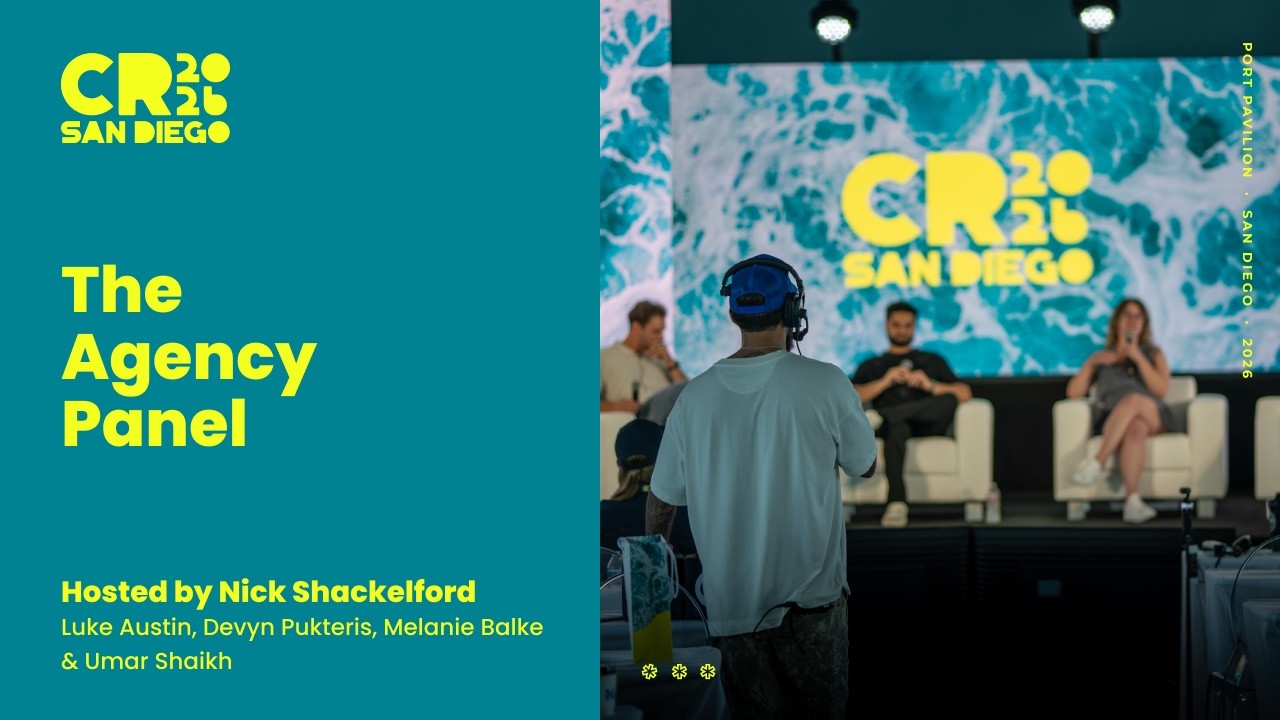
Luke Austin, Devyn Pukteris, Melanie Balke, and Umar Shaikh join moderator Nick Shackelford to debate agency hiring, brand onboarding, pricing models, and what clients should expect when AI changes the work.
Luke Austin, Devyn Pukteris, Melanie Balke, and Umar Shaikh join moderator Nick Shackelford to debate agency hiring, brand onboarding, pricing models, and what clients should expect when AI changes the work.
For ecommerce founders choosing an agency, marketing leaders managing partners, and agency owners rethinking how they hire, price, and deliver value.
Recorded at Commerce Roundtable San Diego 2026. Moderated by Nick Shackelford. The panel includes differing views on pricing and AI; predictions reflect the speakers’ views at the time. Chapter times follow the publisher’s YouTube description.
Speaker roles and platform examples reflect the session’s original context. This is an archived conversation.
Shared methods, processes, and client context help teammates contribute without relying entirely on years of prior experience.
Read this part · 03:18 ↓Bring account access and business context, then define what success means so the agency can prioritize around the same goal.
Read this part · 08:10 ↓Choose one available point of contact with the power to decide. The panel disagrees on whether that person should be the founder.
Read this part · 10:28 ↓Compare retainers and performance components against the service being delivered and the business result you actually want.
Read this part · 13:58 ↓Request concrete examples of faster delivery, deeper strategy, or additional output instead of accepting a vague promise of more value.
Read this part · 22:26 ↓A quick editorial guide to the key ideas. Read the complete transcript below for the examples, details, and discussion in the recording.
Original recording on YouTube ↗The panel describes different hiring approaches, from extensive screening to faster decisions followed by close senior supervision. Melanie calls recruiting one of the hardest parts of agency life. Devyn emphasizes that a new hire should not be left alone on an account, even when their experience looks strong on paper.
Luke describes the CTC Canon, a shared methodology for work such as media buying and forecasting. Umar adds that documented processes, client communication, and operating context can support AI-assisted onboarding. The common thread is making knowledge accessible so new teammates can become effective without having to rediscover every decision.
The panel asks brands to provide account access, reports, customer feedback, offer details, and a view of where the business is going. Luke emphasizes choosing a specific desired business outcome, such as contribution margin or cash flow, so the agency and internal team know what they are optimizing for.
Melanie argues for a single point of contact who is not the founder, citing the friction created by constant founder opinions. Devyn disagrees that founders must be excluded, and emphasizes availability, flexibility, and authority. The discussion also considers the agency’s responsibility to vet fit and set clear expectations before accepting the work.
The panel resists a universal revenue threshold for hiring an agency. Time, budget, internal capabilities, and available people matter. A staffed team may need consulting and direction, while a lean business may need an agency that can take ownership of execution.
Luke favors a fixed fee plus a variable incentive tied to an agreed business result, rather than spend alone. Umar discusses revisiting scope and compensation when the work expands beyond email. Other panelists describe using retainers for email services. The panel presents different approaches rather than one pricing formula that fits every engagement.
Nick asks what happens when AI reduces 100 hours of work to 40. The responses differ: deliver more at the same price, lower the cost, or price around the result and speed rather than hours alone. Luke describes aiming for lower customer costs alongside better employee pay and a stronger agency business. This is a debate about value, not a unanimous recommendation.
The conversation moves from broad promises of more to examples: faster delivery, deeper strategy, and additional services. Luke describes CTC combining core services into its Profit Engineer offering and adding creative and email output. The panel’s examples illustrate how a service can evolve; they are not a current price list or a guarantee of results.
In their closing predictions, the panelists expect AI to change onboarding, make distributed talent more capable, and pressure agencies to deliver more value. Melanie anticipates a divide between agencies that evolve and those focused only on execution. Luke highlights opportunity among growing brands. These are the panel’s forecasts from the recording, not established outcomes.
From the transcript supplied by Commerce Roundtable, with filler words removed and paragraph breaks retained for readability. This source does not include paragraph timestamps. Refer to the recording for exact wording and the session guide above for chapter times.
The supplied transcript includes the replay sponsor message and audience contributions. Brand names, figures, and other transcription variations are preserved from the source; refer to the recording for exact wording.
Original recording on YouTube ↗situation to be in. End of the day, all brands are staring at us, and it's a beautiful time outside and people just wanna get drunk and fucked up. Everyone's looking forward to happy hour, right? And they're about to after this. So- We'll get there ... we're gonna go, we're gonna go this way. And actually, we're gonna go women first.
We're gonna go this way to this way. Who are we speaking to? What are you up to? What do you guys got going on? my name is Melanie Balke. I don't normally sound like this, but the good news is I'm not contagious, apparently. I run The Email Marketers. We're a retention marketing agency for e-commerce. Hey, everyone.
My name is Devon Poukhtares. I'm the head of lifecycle marketing at Sweatpants Agency. So we work in paid media and lifecycle marketing across, mostly e-commerce brands, but we do B2B, as well, and services. My name's Umar Shaikh. I run a retention and email marketing agency. we've done amazing things in the space for telehealth supplement companies.
based out of Toronto and, happy to be in sunny San Diego 'cause Toronto is not too bright today. but yeah. And I'm Luke Austin, the president of Comthread Collective. We're a commerce acceleration platform that combines proprietary tech, AI, and expert operators to help brands grow predictably and profitably.
So I'm gonna ask these questions and I'm gonna kind of popcorn where it goes to. I'll kind of just look at you and start pointing the phone at you all across the way, but I do want this to be a little bit of a debate. You guys-- I've chosen you guys by design. I know all of you pretty well. I know your agencies pretty well.
I've stolen brands from you guys, and you've stolen brands from me, so it's fucking awesome. It's all, all here. The biggest thing I want to ask is, like, why? Why would you stay on the agency side and not go brand side? How have you guys found talent coming into the agency side? Because look, when people jump on stage, and usually you don't have a ton of brand folks speaking.
We do our best to get Evan, we do our best to get Kyle, we do our best to get a couple agency or, non-agency strategist folks talking. How have you guys been finding your talent? Is it US-based? Is it English-based? Is it abroad? Melanie, where are we finding talent and how do you, like, bring these people along?
Finding talent's the hardest thing. So, we find talent anywhere in the world and they go through like an insane hiring process and we still find that, you know... Someone once said to me, "Just expect fifty percent of your hires are gonna suck." And I find that, you know, fifty percent of people don't make it in agency world.
Like you have to be a really special flavor of insane to like working for an agency. So I mean, we post on LinkedIn, we have a recruiter, we work with agencies, we like are firing on all cylinders when it comes to hiring and it still remains to be one of the hardest things in the business. Do you guys believe in the like bring them up or use an ecosystem?
I know Luke at, at Common, we have like an operating system that kind of dictates how things should be done. You don't really necessarily need a super highly skilled person to do this or do you guide a highly skilled person into a system? Yeah. So I think we're trying to become less and less contingent i-in terms of our growth around firing-- hi-hiring really talented people and having a, having a pool of those folks.
It's really-- 'cause it's really challenging to do at, at a greater scale, right? Like even to the point that, Mel, you, you just mentioned in terms of the pipeline. Now we hire, we hire folks, from, from everywhere. Our fast- our fastest-growing service offering is for seven-figure brands, and it's, it's a global workforce primarily.
But the thing that we're really focused on is, Taylor talked about this yesterday briefly. We call it the CTC Canon, and it's a, it's a methodology, document, that we keep at the agency level that's, a documentation of how we do everything across each of our services. How we buy meta ads, what is the account structure we use, how do we execute on that?
How we do forecasting, what are the models you need? And what that allows us to do is, one, fulfill the core promise of an agency, which is that we take learnings from our data set of billions in GMV, and we help that inform the best strategy. So it helps to inform that. But then two, what it allows someone to do, Jacob, I, I feel like did a g-good job of this earlier, sort of highlighting how important it is that you can have someone come in to the agency, to the brand, and if you have a very desi-defined methodology for how you do things, can plug in and be effective really quickly without needing to have seven years of experience running supplement brands and growing them on an e-commerce, you know, store.
And then it's a really, it's a really challenging sort of, hiring pipeline to be able to find those people. Umar, do you, do you think it's-- We talk about AI and how, how you think it can bring people along a little bit quicker. Is it like hire first or AI first and then let the people leverage with the AI?
Where's your thoughts on this? 'Cause it's still in the hiring question. No, one-one hundred percent. And I think what the fine line is, is you, you need to integrate AI into your hiring stack one million percent. so the way we do it, and this is something that I think everyone should absolutely learn from, is have some sort of agentic setup where whether you use Slack, ClickUp, whatever it is, where it's documenting everything as you go day to day.
So whether it's your SOPs, whether it's your Slack channels, whether it's communication with clients. So that way when you bring someone onto the team, they should be able to ask whoever it is, whether it's an agent, whether it's a specific channel, to get the full context parameters of your agency, right?
So, I, I mean, we're all hiring people that are going to excel our company. They should have the full context of your business, right? Do you have anything on that, Calder? 'Cause I know you guys are a tight team, but you work with some of the biggest brands. I'm very curious on how you get Smaller team working with incredibly large brands.
Do you think it's like, the, the skill of the person's important, or is it the process of the agency? So I would say especially, like, when hiring someone, I think, you know, going through all of these, levels of hiring and a personality test and all these things a lot of agencies do is a little bit extreme.
We usually do one or two interviews. We give someone a chance under senior leadership to prove what they have, and usually, I mean, we teach them that way. We never put someone alone on an account. it's always with someone overseeing, but we make sure that they're qualified. But our process is to move quickly and to make sure that someone who knows the brand and knows the agency is taking the lead and is overseeing everything.
but when we're hiring, we tend to move quickly and go off someone's experience and skills and make sure that they're the right fit. But every single new person needs leadership and, you know, we've hired people who seem amazing on paper, but in reality, once we get them in, you know, people... Some people are great at talking, so.
yeah, I, I... Some people are really good at talking- ... and some people are not great at doing. That is a fact. I'm gonna come back with this question to you. I'm gonna go to all, the entire panel. So you, Umar, and we'll finish over here with Mel.
All right, I hope you're enjoying the replay from Commerce Roundtable. I wanted to stop you for just 30 seconds and tell you all about the sponsor that made this happen. I see too many Shopify brands overpaying for big email tools and using only a fraction of their features. We're tired of complexity and never-ending price hikes too.
That's why Seguno Email is different. Lives inside of Shopify and uses your shop live data, not a synced copy of that. Plus, the integrations with Sidekick, ChatGPT, Claude, and Canva saves you time. And get this, Seguno is the only email app to win a Shopify Build Award. Sounds interesting, right? Switching is easy, and you get 20% off for being a part of the Commerce Roundtable community.
Link in the show description. Now back to your replay. What do you wish every single brand had ready on day one to make sure that they had a little bit of success when onboarding? So day one, I would say having access to their, to their store, to the reports, to their full account so that we can do a full data download, customer reviews.
that's something that really helps us right off the bat to evaluate the brand and make sure that there's opportunity. So that would definitely be, the great day one to start with. Cool. For us, it-- what is very important, of course, access and everything along those lines, but understanding their offer, which angles and sub-angles within their niche avatar are they selling to?
Because at the end of the day, these are the customers that you're going to be selling to through email. and beyond that as well too, where is the general direction of their business? Are they adding more SKUs? Are they adding more products? Are they going to be staying as a single SKU store? So understanding the full ecosystem of where they're currently present in their business because we work to-- we look to work with brands for an excess of six months over a year, and that's what we're building in the first place.
We don't want to know what they're doing next month. We wanna know what they're doing six months from now What do you got? Oh, man. so I think the most important thing, in any, in any productive relationship is for each party to know what it is that they want from the get-go. What is the core thing that you are after?
What is the core outcome that you desire? I think that when, when I think about why, great employees I want to hire, vendors, partner relationships, the ultimate thing that I'm after is can this person deliver a specific outcome, right? Like, what we're not looking for is we want someone to execute against this very specific playbook or even to bring strategy to the table.
But the highest form of the, of the service that someone can bring, whether it's an employee or an agency or a vendor, is they deliver a very specific outcome to you that's defined. most of us do not know what we want, what we're optimizing for. Optimizing contribution margin, trying to sell the business in two years and maximize TTM EBITDA, s- get, get incre-incremental cash flow and move our SKUs, and it, it just creates disorganization for your agency partners and your internal team when you don't have a clear, clear framework for what it is that you want and the goal that you're after I agree, clarity, super important.
Like, your goals, what do you wanna get out of this? But to keep this spicy and exciting, my number one thing would be a point of contact. One point of contact, not five people. One point of contact that's not the founder to work with, because I'm a founder, and guys, we fucking suck. Shit, am I allowed to- You're all right
swear here? Yeah, yeah, yeah. For sure. For sure. No one cares. That we, like, we have opinions on everything. We think we know everything better than... We design better than designers. We write copy better than copywriters. The word but is too negative, so we sh- we should use the word and. We are exceptional at burning efficiency as founders.
So if I were to pick, like, what would my number one thing on the checklist be is, like, one point of contact that's not the founder. I have to disagree with that. Good. You know, not every brand can have someone to be the point of contact. I think that if, someone has the time to be the point of contact, it's okay, and if the person's flexible but not tied to the ideas, they're willing to be set on the outcome, I think that, you know, that could be the marketing manager as long...
or founder, as long as they have full authority. Because not everyone has... We work with a lot of, founders, and we don't, we don't really come across that problem. Dude, the found- when I have to deal with a founder in Slack, I just know this is just takes so much longer, but then it also, if I deal with the marketing manager, I just know they actually don't have decision-making ability, or they're like, "Yeah, yeah, yeah, no problem," and then all of a sudden they're like, "But..."
They'll come back. There's, it's... 'Cause this leads me to the next one is, like, usually when relationships go wrong, is it more agency side or is it more brand side? I don't think it's ever really fair to say the brand side, because we do a lot of vetting in the beginning, and we know the person that we're gonna work with.
We speak to them, we interview them, we make sure there's opportunity. So to come back, you know, five, six months later and say, "Oh, it's the product or the person," well, then we didn't set clear expectations. So I don't think that's really, like, a... I don't think that's really fair to say it's a brand or a brand's fault.
So the follow-up to that would be, like, is there a size of a brand, revenue or success or cracked, something... Like, when, when does it make sense for the brand to actually engage with any sort of vendor? Agency specific. Is it... Pardon me? So when you... There's a size at which a brand should engage with a vendor What size is that?
I don't think it's about size. I think it's about do you have the time or do you have more time or do you have more money? Like, that's one. I think, you know, we've worked with brands that are big. We've worked with s- brands starting from essentially zero and, you know, it depends on what your, like, your, capabilities and what your goals are.
What do you guys got on that one? I think it's how many people do they actually have expendable to take over the things within the company, right? And we've worked with some companies that are maybe sub eight figures, and they have over 100 plus employees, and they have all these people available for them to do it.
And for those brands, consulting makes sense. You know, you-- they, they're actually looking for someone to hold their hand and guide their team because their team might just be over or underworked and ill-informed. and then there's the complete opposite where you're-- you'll have, like, five-person billion-dollar companies, and yeah, they, they need the people.
They, they need a, a solid agency. They need someone that has done this rodeo maybe 100 times over, and that's what they're looking for, right? So while I do agree it comes down to their budget and who they're looking to actively hire, but I think if they have the people expendable, that matters a lot, for a company in this day and age.
I'm gonna go into-- Do you want something on that? No, you. I'm gonna go into, more, like, money conversations, okay? So I have a list. Th- these are more of, like, the, the informative ones for brands or even just other agencies thinking about pricing. Retainer, percentage of spend, performance, hybrid. Do you feel like there's, like, an actual pricing structure, and I'll go with you 'cause it finished with you, that is defensible?
And is it maybe, like, specific to the service? Yeah, so I was having a conversation earlier, earlier today about this, with, with a couple folks. So I think if, if we all agree that what we're after is, in a relationship with an agency or a vendor or an employee, what we're after is a specific defined outcome that that person is delivering, then there should be a, a variable incentive tied to the actual achievement of that thing, right?
That's related to the per- the, the performance. so how we like to structure our engagements is there's a fixed, a fixed fee. That's sort of the base expectation in terms of the, the engagement, and then there's a variable incentive tied to performance and us hitting an agreed-upon business objective that we define as the outcome.
we've done it all over the past ten-plus years at CTC. percentage of spend models were, the thing for, for quite a while, and in the past few years have, have, have decreased, for sure in their, in their popularity. I think the-- as much as you can create the alignment of incentive against the actual business objective that you are after is critical.
Percentage of spend doesn't do that. Fully variable without any f-fixed retainer doesn't achieve that either. So variable plus or fixed retainer plus a variable model tied to an actual business outcome, the contribution margin of the business, the profit of the business, is what we've seen be most success-successful to structure our agreements around.
It's hard to do that if you just do email. It's got to be flat retainer and a margin, - Well- -compression, no? ... what I think is scope also comes into the q- the question as well too, right? there's many times where we'll start working with them, and we have a very similar model as well too, where it's, it's a lower base percentage of, you know, the incremental growth in terms of revenue.
But now we're taking over the retention side of things, right? we're taking over, like, their credit card dunning, their things that are outside of just, like, you know, Klaviyo emails, normal setup. and those are the things that they're looking for. Maybe it's advertorials. Maybe it's things where they understand that you guys are crushing it on the backend side, and you have the team and the capabilities for you to take over another area of our business.
and you want to truly be a growth partner with you. And at that point, I think it's very fair to have a conversation where, you have a increased retainer, increased base. you're compensating them for the extra attention to detail or care, right? because majority of the times, like for us anyways, people don't want to be working with like ten-plus different vendors.
They want to find one or two guys, specifically inside a certain area that they're like masters in, and they just want to hold onto them for a while, right? Unless they're not performing, which- Sure ... in that case, you want to rotate, of course. Thoughts? We do retainers. Fair. We do retainers. For paid media it is different, but that's my business partner who does that side.
So they usually, we usually have a, a base retainer, and then we also, they do cap it at some point when we're taking a percentage because... I'd actually don't, I, I don't have enough, - Sure. Yeah. I'll, I'll continue. Sure. Fair. Yeah. Nope, no problem. For email we do retainer. So this is, probably one of the spicier questions, so here we go.
Good luck. We got 10 minutes left. If AI is gonna turn 100 hours into 40, are we fucking billing for 100 hours or what? So- Let's go. Come on, give me something. So I think at the end of the day, if AI is saving us a hu- you know, 100 hours into 40, we're spending those hours elsewhere. So we're using AI to analyze reviews, to listen to calls, to do all the manual stuff that now we're improving.
So it's just- But are you charging more for that? If you're gonna deliver, you're already gonna deliver what the 100 hours were, and now you're like, "I have to go do more because I don't have to do this." Oh, that's not how we- Do you charge more? No, no. Sorry, I misunderstood. No. So that's not how we think. We have expanded.
We're actually able to do more for our clients, with AI. But do you charge more for that? Pardon? Do you charge more for that? Are you charging more- No ... that they're doing more? No, our prices haven't changed. Okay. And I don't see them going down or going up with it, honestly. Interesting. Because we're able to do more, we provide more for our clients, but we're still working the same amount.
If anything, we're working more. Thoughts? This is, this is my favorite question. Dude, I'll charge them the 40, you know? So you're charging, so you're dropping the price- To a certain extent, like it's less work for us, right? But what if, but okay, okay. Yes. Less... No, no, so I, I wanna, I, like I wanna play theory.
Like it's less work for us, right? Is it? If-
Not, not necessarily. It's based off of, like, what we're able to reap to the company, right? If the benefit is for the company and it's, it's able to get to them quicker, faster, whatever the case it is, right? I'm more than inclined to help the company out. So, so you s- you're saying if it's using
What, what if, what if the results you're getting at 40 hours that's enabled by... Let's do scenarios, right? 100 hours manual person that, like, has a IBM or whatever, and then you have 40 hours, which is like Claude LLM technology, right? What if you're achieving better results in this setup? How much, how much does the outcome dictate the value and the pricing from your perspective?
Yeah. I think, I think the pr- the, the pricing thing generally is like the, there's all sorts of factors that impr- that inform what we're all willing to pay for something, right? Like anyone who's bought a home is like you're-- it's like, "Oh, what's the, like, price per square foot based on the neighborhood?"
But then you go in there with your wife and your kids, and it's like, "Oh, I really like what they did with the flooring." And you're like, "Now I'm gonna pay a 20% premium," right? There's like all sorts of things that in- that inform the pricing. So the competitive landscape, the outcome, the, yeah, the time that goes in is obviously a component of it.
How, how we think about pricing is we're, we're constantly trying to drive down the price of our service all the time consistently. And what we want to be true, and we track this on a quarterly basis and then throughout the years, is that the price to the customer is going lower over time, that our people, our employees, are making more over time, and that CTC, Comthread Collective, we're making more money over time as well.
Cheaper cost of service to the customer, our people are making more money, and the company's making more money. That's like if you take those three, like the intersection of that Venn diagram is the ideal state. And I think what the standard we should all push to as much as possible for those three things to all be s- true at the same time.
I don't think it's a zero-sum game that we drive the price down, but then we're, we're making less, or we drive the price up to be able to make more. All three of those things should be true at the same time.
So I'm in software, and if something that could previously take six months to develop, like a web application, for example, if it were to take only two weeks to develop that, the software company would charge for two weeks of time. But to your point, perhaps the, the pricing structure would change because you're now doing a lot more in a much shorter amount of time.
Yeah. I mean, y- that's like-- that's, that's the outcome-- that's like a more outcome-based pricing model, right? Which is like, you're gonna get a thing, what are you willing to pay, what are you willing to pay for that thing? And the more, the more you can move your service or your software or your software ena- software-enabled service outside of commoditization, you have more of that pricing power.
The challenge is, though, like, the- That's nice ... the way that the competition and the forces of AI and technology will continue to work is that that's not-- it's just gonna continue to drive the price down for all of us, right? So if it takes you one-tenth of the time and you can charge one-tenth of the price, you could be serving ten times the amount of customers and take ten times the amount of market share.
Now, that's up to you in terms of what you're optimizing for over the next one year, five year, ten years, right? Like, you're growing the thing over ten years, take a lot of market share or like, "Okay, we're, we're trying to maximize EBITDA for the next two years," right? Like, this is a completely different game.
Right here. Now, I might be biased because of my product, but my big question is, you keep on saying, doing more, right? Outside of creative, what is the more based on what AI can do capability-wise marketing? Say the last part of that sentence again. What is the more that you guys would be able to do outside of creative- Oh
based on what AI, like I've seen AI be able to achieve on a traditional marketing scale? Yeah, can I-- So- Yeah. Yeah, everyone ... I wanted to add to this because I agree with everything you guys said. I think ultimately as agencies with AI, like we've been able to build proprietary processes, automations, dashboards, literal like AI personalization bots and whatnot.
My focus with that is how am I now creating a better service for my end customer. I actually am not as much around like how do I make it cheaper yet. I do think that's a good way to look at it ultimately. But as an agency, I think our reason for existence has to be... Like, we, we have to deliver so much more, right?
Like, a year from now, a lot of agencies that exist now won't exist unless they choose to evolve and give their customers more. Like, unless the AI tool isn't just something that allows me to be more efficient and make more money, but it also actually gets passed down to my end customer, which means because of AI now, you guys get more for the same amount of money and you get better results.
Those are the types of agencies that I think will survive. And so I think- I, I'm gonna ask that question at the end. So, so what is more, right? What could be- What could be more? Well, if you, if you're just an email person and you're like, "I have AI to optimize that," like, you're not fucking doing creative.
Yeah. You're gonna do more emails. You're gonna do, like, more segmentation. But it's... Is it really more? I don't think it's more. I don't think... But if you're a full service, if you're a full service, you're like, "Hey, guess what? We're doing way more forecasting and we're getting into more of, like, understanding of, like, maybe your margin cogs of what product we should start selling that are different."
But I- But that's just analysis Larry, I get all my reports from that, right? So what's the more that the human aspect Dude, I, I think it's speed. Like, I- the, the most important thing is speed. Like, we're in a day and age where, and you guys can all agree, like, something that used to take 30 days, 45 days, you can get it done in, like, sub one week now, right?
You as a business owner, your leverage now, your only moat now is speed, 'cause everyone else has AI, right? Everyone has that. So now if you're bringing onto a team and they're telling you, "Oh yeah, it'll take us 30 days for us to onboard," I highly recommend you get other quotes and speak to other people.
Because if someone can get you to that end goal faster, just like his point that he said over there, if he can get it to two weeks, A, they'll probably charge a premium first. That's the most important thing. But even beyond that, they're seen as way more of an asset than anyone else, right? Whether it's agency A that's able to get it done in 30 days, mind you, it might be really good quality, I would always go with agency B if they're able to do it faster, just as good, and I'm able to give them more stuff thereafter as well too, to progress my business.
I think the more stuff is literally more services. Okay. I, I don't think- I, more actually- Right? Like, you literally have to just do more shit. Yeah. For, for us, more means that my strategists get to spend more time on the stuff that they're good at, which is look at the data, build strategies, and go deep on that.
Because w- our game is like a time game, right? I would love for my team to only work on one account and every day wake up and think about this one account. AI's now allowing my team to spend more time on the strategy piece of each account. I'll, I'll give a spec- specific example to your question of what, of how, of how we do this.
So, a lot of customers typically would come to us, like a very normal engagement with Common Thread Collective, say two years ago, would be you come to us for growth strategy, which is like forecasting, media measurement, manage your meta account, manage your Google account. this sort of core stack, and then like the technology on top of that, right?
And that would charge, it'd cost you X amount of dollars. What we did about a year and a half ago, we sh- shifted that and compressed it into one service offering, offering we call the Profit Engineer. So it's all, all those services in one, and it's a third of the price, or it's a third lower price, 33% lower.
So two thirds of the price, and then we added in additional, creative output, UGC, branded ads, emails, et cetera, other layers. So for the same price as it was previously, you're getting the same services, but then you're also getting 50 ads, you're also getting 20 emails, you're getting things that are added in that.
Now, to your point, you have to be able to have those layers to be able to pull in too, because, like, this just-- The, the, the agency business model, the whole goal, like the gold standard for an agency is to get to 100% NRR, net revenue retention. And so you don't get there by lowering your prices 20, 30%, every year.
You have to be able to f- fulfill that with additional services at different-- Ad- additional ways to be able to bring, bring value to the customer. It's one of my favorite questions. I think about-- I've been thinking about this one for a very long time, and it's never gonna be answered because you could always do more, but then like, should you do more, or should you just get more clients and just do the same exact thing?
But you're, you're at- growth department. So what's more to you? So, so I guess for me it's like the idea of more from an agency, right? And again, I- biased because I'm kind of your competition. but yeah. Well, I, I do, I do this in a box. Nice. You know? So my question for more, and this honestly comes from my experience in the C-suite of having to talk to agencies like you where I'm, I'm saying, "Hey, I'm looking at a value proposition behind going with a CMO in a box or a fractional CMO sitting in front of me.
What value and how much more revenue is it realistically gonna bring me in, in addition to what I could do with tech," right? And then also on top of that, what point... And I'm not trying to throw any shade here, 'cause I've had a marketing agency before as well. At what point does it become predatory to the CEO that doesn't know better, right?
And at what point is it like, yeah, the services are now no longer a marketing agency. We are now basically a consulting service like someone said. Or, "Hey, we're actually doing more operations." At what point is there no more actual marketing agency and the more actually is just being a plug and play business?
Don't, don't. No, we're not gonna go that route. We're not gonna reply to this just 'cause we're so much over it, but this is, this is exactly the type of conversation that I-- this panel brings every single time. 'Cause it's like what is marketers gonna do when AI does a lot of these things? And I know you all wanna reply to this.
I'm not gonna let you reply to this. Finally not gonna reply to this. I'm glad. I'm glad. We'll pull Eli Lit next time. But crystal ball, final statement. Shoot your shot. You guys will all be here next year. Shoot your shot. What does the landscape look like this time next year in the agencies supplying or, or servicing brands?
Final thing. You have like no th- no five-minute reply, just like one sentence, shoot your shot. It's on... It-- We're, we're recording this by the way
Okay, I'll go first. I'm a relentless optimist. I think AI is gonna make it better for all of us. I think, brands are gonna need to rely less on agencies when they maybe had to beforehand, which I think is good. It allows you to be more efficient with your capital. I also think it's forcing agencies to be better at what we do.
So I think you're gonna see a big divide where I think a lot of agencies are really gonna up-level, and I also think you're gonna see a lot of agencies die on the way. Like, I think, like, pure execution agencies, it's gonna be really rough for them, so... All right. Shoot your shot. Shoot your shot. So the way I see it is that a lot of, right now, information from brands live inside the founder's head, and we have to pull that out of them.
I see the future of AI being, you know, brands having AI meeting notes and things like that, that we can poll AI for all of that information, get their full DNA, and be able to process and move faster, without all of that interview, without having to go through the founder and know their voice right off the bat because we have that AI brain.
Cool Not AI. I think Jira arbitrage is the most important thing Which? What did you say? Jira arbitrage. So the ability to take talent, in different countries around the world that are not America or Canada or UK or anything like that, third world countries. and being able to take those people and the fact that they're able to now utilize AI just like we do, the speed to become an A player is going to be ridiculous.
So right now everyone prides themself as being, you know, number one or number two at a company because they grew up here. But you guys have a lot of things coming because the people that are coming out of these countries have the same tools, no diff- nothing different, except they're a lot more hungrier than we are.
and that's what we're actively investing in right now, having a team of savages that are, you know, really looking to grow in this space. Just a bunch of Umars. Just a bunch of Umars. Just- Deal. two things. lower costs or more for, more for less across everything. The services, more creative, every...
So it's, it's just gonna continue. And the second thing, is I think, services and software in particular are going to, start to tune in more that what Shopify defines as its SMB market segment, which is 5 to $50 million brands, is the fastest growing, most exciting space to build in this space.
And the, the enterprise brands doing 500 million and the big logos that we all love, awesome brands, they've done really cool things. but this segment of the 5 to 50 million, is, is what's most exciting in this space and where a lot of the opportunity exists. Dude, this sounds like the year of the brand.
Like I think, I think it's the year of like the brands getting smarter, better, faster, and, cheaper services all around. Thank you, thank you, thank you, thank you for being vulnerable, guys. Round of applause. We just did that.
Join Commerce Roundtable in 2027 for focused learning and conversations with people working through the same challenges.