 31:31
Miami · 2025

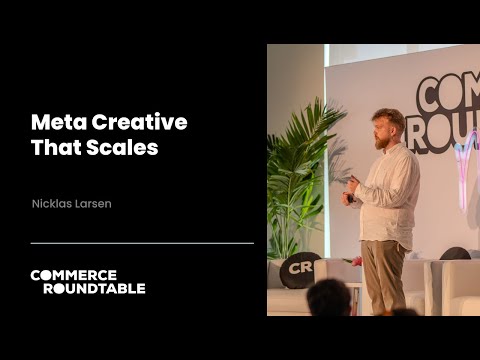
Nicklas Larsen lays out a research-led system for producing and testing more creative angles. Learn how customer insights, AI-assisted research, and a repeatable production process fit together.
Nicklas Larsen lays out a research-led system for producing and testing more creative angles. Learn how customer insights, AI-assisted research, and a repeatable production process fit together.
For ecommerce founders, marketers, and operators working on paid media & creative.
Speaker roles and platform examples reflect the session’s original context. This is an archived conversation.
Use AI to organize research into creative angles rather than substituting it for customer understanding.
Read this part · 03:23 ↓Connect what the product does with the reasons people care about it.
Read this part · 09:17 ↓Treat creative deployment as an ongoing process of testing and iteration.
Read this part · 12:35 ↓A quick editorial guide to the key ideas. Read the complete transcript below for the examples, details, and discussion in the recording.
Original recording on YouTube ↗Use AI to organize research into creative angles rather than substituting it for customer understanding. Nicklas describes a process that combines product information, market context, and customer feedback. The goal is a useful catalog of messages the team can produce and test, not simply more variations of the same advertisement.
Connect what the product does with the reasons people care about it. Customer reviews and market research help reveal different needs, objections, and emotional motivations. Nicklas connects those findings to creative choices so that broader platform targeting still receives specific, relevant messages.
Treat creative deployment as an ongoing process of testing and iteration. The session moves from research into execution, including how to expand creative output and evaluate what works. Throughput matters, but the team also needs to learn which angles deserve further investment.
From the recording’s auto-generated YouTube captions, with filler words removed and paragraph breaks added for readability. Names, numbers, and wording may contain caption errors; refer to the recording for exact phrasing. Chapter links jump to the text below.
Original recording on YouTube ↗0:00In strategy and production, we want to think about three things primarily. Our messaging, our target, and then finally, our creative angle. We have one primary goal when we make ads. So, we don't actually run individual ads anymore, and we don't even manage budgets on individual ads. We exclusively scale the winners, but we evaluate all of our briefs, all of our creatives that we output on an angle level. We don't care what individual ads do unless they prove
0:26themselves. We need to launch as many creatives as we can on a customer data based solution. And then we're simply just trying to evaluate the success of the angle, right? More volume. So you can effectively put 10 times the amount of creative, 15 times the amount of creative that you used to be able to because it will deliver the spend according to the daily active users in your target market. So we have ASC's now
0:51with 40, 50, 60, sometimes 100 ads in them and Meta will just deliver all of the spend. I'm an guy. That was a big change because give Meta all the keys. But essentially the way that it works is they just predict the output.
1:04What you really have to know about this is just two things. You have to personalize your creative, which is this process we just went through, right? That will allow you to create more angles more specifically and then you just have to invest in more volume. So the way that we do this is inhouse AI. creative agencies and you just benchmark throughput and hit rate. Ready for the after party? Getting tired. Okay, cool. So, let's get into it.
1:33Today's talk is about meta creative that scales. The framework really applies to anything creative. So, paid social, Tik Tok. you're going to like essentially learn how to generate more angles than you know what to do with. And I'm going to focus on the mechanization of the process. Nick has essentially forbid me from going into creative strategy as a whole. He would come up on stage and kill me if I try to because I'll go on for hours and everybody wants to go horny. So, I'll try and keep it short.
2:04what you're going to learn by the time we're done is how targeting a Shainan meta. I think it's important to understand the context of what has changed technically, fundamentally, and what it means for how you do creative strategy. you're going to learn how to 5x your creative angles and your creative output using AI. We've built an internal process using AI that we've applied to our multi7 figure and eight figure brands to start generating angles and building a catalog of what works and what doesn't. And finally, just how to think about deployment. We want to make sure that we do closed feedback loops.
2:40When you build something, when you put resources and money and time into building creative strategy, you want to have a desired outcome whether the ad wins or it doesn't because ads will die. Every single one of your best ads ever will always die. It's creative fatigue. It's a natural law. Systems don't. So, I included the the Cisphus analogy here because I think it's very reminiscent of creative strategy. you put all this effort, you put all this time, all this money into making creatives just to know that it's going to die eventually. Like I said, I won't be talking about like creative strategy itself, how to write scripts, what scripts to write, what angles to do, creative formats, all that stuff. You can catch me later if you want to talk creative strategy, happy to do that. So just from a high level, this is
3:26kind of basic, but I just think it's good to kind of fundamentally rooted in this like that the system is built on aggregate customer feedback. your customers will tell you how to scale. and we break it down into a three-step process. So, we have our product creative and and and customer research. So, who is coming to the store? Who is coming to the to the products? Who is interested in these products and why? Then we have our strategy process or production process which goes into how you want to think about turning these aggregate customer feedback, the aggregate customer data into a specific ad. and then finally on deployment and iteration, how do you launch the ads to maximize your learnings whether the ad wins or not?
4:11and essentially what the customers say is what you make. as simple as that. So, a little bit about me. I run a growth partner firm called Larsson Digital. we partner with a few select brands and essentially manage full stack marketing strategy. So everything from go to market, product launch. we kind of sit at the intersection between performance marketing and M&A. so we actually rebuilt our entire creative strategy process early Q3 of last year and it so turned out so raise of hands here. How many people know Andromeda?
4:45There's a few mentions about Andromeda today. Okay, of those same people, who actually knows what Andromeda does or how it works? No. Okay, no one. Just no one. Okay, good. So, we'll have some time for Andromeda as well. I spent hours going into this. And it just kind of like this is like better to be lucky than good. But what we essentially found that we needed was because we sit on the M&A side in terms of building performance marketing, we needed a way to output a lot of creative and catalog performance so that we could build creative IP, right? So if you are a brand and you want to sell at some point, there's going to be two things that are very very important. The first one is team and the second one is process and IP. us being full stack management, we needed a way to build the IP into like a catalog like a catalog and a database that we could essentially just provide to the potential acquirers and say this is the playbook. This is
5:40how we grow. This is how we acquire customers. These are the different personas that we have. so yeah we run across all of paid, all of retention, all of website and finance and acquisition. So just quickly on how
5:54targeting has changed. Jess's presentation was a lot prettier than mine. I'm an operator. I I don't do email designs. I let the team handle that. So we'll focus on the mechanization. But essentially Facebook since inception, since it started its ad inventory has been based on this concept of lookalikes. Everybody has heard about look alikes but not actually a lot of people like truly fundamentally understand how it works. So there's two concepts I want you to know. One is social graph and one is content graph.
6:23And it's essentially two types of algorithms. So a social graph is your friends. The pages you follow, the pages you interact with, the pages your friends follow. This was how Facebook back in the day really worked. If if Nick is into UFC, I'm friends with Nick on Facebook. he likes a post from the UFC, I'm going to be much more likely to receive that post. Same thing applied to the ad delivery. Then Tik Tok came along. They basically dominated the entertainment market immediately and it was because they use something called a content graph. and a content graph is similar to a lookalike, but instead of looking at who you are and who you interact with, they look exclusively at how you interact with the content that you're served and how people similar to you have interacted with that same piece of content and what they do with the rest of the piece. It really came from iOS 14 to have lots of brands really lost a lot of market share, profitability, and just ability to spend
7:24on platforms when iOS 14 happened. And it's it's it's because of one simple thing. They just didn't know who people were anymore, right? They lost the signals. They lost the access to who people are. So the lookalike model kind of fell to the wayside. And this is why broad on Facebook ads specifically became the gold standard, right? Everyone says go broad, but nobody actually talks about why. The reason why. So broad alone won't fix your problems. broad with creative volume with very specific intent on your angles is how you solve the iOS 14 problem because what you do is you essentially build your creative strategy from the ground up to target a specific customer.
8:05So back in the day you would like literally target the interest. Now what you have to do is you have to engineer your creative to target that specific customer so that only the people you're trying to hit will interact positively with the creative, right? because then that tells meta this person if you say the best boxing gloves only people who are interested in boxing is going to take positive action on that creative and that builds the foundation for the lookalike. So just quickly wanted to run through what do we want to achieve again three-step process. The first thing is we want to catalog the consumer sentiment. So we want to take aggregate customer feedback, consumer feedback and then we use AI to classify them into five buckets. I'll show you what those five buckets are. Then we turn that sentiment into specific creative angles to test the customer feedback. and we do this through multi-arm single variable testing. And I'll show you what that is as well. And then the final stage that loops everything back
9:01together is you you iterate on outliers. So you essentially you get all the feedback, you get all the data in, you aggregate it, you turn it into one of these five buckets and then you run the deployment, you measure the variance and you just focus on the outliers. So we
9:17start with two things. So we have customer research and we have product research. Product research comes from the brand and the industry. This is the market, the competitors, the product itself. and the customer re search is your social listening. So, it's your customer surveys, it's your reviews, social listening, which we'll get into what the process for that is. I'm assuming most people have some kind of social listening process. but basically with these two, you just put these into a document, literally a research document. This is the industry, this is the market, this is the product and everything it does. here is as many customer reviews as we can get, as many articles, product reviews as we can get, and as many customer survey responses as we can get. You put them into a data set. You take your product features and your product benefits. So the difference here is your product features is like functionally what does your product do?
10:11Like actually, if you were to describe it as objectively as possible, what does the product actually do? And your benefits is how does it make the customer feel, right? So what does those features mean for the customer in their everyday life? And your customer research is going to output pain points, failed solutions, and sales objections. So these are essentially the five categories that the AI and I'll give you guys a prompt cheat sheet that we'll go into as well. The every single piece of customer feedback that you collect goes into one of these five buckets. So product features, what the product does.
10:47Product benefits, how it makes the customer feel. Painpoints, the issues that they had that led to buying the product. Failed solutions is what they tried in the past that didn't work. And sales objections is what almost made them not buy. We'll go into these in a little bit more detail. And that will essentially output your creative angle through the briefing process. So if we go into creative that scales, we have our research phase that's going to go into social listening, our customer reviews, and our publications, right? So PR Oh, this a bit mess messed up. anyways, we have ad comments. So you basically just go to your top spending historical ads. You pull out I recommend chunks of 75 75 reviews, 75 ad comments.
11:33You go to forums like Quora and Reddit. there's an AI tool called Gigabrain which has been super helpful for this where you can kind of like talk to Reddit. and you just extract in chunks of 75 pieces. We recommend setting a a filter of 45 characters or more because a lot of people will say like, "Yeah, the product's great. That's not super helpful for this." You kind of want a little bit of consideration. You want a little bit of effort. so customer reviews on-site Amazon post-purchase surveys, but like on-site in email thirdparty services. trust pilot. This is kind of the role of a creative strategist to go out and collect all of this data, put it into we have a process that we call the brand one sheet, but it's really just a research document where you put all of this in, we build it on Google sheet, and then you essentially just turn it into these five points. So again, pain points, pains that drove the purchase, failed solutions, things that
12:27didn't work for them, sales objections, what almost stopped them from buying, and that ties into the benefits and the features of the actual product. Then we
12:35go into the strategy and the production. Now we have sort of a master document that we've run through AI to classify all of the customer feedback into one of these five buckets. and those five buckets will essentially turn into oneliners, right? So if we go back a bit, so we can see here on pain points. So like a classic extraction and there could be multiple extractions from one single review is I spend so much time doing X, Y, and C every day, right?
13:08That's like a pain point. That's like a common start to a review. I always put on pounds after the holidays. I always miss my dog when I'm traveling. And what we're trying to do in the strategy phase is take the inbound customer feedback and basically flip it and turn it towards the market. Do you always put pounds on after holidays? That becomes your base for the creative angle because it means that you're taking your aggregate customer feedback, literally the reason people are telling you that they purchased and you're just turning into mass creative angle production. because again iOS 14 and a half all the way up to iOS 18 now you can't target customers based on who they are anymore. You can only target them based on how they interact with the content. So the way that we do this and this is what the Facebook engineers tell us, this is what Andromeda tells us is you need personalization which means like the use cases of the product and the only way that you can get personalization
14:08spending money on ads is you need volume, right? So when you do personalization, when you do volume, you need to have a process and you need to have a system that can consistently generate creative angles. The sort of old way of doing this and like we used to do this like even just like a year and a half ago is you tell your creative strategist go make some ads, right? Go figure out some angles. But I found that often that wasn't really helpful. And I found that we often spend a lot of time and effort making concepts that really didn't have any backing in reality. It was really in the heads of of the creative strategist. And again, what we're trying to do is not make winning ads because we don't really care about a winning ad. Yeah, let's sustain the revenue for two months. If it wins, if you have a hit rate of 10%, that means like you're spending 10 times more resources on making these angles and it still has to come from the brain of the
14:59creative strategist, which means you as a brand don't actually own the IP. The IP of how you scale and how you make winning ads is actually in the brain of that creative strategist or maybe even scatter across multiple creative strategists. So then you have failed solutions. failed solutions could be, "I tried DIY. It was too complex. I could never keep up with the program. I tried bringing a bag of my dog's hair. People say random stuff."
15:25these different buckets can help you sort your creative angles into different levels of awareness. So, like trying DIYer is too complex. I can never keep up with the program. When you do this in this layered function with volume, what you end up doing is you're able to address very specific problems and pain points and objections that people have and you build it essentially out across the entire funnel. Andromeda like it was discussed earlier today is getting very very good at predicting what individual customers will do. So we can touch on Andromeda a little bit just high level because I think it's useful for this but essentially Andromeda is Gen AI it's LLMs it's AI using this the content graph mechanism but instead of looking across who interacts with content in the same way that you do it is predicting how you will interact with every piece of content it serves. Right?
16:23So every time you get a piece of content, it's essentially going to predict how you are going to interact based on your previous interactions. And that is all that's driving it. And it just allows for further personalization. And it means you have to produce way more creative if you want to win. Format becomes the next thing. I won't go into too much detail on that because most people who deal with creative know all the formats. Us versus them, founder story, yada yada yada. you essentially then when you find these angles in the customer feedback you pick three, four, five creative formats and you apply that angle. You try to attack that specific angle or pain point in different ways. So this is where we call it the multi-arm single variable testing. You have the same exact concept often the same exact copy but you show it in very different creative formats and that's what we call personalization. And then objections, benefits, and features. You can call these the lowerfunnel effects because this is for people
17:22who understand the problem. This is for people who probably understand the product. Objections and failed solutions is kind of middle of funnel because you're more in the consideration stage, right? I know the problem. I know there's some some products out there that might be able to solve it, but I don't know why I should pick you over this. And then obviously your pain point is literally like, I have this issue. I wish someone would solve it but I don't know what to do. So in strategy and production we want to think about three things primarily. Our messaging, our target and that's target ICP and we'll go into this and then finally our creative angle. So we have one primary goal when we make ads and we so we don't actually run individual ads anymore and we don't even manage budgets on individual ads. We exclusively scale the winners, but we evaluate all of our briefs, all of our creatives that we output on an angle level, right? We don't care what individual ads do unless
18:16they prove themselves. We need to launch as many creatives as we can on a customer data based solution. And then we're simply just trying to evaluate the success of the angle, right? So like, do you miss your dog when you travel? Did you try and bring a bag of your dog's hair and it didn't actually make you miss the dog less versus like do you miss your dog when you sleep? Right? Like if you have two different angles that you just launch consecutively amongst each other, you measure the variance and you just go deeper on the one that works. Your target is then you take your creative base angle itself.
18:51You've picked your format that you want to launch into and deploy into. now you have to match it to a level of awareness stage. This is something I don't really see people do. and it's a huge bottleneck in particularly winning ads. so a process that we've done that I'll show you a bit later is when you have a winner, you can essentially use this process to build very quick, very fast iterations of those winners because you don't have to worry about the concept itself. You can just use the new information that you have to make a lot of iterations and a lot of variations. And then what's been most helpful is the further up the funnel you can go in how you build angles, the more scalable the asset is going to be, right? Because it's going to speak to a bigger TAM, a bigger audience. and if you can get those to convert, it's going to last for longer. So the sysifice process is going to essentially stave itself off. You
19:46then define the ideal customer profile, your avatar, and that comes from the initial research phase as well. based on the pain points you can see what type of consumer they are what kind of problems they deal with and then the angle itself I don't know why the presentation is messed up but the angle is then you like build it into very very specific creative directions and then you have to build multiple variations if you take nothing else away from this conversation is when you build an angle when you build a brief or a creative you must make multiple four to six is fine And literally if you change the product image, if you change the headline, you should always launch multiple variations. So we do this on three tiers. We have same concept, four different variations of that concept.
20:36Then we have same concept, four different variations on a different creative format. So like us versus them versus founder story. Founder story talks about that angle or the us versus them talks about the angle. And then we do that same thing across other angles, right? So we can launch the the miss your dog versus like convenience across two different formats at the same time. and the reason that we do this is because we're not actually trying to find a winning asset. We're just trying to find a winning angle. And to do that, we need one of them to exceed the others like by enough to produce statistical significance. If you just run that one asset, you're going to evaluate that asset on its own terms.
21:21And that's not super helpful because again, we're just trying to build the angles that win. one thing that we do is we assign every single angle with a number of code. So, we just do a number of code and then we do a description of the concept so that we can just go back and we can look at the strategy that we deployed. Some quick hook dos and don'ts. I know I said I wouldn't do this, Nick, but I'm going to do it anyways. there's two ways to think about hooks, the way that we look at hooks. So one is disqualification and the other one is impression maximization. So disqualification is kind of the one that speaks to what we're talking about here. You call out your ICP very specifically. So this is how I solved X three accessories that completely changed my running routine.
22:03This product completely removed my problem. These are really good for this process where you want to call out an ICP. the other one is impression maximization. So, these are kind of the bait and switch hooks that you see, right? The bull runs into the guy. The guy is sent flying and then all of a sudden they're selling sneakers. These are really good for hook rates. They're really good for getting the impressions and getting people to see your process, but it's mostly applicable if you have a product you could sell to anyone. If you have a very niche product, I would stay away from these deployment and
22:35iteration. So, launch and testing, we kind of went through that. You want to run multiple concepts at once. you want to wait like you just have to wait and then analyze as you go. hook rate, hold rate, click score, and convert score. We'll go through these. and then you want to iterate and deploy. So once you've run those, you essentially just break it down same way that you would a funnel. So these are the four metrics that you want to evaluate. This is for video creatives.
23:02There's a different process, more click-through rate, but most people run video and media mix today. hook score, watch score, click score, and convert score. These are the only four metrics that you really need to look at when you want to iterate on creative. Your hook score is how many of the people who see your ad who actually stay. Your watch score is of the people that stay, how many of them will actually watch the whole thing through.
23:25Your click score is of the people who watch your videos, how many actually click. And your convert score is how many of the people who click actually convert. And this is benchmarked on an average across your entire funnel. Right? So if you have an average of 30 and your new ad has a 40, that's going to have a very high click score because it's beating the benchmark of the rest of your account. We recommend So for the technical media virus in here, I know people who run very successful accounts on CBO. I personally like like the control more on concept testing because we can just do adsets and we can measure them very specifically.
24:00depending on your budget typically it's five to 10 days and then because we run multiple variations in the same adset you should expect one of them to get vast majority of spend 90 plus% 95 plus percent and then what you get is when you run the same concept and this is kind of where the magic comes and I'll give you a specific example of how we did this when you run multiple concepts in parallel the way that meta allocates spend to certain ads will tell you a lot about what you should do next because that single variable that you changed is going to have some kind of closer connection to your ICP or the awareness stage and you can use that to then iterate very very quickly. So I'll
24:41give you an example of what we did for a specific client. So they basically had two historical ad ads that really just performed. Those two ads had done 85% of their historical spend which is 1015 million worth of spend. We took one, one was a founder story, so that's easy to iterate on. So what we essentially did was we took every single shot of that video. It's a minute and a half video, so that was a bit of a process, but literally every single shot when the camera cuts, what we do is we take the script, what he's like what he actually said, and then we do the shot breakdown of what was actually shown in the video, and then we attach one of their core USPS to that shot. That gives us what you can see down here which is basically just a tier table of what USPS we focused on the most. These are the USPS from the initial research. then what we did was we benchmarked the scores and we could see the hook score and click
25:36score was our biggest bottlenecks. So, we just took the most applicable concepts from our strategy document and we just built four hook variations, four call to action variations on the same video. And then we ran those against each other. One hook iteration got most of the spend, one call to action iteration got most of the spend. We combined them into the original video and now it's the top performer. So, that's basically what we did. We scaled
26:05in that ASC. I don't have a lot of time left, but I do want to quickly talk about Andromeda as well. AI prompt cheat sheet. This is what you use to analyze the customer feedback. Again, you literally just put 75 reviews, 75 ad comments, 75 publications into a Google sheet, you export it, put it into chat GBT, and you just give it these prompts. So, I'll give you this. If you scan this, you'll get the whole prompt cheat sheet, and it'll just give you the output that you then put into the research document. So quickly on Andromeda, the way that it really works is more volume. So you can effectively put 10 times the amount of creative, 15 times the amount of creative that you used to be able to because it will deliver the spend according to the daily active users in your target market. so we have ASC's now with 40, 50, 60, sometimes 100 ads in them. and Meta will just deliver all of the spend. I'm an guy. And that was a big change
27:06cuz like just give meta all the keys. but essentially the way that it works is they just predict the output. The what you really have to know about this is just two things. You have to personalize your creative which is this process we just went through, right? That will allow you to create more angles more specifically and then you just have to invest in more volume. So the way that we do this is in-house. It's AI. It's creative agencies. and you just benchmark throughput and hit rate, right? So, how many ads do you make per month? How many creative concepts do you make per month? And what's the hit rate?
27:39A hit rate is just winners divided by launched. That's it. and we've tripled, quadrupled. We run something like three, four, 500 concepts a month now. And we used to run maybe 60, 70.
27:52so basically that's Andromeda. And I think that's me. Maybe we have time for questions. No time for questions. Not for your nerd brain. You go way. Thank you very much.
Join Commerce Roundtable in 2027 for focused learning and conversations with people working through the same challenges.