 30:55
30:55The Retention Roadshow · 2026

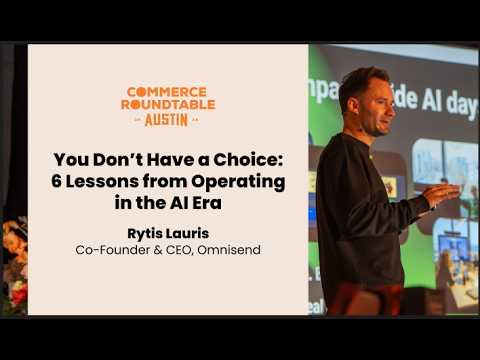
Rytis Lauris shares lessons from adopting AI inside Omnisend: creating time to experiment, starting small, assigning ownership, and improving tools people will actually use.
Rytis Lauris shares lessons from adopting AI inside Omnisend: creating time to experiment, starting small, assigning ownership, and improving tools people will actually use.
For marketing leaders and operators turning AI experiments into dependable team workflows.
Speaker roles and platform examples reflect the session’s original context. This is an archived conversation.
Set aside working time for people to improve a repetitive task with AI.
Read this part · 01:05 ↓Start with a reviewable draft or recommendation before allowing an agent to act independently.
Read this part · 05:08 ↓Choose a narrow first use case and improve it through actual use.
Read this part · 08:17 ↓Name a human owner who reviews output, fixes failures, and maintains the workflow.
Read this part · 14:18 ↓Place the tool inside a recurring task rather than ask the team to invent a new habit.
Read this part · 18:33 ↓A quick editorial guide to the key ideas. Read the complete transcript below for the examples, details, and discussion in the recording.
Original recording on YouTube ↗Providing access to AI does not mean a team will change how it works. Rytis describes making experimentation deliberate through dedicated AI days, giving people outside engineering a chance to identify problems and build small solutions.
The emphasis is on participation in real work rather than a separate innovation exercise. People closest to repetitive tasks can see opportunities that leadership may miss. A scheduled opportunity to try those ideas helps turn curiosity into something the team can evaluate.
A sales example prepares a follow-up email from a call, including questions and commitments, then leaves a person to review and send it. The assistant removes preparation work without assuming every generated detail is correct.
Other examples involve influencer review and support. Across them, the useful starting point is a task with a recognizable input and output. Make the first version easy to check so the team can learn where it helps and where it makes mistakes.
Rytis warns against making an AI project so complicated that it becomes difficult to launch or maintain. A narrower tool can demonstrate value sooner and reveal what actually needs improvement.
Treat the workflow like a product. Launch a usable first version, watch how people use it, and adjust it in response to their experience. The value comes from repeated use and improvement, not from the complexity of the original design.
An agent needs a person responsible for its quality and continued usefulness. Rytis compares that responsibility with managing a new employee: someone must know what the tool is supposed to do and notice when it stops doing it well.
Ownership includes iteration, maintenance, and checking failures. A one-time launch is not the end of the project. Without a clear owner, small errors and changing requirements can quietly turn a promising tool into something the team no longer trusts.
Adoption is easier when a tool improves something people already have to do. Rytis points to subject-line and preheader generation as an example of assistance placed inside a recurring marketing task.
The broader lesson is to start from the routine, not from a desire to use a particular technology. Look for work that happens often, is easy to recognize, and creates a clear benefit when made faster or better. That gives the team a reason to return to the tool.
From the recording’s auto-generated YouTube captions, with filler words removed and paragraph breaks added for readability. Names, numbers, and wording may contain caption errors; refer to the recording for exact phrasing. Chapter links jump to the text below.
Original recording on YouTube ↗0:07Hey, thank you. Thank you. Okay, I have some water if we need. So, so, hello. Great to see all of you. It's really great to be in the crowd of e-commerce people. In my conversation, I'm coming like organization which is not e-commerce itself. Yes, we facilitate all of you. We do help you do email marketing, SMS marketing, web push notifications, etc. Such automated marketing. But today I'm going to talk about how to transform organization into AI-first, AI-native.
0:38Whatever term you choose, you can call it whatever you want, but but and those kind of I'm going to share like six lessons that we have learned from our own experience. As you know, we all of us use AI. Yeah, that's true. Who use AI? Oh, everybody does. Yeah, everybody does. And that's what we kind of thought at the very beginning. Okay, where is this click? Shall I click this one? does it change? No, this one? Okay, this one works. So,
1:06AI does not adopt itself. Although at the very beginning we thought in opposite. Okay, so, there is a chat GPT, we going to give away like licenses. Okay, Gemini licenses. Every employee in the organization has AI licenses. And people use. And if you ask people, "Do you use AI, LLMs?" Yes, I do use. "What exactly do you do?" So, initially the vast majority of people still, up until today, use AI to replace Google, to replace search. I just write the kind of prompt, etc. Maybe some design work, some basic work, etc. So, and that's what we thought. Okay, so, and if we would ask like all the employees at Omniscient, everybody would say, "Yes, I use AI. It really helps me save time. It really helps me to be productive." And that's right to some extent. But really in order for AI to become a true agent, a true employee of organization, and truly save time, and to improve processes inside the organization, it's not enough. It's not enough that every individual is using LLMs, is using ChatGPT, Gemini, Claude
2:16for for for the daily tasks that we do alone. It's very important to employ AI to do tasks that are cross-organizational, that the same people in the same department and whatever marketing department or or inventory departments do. Routine their tasks, do routine their processes, and automate them employing AI agents. So, that's what we kind of initial distributed, and we saw that okay, so yes, the efficiency has increased, but not by much that we wanted to. So, what
2:50we did, we start doing AI days. What does that mean? Once per month, we basically force everyone to get rid of all the routine tasks and clear up their calendar. So, that means that you should not have any meetings, any routine tasks, and one day per month entire organization is playing with AI. And we kind of had two phases, and this is a massive investment. If you would take like the salaries of entire head count for the organization, it's massive massive investment. Currently, we have we have 260 people working, so and and people sometimes might ask you, "Okay, but it's it's it's it's a lot of money.
3:28It's it's a cost for organization." But we strongly believe that this is the cost that each organization, each team has to come through. And you as those who are leaders in in in the teams, etc., this is where you have to invest. Those who are brand owners, those who are CEOs in the businesses, I believe that you have to invest into organization capability to really employ true AI agents. And initially, we kind of did in the two phases on those AI days. First phase was okay, let's play a bit.
3:56Everybody is doing some like some nice games, some videos, some piece of software, which is this very lightweight. It's more of like a hackathon. There is a task that everybody is doing something similar, etc. And people were playing and just to explore capabilities cuz you know, the people who's working in legal department, they kind of know that they they can do something beautiful. They with AI, but we have never ever tried. And this is where you kind of expand that everybody would try different capabilities of LLMs, try different capabilities of different AI tools, and of course, we provide with the tools, etc.
4:32So, that was the beginning. Second phase that we are currently going and we already did like six or seven AI days. It's always once per month. So, second phase that we are going now through is like really resolving and solving real problems of your own. So, we help you to automate the routine tasks that you have within your team, within your department. And then the second stage and just a couple of examples, what did people build on their own, not some kind of engineers, AI engineers, forward development engineers, etc., but they build by themselves. For example, first
5:08is about like sales. Sales team and how they improve their work. And again, they build it on their own. So, usually a lot after each like sales call, it would be good to send a follow-up immediately, at least in 24 hours. But in reality, what sometimes happened that, you know, people are busy, account managers are like account executives are busy with having more calls, etc. This is kind of main driver, and they forget to send the follow-up message in 24 hours. So, they build a tool they build a tool that actually, you know, analyzes the script of the call finds what questions did customer ask and maybe what you promised, what account executives promised, and they build a tool that prepares the email and puts it in your inbox outbox.
6:01So, it does not send on behalf of you, but it already does all the hard work for you, and in your outbox you can see, "Okay, this is an email with all the promises I gave. Okay, maybe pricing, maybe maybe some questions that the potential customer had." And I will already have it in my outbox. I just need to click send. Of course, review it cuz sometimes AI does mistakes and AI hallucinates and it sometimes it's buggy and you know, it it it it improvise in the way you don't want it to improvise. So, that's why the human has to review, but saves ton of time.
6:38Another example, I believe all of you have work with like creators with influencers. So, we work with influencers as well. And you know, to review what influencers are about to publish, what creators are about to publish, it took around 90 hours each month for our team to review those videos that are ready to to publish. Just to have a look. I mean, is it is it on brand? Is it on like tone and voice? Is the messaging there, etc.
7:06So, our influencers marketing team built a tool, a solution that is being used cross-team that saves a lot of time. So, basically, what does that tool do? It analyzes the video. It analyze it matches with our tone of voice, with our brand messaging, with our main messaging, and it puts in brackets. I think I think it's like fully good. I think it's somehow needs review. And I think that this is not in what we expect it to be. And it cut down from 90 hours to 20 hours per month. So, the human actually release a lot of time to do better work instead of do very kind of like automated and then like thank you job not not not too intelligent work, yeah? And again, those tools are being built internally by the teams who are not developers, who are not engineers, but they have been built just because we as an organization gave them a room to do that. And the during those AI days we spent time, they start building and we see that they Okay, this
8:10is really valuable for me. So, I should do that and I will improve it.
8:17>> [sighs] >> On the other hand, and this is where we come to the second lesson, people start experimenting with special agentic AI and initially they think, "Oh, come on, it can do so much. Oh, it will be do this and that, etc." And they come with a brilliant ideas. Now, if they with like, you know, wipe coding with with agentic tools, I can accomplish something in 2 hours. So, maybe if I spend 1 day or 2 days developing something, I can build a very, very comprehensive solutions that basically will do my life easier.
8:53yes and no. And this is the second lesson that we learned like complexity is really a trap. And just a couple of examples from our lives. So, as we call it like, you know, beautiful junk. You cannot over engineer. And this is what usually happens with people at least from our lessons that you you start seeing that the the results MVP results are great. So, maybe we can build a tool and this is coming from our account managers, customer success managers that we thought, "Okay, we're going to build very comprehensive, very big solution that will really you know, analyze our customers behavior, benchmark it with industry standards, come up with recommendations and even automatically will send those recommendations. So, basically will do the majority of work for us and we will only can have like, you know, chit-chats with customers, have a good time on our conversations, on our calls, etc. And AI will do the rest.
9:53But it didn't work. And, you know, we built this, we built this, but they did not use this. And then we start challenging, "Okay, folks, what happened? Why don't you use it?" "Oh, look, it's buggy, it's clunky, it doesn't do the job, it hallucinates in many occasions, so I don't trust it, I don't rely it on it, etc." So, what did they do themselves? They just disco bit. And instead of having a big, big, big, very comprehensive solution, they said, "Okay, let's start a bit smaller."
10:25And this actually works and this actually is being used and this is a solution that just helps to prepare for QBR, which is quarterly business reviews. In the past, our account managers, customer success managers, they used to spend half an hour or even more to prepare for the conversation with a customer. Now, they just can spend 5 minutes because AI agent goes through the customer account, collects the main information, puts it in one single document, benchmarks it, etc. And basically gives you the the like, you know, draft for your call with a customer. So, instead of half an hour, now it's spent 5 minutes. It's not kind of like, you know, very comprehensive
11:09solution, it's pretty tactical solution, but it really works already and it saves ton of time for the entire department of customer success. third lesson that we learned, it's and probably this is the main transformation that we believe has to happen in any organization that wants to become AI native and AI first. So, from project mindset to product mindset. What does that mean? So, project mindset is basically we have a we have an idea. Let's say migrate from your other ESP Omniscient. So, we say, "Okay, you're responsible for that. This is what we're going to do. we spend some time, we do the job, we do the task, and it's over. We already an Omniscient. And this is where kind of Yeah, this is the new reality. Now it's routine and we forget about that and then people continue working and and everybody is happy. So, the project is basically over. So, with AI adoption, with agentic AI adoption, it's not the case. It doesn't work in that way.
12:17And we ourselves we're SaaS organization, we're product organization, but not everybody is actually in a product world. So, it's not even for us it's a really really challenging to transform our mindset from a prod- ject thinking. Or like you're introducing new SKU. Yeah, so you kind of think, "Okay, this is my idea. Who's responsible for that? We introduced it. It's already now inventory. We are going to the next project." With a product mindset, it's like over going process. So, basically initially you have to launch MVP, minimum viable product with your agentic AI, and usually this MVP is really clunky, is really buggy, it's not working as good as you would expect it to work. But you have to launch it and you have to start using it already.
13:05Because if you don't use it, you will not learn how to constantly improve it. So, that using a clunky product, a clunky solution, and buggy solution, it's absolutely important part of AI agentic AI adoption. If you don't do this and you will expect it to be like, you know, ideal, expect it to be like really good. I cannot use it now because it's not good enough. It makes mistakes. Yes, it does. But we do understand that we just launched MVP, we use it, we learn, we improve, we repeat.
13:41So we relaunch again, improved version, etc. And this is how it all works. And this is kind of a fundamental shift that has to happen in our own mindset, in our colleagues mindset, that we have to think about it in a product mindset. So, using some buggy solution, it's absolutely okay, and that's what you have to do. Okay. Sorry, what happened? -huh, okay, cool. Yeah, finally it's
14:18here. So, and it's like the fourth lesson that is really really related to that, that iteration isn't sexy, but it's everything. So again, you have to initially launch it, and then you have to improve it. So what does that mean? That each agent you use in your work has to have an owner. As like an agent is like like employee. You employ that new person, new person to do the job, you have always assigned the manager. There's no employee in your company that has no manager. So if that it's exactly what is happening with AI agents. You have to hire them, you hire new agent, you have and you assign who is responsible for that AI agent. And it's always has to be human, at least at this point. So, they Ownership is very important, and they constantly maintain those AI tools and AI agents. And this is a critically important as well. As we constantly iterate, improve it, they have to maintain. And here we have to just like few examples of of our own tools that already showed and
15:27they didn't show. So, sales follow-up agent that that already kind of saves a ton ton of time and guarantees that sales follow-up will be sent on time, but at the same time requires constant constant upgrades and constant maintenance. It's not that we build and again, it's not a project that we build and that is already running. We have to constantly maintain it. It requires only like 10 minutes, not too much because it's again pretty simple, but like influencer marketing team, it requires few hours every month. So, it saves from 90 hours to 20 hours. It saves a lot of time, but there is a manager, there is an owner who has to spend few additional hours to always maintain this solution, to always maintain this agent. And CX reporting tool. So, yeah, a couple of updates, quite not too much. And the fourth example that I have not mentioned yet. So, now already our AI agents, we resolve 40% of our support tickets.
16:32So, and it's not kind of like those shitty bots that people are usually used to that, yeah? Cuz a lot of people still hate like AI support agents that that they think, "Okay, those agents are not reliable and they just give you So, okay, this is my knowledge knowledge base article." No, in opposite, our support agents are fully connected to all the tools that our human agents have. So, they can resolve things for you, not only kind of give you a knowledge base article, but maybe unblock your account if it has been blocked, maybe review something, help you because they have the exactly access to the same tools that our human agents have. And satisfaction score of our customers that have been served by AI agents is now already equal to the satisfaction score that those people who have been served of human agents.
17:21But it was not the case all the time. Once we launched those AI support agents, the satisfaction score was twice as lower. But again, we adopted this product mindset and we kept iterating and the quality kept increasing, increasing, increasing. But what happens, we have two full-time employees who are supervising those AI agents. As we have like supervisors for human agents usually like you know support agents they are pretty junior role. So we have supervisors for human support agents. Equally we do have two full-time employees as that are supervisors for our LLMs for our AI support agents. What do they do? They constantly view the conversations and they constantly say, "Okay, I think you should have answered this way, that way.
18:12Maybe you could do that better. I'm not sure if it's already already covered in our knowledge base etc." And it's like full-time job, full-time job to keep it going, to keep it in a good quality and that's how the quality increases over time. If you don't do this, you will be super disappointed and we were disappointed in many cases. Our customers will be disappointed.
18:33>> [sighs] >> fifth lesson is fifth lesson is you should start and build on existing processes. And this is kind of where I would like to come with like very like personal personal example that you know, I thought I should be posting more on social media. Okay, and not I that I thought but our marketing team always says, "Rytis, you should be posting more on social media etc. Whenever you post there is a good engagement and people are happy etc. with that." So and I don't do this. So it's difficult for me.
19:09And we they "Look, if I cuz I I don't like writing, but that's okay for me to to speak. So, if if I don't do this, if I had a tool where I can say like in my phone, okay, those are my thoughts and it would convert it into into a post on LinkedIn. That I would I would post more. And guess what? Our marketing team built that solution for me. Now, I have this vibe coded solution here in my phone that I could say just pieces that I want to post about and it will convert into the LinkedIn post on my tone and voice of everything.
19:44And guess what? Did I post more? No. I did not. I didn't because I had no habit to do that. And AI helps to make it more efficient what you already do. And people in many cases use AI just too much to ask, okay, what shall I do more? How can I improve how I work, etc. And AI comes with many ideas, with so many ideas that okay, you can do this, you can do that, etc. etc. etc.
20:18And what happens? AI does the creative job, but the donkey job, the routine job is being left to human. And that should be absolutely in opposite, absolutely in opposite. That I think about great ideas, about like I I unleash my creativity. I I come with new ideas. I come with new challenges. And I employ AI AI AI agents to do the automatic job, to do the routine tasks. And that's how we have to start thinking and that's how we have to act cuz it's not always the case. And now with AI we can do more.
20:53That's great, but initially with AI we should save time, free up some time for ourselves in order to be able to do more, to do new tasks, to have free time, to to do something that we have not been doing in the past. So, that is very important. And yeah, so and this is where as kind of leaders have to think and have to talk with a team. So, okay, what is the most repetitive tasks you are doing on daily basis? where do you waste most of your time, etc. So, where your execution is being slowed down. And then you list that and then you think and find a ways how to automate those tasks. Not ask LLM, not ask AI what I can do more. No, start with what is the most routine tasks. And with that in mind,
21:44so I will share what what we brought into product. like so, kind of I was talking like how we are transforming our organization. Now, just share some example with with that in mind that okay, what are the most routine tasks? And with within Omniscient, the most used AI capability is subject line and preheader generator. Why is it so? Because it's one of the tasks that once you are sending email campaigns, it's inevitable. You always have to pass this. You have always have to come with a good subject line and with preheader. And yes, you know what you want to promote, etc. But this is a kind of a very routine task and we trained our AI agents with all the best practices. We know what opens the best.
22:31We know what customers love receiving, what kind of subject lines, etc. So, this is the most used AI capability within the product. It's nothing like super super fancy, but it already saves so much time for the customers our customers that are already using it. another thing that we moved exactly the same idea to into the product, into the copywriting. Yeah, within email, you write copy and it's really really it sucks time so much time. And some some of marketers, they are more creative people, yeah, and writing a really proper copyright, it's it's a big challenge for them. So, again, this is inevitable task. This is a the task that each marketer is doing email marketing marketer is doing on daily basis, and this is where you help save time.
23:22another thing that is really, really well used with Phenomenon Send, it is AI segment builder. So, to build segments for those marketers who are more creative people, it's a bit of a challenge. All those logical junctions and or, etc. So, it's not that straightforward, it's not that easy. So, now you can just prompt in human language, you can prompt in human language, and AI will build the segment. So, I want to pull my customers who have bought in the past 3 months and spend at least 100 bucks. And again, this is not something new that AI brings on the plate for the marketers, but this is where AI saves a bunch of time and a bunch of energy for all to help to to do the already existing tasks.
24:08And yeah, now it's kind of like the the newest where we see a massive adoption. So, with forms AI, forms AI, and so now with Phenomenon Send, we have two. You can do it in manual way, or you can do it with AI to build forms. And forms is not the thing that is being used new forms, nobody builds new forms on daily basis. But still, it is very, very important for for collecting subscribers, email subscribers, SMS subscribers, for growing good database, it's crucially important. And with AI, already 40% of forms that are being published now in the past couple of months is being generated with AI.
24:44Again, very routine tasks, not not creating new work for you, but saving bunch of time.
24:51And the sixth lesson, and like overarching lesson, is that AI is an assistant. So, yes, we do use AI a lot for our daily basis. And people say that, "Okay, maybe I'm going to lose my job." And that's what I said to the team, yes, all of you, all of us will lose your job in the upcoming 3 to 5 years. The job as it is today, but I believe that you can adopt and you will have a job.
25:22But, I believe that the future competition is not between humans and artificial intelligence. I believe that the future competition is between humans who know how to employ AI and humans who don't know how to really well employ AI. And this is where the true competition will happen. And you know, AI will not you instantly make you instantly perfect on the things you don't understand. During our AI days, sometimes we build videos. And you know who built the best video?
26:00The video team. Who You know who builds the best-looking solution? The designers. Because they know what to prompt, they know what to ask, they know what result should look like, they know how process of creating that looks like. That's why it is kind of very important still to to to to to to improve your skills, to improve yourself in order to be able to employ AI, AI agents to help you serve whatever you do at your work now.
26:32And yeah, so just to wrap up and to remind the lessons that we learned. Yeah, so AI will not adopt itself. You as organizations have to invest in it and you as organizations leaders have to have to help people within your teams, within your departments, within your organizations to employ AI. And you should not start building from complex solutions. Complexity is a trap and there is a lot of beautiful junk that you build but nobody actually uses or you build yourself and you don't use yourself because it's just too clunky, just too complex, etc. So start small and start with a product mindset. Start small, you launch MVP, it's far away from ideal, far away from perfect, but you already start using it and then you start improving it. And yeah, that's how you iterate. You have to have each AI agent has to have manager, human manager, human owner and it has to constantly be maintained and constantly has to be iterated. And don't think about new processes. Employ AI to free up your time with existing processes,
27:41with existing routine task and from there you can come up with new ideas what you can do better in the future. And AI is an assistant. It is not replacing humans, but it is helping humans to be way more productive. Yeah, so thank you for attention and just kind of a little bit of that for the beginning for the beginning for the end of my presentation. So yeah, if you are considering moving to Omnisend, which again, we employed AI internally to help migration from other ESP way easier and now we promise that we will migrate you in 5 days.
28:16So it used to take months to migrate ESPs. Now with AI agents, we replicate everything whatever you have in your current ESP like templates, designs, segments, everything we do it for you and AI agents help us a lot here. And now there is a little really killer offer here for you, 50% off for 3 months just because you are here attending and listening here today. Yeah, so thank you for attention. Thank you, Rytis. >> [applause]
30:55 26:17
26:17 57:56
57:56Join Commerce Roundtable in 2027 for focused learning and conversations with people working through the same challenges.