 41:08
41:08Austin · 2026

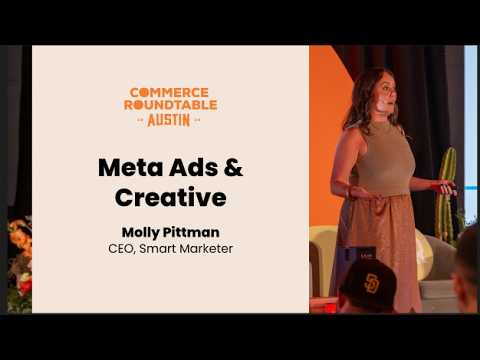
Molly Pittman explores how creative, copy, and landing pages work together in Meta advertising, then turns to practical ways brands can become easier to understand in AI search.
Molly Pittman explores how creative, copy, and landing pages work together in Meta advertising, then turns to practical ways brands can become easier to understand in AI search.
For media buyers, creative strategists, and ecommerce teams connecting acquisition with the on-site experience.
Speaker roles and platform examples reflect the session’s original context. This is an archived conversation.
Make the customer’s motivation clear in the image, copy, and offer.
Read this part · 10:43 ↓Review whether each major ad angle has a destination that continues its story.
Read this part · 19:22 ↓Add customer motivations and story angles to your creative review, alongside format metrics.
Read this part · 27:20 ↓Test story-led copy with a clear customer situation instead of length for its own sake.
Read this part · 33:55 ↓Make product facts and common questions easy to find and understand on your site.
Read this part · 38:11 ↓A quick editorial guide to the key ideas. Read the complete transcript below for the examples, details, and discussion in the recording.
Original recording on YouTube ↗Molly argues that the inputs surrounding an ad deserve as much attention as its account structure. Visuals, language, the offer, and the destination help explain who the product is for and why someone might care. A narrowly described customer motivation can be more useful than a broad demographic label.
Her examples explore reassurance, identity, and other reasons people respond to creative. The practical task is to make those motivations visible in the work rather than assume targeting settings will communicate them for you.
Different ads can begin different conversations, even when they sell the same product. Molly discusses landing pages and hybrid pages that carry those ideas forward, rather than sending every visitor into one generic experience.
The page should provide the context promised by the creative. Check the connection between the ad’s story, the questions it raises, and the information at the destination. The opportunity is a coherent path from first attention to an informed purchase.
A creative report that only distinguishes video from static misses why an ad worked. Molly encourages teams to look at motivations, stories, and the message behind a winner. That creates a more useful feedback loop between media buyers and the people making ads.
The next test can preserve a strong idea while changing its expression. This is different from making superficial variants with no explanation for their success. A shared vocabulary helps the team turn account performance into better creative decisions.
The session shows long-copy examples that build a narrative around a person and an experience. Molly explicitly distinguishes that from writing thousands of words about how great the product is. The story earns the reader’s attention before the product enters the conversation.
Length is therefore a test variable, not the strategy itself. Ask whether the copy has a recognizable situation, a reason to keep reading, and a connection to the customer. More words without those qualities simply create a longer ad.
The closing section turns to AI search and answer engines. Molly discusses accessible information, authority, and clear explanations on product pages. Specific answers, comparison details, and well-organized facts help make the brand understandable beyond its advertising.
She frames these changes within a longer-term commitment to serving a group of people. The durable task is knowing who the business helps and expressing that clearly across channels, even as the platforms and interfaces change.
From the recording’s auto-generated YouTube captions, with filler words removed and paragraph breaks added for readability. Names, numbers, and wording may contain caption errors; refer to the recording for exact phrasing. Chapter links jump to the text below.
Original recording on YouTube ↗0:06What's up, y'all? How are you feeling? Nick just open-looped me in true marketing fashion. Sat there with my butterflies. Austin, Texas, baby. Y'all have fun last night? I got to live in Austin back in my 20s and I think I have a little PTSD. I think I'm still hungover from that and it's been almost 10 years, so >> [laughter] >> bless us. Y'all having fun? Lots of men here. Where are my ladies? Woo! Okay, we've got some ladies. Sorry, Nick. I love you. I think we attract the ladies at Smart Marketer. You attract the bros. I'm try- I'm not trying to.
0:49>> [laughter] >> I do my best. >> I'm saying it's just who you are. Even worse. >> a knock. all right, y'all. You ready? Cool, let's do it. So, I've got a little
1:00mix of a presentation here, which is going to be fun. About 70% of this is Meta Ads. Who's struggling a little bit in the past month or two with Meta? Sure y'all talked about that. Nobody? Just three of you? Holy All right, I'll I'll get down from here. you should run my agency. >> [laughter] >> and then at the end we're going to talk about AEO, which is a new service that we just started offering at Smart Marketer. We've got a team of 12 badass AEO specialists out there doing it every day, figuring out how to rank in these LLMs. So, I'll close out with a little bit of info on that. What's up, dude?
1:36Good to see you guys. but I'm Molly.
1:39Most importantly, this is Larry. Actually adopted Larry here in Austin from Austin Pets Alive. Has anyone ever been to that shelter? Y'all, it is the coolest dog shelter that has ever existed. Matthew McConaughey is their spokesperson. You should go visit. Larry looks much older than this now. He's jealous that I'm in Texas, but I took him to one of our Smart Marketer events a few years and he bit someone. So, Larry has retired from marketing events. John, my business partner, told me our insurance was not good enough to bring Larry to events anymore. So, it's really cool.
2:18This is very full circle for me. I
2:20actually grew up in Kentucky, small town, moved to Austin, Texas back in 2012, didn't own a laptop, had no idea what the hell I wanted to do with my life. I found an ad on Craigslist. That sounds creepier now than it was then. for a marketing internship with Ryan Deiss and Digital Marketer. I took that internship, ended up with a full-time position, totally changed my life. That's what really got me into this space. Now, I own a company called Smart Marketer with Ezra Firestone. I see his face here. He is not here, but he would like that. John in the back and our Dutch friend Pep. but yeah, I never meant to get into this, which is wild.
3:05actually thought I would be in the alcohol industry, but that is a story for another time.
3:11I also run a dog rescue. So, I lived in Austin, moved to Colorado, moved to Amsterdam, moved back to Kentucky, and I have a dog rescue now called Fields of Freedom. If you ever want to talk nonprofits, it is the most fulfilling thing I've ever done in my life. All of you are sitting here because you have business skill sets, you have marketing skill sets. Those can be used for other reasons than making money. How about that?
3:39>> [laughter] >> and it will give you an energy source and a level of fulfillment that you cannot get from a for-profit business. So, if you take nothing away from this, think about a problem that you want to solve in the world and use the amazing skill sets that got you here to solve that problem. So, we save hundreds of dogs every year from euthanasia at local shelters. I have a farm where they stay. It is really wild. It is a whole other part of my life. If you're interested, I'll be around all day if you want to talk about it. I also own a restaurant. Anyone in here have a local business?
4:16One person, two people. Don't miss out on local, especially in this AI world. That's never going away. So, local business is what is up. And then just a few more things about Smart Marketer. We have a few pieces to our business. One is an agency. We also own over 15 of our own businesses, e-com, local, SaaS. So, if you're doing it, we probably have some sort of experience in that business type. And then we take all of that information. We have events. We provide services for people. so, it's a really really fun thing that we do. and we have over 60 amazing marketers on our team. So, if you ever want to talk about leadership, hiring, that's where I spend a lot of my day-to-day. Sound good?
5:05All right. So, before we dive into the
5:08information, if you've ever learned from myself or Ezra before, you have heard this, but this is the secret sauce to business that most people are missing. this is the mantra of our company. This is the mantra of the living experiment that Ezra grew up on in California. And this is how we operate every single day. This is how we hire. This is how we do marketing. And it's really simple. Serve the world unselfishly and profit. And essentially that means if you are of service to a group of people, if you wake up every day, and that is what you think about, right?
5:46That is the place in which you are coming from when you go about your day-to-day work, you will profit. It will work out for you. And unfortunately, most people have that switched. It's all about the money. This becomes unfulfilling. They have no longevity in this industry, which you have to have. and then things don't work out the way that you want. So, remember this always.
6:11Also, my dad died last year unexpectedly. I was with him the night before. We had a big time. He went home dead in his garage. And if you knew him, this was perfectly him. It was like the best way for him to die. And this has totally changed my life and the way I think about what we do. And business is important. This stuff is also very addicting. You can spend your whole life in front of that screen.
6:42And just remember there's so much more to life. And there will be a last moment that you have with every single person that you know. Think about the people that you love right now. You will have a last moment with them. And you might not know that it's coming. Or you might know that it's coming. And send to yourself in that every morning and remind yourself of what's important. So, we laughed, we cried. You all ready to talk about marketing stuff?
7:12>> [laughter] >> Let's do it. Okay. So, the best way that
7:16I can sum up where we're going in this industry, there's really only one way to lose. When we're looking at Meta, we're looking at where things are going with AI, and the only way to lose is to not be of service to a group of people. So, the people that are sitting in this room that are selling a product or service, and that's the only way in which you think of it, right? I sell this thing. I sell this widget.
7:46If you do not shift that mindset, if you do not shift that strategy, you will not be in business in 5 years. Your thought process should be I service this group of people and I sell them this widget, and those widgets will change over time, but I am at a service to this group of people, and that is really the foundation of this entire presentation. So, let's first dive into Meta advertising. So, again, who is kind of struggling right now? Who has seen a down flip? Okay, a little bit more hands. Yeah, there have been lots of changes. I've been running Meta ads for 14 years now, and the last year has probably been the most interesting that I've seen of my career, but for me, the most exciting.
8:37And everybody wants to talk about Andromeda. Oh my god, this is about campaign structure. This is about the new way of doing things, right? Squishing everything into one or two campaigns versus the old way of doing things with hundreds of ad sets and everything segmented. I'm not going to talk about that today. That's what everyone's talking about, and when we research this, we look at our businesses, we look at our ad accounts, we're still about half and half, and it's interesting. Some accounts are using both structures, which sounds contradictory, but it's true.
9:11Some of our accounts are really working in a consolidated approach for a few months, and then we need to switch to a more segmented approach. Not going to go too deep here, but I just want to present the idea that everything that you see on Twitter is not always true. >> [laughter] >> and everything that Meta says is not always true, and just consolidating your campaign structure is not going to fix your business. And when we look at the idea of Andromeda, this was really just a simple yet complicated change that Meta made and everyone panic. So John and I the last 12 years when something changes in the industry, give it to me.
9:50Panic. That's what everybody does. They spend their time panicking instead of actually solving the problem and it's like, okay guys, this is just an upgraded system. This is not that big of a deal. There's so much more at play here which most know and are way nerdier at this than I am. You got Jim, you got Lattice, you've got sequence learning, all of this that Meta's doing. But really what changed with Andromeda was the way in which Meta is showing ads to users. Back to that whole thing about having a market or multiple markets of people in which you are servicing with your business, right? When we think about the real changes, it was less in the way that we think around campaign structure, way more in the way that filter or ads are filtered and then served to groups of people. So what does this mean? What do we do about it? One
10:44of the biggest changes as most of you know is that Meta is really learning leaning into context, right? Meaning, how can we extract as much information from the assets in which the advertisers are submitting to figure out who the hell to show ads to? Everyone's talking about creative diversification. Yes, that matters but it's mostly misunderstood. You have to think about the way Meta's doing this in terms of clusters. I don't know why I really like that word. I'm like, yeah, clusters.
11:14>> [laughter] [gasps] >> So an example of this would be a topic which is very obvious. This is like the most obvious way in which most people understand this. I'm selling skin care, I'm selling a tool or offer type. I was just talking to the guys at Groove. Where where are you all? All the way from Tennessee, somewhere here. They said, "Oh, a big change we made last year was eliminating discounts, and that really helped us with our paid ads." And it's like, yeah, you were able to get out of that cluster of people that meta know wants discounts. Just by changing your offer structure, you have now completely changed your advertising strategy.
11:55Obviously, creative style, and this is what everyone's so hung up on. We have to have diversification, so we're going to change the style, but that's just one small piece of this. and then, of course, you have to factor in the audience and all of the signals in which meta is getting from humans, which Think about how many times most of us log on to meta every single day. Think about I mean, they have millions of data points on each of us. Almost everything we're doing on the web right now, meta knows, right? What we're buying, of course, what we're reading, how long we're reading, how long we're watching.
12:32But the most overlooked part of this that our industry is missing is what they're calling daily context. The idea that they know that I like dogs, that's very obvious. My whole newsfeed is dogs all day, every day, which I'm cool with, and some other marketing things. Yes, they're looking at what we're interested in, what we're buying, but they're also looking at the context of our life. They know this is not true, but Molly is on the subway every day from 5:00 to 5:32, and because she is sitting and she is in a long session on her phone, she is more likely to consume a longer sales page than she is in the morning, right? When she's quick and when she's on and off the app. That is just one simple example of context, but we as advertisers, we're always looking for the winner, right?
13:27What works best? We're not necessarily thinking about building assets that meet different parts of people's daily life, the different scenarios that they might be in that would change whether they're served an ad just because of the context of why they're on the app or the desktop. Does that make sense to you guys? This is huge. This is a big change over the last year. This daily context used to not really be factored into what was going on. It's a huge part of the game moving forward.
13:58So Meta might look at you and what's your name? Jacob. So Jacob, you might currently be behaving like someone who engages with cluster 847 UGC fitness discount ads. It's a simple example. And add-on that they know that at this time of day you're usually only on the app for a certain amount of time, so they're going to show you an offer page that's a bit shorter or easier to navigate than what they would if they knew you were going to be on for longer.
14:30It's a really, really fascinating. So as you all know, this is all about strong inputs. This is what we have left, right? This is no longer 2012. Unfortunately, we can't control everything on the platform. So what do we do? We focus on our inputs as most of you know. so while everyone's in Andromeda land focused on campaign structure, we're going back to the basics. Creative, copy, offer. This is really all we have left. That sounds negative. We get to have these things. Let's re- reposition that. but changing your campaign structure isn't going to fix your business overnight, right? You might consolidate, see good results for a few months. That is not sustainable. Okay, it's not going to fix anything. Quit quit obsessing over that. It's definitely not going to fix bad marketing, which you all are in this room, so you are not bad marketers.
15:24so, our success is the ability to produce assets that are not only strong from a marketing perspective, but fit this new world of the data that Meta is looking at for all of us. So, if you
15:37didn't know, this is a really fascinating part of this, and a part of these updates is the way that Meta is reading, or think about it, ingesting it, like it's eating it, it's ingesting it, it's learning has gotten so much stronger the last year, especially in these three different areas. So, the ability to ingest an image or a video and turn that into written word, to understand what that thing means. Of course, text has always been easy for them to ingest, but that's something that's gotten a lot stronger. And then audio and speech, which has been a huge improvement. The ability to take a 5-minute UGC video, and not just look at it from "It's a woman, she's on a farm", but she has a country accent, she's talking really fast, so we think she has urgency. She mentioned her age. Actually looking at the pacing and the tone of the delivery to figure out who they should show this ad to. It's really fascinating, super exciting, and Meta doesn't need us to tell them if an ad is
16:47emotional now, or is it educational, is it motivation? They know, right? They are using these new tools that they have strengthened to understand this. So, we won't have to get too nerdy. If you are a nerd like me and you want to go study this later, it's really about these three different areas now. So, we have vision that we talked about. So, this is turning the raw pixels into descriptive words that Meta can use, right? The colors, objects, motion.
17:18So, an example of this, as we have a brand, I don't have my phone safe sleeve. Anyone have a safe sleeve? It's a really cool brand. Check it out. It blocks your EMF exposure. It also gives you a nice little cover for your phone. Anyway, sales pitch. these examples are from Safe Sleeve. So, it sees that your ad has a calm color palette. That might appeal to someone that's nurturing, right? A mother is holding a child. A product is near the face. This is starting to tag as nurturing. Family, emotional safety.
17:56Isn't that wild? Like, this is so next level, guys. All right, the language encoders. So, this is converting your copy, your captions that we talked about, the text into something that's meaningful. So, for Safe Sleeve, Meta would understand that, you know, feel confident knowing your phone is safe. That sits close in the vector space, in the clusters, to a reassurance ad. So, we're going to show that to someone that tends to engage with things that reassure them. That is how Meta is looking at this. It's not just mother-child. It's literally about how safe I feel as a human being, and how safe I have told Meta through my actions that I feel. Fascinating.
18:37And then you have how do we get the visuals, the text, the audio, how do we kind of squish all of that together? So, a video of someone testing EMF exposure, and a static image, right? So, both of these, even being different creative formats, those would be clustered into the same group of, you know, people that are interested in radiation-blocking cases. So, really starting to understand text, tone, pacing, every single thing that you are submitting to Meta, it's not just being indexed on a basic level.
19:09This is like true human psychology, true human need. and I went backwards. Okay, this screenshot is not really important. This is just a reminder to tell me to talk to you about something.
19:22We forget, and if you've learned with me ever, I've always been about the offer. I've always been about the page since I started in marketing. It's my favorite part of the paid advertising experience. And I was a little bit like, "Mhm, what's going to happen with this as we move into this new realm?" And John and I have been surprised to find that this is more important than it's ever been. And there are a few reasons for this.
19:50So, we understand that the assets that we submit are really the only control that we have left. And we have found that your page is actually the most important asset in terms of meta indexing in all the ways that I just showed you in figuring out what the hell to do with your advertising. So, we started to realize this for Smart Marketer a few months ago. We were running We were doing a launch in true internet marketing fashion for this free Andromeda class. I'll give it to you guys. I'll give it to Nick and email it out to you all. That doesn't matter.
20:25But, we were running a six-way split test. It was a pretty cool split test. So, we were running a few different page variations that were more format obvious. So, short page versus long page. And then, of course, we were running some different marketing messages, different images, different copy. So, we're wanting to test more of that contextual experience we were talking about. And then, of course, we want to test marketing messaging like we always have. All right, John and I have literally done this same launch style together for 14 years. Like, the same thing over and over again, change the content.
21:01So, we're running the test, rock and roll. We have a page winner, of course. It's like, all right, V3 is winning. So, usually, once we reach statistical significance, we'll call the test. All right, call the winner. Let's go roll with that page. And then the campaign will start to scale. Meta has one page to focus on. We know it's the winner. It's converting the highest. Let's roll. Well, for the first time in my career, we cut the test.
21:31Bam. The campaign, like, it just starts to go to I'm like, oh my god, this has never happened. What is happening, John, who is the data side of my brain? And what we started to figure out, and that we are now further verifying through tests, especially in the e-commerce space, was that our thought process around pages, and even something like split testing, is way too simplified. This is not 2015 any longer. And what was happening was that it wasn't really a split test. Meta was using the different variations of the page to show which page was most relevant to the right person based off of who they were, cuz we had all the avatars listed on the page in different variations. And most importantly, the context of what they knew that person was doing in that moment. All right, this person's only going to be on the app for a minute, we'll show them the short page. This person's going to be here for a minute, we'll show them the long page.
22:32Turn the split test back on, which it's no longer a split test. It is just a mechanism to give Meta more assets at this point. Guess what? Bam, we're back up and rolling. And so, I tell you this story for a few reasons. Pages are important. You've always known this. Meta is weighting your pages more than they are your copy and creative. I promise you this. We have to think about our pages now in terms of how am I giving Meta the most variations to work with? Who's seen the little box in Ads Manager now that's like let Meta show any page from my website, basically is what it says. Has Have any of you all seen it? It works terribly. It's absolutely terrible.
23:14Don't do it. But it shows you that this is true and it shows you that this will continue to be built out inside of the platform.
23:24Something else that's really important about this, guys. We're calling these hybrid pages and this works in e-com, too. You see the want to know more button right there below the three blocks? This was the short version of our page. When you click want to know more, it basically just opens the rest of the page. There's like 10 more scrolls. There's a ton of copy and creative. No one reads those. No one looks at the images or videos.
23:51But that is important now because that is essentially a way for us to stuff like old-school SEO stuff who used to be in SEO back in the day? Nobody? Okay, one dude thinks you get it. this is essentially a way to still give a short what whatever length page experience that you want to while stuffing the page full of contacts that is going to help Meta. So if you do nothing from this little story that we're telling, please start to think about even on your PDP pages, which we'll talk more about later.
24:26How can you add functionality to the page that might not even be visible to the end user unless they want to click and open it that is going to allow you to tell stories, to put more written word to describe your avatar, and put more images and videos. I promise you this will boost your Meta performance. It's just giving them more to work with and as we get to the AEO portion of things, you guys will see why this is even more important. So pages, play with them. It is one of the biggest levers you have right now.
24:57Here's another quick story. This is so simple. Sweet Flex, anyone heard of Sweet Flex? They're really cool brand. They have leggings with resistance bands built into them. So, when you wear them even if you don't work out, you burn 255 more calories a day than if you don't. It's like the best sales pitch you could ever have. they're one of our clients. We've worked with them for 5 years. Amazing people. But, we were trying to test this idea in a more simplified way than the nerdy that I So, on their homepage, it used to just be product imagery of different women with the leggings on.
25:32We were really trying to open up to the mom market. This was a huge like we knew there was something there, but we hadn't unlocked the avatar yet. So, we changed one image on the landing page. That's all we changed. Mother with son. Again, Meta's indexing this every time you submit ads. Guess what? Even though we had been trying mom ads for so long and they weren't converting, once we changed that image, bam! Now we had opened up that avatar. Really, really fascinating. So, start to play with this, guys. There is so much here, and it is just the beginning. And ad copy is the same. As most of you know, this is a really simple example from one of our senior media buyers, Attila. This is for a brand called Tactical Baby Gear. You guys got to check them out. They sell diaper bags, but for like masculine men, which is not really available in the market.
26:31We ran a campaign where we changed all of the copy to speak to women. This account for 10 years had really been speaking mostly to men. Just over the weekend, we went from 22 to 34% of our ads being shown to females to 83% of our ads being shown to females. no change in targeting, no change in anything other same video. >> [laughter] >> Literally same creative. Everyone's freaking out about the creative. Same video. No change in targeting. Literally just changed the copy. That completely changed the audience signal. So, something else that you can play with other than creative.
27:16Now, of course, creative is still important. I'm not here to knock it. At
27:20our event in October, we had someone from Meta speak and she actually knows what she's doing. No knock to anyone from Meta if you're here, sorry. But, she really gets the game. She owned her own e-com business and something that she said really stood out to me and I hadn't thought of it in this way. But, she called creative a cost multiplier. She said, "If you have really good creative, we will literally subsidize your cost up to 50%. Like, that is how important this is to us."
27:53So, it's not just about success. This is not just about getting your ads to convert. This literally directly affects your CPMs. You look at an account like Tactical Baby Gear, check them out in Facebook ad library, amazing creative. They always have the lowest CPMs. So, just a quick little note that this isn't just something we need to do. This is also affecting or penalizing, right? You could think about this as a penalty. Your creative sucks, you're being penalized for that. so, think about this as a cost multiplier inside of your account. All right. So,
28:27now that I kind of on creative, I want to talk about why it's important and kind of how we're thinking about this. So, at Smart Marketer and working with Meta and all the work that we do, this is how we are trying to achieve this elusive creative diversity on Meta in 2026. By the way, I'm going to give you guys all of these assets that I show with videos that show you how to use them if you want to put them into Claude or whatever you want to do with it. So, don't freak out about the actual templates. You're going to get them.
28:58So, this is what most people do. This is called our creative mix audit. We have a brand. We have all of the different video styles that are working for us right now that we don't have time to go through. We have every product that this brand has. And then, did we launch it? Did it work? Right? This is very much staying in the format game. This is where most people are playing right now. So, it's very important. This is how we plan what we're going to build, right? There's nothing wrong with this. But, if you are only staying in this format game, you do not have true diversity. and of course, we do this for static images also. Again, I'll give you all of these.
29:41But, what's really important? What's really important with creative diversity is the back end. What is that feedback loop after you have tested a creative? And everything that we just talked about with Andromeda, how are we actually measuring that? This is a question I've been asking our team for a year. All right, you tell me that they are, you know, indexing and looking at the tone of a video. That's cool. That sounds very cool. How the hell do we measure >> [laughter] >> that? Like I don't know. I I did not have an answer.
30:18So, we gave this project to Ben Ben at our creative director who That's a whole side note, but we hired him as a junior media buyer. He was the worst media buyer ever in the history of time. But, he found his way with creative, and he's just a nerd with this stuff. And I said, "Okay, all the things in which we know Meta is indexing, digesting, I want you to build a system that measures those things. You guys will get a description of this system and the ability to copy it.
30:48Obviously, AI is being used to do this. But a few things I want to point out that should be a part of your creative feedback loop, that should be a part of your creative measurement context that we talked about, right? How can you use AI to figure out the context behind the asset? Create a way to organize that and then measure it. If you can do that, oh my god, now you have cracked the code. Now you have a way to measure something that is impossible to measure.
31:18Character analysis, right? Who actually is the person in the ad, right? How do we describe that more than woman with leggings on? >> [laughter] >> What is a deeper way to do this? Story framework. What is the actual framework of the story we're telling in the ad? How do we measure it, right? How How do we actually tag these things? Secondary tone, angle summary, imagery, focus, motivator. Remember when we talked about what motivates people like deep down in their heart?
31:50You can measure that. You can actually index your creatives by motivators. Don't fall asleep on me, buddy, there in the the hockey jersey. Love you. >> [laughter] >> You can actually measure and categorize different motivations and use that as a feedback loop. Then of course we're have the simple stuff we're all thinking about. Awareness level, like where is this in the funnel, what is the style, what is the persona. But I wanted to show you this. However you build it is up to you, but this is the future. If we're just looking at style, if we're just looking at persona, you're not actually getting the data that you need to inform the next iteration of what you should do. Make sense?
32:32Rock and roll. Cool.
32:34And then, once you have that information, by the way, I'm like the worst person to talk about AI, so if I sound really stupid about this topic, I am. So, you can be successful without being an AI nerd, by the way. Hire really smart people to do this. but Bend is now able to take what I just showed you and run really cool reports, right? Let's start to analyze things on a deeper level than just the format of the creative. Even things like the persona, where is the opportunity with avatars for us to scale on Meta?
33:11And then how can we start to look at cross variable analyses of what's actually working and what's not to tell us what to do. So, it's not just a feedback loop in one account, right? This isn't just we're selling kids journals, give me a feedback loop. Next set of creatives, next week, rock and roll. This is a big picture thing, right? This is all of us working together to try to take this black box that is Meta and figure out how the hell it actually works. So, you don't just want to be measuring and using this as a feedback loop, you also want to be using this as a way to try to figure out big picture how this black box is working. Make sense?
33:52Awesome.
33:55I talked about this with pages and a little bit with the copy. My heart loves this, by the way. Like being an old school marketer, this makes me so happy what I'm about to show you. When we analyze ad copy nowadays, I feel like we went to this very short form like trendy ad copy style, which can work. When we analyze all of our accounts right now, this is what's working. This is one ad, you all. That is the first screenshot.
34:28That is the second Is Is the longest ad copy you've ever seen? Like, we can't even read it. This is one ad. Isn't that wild? This is one ad. I love this It's like a VSL in written format. Like, who who would think that that would work? Why does it work? Well, you guys already know why it works. It works because we just gave Meta thousands of words of context on what to do with this ad. And of course, it's native. It looks real. It tells a story. Like, all the things we've always known about native ads.
35:04Like, that still works. But, why is this working even better than it has been working? Oh my god, because the input, instead of 30 words, there are thousands of words. This is one of Ezra's brands, Boom by Cindy Joseph. The media buyer on this, Jeremiah Allen, is just brilliant. And he is absolutely crushing it with and we see this across all accounts. You guys will get this. And most of the stories, this is very important. I do not want you to just think that you need to go and write 3,000 words about why your product is great. That is not going to work.
35:41These need to be story-based. So, this is a long long long story about this woman, Cindy Joseph, who's since passed away. RIP, Cindy. Long story about her, what she was going through in her life. Only at the very end do we even start to talk about what we're actually trying to sell. It's just a bunch of context in terms of who we are wanting to reach. Really, really easy to to mimic this. Definitely try this.
36:12But, like I said, over 50% of our highest converting ad copy right now is in this long-form. So, as I said, Meta rewards strong
36:21inputs. What is our job as media buyers now? What is our job as business owners? We're just creating really cool that has way more context than we have ever created. Right? Most people are still in this This drives me a little crazy, but still in this like what's the winner? Like my whole career I've heard that from the industry. Molly, what's better? Images versus videos. Okay, did this page win or did this page win? Our brains are so obsessed with that because it gives us clarity. Like I understand why we are like that, but we have to think opposite of that.
36:57Yes, we want winners. Yes, we want success, but the name of the game now is how do I create as many assets as I can that are all going to win? Maybe one converts a little bit more than the other, so that I do have diversification, so I can literally stuff meta full of as much context as possible. If you're always looking for the winners, turning everything off, you're down to five ads, it's like, cool, your ROAS is going to look good for a few weeks. Then what's going to happen? Meta has no idea what the hell you're trying to do, right? You're You're giving it nothing cuz you're so obsessed with the winner. So we've got to really shift that way of thinking in our mind to get the winners winning is that final number you're looking for, right? That the business growth, the ROAS, the MER, like whatever it is that you're using as your North Star, that's the winning. The winning is not, oh, I found three great ads, and that's what
37:56we're going to do. Oh, I have one page that won. That's all I'm going to use moving forward. That is absolutely crushing people right now because the game is different than it used to be. But the future is bright. The future is
38:11exciting. I'm going to transition a little bit right now quickly to end things into AEO. I struggle to say that. I'm from Kentucky, so sometimes like things just don't John has to speak for me sometimes. I'm like, I don't think we learned denunciation. A E O. Who knows what that means? Who feels like Okay, wow. Cool. A few people. All right. Really, all I'm talking about here how the hell do we, as brands rank in these LLMs? Any of them. Right?
38:49They will come, they will go. This is not LLM specific. Not just talking about ChatGPT, right? This is just the idea of how do we rank. This is the most important question for us to solve right now if we want to be in business. Well, at least we'll solve it at Smart Marketer and tell you, but this is the most important thing for us all to be doing. And as I told you, we have a team of 12 people who have spent the last 18 months of their career all they're doing every single day is researching how this works.
39:24It's very complicated. I will include it in the resources I give you guys, but it looks something like this. We have an e-com researcher. He or she is running the same exact, let's call them searches in LLMs every single day and then starting to note what information comes up, what are the sources, who is cited. We collect that data and then we try to find correlations in these different markets of who is showing up and why.
39:56So, if we can understand how it works, now we can actually craft a strategy that is going to help all of us in this room actually rank, which we're getting much closer to doing. So, there are three
40:10pieces of it. This could be a whole presentation, and again, I'm not the best Actually, I'm a good person to give this cuz we're not going to get too too technical. But, there are really three pieces that we found that are important. The first is obvious. Most of you know this if you've researched this at all. Indexability. This is completely technical. This is completely structural. This has to do with schema. This has to do with how your website's set up. This is essentially ensuring that your site is set up to give LLMs all of the information that they need for you to rank. We're not going to talk about that. I'm giving you an AEO playbook for e-com. It has all the code in there and like all the instructions so you can go do it for yourself if you haven't.
40:54That's first. That will change over time, but that's really simple. Most people think that's it though and they're like, "Oh, I did it. Now I'm like AEO ready." It's like, "No, you just did the first piece." The second is content readiness. So, this is along the lines of SEO. This is along the lines of like organic content as we have thought of it in the industry for many years. But, the way in which we go about it is different and I'll show you that in a minute. And then there's brand authority.
41:25This is a tough one to just create, right? Like, this is where at Smart Marketer we're really lucky. Ezra and I have been both for 15 years out here doing stuff like this on podcasts, blog posts. People talk about us in forums even if it's not nice sometimes. I don't read those things, but they do. So, we've we have that historical brand authority. You can't go back and achieve that really, but you can start to think about it moving forward and like digital PR. Who remembers when when that kind of came out? It's like, "Ooh, I can buy my way into an article or buy my way into some digital PR." Guess what? Those agencies are coming back. They're rocking because now this is becoming more important. So, I'm going to focus mostly on this content readiness area and what that means to you, but I do want to show you
42:21our primary research. You will see this more in the playbook. this is what we have found through 18 months of research. It's really interesting, and this is essentially how we categorize and break down what LLMs are pulling. So, 37% is from a brand's actual website, which we're going to talk about how to optimize that. 34% blogs. That's no shocker, but like damn, the blog has made a big comeback in the next year. Most people forgot about their blogs.
42:54Review sites, which is pretty obvious, but it is wild how weighted these are. It's insane. We have one AEO client, Outdoor Vitals. They're an outdoor backpacking company, really cool. They had like one guy on them in a review, and it's like we can trace that back to really affecting the LLM search. It's like that sucks. >> [laughter] >> Communities, e-com, social media, directories. I don't really know what directories means, Sean, but you might be able to tell me later.
43:26so, this is kind of how we break it down. This changes every day, by the way. Like this was pulled 2 days ago. This is constantly changing, but this is where we are in 2026.
43:38And a few quick things that you can do. Your PDP. These are some quick changes that you can make that will really help with your LLM rankings. I don't have time to go through them all, but tables really help. It's crazy how much tables help. Like we can see a PDP without a table and a PDP with a table. These LLMs love tables. I don't know why. structured bulleted lists on your PDP absolutely help. Numbered steps, anything that steps, you know, people love that psychologically, but especially on your PDP, anything you can step out is is very important.
44:19Anything that's FAQ, that question answer, question answer, even if it seems overkill from a consumer standpoint, I want you all to add an hundreds of FAQs to your PDP. Even if it's a little drop down and no one ever clicks it, so they're literally just for the LLMs. and then clear price values, most of us already have this. specify the currency, even if you feel like that's obvious, it's wild that seems to be a hiccup with some of these LLMs. So we're starting to put like USD right right in front of the price.
44:57Clears up a lot of confusion. So those are some quick little optimizations on the PDP. And then as you think about and
45:04I'm about to wrap up, guys, as you think about content moving forward, there's so much to say on this topic, but the best action I can give you is what we're calling answer capsules. So this is a way to structure content to really help LLMs understand what you're trying to do. So imagine this is a blog post. This is a listicle. Like this is anything you're doing on your website, okay? Start with a clear question, even if it doesn't feel super native to how the person would read. Clear, simple question.
45:37Direct answer, but only one to two sentences. Very clear, direct answer. Then go into a detailed explanation of why that answer is what it is. And then have some sort of visual structure on there that we talked about. List, steps, tables. If you use answer capsules on every page that you're building, LLMs will just eat it up. This is something simple you can apply across the board. If it's something that's being indexed.
46:08And then back to this idea of being of service to a group of people. This is where things are going. You know, we buy and sell and start a lot of businesses at Smart Marketer. And you know, the thought process used to be what's the best business? Like what's most scalable? What are we interested in? Cool. We're going to buy a Navage, this nasal like a neti pot thing. Like that's really cool. Our thought process is very, very different now. We want businesses and we want to take businesses more niche than they have ever, ever been before.
46:47I would rather have a supplement brand that's for dogs that have foggy eyes that is less scalable revenue-wise than having a generalized supplement that any human in this world could take because of where this is going. Your big generic brands without focus, without avatars, they're going to be eaten up in this new world. And you even see that happening on Meta. So, when you're thinking about your brand, you're thinking about the assets that you're building go deep. Do not go wide. For the last 6 to 8 years, it's been go wide and that was really fun.
47:30And that was really easy. And the game is changing on all of these platforms. So, if you take nothing away from me being up here make sure your brand, make sure your clients, they are for someone. It can be one group. It could be 10 different groups of people. It really doesn't matter. But this will keep you around. This game is about longevity. And just remember that as we wrap up. This stuff, like I
47:57said, can be addicting. It is so exciting. But this is not about the now, right? Ezra, myself, John, we want to be in this game in 20 years. We want to be in this game in 40 years. We want to build our lives and our businesses in a way where we don't burn out. We stay interested. We stay up-to-date on the time. So, make sure you reflect in yourself, "Am I living that way? Is the way I am living sustainable? Is the way that I'm doing business sustainable?"
48:26That is really the key to success moving forward if you want to keep rocking and rolling with all of this. So, just remember the only way to lose is to not be of service to a group of people. It's really that simple. Otherwise, have fun. Our core value is fun is the goal, right? If everything we're doing is fun, if the currency and the energy of our business is fun, we will always succeed. And then, love is the way. When bad happens, it's going to happen. My dad's going to die.
48:57Ezra's daughter died. Like, people do crazy in business and they steal and they do awful things. It's like, if you look at those things as right and you approach them with love, it still sucks, right? It [laughter] can still be a bad thing, but you will be able to move past it. You will be able to use that situation to create more depth as a person and then move forward with more love and more fun and success in your life. So, if you guys want to reach out to me, this is my personal email. If you have questions, I'll be around all day.
49:32If you're interested in our agency, mastermind, dog rescue, nonprofit Kentucky bourbon, like >> [laughter] >> Whatever you want to talk about, I'm here. And like I said, I'll I'll be around most of today, too. So, thank you guys for listening. This was super fun.
49:48Oh, you want me to stay? >> [applause] >> Nick, I just do what you tell me to do. Well, I'm just making sure we don't You can't get off the stage unless we ask a couple questions first. Anyway, any questions to the the one and the only the Molly. Thank you. Hey, I threw one of these at our event a couple weeks ago. The mic came out. Bam! All right, so you're done. Yeah. >> [laughter] >> All right, so >> It It was a good soccer overhead throw though. One right here and you're going to go right behind you after.
50:18Hi. that was super interesting. I'm I'm I've been doing like growth and CRO for a long time. So, like it's like as we're doing all these CRO tests, we're running into the same problems. Like we ran one a couple weeks ago. >> little louder? Oh, sorry. Is that better? >> Yeah, yeah, better. >> hold it like this. >> Put your mouth up in there. >> [laughter] >> we like we ran we ran a test recently where like we had a landing page like the click-through rate was converting like 10% better. So, it was a clear winner. We pushed it, but then we saw sales drop. So, like what you're saying adds up perfectly to like why >> It's such a mind Yeah, and like you like you said it it used to be like cool, that's the winner. That got us closer to the result down the funnel.
51:01Great, let's run that. So, like we've we've been experimenting around this, but I'm really interested in where you were saying about different landing pages, like having multiple variations that Meta can run to. it's kind of a technical question, but like how do you run that from Meta to go to like how do you split test it from the Meta spot to let it choose different variations? We're still trying to figure that out. John has the more technical answer, but what I know is coming What I know is coming is there will be you're setting up a Meta campaign. Instead of submitting one URL, we will be able or clicking choose any page from my site cuz that's just crazy.
51:42Yeah. We'll be able to do this. I mean, we kind of already can, but we'll be able to do this in a more structured way. So, this will be in platform. >> Sweet. Okay. Awesome. Thank you. >> outside of that you got to talk to that guy. Yeah, no, that's great. Thank you very much. Right here. I had the same exact question as that guy. So, that's that's answered. Thank you. Cool. Anything else? You all want Nick to dance? No, Caleb, go.
52:09Yep, go ahead. With the long ad copy, what if your results has been testing that with video ads? I can't hear you. I'm sorry. >> With the long like the example you had that had like the really long ad copy, that was for a static ad. What were your results when you were testing it with video ads? I'm not really sure, honestly, but test it. It's not going to make that like those things are the same, but they're not, right? We know that with video or with not video, this is the ability to give meta more context of what the hell we want them to do.
52:47So, don't try to put those idea That's like going for the winner thing again that we were talking about. It's a good question, but think opposite of that. Think how can I get long copy to work with all of the videos in which I create? That's the question I would ask myself. Thank you. Real quick here, Molly. So, let me don't question, but you said that good creative >> to your mouth, sorry. Good creative can see roughly 50% discount on CPMs. You mentioned that earlier in the presentation. How do you define good creative? Is it the production quality, the click-through rate? Like like what makes a creative defined as good in your opinion?
53:26Thousands of variables, most of which we cannot track or measure, which is what makes this game fun. A lot of it is what I was showing you on that feedback loop workflow, and the way we were trying to measure things that are not able to measure. But if you're looking at it just like top five, whatever thing you told Meta you want, you want to purchase, at what rate is that happening? Are people actually doing that? That's going to be most important. Definitely time on site, definitely click-through rate, especially the especially the unique link click-through rate, right? Not just clicking on the ad. Those would be the first few things that I would look at to to try to measure that. But the fun part of this is there's thousands of other variables that we can't. 100%. Thank you, Molly. But good is like let's achieve the goals. Like let's scale this Let's grow the business.
54:18Hit the metrics that we want. And it looks very different for different people. I'm coming to the back. I'm not going to throw it. I don't trust myself. Nick, I like the horses. This is like a very Kentucky-themed event. I feel like you did this just for me. The round table? I did. I did. I mean, it's important >> You're playing country music. Most of them are Kentucky artists. Like who are you? I wanted some some crazy stuff, but the team pushed back pretty aggressively.
54:45Hey, Molly. Thanks so much. I'm curious about success on Meta. Have you seen a minimum rate, I guess you'd say, of new content assets you need to upload per week or per month to be successful? Oh god, that's like the question of the hour right now. No, it is so different across the board. We have clients that are like, "If you don't test 200 creatives Okay, we have a new client that came on a few months ago.
55:14Guys, you want to achieve this goal of growing the business, we got to cut down on the number of creatives tested. They want to test 200 a week. They're spending like a million dollars a month. Love these people, but it is completely destroying them. Like the the whole focus of the account is testing creatives. We have lost sight of what's actually going on. Other hand, we have clients that won't approve any creative, so nothing's happening and they're in just as shitty of a spot. So, there is no right answer.
55:43If someone tells you there is a right answer, they are absolutely lying. It is so specific to the account. Now, we will say at least 10 new creatives in an account every week is good. That's good, but oh my god, it's so across the board. How how much money in your pocket? I'll tell you how much. >> [laughter] >> It's it's a it's a weird Yeah, go ahead. Hand it to Hand it to this gentleman back. This creative testing has been the craziest process around what structures go in and out and it's something that I don't think there's a perfect science to, but it's like a rhythm to how your team likes to execute. And then there's a couple of like CMOs in here that they're like, "How many should you be launching?" I was like, "Well, it's like, what is your hit rate?" I know the Common Thread boys talk about this pretty often. They're like, "What's your success rate of the things that you're launching in the account with the diversification around the placements
56:32that you're serving?" And then you're like, "Find a a number that your team can be consistent with and then you push them to make more shit." >> Exactly. And every account's different though. Like, we can think we found the perfect way. Doesn't work for the next business. So, I think I see someone I know with the mic. Hi, I'm Ollie. Hey, buddy. so, we rank rank pretty high in Gemini for LLM [clears throat] search, but chat not so much. Do you guys What's the strategy or what do you guys seeing there to cater to the different LLMs?
57:06You know, why why are some signals, you know, firing hot and heavy on Gemini and and chat you're just, you know, we don't show up at all. It's really frustrating. I'll send you all the research that we did because we're doing it across, I think, like, eight platforms and they're all a little bit different. So, the data that I showed was an aggregation of all of them. I didn't want to discourage people and be like, "But it's a little different per platform." But it is. I don't know why I mean, we kind of know why that's the case, but it is the truth. The good news is that the general takeaways are the same. Like, the the what do we do about it? The three steps that I showed you, those are pretty much the same across the board.
57:47Okay. Thanks. Molly Pittman, thank you very much, ma'am. Thanks, buddy. >> [music] [applause]
Join Commerce Roundtable in 2027 for focused learning and conversations with people working through the same challenges.