 43:39
43:39San Diego · 2026

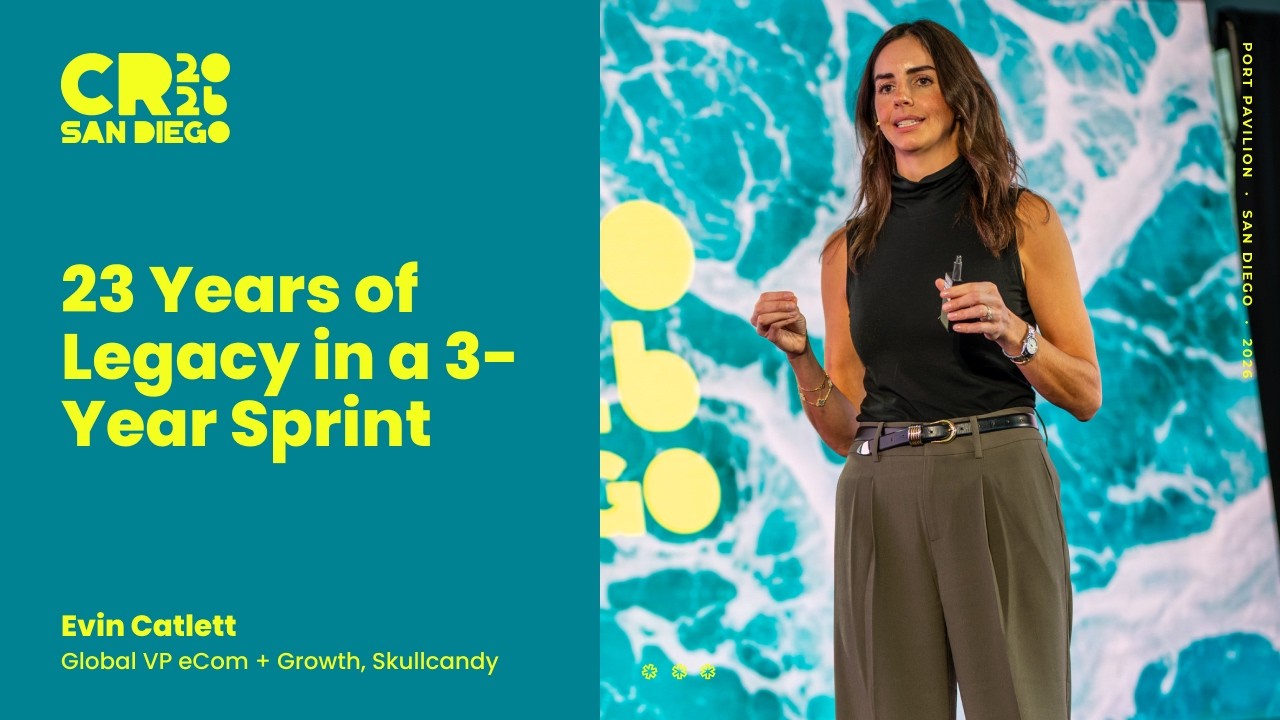
Evin Catlett shares how Skullcandy rebuilt its ecommerce approach around creators, TikTok Shop, and connected retail channels. Learn how to test more creator content, evaluate demand beyond direct sales, and manage product seeding and commissions against margin.
Evin Catlett shares how Skullcandy rebuilt its ecommerce approach around creators, TikTok Shop, and connected retail channels. Learn how to test more creator content, evaluate demand beyond direct sales, and manage product seeding and commissions against margin.
For ecommerce founders, growth marketers, and retail leaders building creator programs or connecting DTC, marketplaces, and physical retail.
Recorded at Commerce Roundtable San Diego 2026, including the audience Q&A. Results reflect Skullcandy’s experience; cross-channel sales patterns discussed in the session are not causal attribution.
Speaker roles and platform examples reflect the session’s original context. This is an archived conversation.
Identify where people discover, evaluate, and buy your product. Build demand and access around that behavior rather than forcing every sale through your own site.
Read this part · 04:55 ↓Use product seeding and commission tiers to give creators room to experiment. Let results guide which relationships and content to develop.
Read this part · 10:29 ↓Compare creator campaigns with branded search, DTC traffic, and retail sell-through. Treat the pattern as a signal to investigate, not proof of attribution.
Read this part · 13:39 ↓Adapt creator insights for paid ads, product pages, email, and retail media so one experiment can improve several customer touchpoints.
Read this part · 15:55 ↓Include commissions, platform fees, and product seeding in the economics. Work with finance to decide when the program can support more investment.
Read this part · 25:32 ↓A quick editorial guide to the key ideas. Read the complete transcript below for the examples, details, and discussion in the recording.
Original recording on YouTube ↗Evin describes a shopper moving between TikTok, search, Amazon reviews, a Target display, and Skullcandy’s website before choosing where to buy. Consumers do not organize their lives around a brand’s channel strategy. Her recommendation is to create demand and make the product easy to find wherever the customer prefers to shop.
Skullcandy rebuilt its ecommerce foundation with a 90-day Shopify migration, email and SMS, a loyalty program, and fewer apps. Evin then describes a shift from a linear funnel to a connected system: content creates discovery and engagement, a purchase can happen in different places, and the resulting signals inform the next experiment.
The old model selected creators, negotiated flat fees, and worked through briefs and revisions. Skullcandy’s creator commerce model seeds products more widely, uses commission tiers, and lets creators test different approaches. Evin frames creators as retail partners who provide visibility and validation. The brand’s job is to create enough opportunities to learn, rather than predict every winning video.
Evin describes a Method 360 earbuds campaign that coincided with stronger sell-through across DTC, Walmart, Best Buy, and Amazon. She also looks at branded search and site traffic. She explicitly distinguishes correlation from attribution: these signals suggest a broader effect, but they do not prove that TikTok caused every retail sale. The team repeats experiments product by product.
Skullcandy learned that more content creates more opportunities to learn, and that native creator videos can outperform polished brand assets. Commission-based creators have a reason to keep iterating. Evin recommends carrying the strongest ideas into paid ads, product pages, CRM, and retail media instead of leaving each channel to learn on its own.
There is no universal channel mix. Evin organizes the system around creating demand, providing access, and learning from feedback. A channel or capability might build trust, deepen a relationship, or make a purchase easier. Start with the job the business needs most and the way its customers shop, rather than adding channels simply because they exist.
In the audience Q&A, Evin explains how Skullcandy treats product seeding as a variable cost that can scale with sales. The team works with finance to account for commissions, platform fees, and samples when assessing margin. Commission rates depend on creator performance and the value of the content. She also describes bringing DTC, Amazon, and other online retail experiences into one ecommerce organization, with shared merchandising and content teams adapting assets for each platform.
From the transcript supplied by Commerce Roundtable, with filler words removed and paragraph breaks retained for readability. This source does not include paragraph timestamps. Refer to the recording for exact wording and the session guide above for chapter times.
Original recording on YouTube ↗Hello, everybody. I'm Evan Catlett. I'm Global Vice President of E-commerce and Growth Marketing at Skullcandy, and I'm really excited to be here today. So Skullcandy Audio is a twenty-three-year-old brand, and depending on your perspective, that could mean we're a cool, iconic legacy brand, or it could mean we are a dinosaur in D2C terms.
And Taylor mentioned it this morning, but I think when people hear twenty-three, when they hear global brand, the assumption is that we have huge teams, we have big budgets, we have some really sophisticated machine that's running everything. But unfortunately, we don't. We are-- We operate as a very scrappy team headquartered in Park City, Utah.
And over the last three years, we've honestly been going through the same challenges, facing the same headwinds as everyone in this room. So that's everything from CAC pressure to diverted attention to attribution muddiness, and throw AI on top of that. Throw what do we do with creators? What do we do with TikTok?
The big difference, though, is that we're coming at it from a place of this twenty-plus-year-old history where we have a lot of assumptions around how we think marketing should work and how we think commerce works. And so that's really the story that I want to share with you today. Over the last three years, we have spent a lot of time learning and frankly, unlearning what has felt like twenty years condensed into one sprint.
So the presentation today is by no means me giving you the formula because we absolutely have not figured it out. But I hope what the takeaway is, is that we have twenty-three years of legacy where we realized the consumer is moving faster than us. And then three years of learning essentially how we catch up
So 23 years in three Skullcandy built a lot over the last two decades. We are the original lifestyle audio brand. We were literally born, invented on a chairlift in Park City. And so over that twenty years, twenty-plus years, we were able to build a lot of brand awareness, a lot of cultural permission, really broad retail distribution, everything from airports to Amazon to your local surf or skate shop.
And we built a really strong existing consumer base. But discovery, but commerce, but where consumers were choosing to be inspired on brands that they wanted to purchase started changing faster and faster. And our challenge was to really figure out how do we make an established brand move as fast as modern commerce does today, and do that without abandoning the legacy and just the permission that we have built with our consumers as a brand So for most of our history, you know, the basic funnel really ruled discovery and commerce, right?
Consumers start at the beginning. You don't have a lot of channels to figure out how to drive awareness and consideration. You've got Google, you've got Meta, you have your email and SMS, you have a loyalty program, you have your own DTC site. But then everything began moving faster and faster, and certainly faster than a lot of organizations are designed to change.
And the DTC playbook changed just as fast. So CAC inflation, signal loss, splintered attention. No one thing reaches everybody at once anymore. Discovery moved. Search started shifting into marketplaces and feeds, and then social checkout just added even more complexity. So individually, none of these variables would have broken our model, but all together we realized it was very much starting to cap our growth because the DTC playbook of yesterday assumes that your consumer's attention is both purchasable and it's also measurable So 20 years of assumptions, three years of unlearning, ultimately realizing that the market was just moving faster than our model, and we had to make a change to the old playbook So what did that look like?
This is Janthavi. She's 24. She is doom scrolling TikTok at 11 o'clock at night, and she sees somebody she follows doing a headstand with headphones on. She doesn't buy. Two days later, she searches for Skullcandy Crushers. Still doesn't buy. Goes to Amazon, reads some reviews on the product because that is where reviews really live today.
She goes to Target, sees Skullcandy on an end cap. She sees it in her TikTok feed again. She goes to the website. She starts comparing Crusher models, and then she buys wherever she wants to because consumers don't have a channel strategy, and that was a really big unlock for us. We realized that we needed to create the demand and then just be present where our consumers are shopping.
So three years ago, Skullcandy was much closer to this lower right-hand corner of the quadrant. We had incredible distribution, but we just weren't creating enough demand to make that distribution work as hard as we could. We didn't need more places to sell. We honestly just needed more demand and more consumers to want us, and that's what these three years have really been about.
It's been about building a modern demand engine on top of what we had, which was a very strong distribution engine, and that's when you can start moving from this bottom quadrant up to the top part where things start compounding. You have demand meeting availability, meeting distribution, and every channel starts making the other work harder
For us, being seen, we had to realize, wasn't the same thing as being wanted. For many years with traditional brand marketing, the goal was to be in the conversation. It was to drive the impressions, to drive the PR hits, just to get eyes, to show up in culture. And what we had to relearn was that presence alone wasn't enough to create that demand.
We needed to figure out how to drive actual consumer pull. So we thought, again, the goal was to be in the conversation. And what we realized is that the bigger opportunity was actually to create that demand system. All right. I hope you're enjoying the replay from Commerce Roundtable. I wanted to stop you for just 30 seconds and tell you all about the sponsor that made this happen.
I see too many Shopify brands overpaying for big email tools and using only a fraction of their features. We're tired of complexity and never-ending price hikes, too. That's why Seguno Email is different. Lives inside of Shopify and uses your shop live data, not a synced copy of that. Plus, the integrations with Sidekick, ChatGPT, Claude, and Canva saves you time.
And get this, Seguno is the only email app to win a Shopify Build Award. Sounds interesting, right? Switching is easy, and you get 20% off for being a part of the Commerce Roundtable community. Link in the show description. Now back to your replay. So we did a lot in three years. We tackled a 90-day Shopify replatform.
We migrated to Klaviyo for both email and SMS. We launched a loyalty program. We consolidated multiple apps into one unified app ecosystem. And all while we were doing that, commerce continued to move closer to culture. And that feed, that clean way we had to reach consumers and just migrate them all the way from awareness to purchase really shifted into one place.
The funnel collapsed into a feed where you have discovery, you have validation, you have engagement, you have purchase all happening in one place. So what do you do with that? You have to figure out how you shift your mindset from thinking funnel and start thinking system. In a system, content is gonna create discovery.
Discovery is gonna create engagement. Engagement might ultimately drive a transaction. That transaction could result in sell-through in any channel that your brand is present in, and then that data in a system goes back into the system to continue iterating and fueling more and more demand. So the way we like to think about it is in a classic funnel, your channels are competing for credit, and it's all about who owns the credit for the impression, for the click, for the conversion.
But in a system, all of that works together, and that compounding effect makes your brand even stronger
We also tried the channel that we very much did not think was for us. I can attest that I was extremely skeptical that anybody would impulse buy a two hundred and seventy-nine dollar headphone on TikTok Shop. But I can say I was very, very wrong. We also thought it's too promotional of a channel.
What does that do to our retail environment? And again, are consumers really wanting to buy consumer electronics on TikTok Shop? But one of the first things that we looked to change as we launched on the platform was really how we approached creators. So our creator model at the time, this was about a year and a half ago, was very much the traditional model.
We spend a lot of time between our brand marketing team, our DTC team, identifying who are the creators that we feel like are right for our brand, that fit that brand model of ambassador. Now let's go negotiate rates with them. Let's give them a campaign brief. Let's ask them to create a piece of content for us that we may honestly iterate with them back and forth a few times.
Then let's have that piece of content publish and be really excited with the outcome. What we realized was while that works, and we still very much do that in some instances, that we needed to shift from this old creator model to a creator commerce model. And in a creator commerce model, you are seeding many creators.
You're not negotiating one-off fees. You are figuring out what are the different tiers of commissions that you need. You are producing high content velocity. You're letting the algorithm identify the winners as opposed to your subjective view identifying the winners. And you're learning from what consumers are engaging with, what's driving them to buy, and then that winning content is getting more and more distribution So we thought our job was to pick the winner.
And again, for us, that meant possibly channels of distribution. It certainly meant pieces of content. And what we realized that was that really our job was just to create enough opportunities for a winner to emerge. We started treating our creators like retail partners. Retail partners give you shelf space in exchange for a transaction.
We started thinking about how our creators could give us visibility, could give us validation also in exchange for a conversion
And for us, this really wasn't just a marketing experiment. So this black bar chart here represents our TikTok shop GMV. So you can see in October 2025, that is when we shifted from this old creator engagement model to this creator commerce model. We started having substantial scale and velocity with that content and really ramped from there.
And what that resulted in was not just revenue, it was fifteen thousand unique creators engaged. It was twenty-five thousand affiliates showcasing us in their TikTok shop. It's three hundred and fifty million impressions. But what's important here isn't the number, it's really how we approach this through the lens of just experimentation, and experimentation being what led to this level of scale
And the biggest unlock for us as an omni-channel brand was what happened when we started testing into specific case studies. So this is an example of a campaign that we launched across a number of creators in February of twenty twenty-six. It was with one specific product, our Method three-sixty earbud.
And not surprisingly, as that content started to scale around this product, we saw this gray line, our own direct-to-consumer s- sales scale. But what was super interesting was that we also saw sell-through scale in correlation in Walmart, in Best Buy, on Amazon, which was huge for us because it really proved that that halo effect with creator demand generation is real.
A dashboard was telling us, "Hey, this was a sale on TikTok. This is TikTok-attributed revenue." But what we were seeing was, again, that retail POS, like you saw on the previous slide, we were seeing Amazon demand, we were seeing increases in branded search volume, and we were seeing DTC traffic increases as well.
So I'm not claiming by any means that every incremental retail sale was caused by TikTok, but the demand signals were so strong outside of the channel that the demand originated in that it was clearly correlational proof that that creator campaign on TikTok was really driving meaningful sell-through increase in other channels as well.
And we've since been able to replicate it in the same way where we test product by product to, to really see the impact of that in our sell-through data So we thought DTC and retail were separate strategies. We have always managed things as you have your direct-to-consumer team, you're gonna have your key accounts team, you're gonna have your specialty retail team, and every team is responsible for driving traffic and conversion in their channels.
Once we started to shift from funnel thinking to system thinking, what we learned was really they are all the same consumer, and consumers don't see channels, and so we need to adjust our operating model to make sure that we are fa-factoring that in and changing our initiatives and focus because of that So let's take a minute and talk about some of the things we got wrong, because this sprint was by no means clean We didn't realize how important volume was to driving learning.
So we got a lot better when we stopped trying to predict which piece of creative was gonna resonate with which audience, and really just started producing enough attempts to find them
We got better when we realized that creator native content was often beating this perfect brand content that took our teams weeks to ideate and produce. And so really what we needed to do was shift away from this traditional creative model and trust that our creators... Sorry, creative model, and trust that our creators knew what was gonna resonate with their audience Velocity matters.
The more creative iterations we gave the algorithm, the more learnings we had from it. And that didn't just mean our campaigns performed better, but it also gave so much more insight to our teams and their ability to start thinking directionally, how do we shift and evolve? And then this was a big one for us Our affiliate economics changed Might have run out of some clicker battery here
When creators were paid on outcomes They started iterating more. They started changing things without us even asking them. So shifting from that sort of flat fee pay-to-play model to more of a commission-based model, it, it meant we had to change how we approached it financially within our team, but it also resulted in much better outcomes.
And then the last piece is that winning content needs to travel. I would say very much gone are the days where we are creating a set of campaigns that will just... or a set of creative that is just used in Meta, that is just used on TikTok. Whatever we're seeing win organically becomes used across any channel that it makes sense.
And so that could certainly be within paid, but it's often on PDPs, it's often in our CRM, and it's something that we are even starting to test using in retail media programs as well
So let's take a minute now to start thinking about how you can shift from thinking funnel to thinking system. And it really starts with looking at whether your commerce engine looks like your consumer. There is no universal channel mix anymore. Literally no universal channel mix. But there is a need universally to create demand.
So the takeaway from Skullcandy's experience is not that you need to have DTC, you need to be on Amazon, you need to force your CEO to do a really goofy TikTok Live. It's very much that your commerce engine needs to reflect your consumer. So don't add channels just because you feel like you need to and because they're available.
Being in a singular DTC channel may be right for your brand. For another brand, they need, may need to be in five, 10, 50 different channels. It's really about thinking, "Where is my consumer discovering brands? How is my consumer evaluating brands?" And then, "How are they buying?"
So when you stop thinking funnel and you start thinking system, you really start to look at, okay, how do I create demand? That's step number one, and that's gonna be across culture, content, creators, in community, in paid. And then it's about creating access. So how do you make sure that consumers are able to discover your brand in the places that they're shopping and evaluating, that they're able to experience your brand in whatever form that takes, and then ultimately buy it in the most frictionless way possible?
And then lastly, in a system, this learning component is s- really, really critical. So how are you ingesting the behavior of your consumer, how they're consuming content, what's driving conversion, what other signals they're giving you, and then feed that back up so that that is truly what's running your system?
And ultimately the goal isn't channel equality, it's really about orchestration. And every part of your system needs to have a job. So once you've built it, some things are gonna create demand, some things are gonna create access, others are gonna build trust or they're gonna deepen a relationship with a consumer.
So think about starting first where the job needs to be done, where it's the most critical for whatever stage of life your brand is, and then figure out what capabilities do that best and start to anchor your system around that And ultimately, that's what allows you to build your playbook. So thinking first, where your consumer discovers you, creating demand there.
Second, how do they experience or buy you? Remove the friction there. And then what can you learn from every interaction, and then feed that back into your system
And do that while making sure you're also building for what's going to change next, because this is an ever-evolving ecosystem. Here are five things that 20 years of a legacy brand taught us, and three years, frankly, made us unlearn. Legacy is an advantage, but only if it doesn't become your operating model.
We realize that, yes, cultural relevance, brand awareness, retail distribution are huge assets for us and nothing we ever wanna take for granted, but they're that much more powerful if we're willing to rethink how we activate them in a system instead of in a funnel with a focus on what channel takes credit for what
Your consumer is going to change faster than your playbook. Platforms are gonna change. Discovery is gonna change. Shopping behavior is gonna change. AI is gonna make a mess out of all of it and change it all over again. So we need to think of it not as how do we master the playbook, but how do we build a company culture around testing, around learning, around adapting, and around moving faster
Think of new channels like laboratories. Don't think of them like prescriptions. TikTok Shop is our case study, and it is by no means my recommendation to you unless that is where your consumer is, and that is how they are discovering, engaging, and buying products. So for us, what mattered about TikTok Shop is that it forced us to challenge the way we were thinking about channel, the way we were thinking about consumer engagement, and then learn and adapt from there
The goal isn't to be everywhere. The goal is to create demand first and then make it easy for them to choose you. So again, as you think distribution, it may be completely valid to only have one point of distribution, but you need to make those decisions based off of where your consumer is and where your consumer is showing you that they wanna discover and buy from you
And then lastly, consumers are not moving neatly from awareness to consideration to conversion to loyalty anymore. So the funnel is not going to work to build your brand. You need to make sure that you have a system in place that meets the consumer in whatever channel and at whatever stage of their buying journey that they are
So at Skullcandy, 23 years built our brand. Three years really taught us how fast it has to now move. And if there is one thing I hope you take away from today, it's that none of us are going to find or develop the playbook and be able to run it for the next 20 years because that just doesn't happen in modern commerce anymore.
Consumer behavior is changing. The platforms are gonna change. AI is continuing to change discovery. So it's not about having the perfect channel mix. It's not about building the perfect funnel. It's about building a system that creates that demand, that learns from the consumer, and can keep evolving your brand as your consumer does Alright.
Thank you guys. Evan, thank you.
This didn't happen overnight. Like, it, it, it's pretty difficult to get... Oh, actually, I know BG very well. BG is one of our leaders, your leader. How long did it actually take for you guys to be like, "All right, we're fully adopting this approach," or, "We're leaning into TikTok"? Were they kind of hesitant, or was...
How was that conversation internally? Yeah. So for those who were in Taylor's session this morning, our CEO, Brian Garofalo, joined the team in February of 2023, and basically did a complete leadership overhaul. And the intent there was exactly what I pointed out at the beginning, this realization that the consumer was moving faster than we were as a brand.
And if we wanted any hope at not just keeping up, but actually growing, we needed to make some changes and make them fast. So while something like TikTok Shop maybe didn't come to be until May 2025, the mentality and that sort of permission from leadership to, to move quickly, to sort of live in this state of experimentation, I would say, came from BG joining as CEO in 2023.
Do you... 'Cause I'm a big funnel guy. I'm like, "Hey, I want this one specific consumer going through this specific experience." I'm not ignorant to the fact that they're gonna leak and go everywhere else. How do you view the product portfolio of, like, what you're going to lead with? Like, is it gonna be the earbuds?
Is it going to be the speaker? Is it gonna be over ear? Do you look at these? 'Cause they're kind of different enough to where they need to have a different type of consumer. Yep. How do you view the three? Yeah, that's a good question. So we are a multi-category brand. We've got speakers, we've got headphones, we've got earbuds.
Some people will only ever want to purchase from one category, but it goes back to that content velocity. It goes back to having the pieces of content, whether that's through creators, whether that's through your, your own branded content, available to a consumer when they might be ready to wanna learn more or to buy from that other category.
So it's about the volume, and it's, it's not about making assumptions that you, Nick, as a headphone purchaser, will want this next. But it's about being ready to serve you that next category or have that content out there for you to see and be inspired by, and then hopefully wanna purchase. Dude, now I fully regret not giving away Skullcandy.
Right? Like, we just gave away Apple products all- I'm not even gonna talk about that other brand that's over there ... How disrespectful. I'm... God, that's Jimmy's fault. Jimmy Questionable, buddy. you're already getting a couple of questions, so I'm gonna let you read this first one. As you scaled TikTok shop affiliate programs, what item and cost were you trying to distribute as samples?
This is a real good question. Yep. That is a great question because I think one of the concerns that people have with TikTok Shop is how do you scale this profitably? for us, it all goes into our bottom line calculus category by category. So we set a budget, and we make sure that we are sticking to that budget but also view it as a variable cost of sales.
So if what we're seeing is that more product seeding is leading to more purchase, let's keep fueling that and, and don't pull back. In other areas, if it's not, then you need to rethink your strategy there. So that's, that's one of the main ways we've approached that. Do all the TikTok creators get products from you for free to produce videos?
Is that your product seeding? No, they don't. So we've tested out a couple of different options there. Some get them for free directly seeded by us, some are requesting it from TikTok, and then some are even paying for that, and they're then hoping that if they're able to create a piece of content that drives conversion, that they'll be able to get commissioned on that.
So we, we use all three routes. Really good questions. Thank you guys so much for keeping these going. They talked... They've encountered many creators that want the money upfront or are not as motivated to post the product as much as we would like them to. How do you motivate? How do you manage this? Yeah, that's, that's a great question.
And again, it all goes back to just how these creator economics are shifting. You will always encounter creators that push back against that. And one of the things we do is also try to help educate that, yes, there may be a scenario in which we could do a one-time pay-to-play, but here the- here are the advantages if you take a commission model, and how much more that could potentially scale, and, and scale over time with more pieces of content that you create.
I'm gonna go to the third question. It says, "Can you talk more about your affiliate economics?" And is, is more of a... Is that a more of a deeper kind of situation, or do you want me to skip through that? Yeah, I mean, I'm, I'm... This is probably a great, like, happy hour on the, on the deck conversation, but I will say we're continuing to test and learn in this space for sure.
at the end of the day, we need to hold ourselves accountable to a margin target. So while affiliate economics change, they still have to work in our mix, and it is a constant balance of figuring out, you know, what bleeds out for a creator commission, what's going to Tik- as a TikTok fee, where do you calculate the product seeding costs?
but I think the biggest thing there is just continuing to, to test and learn and, and working really closely with whoever your finance counterpart is, maybe that's even yourself, just to make sure you're really confident that those economics are working in your model. Ev, you have so many questions.
I'm gonna keep going. Is that okay with you? Yeah, yeah. Good. Okay. How do you allocate budget for the product seeding? You kind of briefly talked about this. How long did it take for the seeding to really start producing quality content on any sort of basis? Yeah. So we now, as I mentioned before, we look at our product seeding line in our budget similar to our tacos line.
So product seeding is a variable cost of sales and can scale up or down depending on the GMV that we're seeing on TikTok. Now that we're seeing this halo in retail as well, we're, I wouldn't say we're yet at the place where we have a blended ROI on wholesale sell-through and DTC sell-through, but we're getting there I think the, the big thing there is, again, just making sure that you are looking at it as a variable cost and not a finite cost.
Because when something does take off, which sadly I don't think any of us can predict, it would be great if we had, and maybe the TBar guys can. But, when you can see something take off and lean into that more, what we've honestly seen is that a lot of other creators will try to replicate that piece of content, and they'll be paying for the product on their own.
They'll be buying it somewhere- Mm-hmm ... and then creating that video and hoping to earn a, a commission off it, and that's where you start to see a lot of that content velocity really start to come into play. Yeah, that's interesting. Okay. what payment structure works best for your content creators? Any, any percentage tiers you can share?
Yeah. So again, we're always playing around with this. when we look at the commission structure for creators, some of it's gonna be based off of just what success they've had as a creator selling on the platform before, what level has TikTok ranked them at. But a lot of times it changes too. We may see a creator's piece of content take off and say, "Hey, we're actually gonna increase your commission here.
Do more for us in the future." or, "Hey, we really wanna repurpose this content in other channels, and so we're, we're going to incentivize you at a slightly higher commission rate to account for that." So it's, it's definitely something that we vary depending on the situation. All right. This is my last one for you.
Thank you so much. Yeah. You mentioned shifting your workflows and even your team structure to align with retail and DTC no longer being separate channels. What changes did you make? I would say the biggest change and organizational shift we made was we actually consolidated Amazon and DTC and really all of our online retail experience under one brella- umbrella.
So whereas before, again, we would have a channel marketing team that's building PDPs for Best Buy that's gonna be different from Walmart or Amazon, that now sits in one e-commerce organization. So we have site merchandisers that are looking after our own direct-to-consumer site, but they're also looking after TikTok, walmart.com, bestbuy.com, amazon.com.
Same thing for the content side of things. Yes, there are nuances around what product carousels need to look like on Amazon versus your own website, but they can still come from the same team. And so I think not only did that buy us a lot of efficiencies just in terms of who's looking after these things, tons of synergy by having it all sit on one team, but it's a lot easier for us to take learnings and nuggets of good that we're seeing in one channel and then apply those to another channel.
Ab, thank you so much for your time. Awesome. Thank you. Thank you.
Join Commerce Roundtable in 2027 for focused learning and conversations with people working through the same challenges.