 42:03
42:03San Diego · 2024

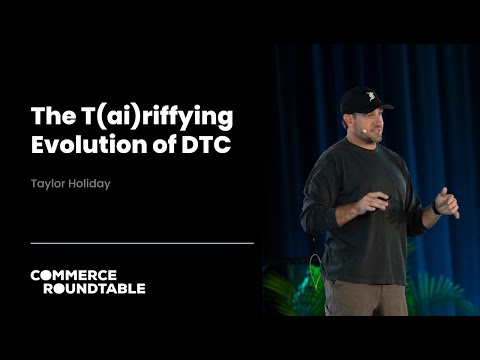
Taylor Holiday examines how capital, competition, inventory, and changing acquisition economics reshape DTC growth and why marketing needs a closer relationship with finance.
Taylor Holiday examines how capital, competition, inventory, and changing acquisition economics reshape DTC growth and why marketing needs a closer relationship with finance.
For founders and growth leaders adapting the business model to tighter economics.
Speaker roles and platform examples reflect the session’s original context. This is an archived conversation.
Revisit the assumptions behind inventory and acquisition plans when the market changes.
Read this part · 02:28 ↓Review overhead and contribution together before setting the next revenue target.
Read this part · 09:34 ↓Identify the product or positioning advantage your media plan is supposed to amplify.
Read this part · 24:47 ↓Plan the product story, expected demand, and inventory together.
Read this part · 29:56 ↓Give aging stock a deliberate promotion and liquidation plan tied to cash recovery.
Read this part · 36:05 ↓A quick editorial guide to the key ideas. Read the complete transcript below for the examples, details, and discussion in the recording.
Original recording on YouTube ↗Taylor looks back at the unusual conditions around the pandemic: demand, funding, and pressure on supply chains. Brands made inventory and growth decisions inside that environment, then had to live with them as conditions changed.
The point is not to blame a single channel for every difficult result. Higher financing costs, changed demand, and competitors clearing excess stock can all affect the economics a marketing team sees. A plan built for a previous environment may need more than a new ad.
The talk connects a leaner operating model with clearer financial expectations. Costs that were manageable during rapid growth can become a constraint when growth slows. Marketing decisions therefore need to reflect the business the team is actually running now.
A useful plan makes those constraints visible. Look at contribution and cash alongside revenue so the team can distinguish productive investment from activity that only sustains the appearance of growth. Adaptation requires changing the operating choices as well as the forecast.
Low barriers to entry make categories easier to copy and margins easier to compete away. Taylor uses Born Primitive to discuss product direction and differentiation in a crowded market. More demand capture is not always the answer to a weak competitive position.
Ask why the customer would choose this product at this price. A distinctive product and story give the acquisition team something stronger to communicate. Without that, each competitor’s willingness to accept less margin can put pressure on everyone else.
The case discussion ties the story of the product to the business opportunity behind it. Marketing is involved in how the product is introduced and adopted, not simply the number of ads launched after it appears on the site.
That requires collaboration across teams. Product, inventory, and marketing need a shared view of what demand they expect and how they intend to create it. A strong narrative is more useful when the rest of the plan can support the response.
Taylor describes a progression in which promotion and liquidation become more deliberate as inventory ages. An ad-account decision may make sense because it recovers cash from slow stock, even if it looks different from a normal acquisition campaign.
The comparison is against the realistic alternatives for that inventory. Recovering cash can create room to buy products customers actually want. Supplier terms, contribution forecasts, and the balance sheet consequently become part of the marketing conversation, rather than information held elsewhere in the company.
From the recording’s auto-generated YouTube captions, with filler words removed and paragraph breaks added for readability. Names, numbers, and wording may contain caption errors; refer to the recording for exact phrasing. Chapter links jump to the text below.
Original recording on YouTube ↗0:00We have to ask ourselves what did we learn? What skills did we develop? We've lived through this. We know what co generated a massive [music] influx of capital. Maybe it wasn't perfect. Maybe it was sort of faux demand. Maybe we cared a little bit too much about revenue. But we learned how to spend money. We developed the skills of growth marketers in that time. The deployment of capital is a skill. What I'll tell you is spending money is a skill. If you hire a media [music] buyer that's come out of a place where money was scarce, they are terrified to spend money incorrectly. If you come out of a place where money is abundant, they know how to deploy capital. Now, the problem with [music] growth in e-commerce is it's almost directly correlated to the availability of capital. Growth stalls when there's no available capital because you have to self-fund all of the growth.
1:06There we go. That's a pretty intro. Thanks, Jimmy. Thanks, Nick. okay.
1:11Today we are going to take a class in evolutionary biology. Just what you all signed up for right here. and we're going to talk about the terrifying evolution and how we are going to progress as a species of DTOC brands. And I got to be honest, when I saw the speakers list, the idea of progressing as a species was kind of front and center because you had me, you have Gary, you have Ezra, I was afraid that Nick was scheduling like to push us all out on an iceberg at the end of it.
1:38because we are been around a minute. But what that means is when we have the benefit of spending a lot of time in an industry, what it means is you see a pattern emerge. You get to watch things play out over the course of 15, 20 years and you can begin to develop an understanding of how the environments that we operate in develop skills in us that become critical to how we improve. and that's what we're going to look at today. We're going to go on a journey through the eras and we're going to talk about how each era of DTOC has developed in us skills that are critical to what we're becoming. And if you follow me in in my content, you might have experienced me to be a bit pessimistic right now today. And candidly, I am.
2:21It's not a great environment for e-commerce. But today, I have a more optimistic view that I want to share. And it's this thesis. It's the idea that
2:29the extreme environments that we've lived in for the last 5 10 years have forced evolutionary changes in brands that will lead to the coming year and the coming era being the best in DDC history. Now, to clarify what I mean, I do not mean that we're going to experience a COVID rising tides, lift all boats, surge of demand that's going to make everybody win. But the winners are going to be the best ever. We're going to see positive returns in the public markets. We're going to see continued M&A activity. We're going to hear of operators driving tons of cash flow because we have evolved skills for this world through our pain. And I'm going to talk about that today. But first, I'm going to tell you a little story because that's how I like to work.
3:13So, this is my kids. That's Hayden and Jet. They're my twins. This is us when we won the Costa Mesa Little League Championship this year. It's my most important job. The thing I care about more than anything else is hanging out with these dudes and playing baseball. and coaching 11 and 12y olds is also a lesson in evolutionary biology. Anybody have some pre-teens, some stinky feet, and some smelly rooms? They're going through some of their own changes, right? biology is beginning to kick in.
3:39And what that means is that if you get a teen of 12y olds, you get wildly disperate size, smell, attention, physical traits. And if you look at my kids right there in the center, you'll notice like a cascade of height out the opposite direction. They're going to be the smallest forever. That's what I've given them. That's my gift is they'll get some loquaciousness and maybe a little charisma, but not much height. That's what they're in doomed for. Now, if you look on the other side, alternatively, this is Babe Ruth right here on the right. This kid hit 963 with 12 home runs. I think he threw three perfect games. He put on paper the best little league season probably in the history of the sport. Really incredible.
4:18And if you put him next to my kids, you'll get a sense of just what a wild justosition that is. How are they the same species competing on the same field? Wildly different. Now, this isn't just about puberty. This is also the fact that their genetic makeup is going to be small. My experience like this is very similar. This is a photo of me next to Bear Handland. So Bear is a client of mine for 10 years. Yes. An agency client relationship that has lasted 10 years.
4:45He's the CEO and founder of Born Primitive. he's a Navy Seal. and someday when they dig up our bodies, there's no way they're going to think our skulls are from the same species. Look at that man's head. It's insane, right? So most of my life is spent around people like this where I go, man, I'm really glad he's going to war and not me. And I'm really it's it's hard for me to understand how he is so imposing physically.
5:12And Bear's actually going to be our inspiration today because he's not just about his physical presence. It's also about his brand and the way that he has evolved over the 10 years that I have known him to adapt through each era to build the best version of his business today. And we're going to use him as an inspiration to learn from to understand what traits we need to adapt and evolve in order to succeed in the coming future. But first, we have to
5:39go backwards. We have to ask ourselves what did we learn? What skills did we develop? And what does that mean about us today? Now, I'm not going to labor on this too much because we've lived through this. We know it. We know what co generated a massive influx of capital. 2021, there was $5 billion of venture capital that flowed into our industry. Suddenly, the alltime the interest rates were at an all-time low. There was an abundance of free money from all of our friends that used to sponsor these events.
6:09No offense, but they were giving it away. And the demand was through the roof. We saw this is from a blo blog article we wrote during COVID all-time highs and demands. It was Black Friday in April. All the stories that we live through. So the question is what did we learn in that time? Okay. So maybe it wasn't perfect. Maybe it was sort of faux demand. Maybe we cared a little bit too much about revenue but we learned how to spend money. We developed the skills of growth marketers in that time.
6:35The deployment of capital is a skill. And what you saw was you had a lot of things like this. So, this is Jordan talked about cohorts earlier. This is a very similar idea. Let's see if I can laser this. Not going to work that way. I'm sorry for the people in the back. I was expecting the horizontal layout, Nick, and you went vertical on me. So, if you're in the back, I'm going to explain. On the left, how many new customers? 2020. January, 4,000 new customers at a slight loss. By April, that's 6,600. By the end of the year, it's 24,000 new customers in a month.
7:04All wildly profitable. Tons of deployment of capital. This was the skill that got developed. We developed the capacity to spend money. And I've hired a lot of media buyers in 12 years of running an agency. And what I'll tell you is spending money is a skill. If you hire a media buyer that's come out of a place where money was scarce, they are terrified to spend money incorrectly. If you come out of a place where money is abundant, they know how to deploy capital. And it's a skill and we evolved it as an industry. And on top of that, we also I'm going to skip this. We're going to come back to that later. We also developed the capacity to produce.
7:36The other thing that happened is we had to ramp up production. We had to make more stuff faster. We had to fulfill it. We had to get it from point A to point B. And so we learned how to make and we learned how to deploy. That's what we learned in CO. And the end result was we grew topline revenue really, really fast. So we run a data aggregator called the DTOC index. If you go to DCindex.com, you can follow us along.
7:58It's a combination of three different brands. Veryos, ourselves at Common Thread Collective, and no commerce. We aggregate about 12 billion dollars of GMV every year. It's a really large data set that we pull this information from. And you can see that prior to COVID, the average store was growing about 15%. COVID hits, it jumps to 60% in 2020, 70% in 2021. The average store was growing that rate. So most stores were growing hundreds of percents. We all remember it. We lived through it. What does that mean? During that era, we developed a defining metric of topline revenue. We had an average performance of 60% topline revenue growth. Probably had a negative IBIDA. All the funding came from venture capital and cheap debt. And we evolved the skill of growth marketing. and we took it with us into the next era. And we had a hammer and everything was a nail and we were just going to whack it. Even still today, there's a little bit of that in us, especially in this room. There's a lot
8:47of hammers in here. But what happened was in 2022, it turned off like a switch. I don't know if you remembered it. We experienced it in our business. The summer of 22, July of 2022, I laid off a hundred people inside of Common Thread Collective. It was a horrible period of time. All of a sudden, everybody's spend a ton to not very much overnight. iOS retail opening back up, venture dollars leaving, interest rates rising, all of it culminating. But yet, everyone was trying to grow off of this base. We had a 70% year-over-year growth comp. We had to grow. And we're just going to pound and pound and pound and pound. And those cohorts become more and more and more and more negative, and the growth slows down. All of a sudden that 70% growth turns to 30%.
9:36And this brings on what I call the Ompic era where all of a sudden we have to learn how to get lean. There's no more money. All the venture capital as quick as it came in, it ran away. Said, "Thank you very much everyone. I've had enough of this. I'm gone." 97% deduction from 2021 to 2022 in dollars flowed in the industry. Interest rates skyrocket. the cost of acquisition just keeps going up and up and up in attempt to grow off of the previous baseline. You had to comp it. You had to grow again. And so brands were taking worse and worse and worse acquisition. The end result was you had a 97% decrease in venture funding, 195% increase in the cost of debt, 130% incre decrease in media efficiency. And remember the skill other skill we learned? What was it? We made a bunch of We made tons of it and we shipped it all here because it was backed up. The supply chain was backed up and so we needed more. This demand's
10:34going on forever. Make it, make it, ship it all to us. And all of a sudden, we were flooded with supply that didn't match demand. The byproduct was discount rates skyrocketed. If you go look in any category, especially like look in the outdoor space, something like that. Go look at standup paddle boards as an industry and follow the price changes over time and you'll see a wild influx of demand, a massive supply of competition. Demand falls off a cliff and all of a sudden it's a race to try and liquidate inventory. So part of the reason you can't drive efficient CAC is because everybody's undercutting on price.
11:05Discount rates growth are through the roof and growth continues to slow. Now, the problem with growth in e-commerce is it's almost directly correlated to the availability of capital. If you're running an e-commerce business and you're profitable, even let's say you run it 6%, 7%, 8% IBIDA, what that might mean in a translation to free cash flow is something like 2%. 3%. after you get out of taxes, after you get out of all the obligations that go on top of that money, the interest due on whatever debt you have, any capex charges that aren't included. What that means is that the availability to go out and purchase an increase of supply, right? If I'm going to grow my business, I have to take money and I have to go buy more inventory in excess of the previous purchase of inventory with a smaller amount of money than I started with. Growth stalls when there's no available capital because you have to self-fund all of the growth.
12:02On top of that, some of these people were just so bloated on the OPEX side that they didn't make it. And there was tons of deaths, right? 22 to 23, tons of bankruptcies that you read about, lots of layoffs, people right sizing staff, a lot of this, which is this is new customer acquisition over time for a very large e-commerce brand where it peaks and then all of a sudden it just declines because you're trying to depend on your existing customer revenue to drive profitability. So you cut back on marketing spend and it's on a death spiral and in 2024 our average growth rate as an industry was only 10%.
12:39So you ride it all the way up and then 2024 is worse than pre-COVID because we are dealing with the consequence of an excess of supply and limitation of demand, bloated opex, no available capital, all the problems. the availability of capital in 24 is worse than 2019 because by 2019 everyone didn't know yet whether this would still work and so there was optimism hope possibility 24 that's all dead it's gone so as we started the year
13:07I wanted to get a sense of the state of the financial reality of our industry so we know topline revenue growth has slowed but what's happening underneath it so final loop accounting platform in our space Leo's a good friend we work closely with them on a lot of data projects and so I had him pull 500 8 figureure brands And I wanted to understand the financial reality of those businesses at the start of 2025. This is what we saw. Okay. Net sales, so think of this as after returns, after discounts about 87%.
13:38Median gross margin about 57%. Median contribution margin about 28% and median IBIDA about 7%. So coming into this year, you have median Ibida on an 8 figureure business. Forget seven figure stores where it's an even more of a blood bath. Eight figure stores healthy have existing customer revenue that they can rely on. Median Ibida 7% growing 10% as a business. That was at the start of the year. But the problem we all know is that the worst is actually yet to come. This is from Lululemon CEO. Their stock just tanked on the most recent quarterly earnings.
14:12And this was the statement that he made. It's going to get worse. And the reason for that is because tariffs, which we all know became a big story this year, have yet to really affect our P&Ls. So there's a lagging effect to the realization of revenue. One of the things that's an interesting data point is the median cash conversion cycle of an 8 figureure e-commerce brand is about 92 days. So practically what that means is that the median onhand available inventory is about 3 months of supply.
14:38So what that means is that tariffs which started in April or for some of you started when Dominus closed or maybe somewhere in between depending on where you were manufacturing. you've got some amount of inventory that you're working through prior to the realization of all those duties and the change in COGS and so it's a lagging effect and so it's yet to show up. So this sort of just illustrates if the tariff policy begins 90 days after that the P&L impact begins. And so for somebody like Lululemon they're like hey just warning you it's going to get real bad because we're going to realize all of these duty effects in the coming months and this idea that we're going to be able to pass it purely on to the customer is just not real. Now in part we may be able to and some of us are in more inelastic pricing spaces than others but for most what we're seeing is that about right now 64% of the companies are eating the tariff 22% by the customer and so that's being
15:31distributed some by your own profitability and some by pricing changes. So particle you guys know particle in our space they do this cool little inflation tracker that they track on their website that's sort of an index of all the prices that they look at across all the things. This is what it looks like since tariffs. That's not good. That's inflation in our space of price over time. What happens when we just raise all the prices? Do you think customers are like, "Yeah, freaking awesome, guys. We're just in. We'll be in more than ever." Nope. You get a corresponding lag in consumer demand as inflation increases? They feel poorer.
16:04They can buy less things. It's a bad indication. And so, one of the things that we do is we build the DTCCI, which is the direct to consumer confidence index. Every month we survey 5,000 customers about their sentiments about the economy and their plans to spend in the future or the past. So what this shows is a question about whether they plan to spend more or less in the future. And you can see for the last two years the pan the pattern's pretty similar. It ramps up right ahead of Q4.
16:29They say we're going to spend a ton and then afterwards they say we're not spending anymore. And the green line is just where we're at now. Same pattern, less spending. This is the self-reported online spending habits just graphed and visualized in a different way where you can see where we're at today relative to the past. So, we've got worse COGS, we've got soft consumer demand, and we've got continued rising CAC. This is the graph of just the underlying data of all of the customer acquisition costs on average for all the brands over time.
17:01So, that's a bad combination of things. rising CAC, worse COGS, worse consumer demand. How does that produce a better future? Well, the funny thing about
17:12change, and I learned this, I don't I don't know if you guys have ever gone through real hardship in your business, like the one I talked about where I had to lay off a hundred people. Well, one of the things about being just okay is it doesn't really force you to change anything. When it's just okay, there's no real impetus for change. And this is the thing about evolution that I find to be fascinating is that it's the impetus for survival that leads to adaptation. It's the I will die if I don't that creates change. It's where we are. We're in the I will die if I don't right now today. And that's why I'm so sure that we're going to get better because I see it happening. The reality is if the CAC's going to rise and your cost of delivery is going to go up, there's only one release valve that exists. And I'm seeing brands act on this already. This is Cody. You guys know Cody. This is a tweet he put out
18:02early in the year. This is the year of efficiency and cost cutting at Jones Road. Across the or we have initiatives of getting staying lean and having improved both gross margin, landed gross margin considerably and opex considerably. Here are 11 things we've done to lead the blah blah blah. And then he goes on to talk about the suddenly becoming CEO changed his mind on full-time employees versus out stores and leverage. But he's just one example. What about the data? Well, if I look at Q2 across all of e-commerce brands, despite the pending future of issues related to COGS, brands are getting lean. You're starting to understand that opex is not a person gain. It is a business that you have to find labor leverage in. And so, opex is being reduced in every imaginable way. That affects service providers, that affects software vendors, that affects all time lab the labor market. Every podcast you listen to is rich panel telling you how they're going to help you fire 50 people. It's like literally every podcast is like, "Hey, hire us and you
19:00can fire half your people tomorrow." That's where we're at is that people understand that the mechanism for profitability, I can't make to Jordan's earlier point, you can't just make the cat go lower. You're a market taker. You're not a market maker. So if you can't move that lever, where do you find relief if cogs are under pressure? So in the Ozepic era, the defining metric becomes IBIDA. Suddenly everybody cares about profitability. Our average performance slows. We're about 20% revenue growth on average over the last couple years. About 6% IBIDA. The funding is yourself and you involve the skill of finance and operations.
19:39Okay. But suddenly this is a pretty powerful combination. I had growth marketing. I'm learning finance. I'm learning how to operate lean. Ah, suddenly you're becoming powerful. Suddenly you're beginning to understand the way in which this kind of business becomes how you survive long term. And this is how we reach our flow era where we learn to produce free cash flow. It's the ultimate ascension of the kind of the metrics that we use as a scoreboard for our businesses. was revenue then it's IBIDA which is just sort of a made up P&L game to ultimately can I grow the money in my bank account can I actually deliver shareholder value to people can I distribute cash to myself could I actually make some money it's the ultimate endote of the game and Bear's a great example we're going to talk about him bear at the peak of this graph in 2022 okay they had the same growth rate as everybody else 2019 2020 we're rocking and rolling 2021 Oh, 2022, 2023. At the peak of that, they were in
20:41the process of looking to sell like everybody else. They were doing multiple eight figures in IBIDA, but had paid 0 in dividends. Okay, zero dollars in dividends. And in apparel, this is not abnormal because it's a very inventory intensive business. But they just kept buying more and more and more. And so, he's looking at his business going, I feel like I'm making a ton of money, but I'm broke. I have no cash. I'm not able to pay myself anything.
21:06the sale didn't end up happening. 2022 happens, the business goes backwards, and all of a sudden, he decides, I can't do this anymore. I have to build it a different way. The impetus for change. So, he evolved five traits that I want to offer to you as traits you could evolve that could help you reach your flow era wherever you are at in this journey. And some of you are more advanced than others, for sure. The first one is
21:32constraint. This sounds like a simple idea, but it's almost impossible for people to embrace. And the danger is that we all absorb so many anecdotes about what could be somewhere else. We all go talk to a friend and their rowass is a little bit better and then they're spending a little bit more and this is possible and maybe if we just do in the business, we could get this efficiency back down and but if we just keep spending we'll get there. You come up with all these reasons why you just push the boundary out a little further and a little further and a little further. And this was happening in this, right? We saw this story. It goes good and then I have to grow and it goes worse and I go I have to grow again and it gets worse.
22:15And all you do is you move the goalpost. You move the goalpost. Your marketing team comes to you and says, "This is what's available. This is the CAC I can get." And you look around and you go, "I don't know. I guess maybe this is just the reality now. I have to now lose $99 to acquire a customer." That's not that's not even remotely viable. That won't pay back in any lifetime. And BP was on the same plan. In 2023, Bear came to us because 2022 was down.
22:38He said, "I have a goal. My goal for the business." Bear's like big he likes metaphors. And so he goes, "We're going to fill the Michigan big house with new customers this year. 120,000 people can sit at the University of Michigan football stadium." And so we every call we all had to have a Zoom background of the University of Michigan Big House. And it was this big unifying moment. And we went after it. We started the year and we spent money. And then the next month we tried to spend more and we tried to spend more and we were finding ourselves on the same hamster wheel that all those other businesses before us were going to be on. And to bear his credit, he stood up. It was in March he called me or in April and he said, "We're not going to do this anymore.
23:15The new rule is you don't lose money acquiring a customer. That's the new rule. And if you fail at it, I'm going to fire you." Eight years into our relationship said, "Fair enough." The constraint bred a creativity and new way of thinking. The line in the sand became this is not an option anymore. So what are you going to do in light of that? Now this is so important. This boundary, especially as leaders, okay? Sometimes our job is to stare at our team and go, "That thing you think is impossible is now the expectation.
23:52And if you can't, I'll find someone who will try because that's the rule now. And that constraint in this moment, I'm telling you, unlocks a change in the way that everybody behaves. Because instead of a bunch of reasons why the CAC is getting worse, we just remove that discussion. We just say we don't talk about that anymore. We don't do that. That's not how we behave. And as a result, what happened was it changed our thinking entirely. And I'm going to talk about that now. And this was the end result. from that day forward. Okay, we never were unprofitable again in new customer acquisition. And and we grew new customer acquisition by more than 50% year-over-year for consecutive years. And we're going to do it again for a third straight year. And we never violated again the first part four profitability. We changed our way of thinking about the thing entirely and it worked. So I'm here to tell you that if you draw this constraint, the boundary will create creativity in your team. And
24:47this is where it led us. So the constraint led to a new form of thinking that push us down different paths. We didn't talk about account setups or or testing or blah blah blah. We changed the form factor of thinking entirely. It started with this product not meta as growth. You guys are going to get tired. This is going to be a narrative that you're hearing it on the operators podcast. You're hearing it everywhere. This is the reality is that one of the hard things about our industry is there's basically zero barrier to entry in every p product category and all the profits get competed away over time.
25:19That is the every SER page is literally designed to eliminate every cent of profit and move it from the competing bids into the pockets of Google and Meta and Amazon and everywhere else. And as every category matures, somebody is willing to take less and less and less and less profit and push their demand capture out further and further and further down the line. And in every product category with no moat, no barrier to entry, no IP, all the profits get competed away. So I'm going to give
25:52you an illustration. Born primitive sold women's fitness apparel. At the start of 2023, this was their share of business by product. Women's leggings were 20% of the business. Sports bras were 15. You can see the mix. The point is that it was a women's fitness company. Okay. Anyone ever searched for leggings? This is an absolute bloodbath of the biggest brands in the world all undercutting each other on price constantly willing to bid more than you to sell products with, let's be honest, not much differentiation.
26:28There is no CAC add creative change to this environment. This gets competed down to nothing. Maybe you catch a trend for a minute. Maybe your Tik Tok video takes off for a few weeks, but the economics of this product category on the open internet get deteriorated down to nothing. And this is what was happening to Born Primitive. The other problem with leggings, it's a seasonal product. I don't need to wear them in the summer. So, Born Primitives business followed the seasonal patterns of leggings. And what's the problem with being a summer brand with a massive Q4 peak? If you have a summer brand that's really low and a Q4 peak that's really high, what's the problem? Cash. When do I have to place my PO for Q4? At the moment, I'm getting the worst performance possible as a business. That means you're going to find yourself taking the worst terms or you're going to have to forecast further out because you don't have it which is going to increase the error bars on your forecast and all sorts of
27:30things. And if you look at their business, this is what it looked like. You could see that early in the year there were peaks, a lot of demand. The summer money months got really soft and then there was big MQ4. So when you think about product development, you have to think about solving all the problems. This isn't just solve CAC. This is how can we solve cash. Remember the game we're playing is cash flow. So how do I solve cash? We build a peak in a valley. This is how they did this.
27:58Okay, they started with a shoe. So the Savage One training shoe. This was the product that they introduced as a novel net new category. Shoes pretty good online product. They have good gross margin, higher AOV. They had an overlap to their existing customer base. So they knew they could get some demand off of that as well as drive net new customer acquisition. not inherently a summer product necessarily, but I'm gonna explain how we handled that in a second.
28:22And this is what it looked like. Okay, so I want you to think about every one of these lines as the sales of an individual product category. Okay, the blue is leggings. The dark teal at the bottom is shoes. As we go through the year, what happens? The decline in leggings is offset and subsidized by the growth of shoes. That's how you create growth is you don't try and sell more leggings in June and scream at the ad account and post on the Twitter, why is my ad account down in June. It just doesn't happen.
28:55You subsidize it with something new. And the end result was by launching shoes. By the end of 2024, almost 17% of the business was now coming from shoes. They all offset all of the decline from leggings and they went, "Aha, this is the future." And so they didn't stop there. Bear went full Navy Seal. Most of their customers were already first responders who were into CrossFit. That was kind of their initial four-way. They launched a tactical line.
29:23They launched an outdoors collection. And just last month, their growth strategist, Garrett, sent me this message. He said, BP's top 20 SKs in August, literally zero active wear in the top 30, even all Savage One, outdoor hunting pants, and tactical pants. Crazy. They walked away entirely from degrading category with no product leverage and said, "How could we take the brand that we've built with an understanding of who the customer is to bring them something new and novel that can allow us to continue to grow?"
29:56On top of that, they embraced story, not iteration. There is an endless narrative in our space about the idea that you are going to iterate your way to some massive unlock in the ad account. I don't believe it. I've been doing this for 12 years. I've never seen anyone produce a consistent capacity to make an ad, read some metrics, change it, change it, change it, change it, and grow your business forever doing that. Doesn't work. I I've just never seen it happen.
30:28David, you cannot bore people into your product. You can only interest them into buying it. This is what BP lived in. So, we lived in this iteration hamster wheel. We bought like look hook line and sinker. We were in on all of it. Track the creative metrics. Make a change. Do the thing. And this is what it looks like. Okay, this is every ad we've made for them in four years. Okay, so you can see thousands of ads created and what it the dots are are the highest performing ads by spend over time. Now, let me ask you, do you want to be in the game of making the pink dot?
31:02Like who any gamblers here? Anybody go to the casino and like it's a terrible idea that the house has a 5248 edge. Like you want to be in the game of make the pink dot one in 5,000 you're going to hit the pink dot. And yet that's the expectation so often is next month we're just going to make another ad and it's going to be the pink dot. And I watch we get as an agency it's like if we haven't beaten the pink dot we're garbage.
31:27You're trash. Why is my ad still there? It's because it's the pink dot. It's the best ad you'll ever make. Why do you think the best ad you'll ever make is one you're going to make in the future? Why is that what you think? This is what happens when you iterate. You fall down this hamster wheel where you find an ad that works and you follow a small band of variation pattern to try and change it and you go, "Ooh, the best performing ad was someone's ass. Let's make ass in every color."
31:53Okay, let's get UGC of people shaking their and then let's get it in red with a red background in blue and pink and white and every color and we made every imaginable variation of women's tights ads you could ever think of. But you know the only thing that mattered and the other thing that will happen if you follow the pattern of you respond to the highest performing ROAS discounts. This is also the mechanism by which it will always be the best performing thing in the window that you're measuring it. And so you will fall into a small iterative band of small changes and you will fall to price. And we were in that trap.
32:29Everything was a flash sale. Everything was a high percentage discount rate. It was small iteration on the same ad format. We tried everything you could imagine. But we were running into a market that was no longer profitable with no real differentiation in the product category. Nothing novel to say. So Bear stopped. He said, "I'm not going to do this anymore." And he decided to tell a story. a story only he could tell, one that would matter to his customers and generate for him word of mouth, generate verality. And so what he did was he found out that it was the 80th anniversary of D-Day. Bear's a Navy Seal. He has a lot of credibility and authority in that community. And he found out that they were sending back the Marines that were that stormed the beach of Normandy and probably for their last time. They're really old. It was in 1942.
33:19This was probably the last time they were ever going to be there. So what they did is they created a limited edition D-Day shoe and the proceeds paid for those guys trips. The Marines that jumped out of the airplane for part of the show were all wearing the shoe. They created this limited edition box that included sand from the beach of Normandy, Dwight Eisenhower's initial statement, this coin, baseball cards of all of the players, and they released a limited edition batch of the shoe. Do you think it did better than the ass?
33:54It worked so well that he doubled down on this. November 7th, Veterans Day, Bear decides, we're going to pay off $5 million in medical debt for veterans. Every dollar that is sold on November 7th will go back to eliminate medical debt for veterans. He gets on Fox and Friends. They do live calls on their Instagram letting these people know that their debt has been relieved and they record them and publish them. They publish stories of everybody. And at the end of it, they ended up paying off $10 million in medical debt for veterans.
34:28As the agency, just give me that ad. I'll put it in whatever account setup you want and it's going to work better. It's a story that matters to people, that moves people, that emotionally means something with a product story that connects to it. And the end result was basically the entirety of the growth for the business comes out of shoes in the summer around the D-Day moment, the Veterans Day peak that leads to an even bigger peak before Black Friday. We call this progressive peaking. If you can do sale before a sale, you can generate a bunch of new customers on November 7th.
35:00Then when your Black Friday comes around sale, it's your biggest effort. Accurate forecasting. So we talked about this idea that their their cash was constantly tied up in inventory. One of the things that we've learned about this idea, okay, accurate forecasting is a constant conversation. The biggest challenge that you have in your business is the ability to sit down, place a PO for a large amount of money for some amount of units. And the more complex your your skew mix becomes, the harder this problem gets. Well, what I'm going to tell you is that accurate forecasting is an exercise in execution as much as it is in modeling. This is what my talk was on last year. If you haven't seen it, go watch it and you'll get a sense of what we believe about this process. But what we figured out is how to work with the BB BP team around how media is built around product. It's around inventory and it's around understanding opportunity to match our demand creation to their damn man
35:50planning. That's how you create cash is that no product sits on shelves. It has a life. It has an age and it has a price at which you're willing to liquidate it when it gets a certain age and you get it out and if you lost on that bet, you get your money back and you make a new bet on a new skew.
36:05So, we created this thing we call the product MVP. We look at every product through this lens, margin, value, popularity. And we created these four attributes that we call product segments, champions, growth drivers, underperformers, and hidden gems. And every week we meet and we look at this. We use AI to match all of their product syntax into categories. One of the things I'm going to tell you that you all do is you make a mess of your product titles. I don't know if you've ever tried to export all of your product data, but some of you will create 74 versions of the same skew by just changing the name to a new price, a new offer, a new variation. And so trying to organize the actual product sales data is really complicated. It's a great thing to use AI for. But what we meet as a team, we look at is we can assign all of our ad spend into these product categories. And we say, okay, what is the return on investment by product
36:48category? How does that match to our inventory position? Where are these areas of underperformers, hidden gems, growth drivers, champions, etc. that we could use then to change the ad account? So rather than the entire ad account conversation being driven by where's the highest rorowass, move the money there. That doesn't work in an inventory business. You can't do that. You have to sell what you have in the warehouse and you got to get it back into cash as fast as you can.
37:12The other thing we adopt is this principle that I call the maximizing of every the maximizing of every the maximum cartusion margin of every unit of sale. Okay. So we break the product into three categories. A grade, B-grade, and C-grade. And the price at which I'm willing to sell all of the inventory is relative to the age of the inventory. Okay? So the way you would maximize the marginal value of a a a set of products that you've ordered is you would sell all of them to your existing customers with an email. There'd be zero CAC.
37:41you'd get it at full price. That would be maximum contribution margin, but it would be in a on a per user basis, but it wouldn't be in a total dollar basis. That would mean that you under represented the total opportunity. So each of these stars sort of represent a different point based on your business strategy. Star one is where I would maximize the total contribution dollars. That star is where I maximize cash. Okay? And the key here is as the inventory ages, my promotion and liquidation strategy increases.
38:12Now, this is where you have to be able to look at your ad account through the lens of a balance sheet, not just the P&L. Okay? Because if I go in the ad account and I say, "Well, I've got this aged inventory that nobody wants in colors that nobody cares about." Usually, what'll happen is there's a liquidation threshold that like TJ Maxx will pay this. Okay. If we can liquidate it for anything better than the TJ Maxx offer, get it out of here. You set up a separate funnel, a landing page that's not in the main header URL, and you move that Get it out of here. Get me the cash back. Let me go buy more A-grade stuff that people actually want.
38:44But the phase of this, we have to move through it with intention and pace. And so this conversation and dialogue means that we're having a conversation. We're forecasting the P&L. We're forecasting the monthly contribution. We're dealing with cash. We're managing inventory. This is all what marketing does. That's what marketing does. This is the evolved trait of bu generating cash flow as a marketer. Let's skip through this. The
39:07last one is manufactured capital. So I talked about earlier there's no money available. The venture dollars aren't back yet. Maybe once we clear a few brands into the public markets there'll be a little bit more interest. But for now there's still no money. And I want to give you a story about what the ultimate leverage point is that some of you don't realize you have. So we worked with Proctor and Gamble since the day that Native was acquired by them. And this past summer in the midst of their own hardship, they came to us and they said, "Hey, we have a new policy now for every agency provider. So, you have seven days to sign this new MSA and take on this policy or we're going to move on." I said, "Okay, what is this policy?" You're now going to float.
39:46You're going to pay my ad spend and you're going to float it for 90 days and then I will pay you back on an invoice that you send after 90 days that has net 60 terms. You want me to float millions of dollars of ad spend for 150 days? Yep. You have seven days. Oh, if you need help, we actually have an internal lending team that we built that will provide you credit to do it. They turned me into a float for them and then made a vig on it. That's how much leverage they have. They're Proctor and Gamble. What am I going to do? they will go to 77,000 other agencies that will gladly take that job. Now, I'm out of that game. I can't afford to do that.
40:29It's way too much risk for me. It's not worth it. But the point is, they will find a dens someone large enough that's willing to float the risk and they will turn them in. They'll become an insurance business. They're going to turn their ad spend into a float that they're going to make a rake on. But that's what leverage is. When capital is not abundant, you go turn your vendors into lenders, right? Because you have leverage against them.
40:52And the same thing is with your suppliers, right? So this is what Bear did. He said in our first year we did net30 on payments for the shoes and they were like, "Hey, you need to get trust." But then we went back to the drawing board and we're like, "Hey, we're taking this thing to the moon. You know, you need to give us net 90." And this is big, compelling, big skull bear, right? And he's going to tell them, "I need net 90 on delivery." And he got him to agree to it. So he turned his vendor into a net 90 recipient. But he didn't stop there. He then said, "You know what else we're going to do? Everything we do is pre-order now. Every new product release is pre-order. So before he even places that PO that he has net 90 on, he's already captured money from the customer. So everything's on pre-order, it tightens up his accuracy of his demand planning and then he places his PO and then he waits.
41:42And I mean that's crazy. And you know, particularly for pre-ordered items, I meant you're paying for it 9 months later. 9 months after the initial PO is placed is when he actually has to fulfill the cash, turns his vendors into lenders, creates capital where it didn't exist at a rate. I was talking with the Final Loop team, the average cost of capital right now on the debt on balance sheets of e-commerce business is about 14%.
42:08that's pretty ownorous, right? Like in a business with 7% IBIDA, if you have an interest rate that you're carrying at 14% on a substantial amount of debt, there's no there's no money. There's no money left. So this is the evolution. How do we get to free cash flow? Forecasting accuracy, a compelling brand story. You got to have an acquisition constraint, turn your suppliers into financers, and find productled growth in your business. You too can reach the flow era. Say hello when you're on X. I'm at Taylor Holiday.
42:39I appreciate the time. >> Probably one of your This is nice. It's a good one, dude. Sometime I've heard a couple Yeah, I think Bridge Anybody catch his Bridges series before? Yeah, this is this is peak peak content on YouTube. Taylor, look up Bridges. you you'll hear from Rich Panel. Yeah, there you go. Yep. anybody got questions on this? It's a brilliant brain, brilliant mind. And if not, he's he's very active on the Twitter's right here. Nick got you coming over.
43:14>> Thank you. watched you last here too and incredible every single time and also shaped our business through a lot of different ways. So thank you. >> Y
43:23>> I wrote down a question because you're so structured so I thought I had to get structured too. >> Okay, cool. so in our business, we built evergreen discounting into our unit economics and it's completely flipped our business upside down. It's improved our CAC, improved our retention, and our customers aren't seeming to get tired of it. But from your perspective, does running evergreen discounting as like a message? So think of like buy one get one free built into your unit economics, so it's extremely profitable, the margin makes sense, and the everything is there. Do you think long term that's going to strengthen growth or do you think that it risks like the equity of the business as a whole down the road?
44:05>> The first problem is it's illegal. I I deal with multiple I have multiple customers right now dealing with class action lawsuits around this specific issue is that if the product isn't available at full price ever, you run into real liability. So that would be my first thing. So let's assume for the sake of this that's my lawyer thing. Let's just assume you do. You're following it in in that way. I have no problem with the idea that there's a perpetual discount offer. So much of this has to do with like going back to the legging example. What is like what is the market dynamic related to price?
44:34I think we like to believe that we have pricing leverage. But the reality is we don't in many cases like unless you have some sort of IP or some sort of way to protect your leverage of price. The price at which you have to sell your product is really related to what the market's availability of other alternative options is. And so without knowing too much about it, it's hard for me to say specifically, but Fablettics has classically run a big discount for a really long time. Like there are brands where you can have a perpetual first order discount as part of the thing. I don't really have brand concerns with it necessarily. I think that you just have to make sure that is that the number that you have only set up to be progressively have to go further and deeper. will it hold? Well, that's related to the other dynamics in the industry and probably what has to happen. I would just go back to like every product has some life cycle like
45:21an ad does and at some point that discount is probably going to be insufficient for the CAC that you need to make it work. but if you can make it work then I I don't really have a problem with it. Just make sure you're following the law and then understand the dynamics of what's happening around you. >> T Jordan's right before he was talking about like a natural CAC that allows you to kind of hit massive scale.
45:41Opinions on that one because I we're we're just DMing about this the other day. I I think just it just applies to such a small subset of businesses in reality is that like the idea that you have that kind of LTV is is just limited to a small subset of businesses. that's why when he tells this story, he says he's done it four times, not 50 times, right? So I think that every business has a unique reality under which their unit economics work. but I don't I don't know that many can just accept the natural CAC. For many that's like going to destroy them in reality.
46:14I think the other thing that becomes hard too that I see a lot of brands do is that you have to widen the aperture of measurement with your distribution. So, as brands mature, what I see them do is they they run their CAC on.com and they have a meta expectation, whatever you're using to measure. Then you launch on Amazon and all of a sudden Amazon's growing and the CAC deteriorates a little bit and you just look at it in this channel. and you launch in total distribution and wholesale and you get this deterioration of the realization of demand capture in your dot but you never change the measurement modality. So CAC is a funny thing because a it becomes more complicated the wider the distribution gets. So it's hard to have that conversation without sort of specifying the business type. But I would say subscription brands I think Jordan's got a great model for driving a ton of leverage. You better have the cash to float that acquisition for a while but if you do it works but for
47:08most businesses that's not the reality. At least that's my experience. >> What's going on, dude? >> What's up? >> great YouTube content. Thanks. recently I had twins and I spent a lot of time on your YouTube channel feeding babies. So, appreciate that. >> Yeah, a lot a lot of late nights and early mornings there. one of the things that I I really respect about, you know, the way that you guys run media just with so much focus on profitability and contribution margin, that I've been thinking a lot about recently that I wanted to ask you is when you guys are are really starting to approach scale, and I know that, you know, you guys take more of a sustainable approach to to scaling, which again, I I I really like it. It fits my thesis for growth as well.
47:54h how are you guys thinking about increasing creative volume and you know about your media mix because you you touched on it here. You talked about you know not going for the pink dot >> and and not necessarily just iterating over and over and over again on the same winning stuff. So how are you guys like fundamentally thinking about your your media mix, your content mix, like how you guys are taking swings at creative. So I think there's two rhythms that are really important inside of a business. One is the marketing calendar we work with. Right now I think we have 160 brands at CDC right now. I have one literally one brand that has a 2026 marketing calendar completed. Y'all are terrible at this. Great storytelling and ideation requires foresight.
48:45So rhythm one is those big moments, those stories, the ones that are going to we call it break the model where they're going to be a shot at trying to outproduce the historical norms. Those have to be planned months in advance. So get into a rhythm where there's a part of your business that's on a different production cycle than the evergreen hamster wheel. That's number one. That's how you really unlock it. is it's a product launch, a big promotion, a huge campaign you're doing with influencer XYZ. That's the whole business pulling on the rope at one time in every channel around something novel. So that's actually number one. The second rhythm is the evergreen rhythm that I think most people are stuck in. And I think that that's a reality is that you're not going to have something brilliant novel to say every day. But what I would say you do then is to vary your production sources, not try to make one production source varied. Okay. So, this this is like I think I see a lot of brands doing
49:40again this goes to lender vendor as lender. The big thing right now is to make get a bunch of providers charge them make them all pay on a percentage of spend and get like seven to 10 different people making creative for you. Then you get varied POVs because I think it's really hard as much as one person wants to try to get outside themselves and produce a bunch of points of view. We're all so biased to our lived experience that I want a lot of different makers creating things. That's why content creators are so useful. So I would have multiple pip pipelines. You could have an internal team. You could have multiple agencies. You could have a creator pipeline. You could have a customer pipeline to where you get a constant influx of stuff. Now your job is to brief them relative to the product roadmap. But that's your evergreen fuel that's constantly feeding your core campaigns that you need to grow and then you're planning these peaks on a different rhythm. So the first thing is
50:29to introduce that dual rhythm inside your business where there's some group of people that aren't working on tomorrow. Everybody's stuck on tomorrow. And until you get out of that, it's really hard to break out of the current sort of band or performance you're in.
Join Commerce Roundtable in 2027 for focused learning and conversations with people working through the same challenges.