 36:08
36:08San Diego · 2026

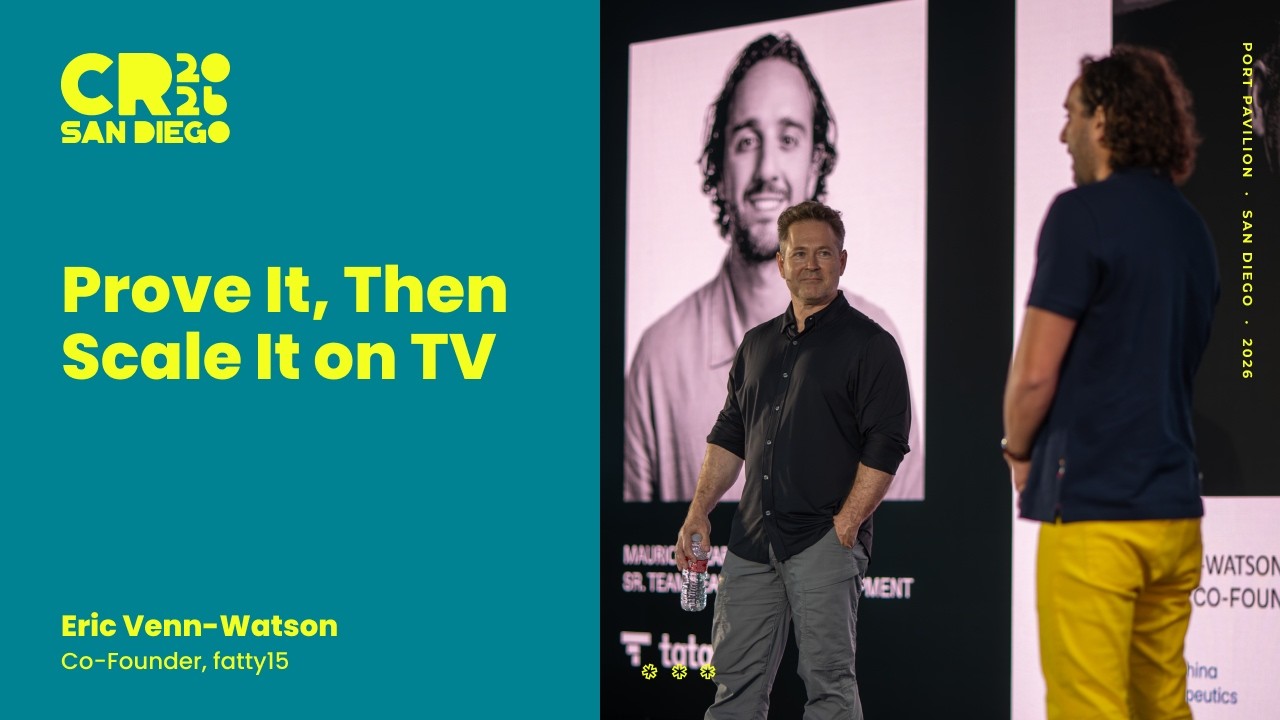
Eric Venn-Watson of Fatty15 and Mauricio Lizarazu of Tatari explain how the brand tested and scaled TV advertising. Explore creative and network testing, Amazon measurement, cross-channel lift, and how to decide when your brand is ready to expand beyond Meta.
Eric Venn-Watson of Fatty15 and Mauricio Lizarazu of Tatari explain how the brand tested and scaled TV advertising. Explore creative and network testing, Amazon measurement, cross-channel lift, and how to decide when your brand is ready to expand beyond Meta.
For DTC founders, growth marketers, and ecommerce leaders evaluating TV or connected TV as a new customer acquisition channel.
Recorded at Commerce Roundtable San Diego 2026, including the audience Q&A. Spending, performance, and attribution figures are reported by the speakers and reflect this brand’s experience.
Speaker roles and platform examples reflect the session’s original context. This is an archived conversation.
Use existing performance channels to learn which product stories and offers resonate, then bring that learning into a TV test.
Read this part · 03:58 ↓Compare where each ad performs before concentrating spend. A weak result in one streaming service or programming category does not describe all of TV.
Read this part · 05:49 ↓Evaluate response against a baseline and account for existing marketing activity rather than crediting every sale after an airing to TV.
Read this part · 11:34 ↓Try recognizable, brand-specific creative and match it to the network’s viewers. Fatty15’s experience shows why a polished production is not automatically the winner.
Read this part · 16:40 ↓Prepare product pages, relevant landing journeys, and clear purchase paths before bringing in a new wave of visitors.
Read this part · 20:04 ↓A quick editorial guide to the key ideas. Read the complete transcript below for the examples, details, and discussion in the recording.
Original recording on YouTube ↗Eric describes Fatty15’s approach as test, optimize, and scale. The team used Meta, Google, and podcasts to learn which messages resonated before expanding into TV. Mauricio frames this as earning the right to scale: establish whether the channel reaches the audience and acquisition targets before committing to a large campaign.
After early self-serve connected TV tests, Fatty15 launched four videos across 34 channels with Tatari. Eric says matching creative to the right network helped the brand scale to roughly $200,000 in weekly TV spend while maintaining a reported 3:1 customer lifetime value to acquisition cost ratio. The team used performance to decide where to increase or reduce spending rather than assuming one category of programming would win.
Mauricio explains Tatari’s use of baseline lift modeling and streaming attribution to assess TV response without taking credit for activity driven by other channels. Eric describes watching Shopify traffic and sales after spots aired. Immediate response provides a signal, while the broader measurement work helps the team evaluate TV alongside its existing marketing.
Fatty15 also sells through Amazon and healthcare providers. Eric describes using Tatari’s Amazon reporting and post-purchase surveys to understand demand beyond the DTC site. Mauricio explains how comparing network performance across destinations can change buying decisions. The speakers discuss a halo effect across channels; the figures presented reflect their measurement methods and Fatty15’s experience.
Eric says organic-feeling ads outperformed a polished production in Fatty15’s tests. He describes matching Dr. Drew content with Fox News and Ricki Lake content with game shows, along with brand-specific UGC. The session includes a dolphin-story ad that Eric says cost about $7,000 to produce with the internal team and outside production help. His emphasis is on recognizable messaging and audience fit rather than production budget alone.
Before adding more reach, Eric recommends a site that can convert it. He describes optimizing product and collection pages, supporting upsells and cross-sells, and matching landing-page journeys to specific ads. The team used lower-funnel testing to refine the message before taking it into channels where changes are harder to make.
The audience asks when TV makes sense, how niche brands can test it, and what a starting budget looks like. The speakers do not offer a universal revenue threshold or budget. They emphasize proven messaging, an audience hypothesis, measurement, and the ability to support the investment. Later questions cover healthcare-provider distribution, researching TV creative with iSpot, network review of advertising claims, and their limited success with QR codes.
From the transcript supplied by Commerce Roundtable, with filler words removed and paragraph breaks retained for readability. This source does not include paragraph timestamps. Refer to the recording for exact wording and the session guide above for chapter times.
Original recording on YouTube ↗Everybody, my name is Mauricio Elizarraraz from Tatari, and today we'll be talking about Fatty Fifteen and how they tested, proved and scaled TV. So, a quick introduction. My name's Mauricio. I lead sales here at Tatari, and at Tatari, we do have a tradition. anytime we do a presentation, a dinner or a meeting, we present ourselves, say who we are and what we're currently streaming.
I am currently streaming Lioness. I'm on the very last episode. I had to stop it because my one-and-a-half-year-old woke up, so don't tell me the spoilers. Three minutes left, and here's Eric. Hello. I'm Eric. my background's actually orthopedic surgery and aerospace medicine in the Navy and Marine Corps.
Different from probably what you've heard up here, but long story short, I was in, aviation, flying at Miramar in F-18s and down here at Coronado in, other aircraft. And so stories for another time, but today I'm gonna present, Fatty Fifteen and what we're doing on TV. and Serafina Therapeutics is the, the company, and Fatty Fifteen is the brand.
So excited to talk to you about that today. Cool. So a quick word, what is Tatari? Tatari is a platform to buy and measure ads across all TV, so linear streaming and online video. So everything from watching Hulu on Roku, ESPN on DirecTV or on CNN.com when you get a video that pops up in that video player.
over three hundred brands use Satari, brands as big as Unilever and their whole-- hold companies all the way down to fast, quick-starting brands from a Cowboy Colostrum to a Fatty Fifteen. and Eric, why don't you tell us a little bit about Fatty Fifteen? Yeah, I'd love to. So, we have the best origin story ever.
We s-- discovered C-fifteen, a molecule that's the first essential fatty acid to be discovered in ninety years, and the first deficiency syndrome of a macronutrient found in seventy years by helping the Navy dolphins, which are across the bay, live healthier, longer. So it's a TED Talk, it's a book, it's a movie.
And long story short, that population of dolphins now lives fifty percent longer than those in the wild. So why dolphins? They don't smoke. They don't drink. They're not on chronic medications. It turns out that they're an incredible model to discover diseases of aging if you control for everything else.
So long story short, we discovered this molecule by seeing which dolphins were getting fatty liver disease and chronic anemia. We moved it forward first as a pharmaceutical, but then because of this discovery of a deficiency syndrome, we felt a moral obligation to bring it out to the world as a natural product.
So we started Fatty Fifteen as a supplement with this pure molecule just as an awareness mechanism to get people to read Nature and Public Library of Science and Journal of Nutrition and all the science. So you may have heard the rest. Launched in two thousand twenty-one, sold out in six weeks, front page of The New York Times, Washington Post, Ingredient Producer of the Year, Fast Company World-Changing Idea twice, and we just became Inc.
five thousand's fastest growing supplement company in America. And so these pictures are just like, how do you bring a brand to the world if the science is at that level? Like, this has never been done before. So how we decided to do it was bring it out in a product that is glass and bamboo and ninety days and the highest level, and then you get your refill mailer that is just, like, ninety days in a pouch that is in a recyclable mailer.
So with that, we've been able to scale on multiple channels, including TV Cool. So one of the things we talk about on TV is you have to earn the right to scale. A lot of brands think they have to come to TV with a million-dollar budget, go for the Super Bowl, get on live sports, but you really have to tell a story on how you start on TV.
You have to first prove upper performances. First figure out, is this reaching my CAC? Is this reaching my audience? Are these reaching my KPIs? So Eric, I'd love to hear, how did you guys earn the right to really scale on TV and really get to that spot? Yeah. We do everything the same. So we always test, optimize, and scale across all our channels.
And much like many of you, we started off on Meta and Google, and that was, you know, the old days. We started this in two thousand twenty-one where your CAC was like twenty to fifty bucks on Meta to scale like lower funnel, like converting creative. And so over time, you know, we got the messaging, right? You can imagine when you make a discovery like this, you can message anything.
You can message dolphins. You can message saturated fats. This is a saturated fat. You can message, you know, that this is a healthy aging nutrient that does all these different things. So we spent a lot of time setting the stage for growth, so testing different messaging on lower funnel channels. And then we had kind of a breakthrough on the upper funnel channels when podcasts came to be after COVID.
And so we actually had at one time, like ten percent of our total marketing spend was on podcasts and about twenty-five percent of our revenue. And what we found the magic there was that if we had an organic podcast with us on it followed by ad reads, it did really, really well. But then, you know, podcasts had their day.
They might not be exactly what they were then today. And so we were searching for other channels to do the same thing, to test, learn from the data, optimize and scale.
So there's actually a lot of data that goes into this as well. So Tatari's team has worked very closely with Fatih fifteen to prepare for that launch on TV. Fatih fifteen actually tested across other CTV self-serve platforms before, but what really what we found out is that through Tatari, they're able to get a lot more scale.
A lot of people here probably watch linear and streaming, but if you just test one of those, you're not truly testing TV. Who's to say that linear TV didn't work or streaming didn't work, or perhaps sports or live news? So if you could talk through maybe a little more the numbers of what that journey looked like when you- Yeah
started on TV. Yeah. So we first started with CTV, and we were doing like Roku and, you know, channels on our own. and they were okay, but then we, we knew eventually that we would scale on TV. We just had to set the stage for it. So we came up with four videos, and we'll talk about creative later, and we launched them on thirty-four channels.
And we had a combination of our awareness producing content and then, you know, things that we thought would actually resonate in specific channels. So it did very well. And so we saw that when we matched the right creative with the right channel over time, we were able to scale. And so as you mentioned, we were able to scale quite significantly to the point we're now at about two hundred thousand a week of TV ad spend, and we're maintaining our CLTV to CAC of three.
And as long as we can do that, 'cause we're a subscription-based business, we will continue to scale. We'll talk about that a little bit more here in a bit. Yeah. So the big takeaway is there, right? It's really all about the data that you're able to get, really be able to figure out the streaming on TV in terms of where you wanna start and really scaling all of TV, not just a part of it.
so one thing about TV too is it's all about first testing before taking those big swings. Fatty Fifteen as a business operates this not just across TV, but across all their channels. So it's not really about saying, "Hey, we think sports are gonna work, so we're just gonna test sports." We really wanna test as many networks as possible.
After that test, we're gonna have winners and we're gonna have losers. We're really gonna try to figure out where the most scale is and double tap into, "Hey, news performed well, so we should do CNN and Fox. Sports didn't, so we need to peel that back." so can you talk a little bit about how you a- adopted this test and learn approach to TV?
Yeah. So TV, like I said, we, we do everything the same. Top test optimize scale. But on TV, like we thought that would be different. We kind of went against what we've always done, and we actually prepared for it quite a bit, maybe too much. and we created content that was really high level, and we'll talk...
I'll show you more of the content later. but what we learned was that, you know, you don't need like production level content. You need content that actually resonates, that feels organic. So once we got that mix in place, we were able to figure out which channels work, test to optimize, and then scale on those channels.
And we'll go over it in a little bit more detail, but if you've seen Dr. Drew on Fox News, like that converts. You'll see a lot of Fatty Fifteen on Fox News with Dr. Drew coming up if you haven't seen that already.
All right, I hope you're enjoying the replay from Commerce Roundtable. I wanted to stop you for just 30 seconds and tell you all about the sponsor that made this happen. I see too many Shopify brands overpaying for big email tools and using only a fraction of their features. We're tired of complexity and never-ending price hikes too.
That's why Seguno Email is different. Lives inside of Shopify and uses your shop live data, not a synced copy of that. Plus, integrations with Sidekick, ChatGPT, Claude, and Canva saves you time. And get this, Seguna is the only email app to win a Shopify Build Award. Sounds interesting, right? Switching is easy, and you get twenty percent off for being a part of the Commerce Roundtable community.
Link in the show description. Now, back to your replay So if you could tell me, Eric, how does it actually feel to see that, that difference on TV or that impact? Because a lot of the times as operators and marketers, you, you're gonna run a channel and you say, "Yeah, our sales went up." But how did that actually- Yeah
feel to see TV come to life for your brand? Yeah. Yeah. It's, it's actually, it was pretty amazing. We live in Shopify, and the real-time analytics are what we have most things connected to. We use a whole bunch of different monitoring devices and performance metrics, including Tatari's ba- dashboard. But what we see when an ad goes out and it's the right content with the right channel, with the right audience, we see immediate sales.
It is pretty spectacular to see. I don't know how, how people actually look at the ad and go to the website that quickly, but it actually happens. So we get, you know, 500 to 600 people on the website pretty quickly. and then we see conversions. And it's, you know... Remember the, you know how Shopify goes ding, ding, ding, ding?
So you get a lot of that. You're doing something else and you hear this ding, ding, ding, ding. Ah, must be a TV ad. and so the other thing to point out here to add it to the right was, you know, TV lifts up a lot, right? It's not a, an isolated channel. And after we were on TV, the credibility of being on TV, had our, our, our board members, investors, family and friends kind of all coming out of the woodwork and saying, "I saw you on TV," you know.
"This is amazing. You've made it." It's really interesting. So immediate lift, certainly on Shopify, and then, we started to see the, the lift on Amazon and with our healthcare providers as well. Cool. And to contextualize that 500 to 600 number, that's within like a five-minute window of the ad airing.
So when you're actually running TV ads, you're actually able to feel when those spots come alive and really come to your website and, and really drive sales. So we've talked about TV buying. We've talked about audience targeting. We've talked about placing it. I would say potentially one of the hardest parts about TV is gonna be measurement.
How do you figure out what actually worked? So we do that in a couple ways at Tatari. One of them is using that baseline lift model to really isolate TV's impact and TV signal. The other way is using different attribution models, especially for streaming. The last thing we want is for TV to take credit for other channels you're already running.
We don't wanna take credit for Meta, for Google, for TikTok. We really wanna isolate what is actually incremental to your business. And something we'll talk about a little bit later that Eric's company's done really well, is measuring off of Amazon and measuring the halo impact of TV. On top of that, we also take a look at creative.
Creative is a very, very important part of TV, and shortly we're gonna take a quick look at one of Fati 15's creative in just a bit before that, I would love to chat a little bit about Amazon. So Amazon, I'm sure a lot of brands here, right? S- Represents a ton of sales for us. Historically, it's been really, really hard to measure Amazon for TV.
You get a Slack message saying, "Hey, I, I think TV's working," or, "Hey, I think this channel's working," or, "Amazon sales really popped off." for Fatty Fifteen, that's around a million dollars in monthly sales. so if you could talk to me a little bit about how did TV or Tatari in particular help you connect sales- Yeah
from Amazon to TV? Yeah. I mentioned you see an immediate lift in Shopify. We also saw a lift, not quite as quickly, but in Amazon as well. And Amazon's traditionally a pretty black box for us. Like, we, we started on Amazon 'cause we felt like we had to, which may not be the ideal way to do it. But we started with a higher priced product, and something that wouldn't compete with our direct-to-consumer brand, but we still saw scale.
And so with the TV ads, we would see immediate scale on Amazon, and using Tatari's dashboard, we can actually say, hey, that TV spot resulted in this performance from Amazon. And so interestingly, like we are now using Tatari's dashboard for everything. Like for instance, you know, we'll be... You might see us on CNBC on, Tuesday and then, we'll be live with Ricki Lake on, Good Day New York next week.
So we'll look at the response and the uplift from that on Tatari's like dashboard, and that helps us see how big is the lift and what did it come from, and then we use our other, you know, performance metrics to see what are we gonna do with that information. Like what do we do with that content now?
Cool. So to go a little bit deeper into this, obviously I forget the stat, but I think around half of all e-com spend flows through Amazon. So at Tatari we said, okay, if we're just tracking based on DTC sales and we're not getting Amazon, this is something we need to capture. We need to be able to figure out what's happening.
So earlier this year, Tatari released this Amazon tracking dashboard, and similar to the way that we measure linear TV, we're gonna be isolating TV's impact based on when those ads ran and what activity happened on your Amazon storefront or third party or whatever it is. The best thing about this is you don't actually need to spend on Amazon to get this data.
This is completely impartial data from us being able to say, "Hey, your TV ad ran. There's a lift in sales on Amazon," and we can correlate and isolate where that's happening. So for marketers, now you figure out, well, hey, wait a minute, maybe Fox does a really good job at driving Amazon sales, but CNN does a really good job at driving DTC sales.
So it gives you tons of takeaways to go back and turn the dials on what actually is working and what isn't on your TV spend. Another piece is the halo effect of TV. So historically, this has been really, really hard to prove. We've been talking a lot about how TV's one-to-one impact has affected Fatty Fifteen, but there's another impact that maybe people aren't paying attention to, is what if somebody saw your TV ad and also saw your meta ad?
Is that gonna increase or decrease their likelihood to convert? So within this, with Fatty Fifteen, we've actually helped develop a way to measure this with the halo effect. the quick takeaway stat here is that before TV, only seven percent was attributed to sales from TV, and now it's twenty-six percent.
So if you can talk through maybe a little about the halo effect and, and how we measure that. Yeah. When we scaled up TV, we see it on our post-purchase surveys that people are actually buying because in part or primarily that they saw us on TV. So it quickly became in three months, like our number two attributed channel, and it has been increasing after that.
And so what we see is the rising tide phenomenon, like TV helps all of the other channels become more efficient. And, you know, our CLTV to CAC, as long as we're maintaining three and our CLTV keeps growing because we have more data, we can put more money into this, this channel and see this halo effect across everything.
And everything means, you know, we have three core channels, so we have DTC, Amazon, and healthcare provider, channels. And so even when our healthcare providers see TV, that adds... I mean, they purchase more. So the halo effect is real
Well, so another question is creative. A lot of people here really kind of assume for TV you really need to have a celebrity, right? I think, everyone saw the Sydney Sweeney ad. Maybe that didn't turn out so well for Novig, but you don't really need a big celebrity to run a TV ad. there's really two buckets I'd really place this in.
You kind of do the big production, the polished ad, what you have historically thought of what you need for TV, or you can do that scrappy and real ad, more that UGC feeling. so could you talk through maybe, 'cause you've tested both of these quite well at Fatty Fifteen. Yeah. Yeah. So as I mentioned, when we scaled...
When we started and planned to scale on TV, we created a, a big production ad. It's pretty amazing. It's a science translator. It's really fun. Don't do that. And so what we found is that, you know, when you have organic feeling creative, that meets the audience on the channels, the networks you're advertising, with people who just you can feel it, it's different, that meets your message, it scales.
It really does well, much better than big productions. I'll give you an example of a manifesto here in a minute. I think we have it there. But, you know, we, we have some super fans, right? So we have a Dr. Drew, if you remember him, Ricki Lake, if you remember her. And meeting Dr. Drew on his audience of Fox News people really does well.
Way better than polished, expensive content. Same thing with Ricki Lake on game shows. And that's just an example of people that are recognizable, but they're not like, you know, mega, mega influencers. But so that type of content works well. We tried just regular UGC content, and that for us only worked if we had messaging that was specific, right?
Because everyone does UGC ads. There has to be something there that is just recognizable to your brand to where you see it, you're like, "That is Fatty Fifteen," and it can't be anyone else. So we'll show you something here, but that's what we found on TV. And, you know, these things are not expensive to do.
You can be scrappy and create ads. In fact, the, the one you'll see here in a minute, I think we spent a total of $7,000. Internal team developed. We had a production agency just help us put the pieces together. my wife is in it, and she... We sent her to the audio booth to record it. So it's definitely as bootstrap-strapped as you can get.
Cool. Let's watch the creative. Oh, yeah. Cool. This is a bottlenose dolphin Is the breakthrough nutrient doctors discovered that helps some dolphins age healthier than others. It's called C-fifteen, and the more they had in their diet, the healthier they aged. Now, over a hundred peer-reviewed studies later, Fatty Fifteen is bringing this discovery out of the ocean into everyday life to give your cells the same age-related benefits as all those happy, healthy dolphins.
Fatty Fifteen, healthy aging for all. Only cost seven thousand, right? Yeah, so. Only cost seven thousand. Yeah, and that's, that's our top of the funnel highest awareness producing. That's the one we test out, you know, where, where our audience lives, and then we come in behind that with other things like the Dr.
Drew, Ricky Lake, our UGC ads. Cool. And the nice thing too about those creatives is that you could really measure how each of those performed in the platform itself. You can see its relative performance based on response rate at the show level. So if you wanna know exactly which program you aired in, you can see exactly how it performed.
so I-I've actually talked to a lot of people before this presentation, Eric- Yeah ... and a lot of them were kind of in the same shoes you were about a year or two years ago. They're like, "Hey, I got, you know, six hundred K in Meta monthly. I haven't really figured out a way to scale beyond that." beyond that, right, what are some departing parts of advice you'd give people here in the audience who've been in those shoes and, and really living that right now?
Yeah, I, I know how we did it, so take this with a grain of salt. But we created an infrastructure to scale on, and that infrastructure was Shopify, right? And so we optimized our PDP and PLP pages and created the ability for people to land and upsell and cross-sell and all that stuff. So the, the integration of technology to make a foundation to get all those new eyeballs to convert them is key.
We also use AI-driven, as we mentioned last time, like landing pages for specific journeys from specific ads. So do that, and then, you know, we had a major challenge because there's so many talking points, right? So we used the lower funnels to test, optimize, and scale messaging to where then when we're on the upper funnel channels, when we have less ability to really, you know, change messaging, we were ready to go.
And so we did a lot of groundwork. And the one thing I'll say is, you know, with TV, what we've experienced is it doesn't take a lot of money. It takes just nailing down the messaging and content that you wanna start with and then test, optimize, scale. And, we were able to do that with Tatari pretty inexpensively, and it's, it's been an incredible eyeball-producing channel for us.
Cool. so yeah, that's pretty much it, folks. If there's any questions, we'd love to hear 'em, and hope you guys enjoyed the story. Thank you
This, this is the bigger question that I have is like, when do I go to TV? Like, I... There's infinite more scale for me to spend on Meta. Why would I just go to TV right now? And/or is it, like, in the order of, like, we already know it's working on Meta, go to TV? Yeah. When is, like, the, the right time, I guess?
Yeah. Yeah, I can take this one. Sure. So TV usually becomes a stronger option once you're looking for more incrementality. A lot of brands tell us they feel like the, the CPMs that are rising on Meta or Google are too high, or they feel like they're just scraping the bottom of the barrel. So sometimes they say, "Hey, we, we really need to find another channel."
And so TV gets bucketed in with audio, podcast, digital out of home, and that's when TV really becomes a, a channel to test. Because if you just keep going on Meta, you're eventually gonna hit rock bottom, and you're gonna be in a really tough position. there's also the exceptions to that rule, right? you got brands like IM8 who come into the market very strongly, and they kinda invert the marketing pyramid.
But for all intents and purposes, I would say it's when you're really looking for incrementality and looking to really, really find a new channel to drive new customers. And I would say as long, as long as you're able to measure the results across your whole ecosystem, like, starting in TV fairly early, once you nail down the messaging and you have the infrastructure to support it...
Like, I think we would've done it a little bit earlier and, you know, the reason we didn't, it was just a black box. It's like Amazon. You don't really know what data you're getting out of it. And so with Tatari's dashboard, it does help, start TV a little earlier than, than usual. You briefly talked about, like, Ricki Lake and Dr.-
Yeah. Drew ... Dr. Drew, and it didn't have to be super polished. It was, like, pretty, pretty raw, would you say? Yeah, yeah. So they- they're super fans of the brand and the science, right? And so we get a lot of people reaching out to us. Like, Barbara Corcoran reached out and said, "Hey, like, I went on a bike ride in Japan.
I took Fatty 15 ahead of time, and I was able to ride the whole way." And so- Yeah ... you know, we take their content that they developed for other channels, could be Meta, could be whatever, and we repurpose that for TV as long as they're agreeable. So- Okay ... and so that content, you can feel the difference. It's not like TV content.
It's more like you just feel that she's a super fan. Like, Ricki Lake really, really likes this product and is benefiting from it. That's, that's what I mean by organic. Yeah. I got you. Chris? Speaker box. Hello. Hey. So basically, I have a very niche brand. I sell hatch chili peppers from New Mexico, okay? So it's what Napa is to wine, is what we are to peppers in the world, okay?
But I'm ninety percent on meta, right? I have salsa. So chili peppers have a season, they have a window that I have to cook them. I wanna sell salsa year-round. I've had trouble getting my salsa, you know, to really take off on meta versus my hatch chili products. Would this be a great place to start, you know, trying to diversify my, my product line of...
on my Shopify store? It could be. That's a very neat... That's a fun one. You said you sell salsas or- Yes, correct. I love hatch chili- Good. Yeah ... in season. I got you. so in that case, right, it really is going back to his framework of testing, assessing, and learning. I'm not gonna suggest that you start off with a million-dollar budget 'cause it...
You really are gonna wanna figure out really in small pockets where you see success. Is it cooking shows? Is it stay-at-home moms watching Oxygen? Is it Bravo? is it guys that watch sports? The biggest, the biggest part for your brand is really testing lightly before taking any big swings. I'd imagine most of your sales happen online and they...
Yep, perfect. So by placing the pixel, you can see right there if TV's having a live impact or not, and you can tell pretty quickly. You're not gonna have to wait weeks or months to say, "Hey, did TV drive anything?" 'Cause if you have a good enough creative and you're in the right spot, you'll see it happen right away.
And I can imagine the creative you could develop. Oh, yeah. So fun, right? Like- We crush it. Yeah, yeah. Like, like, you know, just having people, right, creating, eating with it, things like that. If you find the right creative that really nails down what you wanna do as a brand and messaging, testing that out on TV and, like, even linear could be really, like, beneficial.
But you gotta, like, make sure you know what creative for your audience makes sense, and then meet that creative, that audience on linear. Like, pick the channels where that audience exists. Yeah. Not to hijack this, but has someone come in with a, a hero product that they've done really well on Shopify and tried to launch another product and do re-very well?
That's ultimately my question. Yeah, I mean, a, a big example of Roman or Ro is one of our clients. They started off with, men's ED pills, and now they have GLP-1s. And so they're a brand that's constantly reinventing themselves on TV, right? They started off with one very particular niche product... Or not niche, but one particular product, and then they scaled onto others as the years have gone by.
There's one more here, and then we got a list of questions on the screen. Yeah, yeah. So I'll go... We'll go one more right here, and then we'll go to the screen. Okay. Can you hear me? Yep. All right. so we, we run a supplement company as well that's kind of targeted towards older individuals. my immediate thought...
I'm, I'm, like, new to it, but, like, my immediate thought was TV. Like, older people are watching TV. But I don't think that our supplement company might be at the level where we're selling what you, you know, you're selling. So maybe they already answered this, but I got two questions. When, when is it time to, like, move to TV for us?
At, like, what sales level, you know? And then the second one is, I'm really curious about your healthcare provider channels. Yeah. Because that's something that, like... We're, our formulas are doctor-founded already. Like, the doctor developed the, you know, stuff. But, like, getting into, like, healthcare providers seems like a conflict of interest a little bit.
How do you navigate that? Yeah, I mean, on the HCP side, for us, that's where it started, right? So we were publishing in Nature and Public Library of Science, Journal of Nutrition, and all that kind of stuff. And so people were reading about it, and some of our first customers, before we had a product, were just physicians trying to figure out, like, what this means for their practice.
Like, we had a lot of oncologists using this for, like, stabilizing red blood cells. And so, you know, a lot of specialty, and then it moved into functional medicine. And so, you know, as we developed a product, at first, we didn't have anything that was great for healthcare providers, 'cause they want... They don't want a direct-to-consumer product that comes with a box that there's nothing on the outside so it doesn't get stolen in the mail, right?
And so we developed what they wanted, which for us was a 30-day kit. It was paired with a test. It had refills. It's something that looked beautiful on the shelf, and if you've seen it, it's, like, super high level. And so with that, we were able to go back to them and say, "Hey, here, here's the healthcare provider kit."
That did very well. We don't pay them, so they're buying the product and prescribing-ish, you know, giving it to their patients. And so what we're trying to do, it, it's small compared to a D2C channel, but what we're trying to do is create an army of, you know, healthcare providers that are sharing the science and the need to have this molecule back in our food supply and as a supplement, you know, in just healthy aging and longevity.
And so that was one, and then your other question was what again? Yeah. The other question was just that we're, we're still pretty small, so- Yeah ... like, h- how do I know that it's the right time to, like, run for a TV ad, you know? Yeah. I, I think Eric kind of touched on it earlier, but once you're in a pretty strong spot in terms of profitability...
I'd love to give you a magic number and say, "Hey, when you hit 10 million in MRR, you're in a great spot," but it's different for every single brand. but I would say, right, like, if I started a brand tomorrow, I probably wouldn't launch TV unless I had a massive budget. I first want to establish Meta, Google, those tried and true, tried and true channels.
Because the fact is, TV's gonna really help you on those channels as well, so it acts as, like, a force multiplier on that. Re- roll that into question one. What is a good monthly budget to start for TV, and how long does it take to see some results? I don't wanna say it depends, but I'm going to. Sure. Sure.
But, I mean, we see brands... I'll give you some examples, right? We see brands start with 50K across four weeks. We see other brands start with 200K across four weeks. Other ones have started with 5K a week. so it really depends on the brand and what your goal is. Is it ROAS? Is it incrementality? Is it reach?
Is it frequency? Is it SOV? I feel you. This has been... These top two have, are questions of mine, but I didn't ask it. Somebody else did. Yeah. Any spy tools you can use for creative strategy on TV ads? Like, where could we go to see what could work? iSpot.tv. iSpot.tv? iSpot. So if you... It's just called I- if you just Google iSpot- That's great
you can go in and type in any brand that's been on TV, and it'll show you what ads they're running. That's awesome. That's a huge nugget. What size rev do you wanna see for the incrementality lift? I feel like you've been on this thread this entire time on stage. Is that a question more on the brand side or like- Yeah
yeah, I mean- You take it either way. I mean, you guys didn't- you guys were jumping onto it at what rev size do you think on the Fatty Fifteen side? What revenue size were you like, "Yeah, let's try this"? Oh, so what, what size revenue before we launch on TV? Yes. Yes, yes, yes. Yeah. You know what? I mean, now that we've been through this, I don't think it's a revenue thing.
I think it's more just nailing... As you move up the funnel, you have less ability to use performance marketing and really test out your messaging, right? So you have to have tested it ahead of time before you go in these higher funnel, like awareness producing channels. It's like retail. You can't go back once you go into retail.
So you use performance marketing to test your, your messaging and your creative and all that before you go into those channels. Same thing on TV. So it's not a revenue, it's just when you're ready. Sure. Like when your messaging is locked down, you have creative that you'll think you're re- will resonate, and you have the audience that you wanna target in mind.
I feel, yeah, most people, they like, "Tell me when it's time. I need to know when it's time." I know. And it's like, it's that art and science- I know, I know ... vibe here. what was the TV ads different from your meta ads? Oh, well, one, they're ver- they're horizontal, but they're not that much different, right?
Okay. So there are specific criteria you have to meet. Like for us, we have CARS claims, which are claims we can make that are backed by a team of lawyers in case the FDA comes. And so some of those CARS claims for us, because this molecule is so much science, are reverses aging at the cellular level. And so to get that claim on all the major networks, you have to go through a science deep dive with them and say, "Here's the 800 pages that support this claim."
And so that, that was a rate limiting step for us 'cause we wanted to use, you know, the real claims and the real content that no one else could use. Sure. It took a little while. Yeah. I feel that. last, I'll give you these last two questions. You guys have been awesome. Do you guys see success with QR codes on Amazon specific TV ads?
Yeah, no. And so, you know, they're on there and maybe it's 'cause a lot of people are doing it, but we don't. We see people researching it immediately. They come on the site. I mean, you know, that's another beautiful thing about naming something Fatty Fifteen, which, you know, when we started talking about names a long time ago, that was not on the list of names that we thought we would come out with.
But you know what? From an SEO, GEO, AI standpoint, it's wonderful 'cause there's no competition. So we know people see an ad and they'll, they'll Google it or they'll go straight to the website. Yeah, without a QR code. Anything else you wanna add in? For the QR code question? It's- Yeah. Yeah, I have a hot take.
I don't think it's all that great. I, I tested the first QR codes back in the day at Roku and it still wasn't, wasn't great. The one thing I will say is, like, you will need to have a, a scaling model for that. I mean, think about it. How many people have here have clicked on a QR code from a commercial they saw on TV?
We got one, two. So test it, try it, but I don't have the best hopes for it. I feel like most people are like, "I wanna get a QR code on. I know it's gonna help." Like, co- QR code was the COVID winner. They, they, they beat everybody out on success for that one. Yeah. All 'cause of Coinbase and the Super Bowl. Dude- Doing it for all of us
there's the bouncing. Yeah, yeah, yeah. That was one of the best, dude. Memorable. Thank you for your time. Thank you. Thank you for being so open with your answers, guys. Thank you so much. Thank you, guys. Round of applause. Thank you, guys. What's up, dude?
36:08 43:39
43:39 30:30
30:30Join Commerce Roundtable in 2027 for focused learning and conversations with people working through the same challenges.