 35:27
Austin · 2026
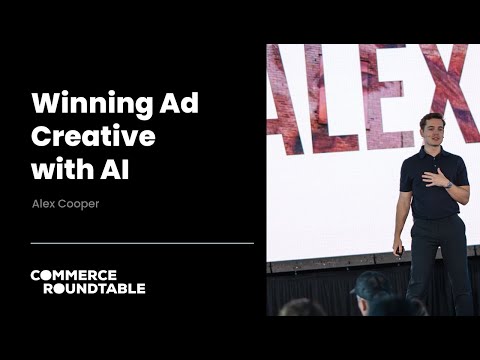
Alex Cooper shows how AI can support research, ideation, copy, and visual production. The session keeps direct-response fundamentals at the center of a faster creative workflow.
Alex Cooper shows how AI can support research, ideation, copy, and visual production. The session keeps direct-response fundamentals at the center of a faster creative workflow.
For ecommerce founders, marketers, and operators working on brand & creative.
Speaker roles and platform examples reflect the session’s original context. This is an archived conversation.
Use customer understanding and observed content behavior to shape the idea.
Read this part · 04:07 ↓Use AI to develop angles while keeping the audience and message explicit.
Read this part · 08:12 ↓Improve hooks, copy, and storytelling before expecting production tools to fix an ad.
Read this part · 15:23 ↓A quick editorial guide to the key ideas. Read the complete transcript below for the examples, details, and discussion in the recording.
Original recording on YouTube ↗Alex starts creative development with research rather than a request for random ad variations. Customer concerns and examples of content that earns attention provide useful inputs. AI can help organize and develop those inputs, but the quality of the resulting idea still depends on what the team understands about the audience.
The session connects organic content observations with paid creative development. A format or message that earns attention can suggest an idea worth testing. Alex treats AI as a way to accelerate exploration and execution, while the marketer decides what the concept is meant to communicate and why it should matter.
Alex warns that more sophisticated generation tools do not compensate for weak marketing fundamentals. Creative teams still need to understand persuasion, structure, and the audience’s awareness. AI can help produce the asset, but the underlying reasoning determines whether it has a useful job in the campaign.
From the recording’s auto-generated YouTube captions, with filler words removed and paragraph breaks added for readability. Names, numbers, and wording may contain caption errors; refer to the recording for exact phrasing. Chapter links jump to the text below.
Original recording on YouTube ↗0:00People make ads for warm audiences because that's what the algorithm is favoring. The problem is those ads aren't incremental. If you want real scale on Meta, it's not about doing the thing that's best for the ad account. It's about doing the thing that's best for the business. When we create whether it be images inside of image general nano banana or whether it be videos inside of a video, I want to make the invisible visible. I want to create ads that show people what they feel but can't say. Like I want a visual whether it's through AI or not. Finding creative ways to write messages on our creative has proven successful for us time and time again.
0:37[Music] >> So Alex, please come share brother. Round of applause.
0:45>> What's up guys? Hope you're all doing well. My name is Alex Cooper and today I'm going to be speaking about how to use AI the correct way to generate ad creative. It is a very hot button topic today. so I co-ounded a company called Ad Crate. We're a performance creative agency for eight and nine figure DTC brands. We worked with 50 DC brands more than 50 DC brands over the last few years including the likes of Hule, Licorage.com, Harry's to name a few. And as Jack said, I make content helping people make better ads with the help of AI. Notice how it doesn't say replacing it with AI, but like help with the help of AI. And as you said, I did recently just finish teaching a course, which is exactly what I'm talking about today, like how to produce creative with the help of AI. So I want
1:38to start off by talking about an economic concept called the Lafa curve which is actually used or actually used to show the optimum amount of the optimum tax rate to set to collect the most revenue but I think that it applies to us as advertisers as well. See, here's the thing. I've trained hundreds of creative teams on how to use AI in ad creative. And what I found is a lot of people around this mark. They can use Claude and Chatbt. They can use Gemini a bit, but they feel like they're not getting the most out of AI. They feel like there's something that they don't know that their competitors know, whether it be a set of prompts, a workflow, a system. They feel like they're not doing as well as they can with the help of AI. And this is added to by all of these posts that all of us have seen on Twitter and all of us have seen on LinkedIn of people claiming, you know, replace your whole creative team
2:37with VO and N banana and N. And I'm sure you've seen a ton of these. I'm not digging these guys out because I could have found a 100 posts like this. The reality is if anyone's tried any of these workflows or any of these tools, you end up on the right side of this curve. I mean the far right side rather than like the actual correct side. and if you produce ads like this, you know that a lot of these tools end up in AI slop. They end up in creative that all looks the same and it doesn't actually help you in your business. So what I've noticed is that actually a lot of people here aren't as far away as they think they are with how to use AI.
3:16You just need to work out how to discern between what is actually creating business value and what is just someone posting on Twitter or LinkedIn for engagement. It's not easy. It is confusing. But I hope that I can help you guys in that discernment today. So, what I'm not going to be showing you is how to replace your 200 crit a year creative team. There is not an infinite ad machine button or that I know of that I'm going to be talking through today.
3:42instead I'm going to be showing you how to use AI the right way to not replace your existing workflow, but just enhance it. Do the things that you already do better and faster with the help of AI. Along the way, I'm also going to be showing some top performing ads that have spent a lot of money for us profitably. as well as touching on where I think the future of ad creative is. So let's start with
4:09research and ideation. See I want to talk about the organic feed. because all p like all the stuff that we do on paid originally starts on the organic feed. When people started using Facebook and Instagram it was a place to connect with your friends and family and it was very difficult for us as advertisers to you know blend in because it was not a post from your friend or your family. Then it was an ad. Obviously the ad cost was so cheap it didn't matter at the time. But as time went on and we started to see more creators, more influencers, and the rise of like what we now know to be UGC content, even though it's not technically UGC content.
4:46and the evolution that we've seen over the last couple of years, as Gary was talking about, as Ezra was talking about earlier, is the Tik Tockification of the feed. Everything is now hyper relevant. Every single post that you see as you're scrolling through Instagram or scrolling through Tik Tok is relevant to you. hyper relevant to you and your interest, whether it's organic or whether it's an ad. Now, the trap that I see a lot of brands falling into is because the algorithm is always going to do its best to serve your ads to the people who it thinks is most likely to convert. People make ads for warm audiences because that's what the algorithm is favoring and they see those ads doing well and they continue to make more ads like those more ads for warm audiences. The problem is is that those ads aren't incremental. If you want real scale on Meta and on all these ad platforms, it's not about the thing that doing the thing that's best for the ad account. It's about doing the thing
5:39that's best for the business. And in many cases, that is creating ads for cold audiences. And stay with me because there's a reason why I'm going through this in a second. What does this mean for you guys? Well, first of all, context matters in the ad account. Which ads are you creating? Is your team creating? are your agencies creating that are actually bringing new people into the funnel versus ads that are just scooping up existing demand. We shouldn't just be iterating on the ads that are made for warm audiences.
6:11This is a trap that I see a lot of brands fall into. If we want to break out of this hyper relevance trap, then we need to understand how to make ad creative for new customers, bringing new eyeballs into the funnel. And the reason that I have this up here and we're going through this at the start is because the way that you do that is with good research. Good research helps you craft ads for cold audiences and bring in new people into your funnel so you can scale consistently on these platforms. Now, I'm not going to spend too long going through research because there are millions of ways to do it and I think a lot of them are just six of one and half a dozen of the other. but I think what matters more is the output and where like what you get to being on the right hand side of this. So for us it looks like this. We have a a deep research prompt that goes and scrapes
6:59everything on Reddit, Kora, websites, articles about the brands that we work with. And then we're just feeding it our real customers information, reviews, ad comments, support tickets, post-purchase surveys. And if we do this, we can then produce a document like this that I mean literally our research one sheets are customer personas, stage of awareness, pain points, desire transformations, objections, trigger events and tone. If you do this properly and to a good extent and not just one time but consistently, you can get to a point where you're not even writing ads. Your customers should be the ones writing the ads. They become your copyriters and we as the brand, we're just repurposing the the exact words and phrases that our customers are using when talking about our pain points and our desired transformations.
7:46This is what an example of that looks like for us. And again, this is not something I'm doing one time and never doing again. This is something that we're consistently updating as we find new things, we find new use cases for the products, we find new pain points that customers have, we find new personas that we can unlock. It's all going into this live wiki, this live document that is the foundation for the ads that we create.
8:11So that's the research side. Then how do
8:13we actually take that and turn it into actual ad ideas and and concepts that are ready to start building? Well, for us, we've had a big unlock when we started training Claude projects on our data. See, when we're making ads, a lot of us will just go to chat GBT or go to Claude and say, you know, generate me five headlines for this brand. And like that's great. That can work, but you're going to find you're doing a lot of discernment looking through the 20 ideas for the one maybe two ideas that are good enough. What I found when you build Claude projects or custom GBTs, you know, it's personal preference, but for me, I think Claude is a better copyriter. Hence we use clawed projects on the specific task of the process that you are conducting the outputs that I get from AI are way better. So we have projects for our UGC scripts our static headlines rewriting a script from organic every part of the process that we already do manually or in GPT and
9:09claude we have a project for and we have specific context training the project on how to write headlines. I'm going to go through that in a second. Each one of these projects, this is inside one of the headline generators for for a brand that we're working with. is trained on three documents. Brand context, domain context, and top performing examples. The brand context just comes from our research. Nothing revolutionary there. I'm sure you guys will have some version of it. The domain context is where I see a lot of people miss out on a document on everything that we believe to be true about the task. In this case, writing static headlines. Because here's the thing.
9:47This is the reason why a lot of your outputs from LLMs are not good enough. Claude and Chad GBT and whatever model you're using, they are not good creative strategists. They are not good direct response marketers. They're trained on thousands, tens of thousands, hundreds of thousands of articles and blog posts all across the internet. Like they're not direct response first. So when you give it, you know, a prompt saying come up with 20 headlines, that's why only one or two of them come out good. But in this case, we've trained it on our our own document stacked with as many examples as I can of ads, headlines that are performed. And I say, "Right now, you know about my brand. You know what's performed for me? And you know how to write a headline that converts. The outputs are way better." And like, of course, it's not going to get to the point where like every single suggestion it gives is a winning ad. And I don't really know how to display this.
10:36There's probably a better way to display it than this, but like here's an example of what you might get from regular claw claude versus a trained claude project on your data and on the domain that it's trying to complete. So, this was from my claw project for for this brand to a male skincare brand. I was super pumped when it came out and said she stopped complaining about my sandpaper face. for a male skincare brand, I really like that headline. and it comes up a lot like that. The cool thing here is that I actually asked it to rank these headlines based on which ones it thinks will perform the best. And the regular Claude doesn't know what a good headline is. It doesn't know what a good direct response headline is. So, it doesn't know. But like of all the 20 ideas, it was interesting that my trained Claude project actually picked out what I believe to be the strongest headline because it's trained on how to write a static headline. So, we'd have
11:28this for headlines, for scripts, for iterations, and have our team build out each of these train claw projects that look, you're not going to get to the point where 100% the ideas are good, but like the quote like hit rate on good ideas for a train claw project is way way higher than anything you'll get from a GPT or a regular claw chat. I don't have time to go into like the full process for that. If you want to watch me build one of these live, I made a YouTube video a few weeks ago on my channel. the problem is you you can't search Alex Cooper because of the Caller Daddy host. So you search Alex Cooper ad crate to find that. There's a full video. I built one of them live if you're interested. of course there are also other methods for inspiration.
12:11I'd always go message first. So I'd always look at the, you know, customer reviews, ad comments, tickets, etc. first. But there are other there are other places you can get inspiration, too. For me, I'm a big proponent for the concept of you will always find better inspiration on the organic feed than you will looking at ad libraries because ultimately your competitors are copying their competitors who are copying their competitors and none of us know what works. You can use tools like ad spy to look at engagement and and sort by engagement but I mean ultimately we don't know what works and like I can't tell you how many times at our agency we have taken something from the organic feed taken something from Tik Tok taken something from YouTube shorts and we have recreated it and inserted our client solution towards the end of the ad and that ad has gone on to do very well inside the ad account. If it's already got two million people have watched it on Tik Tok or on YouTube,
13:11something about that concept, whether it is the the creator, whether it's the background, whether it's what they're wearing, how they look, what they're saying, something about that is getting the attention of your target audience. And for me, that's not an insignificant piece of information. And it's validated by ads that we've made because, like I said, we've had so many examples where I've taken something from the organic feed, recreated it, and it's gone on to perform inside the ad account. so outside of this you know we do have a few other ways that we find ads. adsp spy and foreplay spider I think are very good. if you are spying on other ad libraries and competitors I'm seeing more and more inspiration come from like actual YouTube. A lot of the debate style ads I'm seeing ad accounts doing pretty decently as well. There are a few others there. but that's where we get our main inspiration from. In any case, whatever you like wherever you find your ad inspiration, however you come
14:00with your ads, I would suggest having some version of hypothesis tracking inside of here. Now, I run an agency, so we have to deliver this to clients where we say here are all the concepts that we have workshopped. This is the ICP that we're targeting and this is why this is the hypothesis why we think this will perform. Even if you're not not an agency, even if you're a brand sitting here or if you're just a freelancer sitting here, I would encourage you to have some form of this because it really forces our team to be intentional about who we're targeting and why we think this ad will work. This is great because I think a lot of strategists nowadays like we don't have the issue of, you know, I've run I don't know how to come ads, I don't know where to go. I think the issue at least from sentiment in our company is that there are so many ad ideas. I have no idea how to prioritize. I've got 50 ad ideas from
14:54Claude. I've got 20 from my team. I've got 30 from this email I read. How do I prioritize which ones I should put into execution? And for us, just putting this down onto paper and then going this is exactly who we want to target and this is why we think this will work really gives us clarity on which ideas we're actually going to push forward into execution which is where we go next. So for the sake of today's talk because it is around AI I am going to speak about
15:25AI execution i.e you know generative AI. I'm not gonna spend too much time on human creators today, but I will get to it a little later. So, the question that everyone wants to know, how do you use AI to produce content themselves? I'm assuming a lot of people in here are familiar with AI UGC and, you know, typing in prompts and getting the the the UGC creators or the AIU creators to say those things and put it in a video. that's actually not the best use case for generative AI in my opinion to date. We run a lot of those and we have had multiple winners come from AI UGC. I just don't think it's at the point of like level of authenticity that you need in the hyper relevant feed the algorithm today. I actually think a way better use case for all these tools like Nano Banana, like Image Gen, like VO is in creating intentionally unrealistic visuals. Visuals that viscerally show pain points like these
16:29two ads on the screen here. I actually think Hike Hike Foot were a great brand to spy on. If you are looking inside of Adler Larry, they do a very good job with their creative. But what I want to do when we create whether it be images inside of image channel banana or whether it be videos inside of a video, I want to make the invisible visible. I want to create ads that show people what they feel but can't say. Like I want a visual that that makes me me go like damn like that really that really is me. And this one in the middle is I I I love this ad so much. If I if you had neuropathy and you look on that, you go, "Wow, like that is me. That that stands out. That grabs me even in my hyper relevant feed of things that only I I care about and everyone is competing for, not just not not just against competitors, but everything on the organic feed that stands out and
17:24grabs my attention." The cool thing is AI can actually help you come up with these ideas. Like there's nothing stopping every single person here today taking a picture going to GBT and say here are some ideas for like visceral visuals that I can create give me some potent ideas for my brand that I can create to display the pain point or like the transformation that we are trying to achieve. and a lot of the images that we've made like this have been generated through not generated but like they have been AI ideas that we've then progressed into execution.
18:01I also think something that I like a lot on paid social is finding ways to write messages in creative ways. So we used to do this before image gen but like Image Gen just made this way easier. messages like on body parts or messages in like visually relevant places. So, it doesn't have to necessarily be like this. can I go back on here? Maybe not. the ad from the last slide of the the Fightware brand, they wrote a message on an octagon. It's like how can we think about environments and like settings that are visually relevant to our customers that are going to make them stop and go, "Oh, wait. I I fight like I could do I I'm interested in in content about someone in Octagon. This one here 12 year 12 years of no pain got miss this one performed very well inside the ad account and generally if you can get past legislation ads or I mean more on on GBC rather than in the ad
19:01account writing on body parts I've seen so many examples of that crushing and this is obviously related to nerve pain in the foot. So, this one did very well. No more fatigue, cold sweats and weight gain. Again, writing on a body part. This one in the middle is is less so an example of that. I just wrote on Twitter a couple weeks ago, and I thought it was an interesting ad, too. But like whether it's through AI or not, finding creative ways to write messages on our creative has proven successful for us time and time again. And this is the same when we're doing video gen.
19:31This is all three of these are visuals that we've made inside of VO. And it's the same thing. Yes, you can go and do like full ads inside of VO. I am yet to see a full VO ad from end to end perform inside an ad account and like I'm sure there are examples out there. I have got access to 50 60 ad accounts and I monitor them pretty regularly. I have not seen all the stuff that we've seen over on Twitter. I have not seen any of that stuff up inside the ad accounts.
19:59Again, I think the best use case for VO is in creating intentionally unrealistic hooks. I have seen plenty of examples of VO hooks performed inside of ad accounts. And take this one on the left for example. do hormones cause spider ve spider veins? A visceral visual with a message to it that we created for one of the brands that we work with. And I love this example so much. I put the one on the right in here just to display that like yes, I do think that painoint related visuals in VO are better or like easier for us to generate, but you can still use it even if you have a problem even if you have a product that doesn't necessarily resolve revolve around a pro a a problem. For example, this is our client overpop is a popcorn brand as you can see. and we've always had difficulty explaining the concept of like flavor wrapped kernels because you really never know until you try it. Like once you've tried
20:57it, it makes a lot of sense. But before you try it and obviously no one top funnel has tried this popcorn, it's really difficult for us to just say flavor wrap kernels and people to really understand what we mean by it. So, this visual now we've used in a lot of our ads for Overpopul cuz it really I think does a good job of displaying that what we've been trying to get across visually. I think these are the types of visuals that I'm looking for our brands our strategist to create inside of VR. You can go and do the full ads but like I said I have seen much more examples of these hooks performing these intentionally unrealistic hooks than I have full video ads.
21:37The thing with AI content, whether it be image gen or video gen, is that you really are only bound by your own imagination. There is no restrictions on us producing pretty much anything for pretty much no cost. That's why I think it's so important for us to build some kind of swipe file for our teams, whether it is through a 4 player or an HR like a Google Drive or whatever. just somewhere where they can access all the inspiration and add to all the inspiration. And we have our team adding to our VO bordon foreplay all of the time. And it just gives us them more reference points to see like what is possible with nano banana, what is possible with a VO and then by osmosis they just get better at prompting themselves which by the way again is even if tools like VO and NO Banana are a little bit tedious at the moment. I think it's a very defensible skill set to learn or have your creative teams learn because I do think that a lot of
22:36creative will be made through these platforms in the next 12 18 24 months. I agree with Gary this morning in that it won't be either or it will be and but like the understanding like the skill of working out how to prompt text to videos to generate the creative you want I think it's going to be a very useful skill for creative teams to acquire over the next 6 to 12 months. So you know whether that whatever that looks like for you whether that's bringing in experts to come and train your team helping them upskill consultants I don't know but like I think this is a defensible skill set for our teams to be learning as more and more of this stuff is generated by AI.
23:17I'll touch super quickly on AI UGC because I know I always get questions about this. my opinion on this has shifted in the last few months because I haven't seen too much of this stuff perform. Yes, it has performed for us previously, but it tends to be a little bit more sporadic nowadays. I just don't think you can get the same level of authenticity yet. One day you may well be able to. I think today is great from people going from 0 to one. If you're sitting here and you produce a little bit of ad creative, but you want to scale volume, you know, without having to pay a lot of money for creators and then without having to wait two or three weeks for every creator to to give you a brief, I think it's good for that, but like at scale, I think if AI UGC worked, then we would all have AI UGC at the top of our accounts, and that's just not the case. So, I don't think it's there yet. I think it may
24:06well be one day. I want to show something cool here. This is more cool and it's practical. So, I'll keep this super quick. but this is one of our editors who who lives in the Philippines and he's always wanted to try he's always wanted to try Over Pop because it genuinely is like incredible popcorn. and he's never been able to cuz we haven't been able to ship to the Philippines. So, he goes inside of Nano Banana. he puts in the the Leonardo DiCaprio pointing meme, the popcorn, and his profile picture. He gets the image inside of Nano Banana and it's able to generate that. which again, I don't think this is I don't think we're gonna be using this for an ad anytime soon. But like I at least found it interesting that to this point, one of the biggest problems with Video Gen has been that you can't interact with the product, you can't try the jeans, you can't eat the popcorn, but like this stuff is progressing a lot quicker than we think
24:58it is. and I was just I saw that in Slack the other day and I was like, whoa, like this stuff is really moving. Not to the point where I think it's practical yet, but it's at least cool. So, I kind of made the case for AI in everything we spoke about so far. but I now want to make the case against AI and add a little bit bit of perspective from someone who runs an agency that puts out hundreds of concepts, thousands of ads every single month.
25:27This is a chart of all the creative that we've put out. And I've I've got my VA. It took ages for it to do, by the way. So, I hope it's useful. she's gone through and worked out which ads that we've put out have been AI gen versus non AI gen. By AI gen, I mean that like it's used like a VO or an image gen or an banana. Not like, oh, we've used a claude project to write the script. We've used chat to write the script. And like as you can see, it is rising. We are making more and more AI generated content every single month, but it is still less than 20% of all of the creators that we put out. And I think sometimes in this space, we can get carried away and think that, you know, we should be making all our ads with with AI. And like the reality is even as someone who, you know, I would consider myself pretty AI forward as an agency, it's still the minority of our
26:19ad creative. I think it will get to the point at some point where it's majority. but I don't think we're anywhere near that yet to date. Even in this what 19% that we're at for August, I still think that the the vast majority of that is is image gen. minority of that is VO. And even when it is VO, it's often VO hooks. Whenever I give AI talks, I always like to always like to bring this slide up because like again I think it's so easy to get carried away with with AI that like we sometimes forget that everything that I've spoke about so far in this talk is irrelevant if like your team don't have an understanding of the fundamentals the fundamentals of direct response whether that be you know consumer psychology market research copywriting storytelling if you're a creative strategist out there and you're watching this and it's like don't even worry about picking up tools like VO banana before you've sold this don't even worry about it and if you're a
27:19brand think about like should I pivot or should I like start building all these things out if you have people on your team who are creating ads who are not very sound at direct response principles don't even worry about it because if you look at a lot of the a lot of the biggest brands and actually this is validated by a lot of the ads that we've put made that have worked over the last few years and look at a lot of their ad libraries They don't necessarily make ads that are like necessarily like creative or even disguise as they're an ad. What they focus on is like good direct response copyrightiting, voiceovers, whether that be AI or human and solid B-roll selection. And like if I look at the ads that we've made over the last two years that have worked, a good percentage of them have been this as well. So while I'm like telling you everything about AI today, I just want to like kind of issue a caution. Don't stray too far from the
28:10fundamentals and obsess over the message rather than the format. I also like to think about what types of creative AI struggles to create. And the reason for this is like Instagram came out recently and said 22% of images on Instagram are now created with AI. That number is only going to rise. We are seeing a problem with our our feeds are being flooded with even more AI created. It's going up every single day. So, if that is the case, like are consumers going to start to fatigue with AI generated content? And will the pendulum maybe swing back the other way? Because what we've been doing this year is starting to think about which formats AI struggles to recreate today, for lack of a better term, uglier ads. So, yeah, I'm sure you've seen a bunch of these types of formats on your feeds. We've done a lot of BTS, so like warehouse content, employee content. by the way, these crushing Q4, we're actually going to make a bunch of these throughout this month and next month because we had a
29:08bunch of these that were top performers in our ad accounts last year, throughout November and December. Organic UC real conversations. So, not just a podcast scripted scripted where it says like, you know, hey, have you tried this ad? Have you tried this product? Yes, I've tried it. It's great. But like actual real conversations. AI cannot replicate two people who are experts in the space going back and forth and riffing on a problem or riffing on a transformation right now. And finally, probably my favorite in this list, authority figures. In a feed where it is becoming harder and harder to signal trust and credibility, if you have someone who is an authority figure who can speak authentically on a problem or a transformation, that is so so powerful. Someone that I can Google. And you don't have to be, you know, a celebrity and have thousands of followers, but like just someone who can speak authentically, more authentically than any creator that you could pay on the problem or on the transformation.
30:07We're actually restructuring how we do creator partnerships, ad create for this reason. Whereas like before, we might have just, you know, earmarked, you know, $1,500 a month for creators per client and we pay every creator X amount. Now we're starting to think about okay can we spend 30% 35% 40% of that budget on one expert authority figure who can make content for us and speak authentically and then one step further to this is like can we whitelist through their page which again is something that is working very well in ad accounts authority figures and whitelisting we've done a lot of and has been working so far this year I don't expect that to change anytime soon because meta has lit come out and said that they are pushing whitisting ads Let's have a look at analysis. I'm not going to spend too long on here because it is just one tool. but I'm I'm sure a lot of you here are familiar already users of Gemini. Gemini is the only LM that can actually watch
31:04videos. So it doesn't just transcribe it. Can can actually see the visuals in your ads. And what this means is that we can use it for our analysis. What our performance teams are doing is instead of what they used to do which was filing a weekly report to the strategist or like working alongside the strategist to identify what's working and what we can do more of now we can get a first pass of that in Gemini by uploading our top performing ads and with the right prompt and giving it the metrics from the ad account say what's working here what can we do more of and what should we not be doing more of and just getting the first pass of this from Gemini Again, like all things with AI, is it going to be perfect first time?
31:44Maybe not. But I guarantee if you go and do this and you go back and forth in the chat, it'll be way quicker than if you had to type out this report manually. And this has saved our performance team hours and hours a week across the clients that we work with. Another cool use case for Gemini is being able to look at your top performing ads, video ads, and then ask it for headlines.
32:07Say, you know, this is our top performing ad. here are the metrics. Here's why we think it's working. can you come up with some static headlines that we can use? And again, we've had a lot of top performers this year literally come from this kind of prompt where we say, "Here is our ad. It's working. Come up with five headlines off of the bat of this." And this is an example where we did this for the popcorn brand.
32:31Okay. before we wrap, I want to take
32:34a quick bit of time to speak about where I think the future of ad creative is. I don't think this is happening any time in the immediate future, but I do think it's inevitable that we get here eventually. Whereas right now, you know, all paid media teams or paid social teams may look like this to some extent where you have a creative strategist, you have a media buyer, you maybe have editors and designers on your team. Some of you might even have creative coordinators. I think we already started to see some of these roles merge together over the last 12 18 months.
33:05Those two ones on the end, the strategist with the mini buy, they're getting closer and closer. It's only going to get closer as Meta keeps pushing more AI updates and these two two roles become almost intertwined. I think that at some point we are going to see a team of like this team is going to be collapsed almost into one maybe two roles where you as the creative strategist become almost like you have the opportunity to step up and do high leverage task because you've got AI executing under you. Again, I don't think this is happening in in the next few months, but I'm just laying out like what I believe to be true and where we're heading in the next 12, maybe 18 months. And you have agents underneath you. You have research agents, you have scripting agents, you have static agents, you have video agents. AI is doing all the executing for you. And you as the strategist are just saying, "I'm going to QC. I'm going to point you in the
33:59right direction." And and you're going to make the ads for me. You're going to have agents that are pushing these ideas to you proactively. So, it's going to say, you know, morning, Alex. I've gone through your customer reviews. I've gone through your ad comments. I've done all the research for you. Here are some ideas. So whereas today strategists might be writing scripts, briefing designers, they might be analyzing our performance manually, I think this new paid media specialist role of tomorrow is going to be conducting high level QC training these AI models and agents and managing the kind of orchestration of everything within the creative team.
34:42What does this mean? Well, I think it means that this is going to be, we're already seeing this this year, it's going to be easier to make more ads. Notice how I said more and not necessarily better. And it'll be cheaper to make ads. We're already seeing this with a lot of the tools that will come out today. It's going to continue. And I think that it means that ultimately there's going to be a squeeze. If you're in the bottom 50, 60, 70%, the floor is going to rise. AI is going to become better than a lot of creators, a lot of strategists. And even though there still will be a gap between the best and the rest, it's going to be a lot smaller than it is today because we're all going to have agents that are trained on how to create direct response ads that are helping this. I do think that there's a possibility the ceiling rises as well because there's going to be so much volume that like we will be able to find
35:27messages that work quicker. But the big change is that we're going to see the floor rise. So if we go back to this this graph, how can I create value if everyone has their own agents that are making ads for them? Well, this goes back to what we saying earlier. The value comes from the quality of direction that you give it. So like the strategy, the feedback, i.e. your taste, being able to review the outputs that it gives you and say, I like this and I don't like this. The quality of systems that you create and ultimately the quality of your context.
35:58If I have AI that is trained on better context than yours, then my outputs are going to be better than yours. Which is why I think it's so important going back to the claw projects to produce these context documents because these are going to be the differentiators. This is going to be what makes your claw project or your agent or whatever it is better than your competitors. I think it's a very defensible player to start thinking about if not just for today but for what happens over the next two three years.
36:28And I think we're already starting to see this today, but I think it's just got to be emphasized. AI will be doing the executing. The value will not be in the actual creation of ads itself, but knowing what to create. So I I've met a lot of people here today and a lot of you I I follow from Twitter. But before I wrap up, I'll quickly show you what I'm working on. I'm working on a SAS that is going to help you come with better ideas and it's going to be monitoring your different sources all the time and surfacing you ideas for for your business. It's going to look into customer reviews.
37:05It's going to look into ad comments. It's going to look into surveys, tickets, all of these things we spoke about today. Watch them 24/7 as new ones come in and say, "Hey, Alex, I found this new comment that we should make into an ad. Do you want do you want me to go and draft a script for it?" Something like that. it's funny here. It says it's trained on my friend Jimmy, which is why he's enjoying the evening in in Minnesota.
37:25for time constraints, I'm going to carry on with this, but like you can basically chat to your chat to your customer reviews, chat to your ad comments, chat to everything and surface the most relevant insight so you can make better ads quicker. it also has context of the ad account as well. You can say, you know, conduct an analysis on the an ad account based on the person personas that my ads are marketing to. And here's the cool thing. What we're building in is is going to proactively push these insights to you. It's going to say, "Hey, Alex, I found some Tik Toks that I think you should recreate." do you want me to go write a script to create them? iterations on reports, Tik Toks, Instagrams, YouTube shorts, all this kind of stuff. we're working on as well. and it's going to be inside of Slack and GBT. But yeah, so if you are interested in trying it out, we
38:15have 280 people waiting to get into the tool. I haven't mentioned it publicly. This is actually the first time that I spoke about it. join the wait list. I drop updates every week on the email list. it's probably a few months away from launch so far, but we have people using it in beta right now chatting with it inside of Slack. so
38:34to wrap up five key takeaways from what we spoke about today. Build claw projects and custom GBTs that are trained on your data. double down on formats that AI cannot replicate. Start thinking about upskilling your team into new AI gen platforms. Work with consultants. Work with experts to bring in get your team trained up on how to prompt nano banana how to prompt VO. Obsess over message. It's way more important than format. And ultimately, if you just hire people who are great direct response marketers, it doesn't matter what happens in AI, they will thrive regardless. if you want to find me, I've got another QR code for you. That's the link to today's slides. There's no email capture if you want to go through everything I spoke about and some my speaker notes as well.
39:17scan that. It'll take you straight through to the Google doc. If you want to click on any of those links, I post on Twitter, YouTube, LinkedIn newsletter. If you're spending at least 100K a month and you want to work with a creative agency, adc.com. Although I think we're at full capacity for the next couple of months. So maybe not. And if you want to join the park wait list that is there as well. >> Move off this late as we can.
39:37>> Beautiful. >> I wish I wish I wish we had the chance to do more QA. Yeah. I'm going to send you to the back. You're going to go outside and do some QoA in person. Any questions around creative AI? Alex is going to go outside of the backside to answer any questions. Thank you very much. Well done. Hey man.
35:27 29:38
 46:50
Join Commerce Roundtable in 2027 for focused learning and conversations with people working through the same challenges.