 29:38
San Diego · 2025

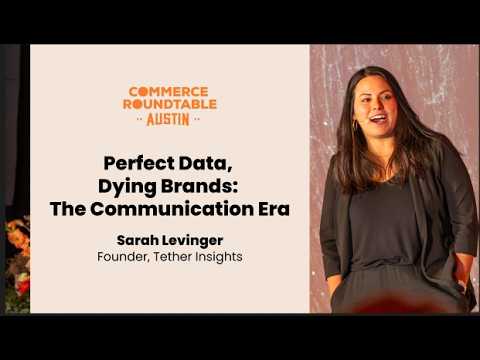
Sarah Levinger explores why producing more content can fail to improve performance. Through brand examples, she argues for a consistent point of view, human connection, and trust in a crowded AI-driven media environment.
Sarah Levinger explores why producing more content can fail to improve performance. Through brand examples, she argues for a consistent point of view, human connection, and trust in a crowded AI-driven media environment.
For ecommerce founders, marketers, and operators working on brand & creative.
Speaker roles and platform examples reflect the session’s original context. This is an archived conversation.
Ask whether more creative is building recognition and trust, not just increasing volume.
Read this part · 02:34 ↓Build communication around recognizable human concerns and a credible relationship.
Read this part · 13:15 ↓Use consistent identity and cultural connection across campaigns and touchpoints.
Read this part · 20:33 ↓A quick editorial guide to the key ideas. Read the complete transcript below for the examples, details, and discussion in the recording.
Original recording on YouTube ↗Sarah compares the disruption of AI with an earlier transformation in communication. As content becomes easier to produce, brands can end up copying one another at greater speed. Her concern is the gap between rising output and meaningful differentiation: more ads do not automatically give customers a clearer reason to care.
The talk shifts from technology to the emotional experience of the audience. Sarah describes trust and supportive messaging as reasons people pay attention. Rather than treating customers as targets for endless variations, she asks brands to consider whether their communication makes people feel understood and connected.
Vacation, Fishwife, and Liquid Death illustrate different ways to create a recognizable world around a product. Sarah emphasizes consistency: an identity gains value when people repeatedly encounter it. A point of view should guide creative choices and customer experience rather than appear briefly in a single campaign.
From the recording’s auto-generated YouTube captions, with filler words removed and paragraph breaks added for readability. Names, numbers, and wording may contain caption errors; refer to the recording for exact phrasing. Chapter links jump to the text below.
Original recording on YouTube ↗0:02Hello. Can I just say I'm so excited to be at this one? I'm just like most of the time I get on stage and I'm like crazy nervous. But this I see so many people that I know and I'm like, "Look at all my friends." Okay. So today we are going to talk about what's happening in our industry, the state of the industry. specifically the communication era. Now I'm going to walk you guys through kind of what I predict is probably going to happen somewhere in the next 5 to 7 years. But to start, I actually want to start with kind of an experiment. If you guys will let me do this if this will work.
0:35Ah. Okay, here we go. 100% AI, but walk with me here because I have like a story that I want to tell you guys today that's like really really interesting how much it kind of parallels with what we're experiencing.
0:49So let's say that you are a physician in Venice, Italy, right? It's 1501 and you've spent kind of the last 10 years training under the masters. So you have an amazing ability to read all of your patients. Your practice is growing, right? So everything is going well. This week though, all of a sudden you have a new competitor who's starting to produce a lot of these new pamphlets and inside these are a guide to curing English sweating sickness, which was a really bad illness of the time.
1:18This guide was written by a verified nobody. Nobody can tell where it came from. Nobody can tell who wrote it. Nobody can tell whether or not it's true. But these are all over the place. They're everywhere now. Now, interestingly enough, this continues and over the course of kind of the next few weeks, your patients start to quote this back to you. They'll come into your practice and say, "I read this in a pamphlet. Is this true? I saw this symptom. Do I have it?" These type of things are happening more and more often and over the course of the next few months you start to see all of these guides flood the market. Some of them are brilliant. A lot of them are actually dangerous and they're starting to affect your business. Now this is a serious problem because for both you and your industry, this resource looks exactly the same as everyone else's.
2:04Your customers can't tell the difference, and your competitors can't tell the difference. So, now who whoever is producing these is starting to eat in the market, and they're taking over, and nobody can tell what's going on or what's going to happen next. This is the story of the introduction of the Gutenberg press, and I truly believe this is critical information, I think, for everybody, even if you're not a history buff. Mostly because what's happening to these guys in 1501 is happening to us right now in D2C and e-com and all over.
2:35Okay. First question I have for you guys, raise your hand How many of you have published more ads in the last 2 years than ever before? Okay, keep your hands up if they are performing better than ever before. Oh, a couple of you. Okay. Okay, yeah, that makes sense. Okay. So, the interesting part is I find this to be true across basically every like category that I consult for. Everybody seems to be producing more and more ads, but they don't seem to be doing better.
3:02Which I find to be really interesting because it shouldn't necessarily be the case if we're producing good creative and we're good at our our output, right? Now, the interesting part is I don't think that this is necessarily an ad problem. I think it's much, much bigger than that. So, here's something that was like genuinely really interesting when I started to to like dig into the history of the Gutenberg press and what happened in that particular era.
3:25Before the press, the number of manuscripts or books in circulation could be counted by the thousands. After the introduction of the Gutenberg press, just 50 years after it actually came to market, there were more than 9 million books in circulation. Some accounts say up to 20 million. So, they went to very, very little all the way up to as many as you could count and higher just within a very short amount of time. A single press could apparently produce 3,600 pages per work day is how many books it could print.
3:58Compared to only a handful by hand, this is like a very drastic change obviously in the industry. The cost of producing a book collapsed to basically nothing. And with that, I think we had a the barrier to publishing kind of just went out the door. Everything collapsed to the floor, and now everybody could produce a book if you wanted to.
4:16Now, if you compare this to the timeline that we just witnessed, it's almost exactly the same if you kind of look at it in parallel. So, interestingly enough, in 2021, we were just barely starting to create these kind of like AI high-quality images. I don't know if you guys remember it. It was like super exciting. Like all of a sudden we could create anything, and they were awful. This was also when we saw Will Smith eating spaghetti, and it was like not okay. That's when this happened. Right after that, in 2022, ChatGPT launched in November and became the fastest-growing consumer app in history.
4:512023 saw massive improvements, though. We saw all kinds of reasoning. Now all of a sudden AI was starting to pass the bar exam, and we saw Meta release all kinds of updates and things to try and keep up with the market. 2024 is when we saw Sora come in, so we have video, we have AI, all kinds of things start to open up. We have real-time kind of like native interactions as well. We can do text, we can talk to our AI.
5:15And in 2025, we see a lot of disruption. Now our AIs can do AI things on their own with other AIs without us having to tell them to do it. So, if you look at this timeline, we kind of just witnessed a very monumental historic event. And some estimates state that there are 10 billion new AI-generated web pages that have been produced since 2023. And it's speeding up. The interesting part about this, I think, for everybody in the room and just like anybody who's a history buff, I'm sitting here just watching it going, this is so fascinating.
5:48It unlike the Gutenberg press, which basically took about 50 years to start feeling the effects of it, our Gutenberg event took less than 50 weeks. So, if you guys are tired, this is why. We just witnessed this giant change in how the world works in a very short amount of time.
6:06Now, I I find this to be a little bit of a a difficult part of being in D2C and e-commerce in particular because the cost of producing content, any content, and producing it at scale has gone to the floor, right? It collapsed. So, we now can do this. We can just produce as much as we want at any time, and we can shove it into any sort of platform and try and get what we want out of it, but here's the key to all of this here.
6:32The problem is now that we have all of this content ability, nobody can tell the difference, right? So, good content and poor content looks almost exactly the same, especially to the consumer, when they look at all of our ads in context of TikTok or Meta or anywhere else, they have a difficult time telling which brand is which. The formats I think that used to signal credibility like YouTube long-form video UGC now kind of signal basically nothing cuz everybody can do it.
7:03So, we go back to Venice for a second. We have to kind of take a look at what the scholars did cuz they're kind of doing what we were doing as well. They and all the physicians that were seeing all of this content flood into the market decided that they have to do something. They can't just let it happen. So, what they decided to do was fight fire with fire. They flooded the market same as we're doing right now in D2C. They started producing massive amounts of content as much as they possibly could, and it was interesting because as soon as this started flooding in, the same thing happened. People started to get to the point where they couldn't differentiate, so it got worse and worse and worse. More output, right? More credibility signals in here, but nothing was really resonating with anybody.
7:47In our timeline, we're trying to do the same exact thing. We have hired five new agencies. We adopt like 50 new AI tools. We try really hard to make sure that we're producing, you know, upwards of like hundreds and hundreds of different ads every single month. but we're all making these changes all at once, and it doesn't seem to be helping at all. So, the interesting part about this is, once you get to this point where everybody's kind of producing content and it's a lot easier to produce, and you don't have to have any sort of like very in-depth intense skill to do it, everything starts almost copying itself. So, this is something that we're currently seeing kind of widespread. Since we've got this in our space where somebody will create a trend, an interesting piece of content, a good ad, whatever it is, we will all start to hop on that trend as fast as possible, and the copying creates an an inability to differentiate. So, it's very domino effect. We get to the point
8:42where we can't stop ourselves from copying good things, and then around and around it goes. People can't differentiate, and so they copy, and it goes and goes and goes.
8:51Today, this kind of rise in like identical volume-based content, I would say, is affecting basically every platform we know. right now, this is an interesting stat. So, 50.5% of all Google searches are ending without a click. People go to Google, type in what they want to learn. They're not clicking on any of the links. They're just waiting for the AI to recommend something at this point. AI summaries are kind of ruining that kind of top-down page. 61% of organic click-through rates have dropped, or I'm sorry, organic click-through rates have dropped by 61% in the last couple years.
9:24And another one that I saw was really interesting here is 68% of paid link clicks are also down just because there's AI on the page. I don't have to scroll. I don't have to try and figure out which of these websites understand me. I also can just ask chat or or Gemini to suggest something and then I will click on that. So, I know that this is like a kind of gloom and doom. I promise this whole entire thing is not going to be about all the bad stuff that's happening. I truly believe this is one of the best times to be a marketer.
9:53but I want to head back just a little bit back in Venice cuz what happened next was really interesting. So,
9:58now that we have the press in in the market, we start seeing a lot of notable people come out and decide that this is not a good thing. And we are going to start actively fighting this. We had a whole bunch of philosophers and and people who were like very very influential. We had the friars come out, lots of different people saying that most printers were completely illiterate, most books in circulation are completely inaccurate, and one in particular basically just called the printing press a because they were so upset that it was just eating into the market and nothing could be done about it. In our timeline, we're seeing some of the exact same kind of response. 61% of consumers right now worry that businesses are purposefully trying to mislead them.
10:40And this was done on a study based upon the injection of AI. People are not super They can't tell. They're not super sure whether or not all this AI means you're correct, that you're a valid business, that you're here to help me. They're super concerned and confused about what's going on in the market. Now, here's what happened in the Gutenberg story and where it kind of starts to run exactly in parallel. So, this part I find interesting just because from the authority pieces of I guess this time period, people started to put in a lot of effort to try and shut the whole process down.
11:14So, they were trying to regain control of the medium, the actual pamphlets that were being printed. In 1501, Pope Alexander the VI threatened to to excommunicate basically anybody who printed these manuscripts. He tried to shut anyone down. He also took a bunch of scribes and built these kind of like really powerful guilds and tried to resist any sort of like printing press output by training all these people to only do this by hand. Interestingly enough, this was one of the most notable pieces of history. A group of scribes actually tried to attack and dismantle a printing press at this point just to try and control what was happening to the market.
11:55In our timeline, the same thing is happening. So, early on in 2023, Italy became the first government to ban ChatGPT, which was super interesting. The ban only lasted a month and I guess they had reports of a 400% surge in VPN downloads because users immediately tried to get around it and that's the reason why it only lasted a month. In late 2023, China started implementing all kinds of rules on AI services. They required providers to kind of ensure that content and anything produced was government approved. You also had to register just to get any sort of access to this particular piece of technology. In 2024, we saw the EU kind of take some sort of action.
12:39They started to kind of prohibit certain AI practices outright. And they also have providers that have to be registered their systems in the EU database just to obtain a certification to actually run these and service them. Finally, US got involved. White House is kind of starting to try and regulate some of this just through federal policy. From what I can tell, a lot more of this is about to come where we're going to see all of the actual authority, right? Authority and governments, anybody that's in charge of any sort of country that has access to this technology is going to start to crack down harder and harder.
13:14Okay.
13:15Back to 1501. And like I said, I want you to stay with me here because I know that the majority of this is like very scary stats, but this is this is kind of where hope was on the horizon for this particular time period. So, at the peak of the noise in in Venice, while all of these pamphlets were being produced, the content flood got so bad that people were trying to figure out which one was valid and which one was not. Something really strange started to happen with the pamphlets that were being produced. There was one type of pamphlet that was being consumed faster and was also kept longer than the rest of these pamphlets that were being produced.
13:51These pamphlets were not very accurate. They still weren't the ones that were going to be the most authoritative. and they really they weren't even the most differentiated ones. These ones were the pamphlets that really made people feel something. So, they were very they're very supportive pamphlets that that kind of spoke to the heart of these people. And they were the ones that people could take home and actually feel safe with. They were the pamphlets that said, "I understand what you're going through.
14:15Here's why this is happening and we just want to support. Here's what to do. You don't need to be afraid." And this is really interesting cuz this is a very human trait that I'm starting to see in AI as well. It's not just here. Why this
14:28is happening though has some deep psychology roots. So, from a neurological standpoint, this is not a flaw, right? So, your ability to pay attention to things and your ability to actually act on them and do something about them is related to how we process information. When it comes to processing any sort of like safety mechanisms, when we're overwhelmed or when we're stressed, that true overwhelm is really only placated by something that's very very distinct and it's usually this.
14:58So, when we're scared, we typically look for people who are in positions of authority who are closest to us, not positions of authority who are way way above us. It's calm voices that typically do better, especially in large amounts of noise and volume. It typically looks like somebody who's been through this before, right? Who's not going to kind of lose their when everything goes down. It's a lot of terms and technology and messaging that that wraps around very supportive authority. Supportive authority in particular. So, it's people who won't panic. This is what the current consumer base is looking for. Somebody who's calm and doesn't try and force me to buy something I don't want to buy.
15:41This is called co-regulation. It's something that happens with all humans on the planet. It's how our nervous system has kind of always borrowed kind of security from other people around us. It's kept us alive on the savanna. It keeps us clicking. It keeps us looking for something like this. We don't really flock to high-level authority when things are very scary. We flock to our tribe. And this is really, really key. So, I want to show you a little bit of like how I'm looking at this this year, especially since I do create a strategy for quite a lot of brands in D2C.
16:09I want to talk about trust cuz I think this is where it's going in 2026 and beyond. If you cannot build trust with your consumer, you're not going to be able to make it, regardless of how many tactics you put in place. So, in our timeline here, there's an annual global survey that measures public trust. it's called the Edelman Trust Barometer. They've been doing this for about 26 years. and this pulls people from all over the world to basically ask like, "What do you guys trust most? What do you hate? How can we build more trust specifically with government entities and businesses in particular?" The Edelman Trust Barometer is interesting cuz over the last 20 some years in here, they're starting to get to see that consumers are starting to pull back their trust with brands in particular and with businesses. And they're placing it back in their tribes.
16:56This is the reason why TikTok lives, influencers, creators, that's why that's working because people don't know who else to trust other than people who look and feel like them. They're looking for brands who kind of understand what they're going through and come to them with a message that says, "Yeah, we feel that, too. We feel that, too." is what the consumers want to hear. In short, consumers are really looking for brands who feel like them, right?
17:24Doesn't always have to look like them. It's still important. You have to make sure that you have good brand. You have to make sure you have good visuals. But if you don't feel like a brand that can be trusted, nobody's going to buy from you. It's going to get more and more expensive as you go along. In general,
17:38most consumers are looking for less proof and they're looking for for peers, right? Somebody I can talk to who will talk to me, too. Right now, AI is a peer. And this is really important. AI is a peer. Everybody in here has talked to AI on the daily and I'm sure it comes into the conversation saying, "You are brilliant. You are the smartest person I've ever met. Let's make five businesses. I can't believe you came up with this idea on your own." It is supposed to do that. It is built to be a helper. It's supposed to be an assistant, which means that everything it's telling everyone is too much in one direction. You're going to constantly hear it tell you you're amazing. So are the consumers, which means we're now going to get cyclical thinking inside the system and it's going to become more and more and more important to help people realize sometimes you're wrong and that's okay.
18:31Sometimes AI is going to tell you things that are not true and that's okay. Very, very important to realize this is where the consumers are going right now to find their information, to understand where to go next, to find a friend to help them to make these decisions. So, AI is interesting because it's endlessly patient here and every single time even at 2:00 a.m. without judgment, it's going to tell these consumers exactly what it thinks is the best solution for them.
18:59And the way that it's going to judge that is not just your good SEO, your product titles, your you know, what's on your webpage. It's also going to judge you based upon how your brand looks compared to everybody else and how your brand feels compared to everybody else.
19:14So, I think the big question here, and this is kind of the entire like premise of the whole presentation. the one that we have on all our minds all the time is what should we do now that AI is here? What should we do now that our Gutenberg press era is here? Should we become AI brands? Should we lean out our teams and give all of that over to AI? Should we give our entire social media presence over to this? Should we just automate everything? Should we be making content with it?
19:44And what happens if we don't? I think that's kind of a key question. I truly believe that the question here is not should we use AI, should we not use AI. I think that would just put us back to where the Catholic Church was, where they tried to just dismantle everything. AI is here, and it's here to stay, and it's going to become a large part of how we do our jobs, and how the entire society works. Nothing's going to turn that off anymore.
20:10But I want us to remember that AI is just the printing press. Right? It's just the press. It and and what we do with this press really does determine what happens to our businesses next. I think the the important part is too that the press story, the Gutenberg press story, doesn't just end with like and nothing was ever good again, the end. There is much more to the story that I kind of want to go in depth in cuz this is the most interesting part. So,
20:34back to Venice. We had a content flood that has risen to its very, very peak here. It's almost its highest point. We had a lot of scholars and physicians that were trying to dismantle it and turn it off. but there was a small group of people that noticed that these pamphlets that were much more human-to-human, a little bit more accepting, a little bit more connective, were starting to take off. So, they started publishing more and more of these.
20:57These pamphlets that they were producing were then distributed to very key people who were able to back up what that pamphlet said with how they acted. So, good customer service, good products, right? Very connective tissue that just confirmed whatever it was that these pamphlets were saying. Now, the interesting part, I think, how they built this credibility was mostly that they were just consistent. So, they had a message that said, "We see you. We hear you. We understand that like our industry is kind of messed up and we haven't done a great job at XYZ. Maybe our industry is just too hard on this, too soft on this, and we agree. We want to make this better and we want to try and do it for you, the consumer."
21:40Those were the pamphlets that did well, and then they took that message into the actual room and said it again and said it again and said it again. This consistency slowly start to build credibility throughout. Okay, I have actually watched this
21:54happen with a couple of brands that I work with and ones that I 100% just love. These guys, oh my gosh, I absolutely love what Vacation's doing. They're If you've ever studied their marketing, whoever's in charge of that, like props to you. So, these guys, they sell skin care, but they sell like sunscreen. The The crazy part about how they're selling it though is they're not trying really to sell it off of what everyone else is trying to do. They're They're going after something completely different.
22:21So, they've created kind of this elaborate kind of fictional, I don't even know what you call it, like universe. And it's a corporate universe where they have specific characters that they've chosen to represent the brand. and all of this is kind of in service of this obsessiveness over one specific emotion that they've tried to make their own and they've done a very good job in doing that. This is 1980s, what we call leisure culture. So, the whole entire brand, not just the website, but basically everywhere in the entire brand leans on this as a way to make themselves not just different, but also connective with the actual culture that they're trying to tap into.
23:01Their marketing kind of references things about their product, but they don't talk a whole lot about skin cancer. And they don't talk a lot about like daily regimens or sun protection. They really talk more about this guy, which is apparently HR associate Neil Smithson, who is a tennis player. And he has massive amounts of content. Every other post I see now from them is all about this Neil guy, and it is so fun to watch and so fun to consume that it's hard to get off of their socials because now I need to know more about what Neil is doing. And then I'm going to go buy from this particular company because I like Neil. And this is what I'm talking about when I say we got to build trust.
23:41We can't just stop at we have a good product. You can't just stop at we do good work. We have the best customer service. We have the best ingredients. It's not good enough anymore. The consumers don't trust it cuz everyone is saying it. This is how we start to build trust. Very specific characters. Another really good example of this I think is the launch that they just did, their orange, what is it called? Orange Revival project.
24:06This one was absolutely crazy. They actually built kind of just like an army basically a influencers, about 15,000 person wait list is what they got from this after just going after all of these like small micro influencers and saying we just want to give you product. We want to see if you like it. We want to see what you think. Amassed this giant following before they launched. but the bit here, the 1980s kind of leisure culture that I was talking about before, stayed consistent. They never changed it. They even have an infomercial. Like they had a 1-800 call number set up so that people could call and order product if they wanted to. They stuck with it. They stuck with it, stayed consistent, never deviated ever from this the entire bit that they were on.
24:49Oh, okay, sorry. I have to breathe.
24:51Okay, next one. I get really excited about them because I love Vacation. These guys are interesting cuz they're just stuff and coming. I just discovered these guys. Let me know if they've been around for a while cuz then that would just be embarrassing for me. But, Fishwife is really fascinating because they made kind of a deliberate choice here to treat their canned fish as normal. They actually have this really beautiful design that they have across their entire brand, and they're very steeped in their kind of like Portuguese and Spanish roots. So, they pulled on this particular level their brand, right, to push into this and help consumers understand that it's normal over here, but it can be normal everywhere.
25:25Everybody should be eating fish, and especially fish in a can, and it's working for them big time. So, their visual identity though is the like cultural connective tissue that they chose to lean on. Vacation chose a little bit more of that kind of 1980s nostalgia. These guys actually got an artist named Danny Miller, who was a guy they met on Instagram. he had never done any sort of packaging or brand work before. He was just a guy that had a really cool eye for things.
25:52And then they brought him in, and every piece of the brand's identity has leaned on his style since then. And what's so interesting, if you consume this as a consumer, if I'm going and looking for tuna or any sort of fish in a can, I think I'd rather buy from these guys just because they're interesting. They have something that's really, really distinct and something that I might align with as a consumer. Messaging-wise, they didn't really try and be a content machine at all. I don't see them producing massive amounts of creative.
26:21They're producing enough, but they let that packaging do the work for them, right? They're so distinct in here that they have that connection with customers because it's just interesting and beautiful to look at. So, anybody that aligns with that type of content is somebody who can come in and try this, even if they're not a fish eater.
26:40Last one on here, I can't get away from any sort of talk without talking about Liquid Death. They have changed quite a lot, and they're breaking my heart over the last couple of years. But, when they first started, these guys launched into one of the most commoditized like categories in the entire game. cuz they sell canned water. And interestingly enough, they didn't really try and like out health anybody. They just noticed something. And this I might sit here and talk about this for the entire rest of the talk.
27:08Noticing whatever your category is saying too much is kind of critical because they came in and noticed the three of the top players in the industry not just looked the same, but didn't really sound any different. They were just trying to spend their way into people's minds and into the people's hearts. When it comes to D2C, very very important that you understand what your category says a lot. So, for instance, one of the things I notice very very often inside supplements is in that particular industry, we often try and tell people that there's something wrong with you. Your gut is not okay, right?
27:43Or maybe your brain needs some extra help. Maybe your anxiety needs something else. These people already know that and everybody else in the industry is also saying that. What you can do is come into the industry and change the narrative. You can tell them you're not messed up cuz you don't feel okay. This gut issue that you're dealing with is not forever. It's not. It's not supposed to be. We can help you heal. And if you want to try some of our other products, do that too. But we want to come into this conversation let you know this is not forever because that's what the entire industry is saying. And this is for every industry on the planet, every category I've ever helped or or done any sort of consulting in, there is a strong rhetoric that goes through the entire industry and the quicker you notice it, the faster you get to be the one to turn it around and say something completely different.
28:30As of March 2024, last time I checked on these guys, Liquid Death is valued at 1.4 billion dollars. They are now oddly and interestingly partnering with all kinds of different brands to just bring their core point of view into the conversation into all sorts of other categories, which is really interesting just based upon the fact that they sell water, but they're able to get these kinds of connections cuz they don't follow everybody else. They have a point of view that makes them enticing, attractive, and a brand that honestly most of the consumers just really enjoy partaking with.
29:07Okay.
29:08Each of these brands I think made a conscious choice early on in their growth to have one specific thing that they were going to adopt as their own. For Vacation, it's this 1980s novelty. For Fishwife, it was like fishes for everybody. We just want you to start enjoying some of the culture that we enjoy. For Liquid Death, it's just like every corporate everybody sucks. So, the interesting part about this is they started to attach so close to the consumers just by getting this brand message in, right? Their point of view became the brand, and this is the reason why I think they're growing as fast as they are and doing as well as they do.
29:46I think it's interesting cuz looking away from that kind of chaos, right? Choosing that path all your own is going to be probably the hardest part of the journey, but this is the way that we kind of break through all this noise where we all start to look the same. We have to stand for something. You got to pick something that's just yours that you can say we just don't think this is right in our industry and we're going to start to say it, stay consistent with it, or we're going to tell everybody we know that this is what we think should be on our planet. Okay.
30:15Back to Venice one last time. and I promise this is going to go somewhere. So, we're in 1660 now. In response to all the chaos that was kind of brought on by the Gutenberg Press, the Royal Society of London started to put in like really really key people in place to try and control some of what was happening, but also try and establish a little bit of a baseline for what's true and what's not. By 1665, they had they had generated a a new charter that was improving natural knowledge was established. And these guys basically just created the first of many world-changing documents that was basically only brought on by the Gutenberg Press. We wouldn't have had this. the primary one being something really interesting and like near and dear to my heart. This is the world's first scientific journal. And this was made specifically because the Gutenberg Press came in and disrupted an entire era of people. Philosophical Transactions was made in response to just this event. And this is really
31:13interesting. It's motto, which I'm going to butcher this, nullius in verba, literally means take nobody's word for it, which I find hilarious. But the entire structure of the journal is really just built around that single premise, which is can it be verified? Can it be verified that what you are reading is true? Now, it it's not really about like how authoritative this book looks, but this one in particular really just sits strongly with me because we would literally not have any sort of scientific or peer-reviewed anything had the Gutenberg Press not happened. Two years later, the Academy of Sciences in Paris is founded, and these institutions publish that first peer-reviewed journal. Lots of collections of letters, all kinds of reviews. I mean, it just continued to grow and grow and grow where all people can design any sort of knowledge-based kind of checks and balances systems and promote better verification. And this is really interesting cuz if you look at what actually happened and what came out of this particular era,
32:14you have to understand that from this standpoint, the peer-review kind of mechanism happened only because they couldn't control what was happening in their own ecosystem. So, there was a lot of information that was flooding everything. And what they did was they started by helping people understand what they should trust first. What you should trust, right? So, the answer for us now is how can we put that trust infrastructure into our own ecosystem and our own market so that people know what's actually true and what's not.
32:44That infrastructure, the peer review process took over a century to fully form. The interesting part though is the people who built it who didn't just like, you know, commit to like just going with the flow or just trying to like produce massive volumes, all they did was start to put in these checks and balances systems, but it was the system that would be used for the next 500 years. So, it matters. It matters how much trust we put into the system and what we decide to produce next.
33:13Okay. Last part of here, AI is already part of our workflow. and soon it's going to become a large part of our society. I think it's great, honestly, that history repeats itself because I think what's coming next, we're not going to be able to predict it very, very closely, but I can say this is going to be a really fun time to be in marketing. It's going to be a very interesting time to be a human.
33:33and I believe the same kind of revolution here is coming for us. We're about to see a lot more put in place so that people can understand what's coming out of this system is true or not, and that's going to become kind of where we need to sit is in that trust marker. The brands left standing from what's happening in AI are not going to be the ones that are going to be able to produce the most because they're just going to blend like everybody else. They're going to be the conscious brands like these guys.
33:59They're going to be the ones that understand that a lot of this comes down to the fact that consumers don't really care who or what makes them feel seen. Right? It could be a brand, it could be AI, it could be somebody sitting next to me. Doesn't matter who it is. Everybody wants to feel seen and belong to something that's important to them. As long as somebody cares about the same things that I care about, whether it's dressing up in Kiss makeup or or, you know, taking care of my skin, as long as somebody cares that you exist, that's what's going to drive these consumers forward.
34:37500 years of communication has taught us that the cost of communication, when that happens, when it collapses to zero, it doesn't really go to whoever produces the most. It just goes to whoever people decide to trust. And I truly believe that this is like a big, big piece of it. it's not really about how much you can communicate. It's really about having a point of view that's going to match with the people that matter most to you, right? And you can't prompt your way into a relatable point of view. So, I think the question that we should probably ask ourselves on a weekly basis, and this is the one that I'll end with. the question is how How are we going to use AI to become better brands, build better businesses, and just connect with the humans that we share this planet with?
35:23Thank you. >> Yes, sir.
Join Commerce Roundtable in 2027 for focused learning and conversations with people working through the same challenges.