 31:16
Austin · 2026

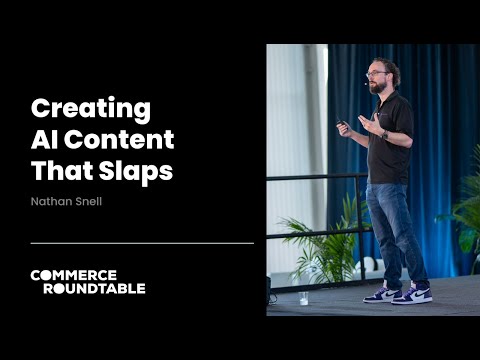
Nathan Snell shares a six-part approach to producing on-brand AI content. The session connects context, performance data, specialized tools, and iteration to a practical email production process.
Nathan Snell shares a six-part approach to producing on-brand AI content. The session connects context, performance data, specialized tools, and iteration to a practical email production process.
For ecommerce founders, marketers, and operators working on ai & automation.
Speaker roles and platform examples reflect the session’s original context. This is an archived conversation.
Document the essentials of voice, audience, product, and creative direction.
Read this part · 08:41 ↓Feed learning from previous creative into the next round of production.
Read this part · 14:45 ↓Choose tools for specific tasks and connect them with a clear review process.
Read this part · 24:07 ↓A quick editorial guide to the key ideas. Read the complete transcript below for the examples, details, and discussion in the recording.
Original recording on YouTube ↗Nathan’s framework starts with the information a model needs to create work that fits the brand. Context helps narrow the output toward a useful result. He also warns against overwhelming the prompt with long lists of prohibitions, recommending that teams emphasize the most important requirements and constraints.
Performance data gives the process a feedback mechanism. Rather than treating each prompt as an isolated request, marketers can use what they learn from previous work to guide the next iteration. The session frames AI as part of a creative system that combines direction, output, evaluation, and refinement.
Nathan separates the choice of model from the process around it. Different tasks can benefit from different tools, but tools alone do not create a reliable operation. The accelerated workflow still needs a brief, appropriate context, creative judgment, and iteration before material is ready for customers.
From the recording’s auto-generated YouTube captions, with filler words removed and paragraph breaks added for readability. Names, numbers, and wording may contain caption errors; refer to the recording for exact phrasing. Chapter links jump to the text below.
Original recording on YouTube ↗0:00We're very email focused. So, we use AI to effectively help you grow your email revenue without growing your headcount. Every single brand on the planet is going to be using AI to create content because like they're focused on literally making AI become the next wave of infrastructure [music] in the world. Effectively, the quality of your context is way more important than [music] the quantity of your context. And the more you can guide the AI to understand how to talk like your brand, the better it will do. So awesome. Thank you, Jimmy. I appreciate it. So, for those that don't know me,
0:40AI is sort of my favorite thing. especially like AI and brands and just bringing that stuff together. My background really quickly, kind of shows that. So, I actually started off in e-commerce. I won't completely date myself, but it was before Shopify was a thing. So, I'm a techie by trade. I grew up in in the valley and we actually started off building an entire e-commerce platform for a particular brand, startup geared. I had a small stint just from a background standpoint in agency life. That stint was about 11 months. it was a digital agency and I realized that that's not for me.
1:13Props to you that are in the agency life. Mad respect. I went back into the product world from there. built out product for a company called Live Oak. They went public in 2015 at about a $3 billion valuation. I then co-founded a company called Enino. It was sort of a martekch company masquerading as a fintech company. And we took that public. I wish it was 8 billion. It was actually 7 billion in valuation. You know, I guess when you get into the billions, I don't know if it matters anymore, but nevertheless, that was in 2020. And then I started Railon. So
1:43Railon's a company I'm a co-founder and CEO of. We're not here to talk about that, but the very quick just sort of understanding of it. We've been talking a lot about opex and everything else. So, we're very email focused. So, we use AI to effectively help you grow your email revenue without growing your headcount. So, we help brands and agencies, we work both to effectively deliver the entirety of the email retention spectrum in an incredibly efficient way, driving more email revenue overall, but again, without having to hire tons and tons of people.
2:12we like robots and that's what we're going to talk about. So, one of the
2:18biggest things that I hear all the time from folks and from brands that we work with, we work with hundreds and hundreds of brands, we advise brands on this sort of stuff, is how do you create AI content that slaps, that really, really performs. So, we're going to start off a little high level to start and then we're going to drill into the tactics. I'm a big fan of like just AI is so overhyped. So, I like to make it real. I like to make it tangible, something that you can actually walk away with and go, "Okay, awesome. This wasn't just this theory. I can actually do something with it." That's what we're going to do. So, before we dive in completely, I want to I want you guys to consider something really important. And this kind of even comes from what Gary was Gary Vee was saying yesterday, and that's that in the very very near future, every single brand on the planet is going to be using AI to create content. Every single
3:06brand. It will literally be as pervasive as electricity. It's going to become a utility overall. And not just because these crazy AI giants are investing billions of dollars into creating nuclear power plants, but because like they're focused on literally making AI become the next wave of infrastructure in the world effectively. So that that's what it's going to it's going to become that pervasive. Now that means two really important things. One is if you're in this room and you're a brand and you're going, "Oh, you know what? AI content doesn't apply to us. Well, we it doesn't work for us. We don't need that." Or, you know, our brand's different. That's an excuse and you're falling behind. I'm sorry. Well, we're we're building this relationship over time. Maybe by the end of this, you'll trust me enough to know I say this because I care. You're falling behind.
3:54Now, number two though is good news, and that's that because you're in this room, by the end of this, you're going to get to make a choice of whether or not you want to fall behind or stay behind or whether you want to lead the pack, understanding how to create really awesome AI content because it is possible.
4:11So, I like to start off just getting a lay of the land. So, raise of hands. How many of you have seen really crappy AI output? Raise of hands. Keep them up. Okay, for some of you whose hands aren't raised, you're not paying attention. And that's okay. We're going to go to the 100% of the room is everybody has seen lousy AI output. Whether that's too many hands, too many emojis, too many freaking M dashes. I still don't know how that got stuck in the model. The M dashes like I loved that grammatically and they've ruined it. It's just it's terrible. But like for some reason AI always puts too many things in and for some reason not enough. But the issue that comes from that, right, is oftentimes when we talk with brands, they have seen all this bad AI content and they go, "Oh, well, like clearly it's not possible. There's AI comments all over LinkedIn and Twitter now. Like, it's just all there is is garbage. It's not possible to make anything good." But
5:01it actually is very possible if you know how to do it. So, this is an example from Kuru Footwear. this is actually a completely AI generated image that I put together. In fact, this image is so spot-on with their like with their actual quality and shoes and everything else that their head of branding at Kuru Footwear reached out to me and asked me if I could actually you give him sort of a rundown of how we produced this image because it was that good. It's that spot on. And it's not the only thing. I'm a fan of Hexclad. So, I had some fun with, you know, with Hexcloud stuff. They've got new knives that is not really steel bread. That's a cinder block. Again, these are fake. You shouldn't use their knives in cinder blocks. It probably won't do that. But as an example of what's kind of possible here, same thing out product shots. that is neither none of these are real. This the products themselves are spoton. The branding is spot on, but these graphics
5:48are completely AI generated. Another one is Chomp. I love Chomp. Like it's a good protein stick. They didn't pay me to say any of this. I I kind of like the Chick-fil-A campaigns. So I took the inverse approach of like what if cows like Chomp so much that they had Chomp. So again, you we actually went through and we made a little graphic kind of ad style for a Chomp stick. And then this one is actually from Rayon from our product where we had an AI generated email header. So we used a product image in there which is why the product looks great and it generated an entire email header you know email kind of hero image as a whole. And I show this again just to kind of hopefully begin to build belief that like it's entirely possible to create really really good AI content.
6:30Now the challenge is and what we've kind of found in in talking with hundreds of brands or working with hundreds of brands is there's this sort of mindset shift that's required to kind to kind of make it happen because the way that we often start and look and I do this sometimes too is we basically take the world's largest super intelligence and we kind of condense it down into the equivalent of like a use case like hey write me some ad copy. We give it no context at all and then we get pissed off when the results are garbage. I mean like that's sort that's sort of the result that happens as a whole. And look like again I'm guilty of it too. And in reality there there needs to be this kind of concept shift which is you know when you think about when you think about that problem overall what we've seen is as you shift to because this new mentality this kind of one simple concept this one new mentality and that's really this idea of
7:18you know AI is actually like hiring your best employee ever but we all skip the onboarding of that employee right and I know it sounds kind of weird but in reality like over the next couple of years we're going to see AI more and more as like these human robot replacements Like often times when people ask me about team size for example, I say we have six robots on our team in addition to our humans because we do. It helps us scale quickly. It's the same concept here. You know AI is like having is like hiring your best employee ever. But so many of us skip onboarding. Let me put that in like non you know or maybe more tangible terms. None of you in this room you as a brand would go out and hire a rockstar designer, right? A killer designer.
8:00Bring them on board. Give them no brand assets. give them no product information, give them no context about your brand at all, and then in that same week ask them to create a banger email that's going to go out for a new promotion and then expect it to perform well. Nobody would do that, but that's exactly how we treat AI almost every single day, right? It's because we're skipping the onboarding. And in AI language, that's called context, right?
8:24So we're we skip sort of giving the AI the context that it needs overall. So, that's kind of the we'll leave that as like the theoretical strategy part. Now, we're going to shift into like, okay, Nathan, great. Hopefully, you're buying what I'm selling here in terms of awesome. We need context. This stuff is real. Now, how do we actually make this thing real as a whole? So, we're going
8:41to talk about the six essentials to onbrand copy or really on brand writing, on brand analysis, anything that's textbased overall. And this is about the context as a whole. And one thing just just to park here for a minute. I'm sure everybody in this room has probably heard the term like prompt engineering. Like if you raise of hands, promp prompt engineering. You know what? Yeah. So prompt engineering is a really great lead magnet and really great for people who want to sell courses as a whole.
9:10It's about 10% of what's actually valuable when it comes to getting AI to do what you want, right? The rest of it's actually context engineering. And I'd say if you're not hearing that already, you're going to hear probably over the next 12 months way more people start to talk about context engineering, right? The difference is it's like if you've tried to get AI to do something, you know, the way to kind of think about it is rarely is the reason that AI gave you a lousy result because you didn't ask the question well, right? It's usually because when you asked it the question, it didn't have enough information, enough context to be able to do something with it. Right? So that's what we're talking about and that's actually what these six essentials are is exactly what we're going to focus on. It's giving it that context. So when you say write me great ad copy, it will in fact do so. So we're going to dive into each one of these specifically. So the first is your brand
9:58summary and overview. Now I use True Classic as an example throughout this. I don't know Brian Sly here. I'm a fan. Great product. Use it myself. when it comes to the brand summary, you'll notice for each of these things, I did not dump in tons and tons of information because there's a really important concept when it comes to context engineering as a whole and getting quality AI output. And we've seen this on the Railand side with more than 100,000 conversations within our own platform with AI. And that's this idea that the quality of your context, right?
10:29So, this is like a highly condensed, if you will, brand summary, brand information. The quality of your context is way more important than the quantity of your context. Right? So to put that into real terms, number one question we get with brands in general, like you either aren't getting good results or first start using our platform, right? They go, Nathan, like I was trying to use this thing and kind of the voice and tone wasn't really good. I'm like, okay, great. Well, like what what did you do?
10:54We see I took our 48page brand guidelines and I dumped all of it into, you know, into a chat GBT custom GPT thing and the results still suck. It's like, well, yes, because you've got a ton of noise without a ton of quality, right? And that's what we're kind of focused on here. This brand summary is focused on the quality. So, the AI understands what the heck is our brand, what's the personality, and so on. Second thing, and this is there's two kind of the most core elements when it comes to really great writing from you know, from like any of these LMS in general. Voice and tone is one, personas is another. We'll talk about that. Voice and tone. You don't have to use this exact format. Again, I I recommend it.
11:32It works really well from everything that we see. I'm not going to read the entire thing. A couple highlights. So, one, you notice we talk about sentence structure. Again, the more you can guide the AI to understand how to talk like your brand, the better it will do. So, the other thing you see with phrases we avoid. This is a trap. There's a concept in sort of large language models called negative semantics. And it's the idea that you want to talk more about the things you want to see than the things that you don't want to see. Right? So you'll notice even for these like these phrases to avoid, there's very little that we put in there, right? We kind of really condense that. So I'd say I'd recommend anytime you're t you're telling the AI something you don't want it to do, you want to focus as much as possible on like the most critical thing you don't want it to do because what happens is it starts to overindex. It's like while it's this great super
12:21intelligence, it's kind of dumb at the same time. So, if you have this long list of things you don't want it to do, like over time, it'll actually start doing those things more and then you're like, "What the hell? I just I literally told you not to do this. Why are you using this particular phrase?" Like, "Why are you saying optimize revolutionary all the time?" It's because you have that too prominent throughout. So, voice and tone really critical to getting the quality outputs there. Another thing that we see really often, product details. So again, that designer example I gave, it's really, really hard for AI to talk about your product well without an understanding of it. One of the things we see most common is folks go into Shopify, they click export on their product catalog, they get a list of SKs, they have a general title, and that's about it, right? And they're like, "All right, here you go, AI." And then it's like, "Okay, well great. We've got this men's crew neck t-shirt, and it makes up a bunch of
13:10random crap." And you're like, "Well, it hallucinated." hallucination is actually a feature that just gets used improperly. So in this case, right, what we want to do again is think about think about being the brand manager and you're trying to give the AI as an employee as much of this context as possible. So you want to go into things like awesome like what's the customer like what's the actual customer language? What are the what's your key USB? Your differentiators, what are the colorways, what are the sizes, right? the kinds of stuff that you'd give to a designer or to a human copywriter to make sure it's going to write the right kind of stuff.
13:42Customer personas. This one is also critical. So, one of the biggest marriages in terms of getting really really really quality results is that voice and tone and the customer personas, right? Because that's how that's how the AI is actually able to begin to connect this idea of you have a brand understanding. I know how you talk. Now, I know who you talk to and why they care. So customer personas is massive. I have one example here. You're going to generally want to have, you know, multiple personas. you know, I would even go more depth than this. This is kind of a basic sort of scaffolding you're welcome to use. We tend to automatically go deeper than this for customer personas. but you'll notice like a review quote. I really like this because it helps the AI even understand how your customers and cells might talk.
14:23And then likewise the emotional state, right? The pain points, it's all geared again towards understanding your customers. one thing we hear kind of often around this too is especially if you have say 20, you know, personas or one of your really deep, you can actually use AI to generate really strong customer personas for you. I'm happy to talk more about more afterwards about how that even looks. Okay, last piece of
14:46the six performance data. So there's kind of two parts of this. So performance data is one of the key aspects of how AI actually even begins to understand how to connect kind of again like what Gary Vee was talking about yesterday. How to connect this idea of the copywriting, the creative and everything else as a whole to like what it should actually write and what good writing actually accomplishes. one of the things if you don't have like a real-time integration to some of this data, what I would recommend is taking say the top five performers from either your email performance, your meta campaigns, depending on what you're focused on, and put that in as context and take your bottom two, again, don't overemphasize it, your bottom two, and put that in as well. Because again, what that allows the AI to do is to begin to marry this understanding of, okay, I understand your personas. I understand your tone of voice. I understand your brand. And now I actually understand what talking to them well looks like and
15:39what talking to them poorly looks like. Right? So that's kind of the that's the importance of that performance data. I say don't skimp on the performance data. It's worth a little bit of the extra time. It will you will see a significant improvement in the quality of the output and what you actually get from that output. So that's that's text, right? So when you think about creating AI content, text is like really important. It also drives analysis. It's like a really really key and important part of it.
16:06It's also the less flashy part of it, right? Everybody likes to talk instead about the creative, right? What do the actual assets look like? So we're going to talk about that as well. Before we jump in, I'm going to make you raise your hands again. I like interaction. So before we jump, I'm just curious again. Raise of hands. Not yet. Raise of hands. How many of you have actually used AI to create content that you put into the wild and it's actually made money, right? Raise raise your hands. Okay, it checks out about 5% I'd say. And honestly, that's that's what we see pretty consistently and it's because right of of this gap overall. So hopefully this will help for those of you who did not raise your hand. This will kind of help move that 5% up to say 25% hopefully over time.
16:50creative content, you know, creative assets is a little bit different than the text side. the difference is kind of in two parts. One, you do still need context, right? So you notice brand summary and and the style guidelines, those are two things that are there. You still need that. You'll notice though that it's much shorter overall. The style guidelines gets kind of clipped. I'd recommend a little bit more than that. But the reason that you actually want to go and put this sort of information into the actual like you know image generation that you're doing is because image models actually have an understanding of the world. The issue is it's like an infant's understanding of the world. So it has this like very rough understanding. So if you're true classic then like the image model has an idea of true classic. But the issue again is comes a hallucination. It's going to go okay well you want me to go and create this new hero image for an email. I kind of understand some of
17:38these things. And then right when it doesn't, it fills in the blanks, which is where hallucinations come in. So the reason that we seed it with a brand summary and some style guidelines is we make sure that we kind of fill in the gaps for it so the AI doesn't itself go out and make up a bunch of random crap that then gets annoying and takes too much time. Now, second thing here, reference image. This is hands down the reference image is the most important aspect to getting very high quality creative assets generated. And you can use more than one. So like I just so I'd say even like if you skip anything else as a part of this, don't skip the reference image. It is the surefire way to be highly annoyed with AI. I instead So like with the Chomp example that we saw earlier, for instance, I used a reference image of the Chomp product. I didn't need a cow. It knows what a cow is, but I used a reference image of a
18:24Chomp product. If I wanted a particular kind of cow, I would have used a reference image for a cow as well. I didn't need one. It had again that kind of minor world understanding. So reference images are huge. Huge. Now, I poked fun at prompt engineering earlier. When it comes to the image side, there is one very new and really important nuance when it comes to prompting AI image generation. It's a new feature. It's a new way of image creation. It was introduced by Google and their newest model, Nanobanana, which I had to practice that because it's really hard to say nanobanana on a public stage without cracking up. I don't know why they called it that, but it's better to say that than Gemini flash 2.5 image something or other.
19:07That's like the the official name. Nano banana is. So what what Google created is this concept of multi-turn editing. That was the Google engineers way of saying you can now build images in steps in layers. Right? So what you're seeing here is effectively a multi-turn edit using Jones Road in this case of creating an entire ad asset. So at the very beginning right I actually pulled this is the reference image one right so
19:31I pulled a reference image from Jones red beauty of you know of the human model overall on kind of that perspective and then from there I did my first prompt which is hey look zoom out and put her in a luxury bathroom right and then from there I used another reference image still the whole same chat right so we're doing this kind of multi-turn I used another reference image of the Jones road product right I didn't jam all this one into in one massive prompt I'd multi-turn editing it so I said hey look then take this Jo take this reference this product and put it in her left hand, right? Because I wanted her to keep that pose with her right. Put it in her left hand. Then I went through a number of additional prompts to get the text in the right spots and everything else to turn it into a more full-fledged ad. And again,
20:10I cover this because there's a lot of folks that I still talk with and they're like, "Oh, image gen sucks. Oh, it doesn't work. It doesn't keep things consistent. Oh, like it messes stuff up all the time." And 90% of the time now when I hear that, it's not because the model isn't capable. It's because we have bad habits from, you know, chat GBT where we go normally what would it be is like, okay, well, I've got these three different reference images. Go and zoom out and put in here, put the product here, do this, put this text on it. The model gets all confused and it makes it look like it's some alien, you know, with 17 fingers in a new language. You want to do multi-turn editing.
20:43All right, I know I just covered a ton with respect to the context side for text and for images. So now we're going to move on to the idea of okay, you know how to actually give the AI what it needs to produce good results. Now it's
20:55a question of like well what actually do you use to get these good results? I call this this is my AI tier list, right? My model tier list overall. One thing I would say with this that's I'd say so important. So, I'd say hear me if if there's if you haven't been paying attention, you know, up until this point, what I would tell you is we
21:16are no longer at the point in this kind of AI cycle where your best results are going to come from using one model only. Right? In other words, the number of times that I talk to a brand and they're like, "Ah, AI sucks. It's terrible at writing and everything else." I'm like, "Okay, great. Well, like explain to me like what what are you trying to do to get great writing results?" I'm like, "Oh, well, like I just I used Chat TBT.
21:39I uploaded my 48 PR brand guidelines and it spouted out a bunch of crap. It's like yes. I'm like, you're right. That AI writing is absolutely going to be terrible because you literally use the worst possible model for creative writing or any sort of writing and you overloaded it with garbage context, right? Quantity, not quality. If you do that same thing and you provide it less context but better context and you use Claude or Kim K2 for example, you're going to get vastly different results.
22:07And I just say that because again, if you want to do this and you want this process to actually be high quality and to get good results, like I would say over the next 12 months, you are going to start to hear this concept of a small language model and you're going to start to see more models that are very use case specific versus these wide generic models because as they get more specialized, they're getting much more high quality. This is exactly why Google released an image specific model, right?
22:30It's because that performs better than Chad GBT's, you know, random gigantic model, for instance.
22:36So really quick, if you're curious how we came to this conclusion, about every two months at Railon, we publish what we call the DTC AI benchmark. We take about 32 different models, many of which you haven't heard heard of before. We run it through hundreds of evaluations so that way we can understand both for ourselves and for the community, everybody in this room, which models are actually the best at which use cases. For us, we build this into our platform for automated model selection, so you don't have to memorize it. for you all for those that you know that kind of like to play around with this different stuff. We put it out there so you know what's really good. All right. A simple example is Kim K2 a model that I'm willing to guess 99% of this room has never heard of is actually the best copyrightiting model out there. The issue is it's really hard to get access to like we have it within the platform. You can get it through other sort of random things. It crushes
23:22it is awesome. You know I'd say I mentioned nanobanana. If you are doing anything design related and you are not using nano banana, you are missing out. It is far and away the best most state-of-the-art image generation model. 40 sucks in comparison. Flex one context sucks in comparison. Every single every single other thing we've tried sucks except for idiogram character and a very specific use case. Nana banana is what you should use. You can thank me later.
23:49All right, we've gone through now all the context, right? So, how do you go and set it up? You know, what do you like? What do you kind of put into your projects, your custom GPTs, and everything else? Now, you know what to actually use so you can make sure that your quality is going to be good. The question then is how do you actually stitch all this stuff together,
24:07right? In other words, what I like to call the AI accelerated content process and whether you're doing this for email, which obviously we care a lot about, or ads, which we care about, but we don't do as much of in ourselves, we do on the Railon side specifically. So we actually use this to generate our own RON ads. but this is the process overall. This is the process that I'd say every kind of brand that we work with or agency that is crushing it with AI related content right now is using this process. So they start off their analysis in chat GBT. They use chat GBT5 thinking because everything less than that in chat GBT right now sucks. Just being honest. Then they go through and they take some of that output. Remember they still have all the contexts, right?
24:47So they have you can use a project in chat GBT. it's kind of easier or a custom GPT. Happy to kind of walk through that in a different, you know, setting if helpful. But you put all your context we just talked about in there. You run the analysis and then you take some of that output and then you have your conversation with Claude because Claude is actually good at creative things, right? So again, all that context is also in the cloud project. You start your conversation and then very intentionally I said iterate the content with Cloud. In other words, have a conversation with Claude. There's a reason for this. That's because contrary to what social media shows all the time, oneshotting this stuff, right?
25:22In other words, you put in one prompt and then magically everything that you ever wanted in the world is done. Like is incredibly rare, right? Like you should not be frustrated when you put in like one message and you don't get sort of the universe that you wanted back. Like that's an unrealistic expectation. It's sort of the hype fest that we see on social media. It happens sometimes. It does not happen often. like that that's okay. And and I'd say in fact you want to have some of that iteration because that also helps even like your own projects and models learn over time.
25:51So you want to have that conversation with JVT. So if you're going through email right you've got your performance it does the analysis you've got an idea of say the campaigns that you might want to do you know you go with you know work through with cloud maybe it's got a couple actually campaigns laid out for you in the project overall. Now you take even the creative sort of layout and suggestions from cloud and you go to nanobanana.
26:12I can't so and it's gonna be hard to continue to say that but you go to nanobana. I think it's the last time I have to say that today. So and you do this multi-turn editing as a whole right so you kind of work through you can create your hero images you can create your static ads make the adjustments to it and so on. Now, if you're looking at this and you're thinking, Nathan, you just said a whole lot of stuff and like that's pretty involved. Yes, I did. And you're right, this is a manual process.
26:42This involves jumping between about four different, you know, of the most state-of-the-art modeling tools today. It it requires managing context across them, bringing data across them, and everything else 100%. It is a manual process. I will not lie to you. I'm not here to hype AI. I'm here to bring it down and make it realistic. But what you're kind of missing here potentially is it's still way faster than doing it all manually. It's like it is manual, but it's not the same as you literally have to do all of this yourself. Now, I would also say this is part of why on the email side, we created Relion as a platform, right? And it's because we literally manage the entirety of this process and a whole hell of a lot more for you. Because our view is you're not like you're not here to be an AI workflow expert. That's why I'm here, right? That's why we built out our platform. Now whether you use any other products or you go direct to the source, you know, of the model
27:33providers, this entire process still absolutely works, right? So don't take sort of what I was saying like you can use whatever you want. This process, I absolutely guarantee you will work. So this is going to get you results. Now when it comes to results, I would also say I'm I'm very data oriented. So to me at the end of the day, like AI is all great and dandy and all that sort of stuff, but if it doesn't actually produce results, I don't care, right? We do the same thing internally. We do what we call literally AI sprints. So like if we're deciding about hiring somebody new, for example, we dedicate a week-long sprint where we see if we can build an agent internally to accomplish at least 25% of that work before hiring for that role overall. Right? And if we can't, great. We're not going to use AI for it. We're going to find a person.
28:17Like AI has to produce results. And it does. It does. I have dozens upon dozens of case studies of brands that are actively and agencies that are actively using AI and this sort of process to produce killer results. Pretty Boy is an
28:31example. They're actually based out of San Diego. Men's skare skincare brand. Prior to going through this, they sent about seven or so emails a month, right? They went through this process. You know, as a result, they literally double the number of emails they're sending per month. And I kid you not, they spend 70% less time sending twice as much volume. Right? This is why every brand on the planet is going to be doing this. E-House, an amazing agency, right? Great partner of ours, awesome agency. They've got a celebrity brand that they work with, right? That brand is awesome. They were sending 25 emails a month for this brand. The demands were going up, right?
29:05The brand's going, "Hey, we want you guys to do more stuff. We don't want to increase the retainer." E-house was saying, "Okay, well, like how do we how do we help with that, right? What do we do?" So they turned to AI, right? Literally saving 25 hours a week going through this and they saw a 94% increase in the click rate. I say that to say this is this is real. Like this is happening now. And this is from from the very beginning. This is also why I was saying the great news for all of you in this room is that you now have the information that you need to produce really awesome AI content. Whether that's for emails, for ads, for landing pages, for newsletters, what have this this process works throughout, right?
29:45And the results are real. So the question now really is you can choose to be on the leading side of it and lead the charge and take advantage of a great wave or you can stay what you're doing today and that's fine, too. So with that, that's all I have for you.
30:01I did leave time for questions if there are any questions. All right, Shaq's got the the box over here, but a little round of applause for Nathan real quick. Nathan and I nerd out on AI all the time. He tells me a lot of things I don't actually understand and then he explains it to me, but he's been a great friend around this. But let's talk AI. I'm sure there's some burning questions in the room. I see some hands raised. We got one right up front. You want to throw it up there?
30:26>> Awesome. >> hi, my name is John. you talked about being really efficient with what you're putting into it. Yeah. >> one question I had, does your team like to use plain language like the way you showed or do you break it even down further into JSON or other things that are more efficient? Which one works better with with AI in your opinion? So, so the question right is do we use plain language like we were showing or do we actually structure the content?
30:53Overall, JSON is massively overrated. all it does is it uses up what's called your context window. We do not structure things in JSON. we if it's a lot of stuff, we will use markout, right? So we'll kind of use like hashtags to kind of indicate things so we can reference it in different points. but I'd say again in our case, we do that on the back end to like to make sure that we're getting really strong results and because we kind of wrap everything so much. most of the time like even for myself, if I've got a really if I'm stuffing a ton of context in there, I will do that. But generally using plain language is is about just as effective. So yeah, good question. Good question. one back there.
31:29>> Hi. >> Hello. >> Hi. >> so I'm just trying to understand what your company does. Do you do you teach a brand how to use AI to make their ads? >> No, we do not. >> Okay. Help me understand. >> Yeah. So it's some of that came. So we off like I often talk with different brands and kind of advise and help some of them like it's like AI optimize their operations which might have been some of the confusion. So what we do on the Railon side specifically is we are we're a SAS product. So we're a platform you know we focus on email specifically.
32:01So if you think about the entirety of the email continuum like analyzing your data, figuring out what to send, figuring out who to send it to, writing the copy, designing the email, building the email in Clavio, segmenting your you know customers as a whole, we do that. So it's like imagine Claio is automated end to end. That's what we do. >> So you do email marketing. >> Yes. >> Okay. on top of Quavio. >> If I if I want to learn how to use AI to create content for ads and social media and things like that, >> what do you suggest?
32:32>> I'd say you can talk to me. You could subscribe to my newsletter. we're getting ready to roll out a lot of like YouTube content around this, but I'd say if you want to see me afterwards, okay, >> I can point you in a couple directions. There's unfortunately not a lot of great content around that yet. I think there's one guy in here, Alex, who does some around the ad side. I don't know if he's around some.
32:51>> Al Alex Cooper, he spoke yesterday. A cont. >> No problem. Alex Cooper, he's he got an incredible accent. That's probably his biggest asset. He he he might be here. If he's here, Alex, if you're here calling Alex, come back to the main room. He's great at this a conversations. >> He's specifically around content. So, it's very it's in and then look at Savannah Sanchez. Savannah Sanchez. She's another one. >> Less on the AI, but just content in general. And then the next talk with Robin, she'll she'll speak a lot about this relationship, too.
33:26>> Heck yeah. >> Yeah. >> Who else has questions? Anyone else have a burning question to ask Nathan when it comes to it? >> All right. Oh, we got one more up here. We'll do one more question, Nathan. Okay. >> Coming up. Coming up right up here. >> We're coming up with a mic right behind you. >> Right here. The other one. >> No, right. Right here. Right here. Right here. His hand was his arm. He was just stretching, relaxing. Oh, >> hey.
33:48>> Hello. >> Hi. >> hey, >> do you have anything for sound effects? >> For sound effects? >> Like instead of just using VO, can I put an AI generated video with no sound into something to get effects onto the video? >> That's a good question. I'll have to think. So, for music, yes. So, if you look at Sunno, Sunno does a really good job for like with like music and instrumental stuff. >> To go with the visual, >> >> you have to know the visual and I think I want explosion here and it can just do >> you you'd have to kind of guide it a little bit on sound effects, but I'd have to think on the sound effects.
34:30There's nothing off the top of my head that I know will >> look at the thing that you like laid out. Claude Chapt V3 Nano Banana. Yes. And it's just like the sound is like the next piece to that. Like once you have a full animation, >> how do I >> instead of go going to like a download every MP3 file in it in After Effects? >> The the other thing that you could check is Google AI Studio. they're I think they're they've got in preview mode a few new sound models. I think it's I'm pretty sure that they've got their that in there now. I I forget. I don't know if it covers the sound effects side, but they're they've got some newer sound models in preview right now if you go to Google AI Studio.
35:12>> Brad. Okay, cool. >> Good question. I had not thought about that one before. So, >> very cool. All right, Nathan. Big round of applause for Nathan. Thank you very much.
Join Commerce Roundtable in 2027 for focused learning and conversations with people working through the same challenges.