 57:56
57:56Austin · 2026
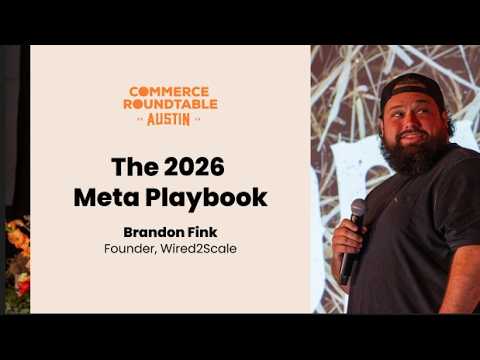
Brandon “Buffalo” Fink shares his Meta ads playbook, connecting offer economics, creative production, campaign structure, and the operating discipline needed to support growth.
Brandon “Buffalo” Fink shares his Meta ads playbook, connecting offer economics, creative production, campaign structure, and the operating discipline needed to support growth.
For paid-media teams and founders preparing to increase spend without losing sight of profitability.
Speaker roles and platform examples reflect the session’s original context. This is an archived conversation.
Diagnose the offer and creative alongside the account setup before adding more campaigns.
Read this part · 01:50 ↓Set acquisition targets using contribution and the full cost of acquiring customers.
Read this part · 03:31 ↓Create a repeatable mix of creative sources and use results to guide the next batch.
Read this part · 06:03 ↓Make every campaign serve a clear purpose, and expand structure only when the account needs it.
Read this part · 10:42 ↓Review recent and cumulative performance together, and confirm operations can support the spend.
Read this part · 34:18 ↓A quick editorial guide to the key ideas. Read the complete transcript below for the examples, details, and discussion in the recording.
Original recording on YouTube ↗Brandon organizes the playbook around three connected pillars. An account structure cannot compensate indefinitely for weak creative or an offer whose economics do not work. Before making the account more complicated, identify which part of that system is holding growth back.
He describes the campaign setup as something that develops with the business. A smaller account does not need every campaign type used at a much larger spend level. Establish a working testing process and reliable winners before adding the full structure.
The discussion distinguishes revenue-based lifetime value from what a customer actually contributes after costs. Acquisition targets also need to account for expenses around media, including creative and agency support, rather than use platform spend alone.
A retention assumption can justify an acquisition cost on paper, but it needs evidence from the business. The offer, repeat behavior, and cost structure together determine how much room the team has to scale. That operating target should guide decisions inside the ad account.
The talk considers several creative sources: AI-assisted statics, creators, employees, and partnership content. The objective is a repeatable supply of useful tests, not dependence on one production method or one winning ad.
Brandon’s examples emphasize speed and volume, but the Q&A also makes clear that execution varies by category and team. Find a production process the business can sustain. Review what works and feed those observations into the next set of concepts rather than simply increasing output without learning.
Brandon walks through testing, scaling, partner-page, flex, and other campaign roles. One reason for separating parts of the account is to avoid having a single dominant ad absorb nearly all the budget while other useful creatives receive little exposure.
The specific setup is his working approach, not a universal template. The Q&A advises starting with fewer components at lower spend. Know the purpose of each campaign and how it contributes to testing or scale before copying a large-account configuration.
At higher spend, the team uses frequent business-wide updates to compare performance with the target. Brandon describes looking at recent results and the month-to-date position together, so an isolated good or bad period does not become the entire decision.
The final discussion extends beyond ads to customer service, retention, and other infrastructure. Growth creates operational demands as well as media opportunities. A business needs to fulfill the promise of the advertising if it wants the acquisition engine to keep working.
From the recording’s auto-generated YouTube captions, with filler words removed and paragraph breaks added for readability. Names, numbers, and wording may contain caption errors; refer to the recording for exact phrasing. Chapter links jump to the text below.
Original recording on YouTube ↗0:01[applause and music] [applause] >> Hey. >> [music]
0:21>> All right, y'all. So, let's go. Yeah, perfect. All right. So, today we're going to be talking about how we scale brands from $2,000 a day to $150,000 a day consistently. we do this We've done this probably 10 plus times in the last year or so. so, something we're really good at. But, before I go into this talk, I wanted to talk about Nick for a second. So, the
0:42reason why I decided to do this talk, Nick called me and I go, "Can we go to Can you do a talk?" And I'm like, "Yo, never done a talk before, but yeah, I'll do it for you, bro." And so, in 2017, my first year in e-commerce, Nick posted in Facebook Ads Group a Black Friday campaign structure that changed my life. So, I came from Eve I came from info products with working with a guy named Jeremy Haynes.
1:07and we did like 25 million in spend year one. And I had to translate that over to e-com, and I was like scaling these brands at this agency. Black Friday came, I had no idea what I was doing, like zero idea. I ran Nick's structure he posted in Facebook Ad Buyers in 2017, and we crushed every brand's Black Friday. So, I figured it was only right to just give you guys the exact structure that we run in our agency. So, Nick, thank you. Everyone give a hand for Nick really quick for putting this together.
1:40Thank you, buddy. >> [applause] >> I probably [laughter] would have got fired from Mark Cuban's brands if it wasn't for Nick in 2017. So, >> [panting]
1:50>> yeah, okay. So, we're going to be going through basically the the three main things that we need to scale ad accounts. Number one is the offer, number two is the creative, and number three is the account structure. So, a quick background on myself, my name is Brandon. People call me Buffalo Fink. I'm a full-stack marketer. We manage over a million dollars a day of spend in our agency. In the last 8 months, we've built three accounts that were at less than $10,000 a day of spend to over $150,000 a day consistently of ad spend. So, these are like brands that they're coming in and they're you know they're low seven figures. Like probably a lot of people in this room where they're you know two to five million dollars per year. and we are able to again within a couple months scale them to over $100,000 a day of spend.
2:38the biggest thing is, you know, I'm also a I I We had a big agency 2019. I've taught 20 plus media buyers on how to spend over $100,000 a day as well. So, so yeah. I say all that not to impress you, but impress upon you I kind of know what the [ __ ] I'm doing a little bit.
3:00So, the reason why most media buyers can never break $10,000 a day in your account, right? number one, they're too busy debating whether to use cost caps or highest value. It's like a kind of like an ex joke, but But yeah, then like they're trying to scale before having the foundation set. But they're relying on media buying strategies to fix the issue. they scale budgets before they have a real creative flywheel system, and they cut creative tests way too early. Right?
3:26So, the answer here is like the ad account is never the issue. It's always the foundation.
3:31So, there's two things before we get into this talk we need to establish is number one, like just like Nick was saying, like hey, he gave us the offer. We came in and we scaled the offer from I believe 10,000 a day to 150,000 a day in three or four days. and then we broke everything in breeze, right? So, the biggest thing is the offer and this understanding like what's your lifetime contribution margin. Does anyone here Does anyone here know lifetime contribution margin?
4:02Okay, so what's really important to understand lifetime contribution margin is it's not lifetime value. Your lifetime contribution margin is Hey, if we come in and I give like for example like Nick, right? Like I'm going to pay you $100 a month to acquire Nick. Got $50 back, Nick. So, [snorts] who thinks this is a good deal? Nobody, right? Okay. Now, month two comes, Nick have 40 bucks. Month three, another 20. Another 20, month four. You got to cancel the subscription, bro.
4:43But so, now who thinks this is a good deal? Like we're we're 3 months in and now we have 120 130 bucks. And what happens is when you get to a year with a customer like this, now all of a sudden you're going to have you know, about $200. So, like what we're looking for an offer we're running, what we're looking for is we want to say, "Hey, if we're going to spend $100 to acquire a customer, I want to have at least $200 of contribution margin in 1 year." Does that make sense?
5:09So, this is why like we only work with CPG brands because when we're working with consumable product goods is a recurring type of product and that product you can you can spend to acquire a customer at a very high CAC and afford to scale the account.
5:25number two, creative flywheel. The creative flywheel we'll get into not like Molly did. Molly did a great job of going very in-depth. We're going to go very like broad with this presentation. I'm going to leave time for Q&A at the end. So, the four types of creatives that work for us in 2026 are are And again, at the end of this presentation is a QR code. I've actually like got the deck. Also, I did like a 10-page PDF guide for you guys like to help to understand how to build an offer, what we test when we do our offers, stuff like that, too. So, cuz again, without an offer, you can't scale. Like, it's just impossible.
6:03So, number one, AI creatives. AI creatives are animated. They can be UGC, AI character ads, whatever you want to be. statics, partnership ads, EGC, which stands for employee generated content. The most important thing with EGC is this is like we're using words like we, we loved, we did this. We're using brand possessive words. And number four is statics to scale. So, with AI creatives, what this is best for is really top of funnel. Like, these have some of the highest new visitor percentage rates for our companies that we work with.
6:43Where these are driving net new customers, net new visitors to your site. And what really works best right now is like AI character ads. So, AI character ads are you'll see like the little like crazy characters and [ __ ] right? Like, on on Meta and they're like explaining a problem and it's like really putting a visual identity to the problem that you guys have. And then you have a solution, which is your product. Partnership ads. This is like the rainmaker in accounts and it takes some time to be able to afford to do partnership ads as you build your brand.
7:17But with partnership ads, we have the micro influencer, which are pages that have zero to 10,000 followers. We have the grinders, which are, you know, 10 to 40,000. They're like kind of early in their creative journey. And then we have the machines. These are creators that have 400,000 to a million. These typically are like where we like to stay. And then we have the empire. These are like, you know, >> [snorts] >> your Nate Diaz, your your your your bigger white list ads are typically 25,000 plus a month or around, so.
7:49And then this one is like the my favorite recently. This started working really well last year. And I think Jordan was one of the first ones to actually kind of make this ad, which is employee generated content where you just have employees cranking UGC in-house. And again, they're using brand possessive wording. What we found is like if you're doing UGC if you're not running it from a white list page, meaning like if you're not running this from the actual creator's page itself, it's not going to do as well if you just run it with your brand page.
8:20So, if we're doing something from the brand page again, we're using the words we we apologize, we're giving this away, we made this for you. words like that. And then statics. statics scale, you know, we can make hundreds of statics a week. We launch hundreds of statics a week in most of our brands. we cut statics faster than like a 25,000, you know, partnership ad. but statics are some of the highest spending ads in all of our brands.
8:50So, statics are not dead. Statics scale very well.
8:55and then so the question is like, "Hey, where where does all this creative content come from?" and this is where I'm not a great at creative, right? Like it's the last thing I do. If I don't have a skill, I just buy it, right? So, it's like, "Hey, if I'm not good at creating creatives, I'll just work with 20 agencies." So, that's what we do. We have like we have an internal team that we'll work with. We'll help the brand we work with like build that creative team out.
9:18And then we work with about 15 to 20 different agencies at all points in time. And these are people that are ex- specialized in sorry, partnership ads, white listing, and agency sourced. And then this spreadsheet right here I'll have for you guys after this the talk's over, but basically if you guys can look over here, you'll see like we have agency one. We we tag our creator strategies in our our naming conventions, creators, agencies.
9:45And if you look, there's a there's a number over here. It's It's a It's called CPO, which stands for cost per order. New asterc asterc. We take the cost of all the agencies, all the creators that we work with. We put them inside and we calculate, "Hey, how much money we spent on their ads? How many new purchases were driven?" And we add the cost of the agency to your creator thought to that CPA and we understand our true CPA. And so if you like let's say for example Nate Diaz, we worked with Nate Diaz on a brand and he was $25,000.
10:17We spent almost a million dollars on his ads in January and our cost per purchase was way cheaper than working with all the agencies we were working with. Right? So like when you're doing those investments, we always go on a three month window and we say like, "Hey, over 3 months, which one's the cheapest agency to work with?" And if they're too expensive, fire them, bring the next one in.
10:42Cool. Here's our account structure that we use. So, we start every ad inside of a creator testing campaign and a brand page. We have a different one for brand ads, which would be like our statics internal, our you know, we apologize ads, whatever we're running. Our white listing, which is going to be like anything coming from an actual like creator page. And then also we do a different campaign for every agency we work with This is mostly to be honest with you guys for the CEO of the brand or you know, the the head of growth I'm working with because they don't really understand. It's easier for them to look and see performance of all these agencies cuz we again, we usually are working with hundreds of creators and 10 to 15 agencies at a time where at the scale.
11:29>> [clears throat] >> for scaling, we have our what we call our four horsemen. Partner pages, flex, flex campaigns, and our electrical campaigns. We'll go through all these individual.
11:44So, creative testing campaigns. when we come in here, we're typically launching at $100 per day. We'll launch an ad, we'll let it run for, you know, six 600 to $1,000 typically. And we're looking to see like, "Hey, do we have any attribution on these ads?" If so, then we'll keep it running, obviously. If not, it'll be killed. And then we also scale inside of our creative testing campaigns. So, we'll what we're we're taking that typically from $100 a day to probably max $5,000 a day, in that creative testing campaign.
12:16The four horsemen. This one is my favorite campaign. So, I work with a lot of nine-figure brands. And a lot of brands just have broad. So, they're scaling like with one broad ad set. And what we find is when you have when you're scaling with one broad ad set, you have lots of creative testing going on, lots of winners in the account. 80% of that spend is going to go to one ad. Right? So, like, if you have, you know, three or four other ad sets in here, I can turn off that winning ad in the other three campaigns, and it will just, you know, it'll it'll take 5,000, 10,000 dollars a day, but I can spend 40,000 on the broad ad set, 10,000 on interest, 5,000 on lookalike stack. I can just give them more spin to those other winning creatives that aren't getting spend on broad.
13:03then we have our partner page campaign. This is, pretty pretty dope. So, with with, meta entity ID, this is a very important thing. The creative, when you have like a [snorts] winning creative, let's say, right? It gets assigned to entity ID. A creative itself has an entity ID. The entity ID is tied to the page that you launch it from. So, when When have a winning creative, what we do is we take it and we'll make four or five different partner pages. This could be you know, 2026 wellness habits, like whatever you want to name those pages.
13:35and we just relaunch them from there and it creates new entity IDs, which gives you more room to scale. And we've been able to spend about 30 to 40% more on winning creatives just by launching these partner pages.
13:50And then you have a flex [ __ ] campaign. With a flex [ __ ] the flex [ __ ] campaign is like Is everyone familiar with flex [ __ ] Nobody here Okay. Go to YouTube when you guys get off when you guys get done and you guys like you're going through this presentation, flex [ __ ] is you're just taking your best winners, we're throwing these into these campaigns. And with these, we're typically going for a 20% lower target than our CPA in the account. So, if my target in the account is a $100 for example, I'm going for $80 cost per purchase in these campaigns. And you can't really scale these campaigns, but they're very profitable. so, we run these campaigns. They're kind of like dynamic ads back in the day. but everything's done at the the ad level.
14:36And then this one, this is my favorite
14:37campaign. this is our listicle [ __ ] So, what we have in the winning ad that comes in and our winning ads, we mean by like hey, if an ad's 10% lesser target. So, if I spend two grand in creative testing, let's say, and I'm, you know, $90 [snorts] CAC on a $100 budget, then $100 target, that would be a winning ad to me. So, then we would move it over to all of our scaling campaigns, including listicle. What listicle does is let's say we make an ad and it's about fasting. It's a fasting angle, right? I'm going to go spin up three different fasting listing pa- listicles.
15:14and with those listicles, we're going to run through IntelliGems. We're going to take that winning ad, make a new ad, run it to those listicles, which then helps us like actually build out just like what Molly was saying, gives you more context for like what the actual ad is. and it's a really good way to also get more spend behind those winners and find new personas, because we'll take these listicles, turn them into new PDPs, and that's how we're able to really like just crank like let's say for example you have 10 winners a week in an account, you're going to be making 30 different listicles per week in that account, and you will find new listicles that convert better than your current PDP.
15:56And then these two campaigns are kind of our what we call our evergreen campaigns. Through the zombie campaign, what we do, for example, if we kill a winner inside of January, I would put that ad inside of the January campaign, and that January campaign turns back on March 1st. So, it it stays dead for at least 1 month, and then it comes back on and then we just keep that at low budgets with cost caps, and they work really well.
16:21again, very profitable, 20% below target. So, $100 $100 acquisition target, $80. And when you have all these campaigns are giving like lots of profit to your company, it allows you to push harder on your top of funnel campaign. So, if we have a $100 target, I can scale our top winning ad to typically $115 to $120 AR CAC. then our win-back campaign, this one is hit or miss. this typically we'll run it for like a week at a time, but like if retention is running a hey, get a free, you know, free pack of shots with Breeze, for example, come back, activate your campaign.
16:59We'll run that, we'll launch it to existing customers, run it for a week, and kill it.
17:05Cool. And then like just like we said earlier, I wanted to I have a like a 10-page PDF I made for you guys that goes more over the offer and the base, because once you guys figure out the right offer for your business, everything changes. Like every like all the ads we launch for our companies work. Right? So like when you're looking at your creatives you guys have now, they're not working, it's probably not your creatives, it's probably your landing page. Like for example, if like you have a $3 cost per click average on Meta, and you have a 3% conversion rate, like what's our CAC?
17:36It's $100. Right? So if you have a $3 cost per click and a 1% conversion rate, like you're [ __ ] right? Like you can't scale. So what as soon as you have a good offer that converts well, what you'll find is almost all of your creatives work at some level of scale, whether it's $100 a day, $400 a day. And then your winners will spend 20, 50, sometimes $100,000 per day just on single winning creatives. So I made this checklist for you guys for all the best practices that I know about offer creation, so you guys can test some offers out for your brands.
18:10So. there is the QR code. >> [laughter] >> Just follow the ask you go. There it is. But yeah.
18:21So that'll be there and yeah, I'll take questions now. >> [applause] [applause] >> So. It's a lot. It's it's it's a lot. The like the some of the brands that you're seeing right now like from an offer standpoint, I know when you talked about creative and I didn't want him to go into like creative examples cuz it's pretty unique to each brand. Like what are you seeing right now on on skin? Cuz a lot of people are saying we probably should be scaling more aggressively on static images, but then I do see a lot of this AI script professional style working. What are you seeing? Yeah, I've seen like UGC. Like if you're going to go and you have a low budget, like start with UGC and statics, like employee generated content, whether that's you, someone in the office, start looking at your competitors. Like I have a folder for every brand I have, I have a Facebook ad library, You know, doc and I have like the top 20 competitors for each brand. And we're
19:16looking at those every single week. And then also too, like like a follow-up on that is like work with a full ton of agencies. Like start with two, start you know, start with 10 creators this month, two agencies and just keep adding to it. Right? And like the biggest thing is like we want to 50, so we're going to spend a million dollars next month. I want to have a $150,000 budget for creative. And then you just optimize and just keep adding and adding to it. So. You're one of the few people that was like the more agencies the better. I've been starting to default that way even when we create good EGC in ourselves. It's just like the style and other how other people deliver is just necessary I think at this point. Yeah. And again, like we have the tracker. So in this spread in this QR code at the bottom of that doc I have the tracker for all those agencies and you'll be able to see exactly like what percentage of spend do they cost?
20:06What's their What's their cost per What's their their CAC like with the agency CP or creator fee included. So you just give them 3 months and then kick them out. Bring new ones in and double down on ones that are working. Yep. Is it working? Okay. for your
20:22EGC stuff So like we run ours like I'm a UGC creator for the company. Is there any strategy or like any reason why we wouldn't just do that and white list my account instead of running it through the brand account? Or should we hit both angles? So you're you're creator, you want to run it through the brand account, is what you're saying? For the EGC, I guess for the EGC are you running it through the brand account or through white listed through mine? Right. So if it I mean you can do both, but what we see work best is like running it from the brand account if we're using brand possessive wording. Yeah. I say cuz I do I say we through my account white listed. Yep. Yeah. Yeah, so I mean you can do both, right? Like you can run it you can you can start off at $100 a day brand account ad set you know, your your page ad set, see which one performs best and kill which one doesn't, if you want to.
21:19Yo. Am I a good ask question? >> Yeah, you're good. >> Yeah, okay, cool. I love the idea of the
21:30AI character, okay? Do you see certain character types work better than others, and do you see that work for certain verticals within CPG? Do you think that performs as well for beauty as it does supplements as it does food, or could you give a little bit more nuance to that cuz I think it's really interesting. Yeah, well, for I'm not a creative expert by any means. it's a good like why we hire a ton of like a [ __ ] ton of creative agencies to work with. but inside of the accounts that we have, I mean, it's working in every brand. There's not a brand where AI character doesn't work. And what works best is probably like the Pixar, like really like the Pixar clay animations, those are working well, but mostly like Pixar style type like where it's a, you know, a character.
22:13cuz, you know, the biggest thing like in marketing is if you have a problem and you can like visualize that problem as a monster, you can visualize that problem as whatever and you're showing that your product is a solution to get rid of that problem, those are the kinds of AI videos are working best. It's kind of like what Sarah's talking about, find a villain. And like Push the Oh, great. Great, Thomas. The villain can be depicted in that way you don't feel like you're using like a fake man or woman that's like talking about the problem or like they really didn't have that. Cuz I know there's like an ethical question of like, do I really want to have like an AI green screen with someone talking about the problem [snorts] that this person actually doesn't have, but they're quoting something from a a review. As long as it's not depicting that way, I think that positioning of creative I actually this is a question to the room that's running this.
22:59If you look at your ad account today, what percentage of your ads are AI generated ads from a static standpoint? Let's say AI static ads 10% more more than 10% in the account. More than 10% of static ads now. More than 20% static ads by AI in the account. I'm going to go to 50%. Anybody more than 50% in the account? Okay, your hand is up. I'm going to just throw this to you. I just share like why did you get to that place? Is it Is it cuz of speed of If I was for you and then right behind you.
23:41Yeah, so I would say in my account
23:45it's probably around 50 to 60 and it partly is because of speed. Also because like I don't have a big team. I'm pretty small and bootstrapped and scrappy. So I don't have a lot of resources to do the the creative research, the the briefing, the execution. And so I've been just really into Claude code recently and I have a three or four workflows that generate me every Monday 10 to 20 net new concepts and each workflow is testing a different angle or or different hypothesis in the ad account. I would say outside of like the the AI statics, I probably produce it kind of depends on the week. Maybe like if I'm feeling inspired I'm going to tell my my graphic designer, oh, go make go test this concept, go make this thing. I'll probably do three to five that I just brief with my own creative research, my own like my own execution essentially.
24:40>> Sure. but yeah, like honestly a [ __ ] ton of of AI statics. >> [laughter] >> It's just It's just the the the speed and volume and you said like you're a little bit on the smaller team size. Yeah. Yeah, it has to happen. Yeah. Go right behind you. I'm going to go to him right after. You keep yours. Yeah, you you're going to Yeah.
24:59>> All right, yeah. I'm across three different accounts right now, primarily. one is in the outdoor space. That's probably got about 50% is all AI. The other is cosmetic, and that's about 90%. That's purely Yeah. That's purely because the owners are on the cheap side, and they don't like to well, they're they're ex-photographers, and they don't want to put money behind models and, you know, fancy shoots. So, we've trained full transparency. I don't make them myself. I've got designers that do that.
25:29>> Sure. But they they do everything, and it looks, in my opinion, better than a model shoot. And so, we've we canceled four four or five shoots, and then ended up doing everything with AI. Oh my god. >> works better than than previously. >> But is it is this is this a the female niche, male niche? female. Female. Is it depicting like the women's faces and stuff of like how This is this is the part where it's like where do you what what line do we live on, right? I'll happily show you some later. But it's it's it's You can't you can't tell that this is AI. Like, these models don't exist.
26:06There's no way. >> [snorts]
26:09>> yeah, we I own a little fashion brand, and I have I'm I've been working in advertising for 20 years as creative director. So, like, I I've been doing shoots all my professional career. The for me, the biggest change is control. It It's speed, of course, but control. Every time we would do shoots, you you're investing a bunch of money without really knowing what happens on set on that day. Like, a model comes, and it's not, you know, she's not in the right mood, and like, there's too much at stake that that you cannot control.
26:45Now, with with AI, like, you if you spend a good amount of time, you you it properly, not just, you know, throwing prompts. If you do it like with lenses, aperture, with with the lights, like you have a result that is absolutely like a real. And if you do if you don't write like if you write in the right way, you say, "I don't want a model. I want like a If you go into the like the result is actually, you know, And personally, we don't do that with stories or UGC or like a We only do it with like products. So, we have to show the product. We we do it that way. We If we have to tell a human story, we don't do it that way, but like there's you know, from a production side of view, that there's no there's no comparison.
27:31Yeah, this this world is changing. Will you hand the the box to the gentleman right next to you?
27:36Man, I was actually pretty impressed with how you walking through this. So, I I've always been a believer of like the more content you can get, the better. And this is for you before by the way. What through how do you set up like expectations with these agencies or providers of content? Like is this something that you're doing? Is this something your clients are doing? Do you tell them, "Listen, you're going to have 3 months to show me the money or otherwise you'll be out?" how do you like are you giving them this is the type of stuff that's working or are they fully independent on it, right?
28:06Is it like fully done for you? And then I saw you work with agencies and creators. Like again, how are you sourcing that? Like that's the that's where the money's at and I believe it and so like if you could break it down even further, like that'd be amazing. I want to I'm going to stop that real quick. I'm going to do my best. Can you ask that question one more time cuz I lost that [ __ ] 2 minutes ago.
28:23>> got it. I got [laughter] it. Yeah, I got it. All right, I'm just slow, bro. I'm sorry. Well, the question I'm slow. Walk me through how you manage these 10 to 20 agencies or providers of contents that you guys are getting on a monthly basis. Yeah, so
28:36the very one of the very first things when a when we come in and we scale a brand at that level, they do is they bring in kind of two key roles. one is a head of retention. And cuz you know, obviously we're getting so many sales per day. and number two is a head of creative. and so what the head of creative will do internally is they'll brief out cuz we build again, we come in, we do two things. We recommend agencies we've worked with in the past.
29:01And we also like help them build out their internal team. So we help them find that right internal UGC creator cuz most time it's not the founder, right? It's just it's just not. so we're helping them like find that person. We're helping them yeah, give us enough creative that we need cuz the internal, when we look at the internal side, the internal should be the lowest the lowest CP- CPA in the account, the highest spend.
29:25it should you know, it should the lowest cost relative to the the amount of spend in the account. Working with these agencies, we have a really good naming convention. so when we're doing our name our naming conventions at the ad level, we're tagging the creative agency, the the actual you know, the strategist name, the creator name. All those things are being tagged at the ad level, as well as the angle, the persona, the landing page it's going to.
29:51And so when we're doing our reports, we can go we can break down. Let's say for example, we hire we we come into a new brand, we say, "Hey, we want, you know, 10 creators and month one and and two new agencies." those creators come in on a 90-day contract. Like most of the time the the agency also, even if it's not a contract, we give them 90 days to kind of you know, they're people that I know.
30:14I've been in the industry for a long time. so I know, you know, all the good creative agencies and know all the bad creative agencies. And then, you know, we'll give new guys a shot all the time as well, right? So but we come in and typically bring in like a vetted kind of vendor. And even my best friends that own creative agencies, they get fired all the time cuz yeah, they have 90 days to come in and perform in the account.
30:36But 30 days in, we're looking, we're saying, "Hey, you guys made us videos, statics, AI creatives. the statics we made are trash. The videos are awesome. The videos you made for fasting versus quitting nicotine versus whatever those angles are, those are doing bad. But hey, this this other angle of you know, high blood pressure is working really well. And so you're giving that that you're giving that information to the brand internally to that creative person.
31:04And he's disseminating that information to all these creators, to all of these agencies. I'm helping them double down. So then month two they can get better. Month three they can get better. And then we're looking at again like what is this agency if we started in let's say January, their January CAC, their February CAC, their March, and their 90-day blended. Last question. Do all these providers have access to your ad account or to the ad accounts to view this data? Yeah, 100%. Very cool. Thanks so much. Yeah, the the one really big thing there too is the reason why is like our creative agency if if you have to brief your creative agency of what you want, that's like defeating the purpose. Just build out your internal team. Like if you want to have the all the ideas, do it yourself. We find that even the best the best creative teams internally when you hire other agencies, they can think differently, right? And the idea is just like getting different ideas and different concepts in the account.
32:02Cool.
32:03I just want to quickly ask you about like account structure. So as I said earlier, smaller like kind of a founder running running everything myself. Mhm. So obviously right now it's consolidated like I have a testing campaign, a scaling campaign, and that's pretty much it. Is there a certain like I don't know, revenue number or like account spend number where you think you typically see better results with a a lot more complex structure like graveyard campaigns, multiple scaling campaigns, multiple testing campaigns, everything split up.
32:34Like how would you kind of think about that process? Yeah, a that's a good one. so, in those brands I told you where it's like, "Hey, we scaled maybe it was like eight you know, eight eight brands from 2K to 150K a day." Those brands is tough, you know, cuz when you're first launching you're going to go make three or four different offer types. just to kind of give some context here. You're going to launch three or four different offers out the gate. You're going to have to evenly split traffic to that. You're going to be 100% testing in the account.
33:02Your CAC's going to suck. You're going to want to quit after month one. then things will get better. You're going to start directing that traffic to the offer we believe is best based off early data. your your CAC's will start dropping. You'll start having winners in the account. So, you know, when when you're first starting off we use just our creative testing campaign. sometimes like if we're we use North Beam for all of our accounts for our third-party attribution.
33:29so, we do like we're specifically [ __ ] only just because with CBO it's going to direct the ad the spend to the ads we don't want to spend on. Yeah. but, you know, I would start with the CPM maybe, right? It's like, "Hey, you have the four horsemen. Do the four horsemen with the CBO. Maybe just broad only." And the creative testing campaign, get that to like 5 10K a day of spend. And then you can go kind of full, you know, buffalo account style.
33:52So. On one like last question, on one account that you're running for a client, do you have How many people are actually inside the ad account every day making changes, pulling reports, doing like data analysis? Curious. Hourly update. Hourly update? >> Every single hour of revenue posted every single hour and it's probably faster than that. Hm. Yeah, so >> much. Yeah, so the the big thing when
34:15you're scaling, right? Is we we do what we call scale threads. And so, every two hours we do a site-wide pull of the data and that helps us like Actually, when you guys go and download the slides, there's a [ __ ] ton more of slides. I figured you'd be more productive to do like a Q&A. have more time for that. But, if you look there's more. It's like how we think before we go into the accounts. So, we're going to look site wide.
34:33North beam refreshes every hour, 2 hours. Mhm. So, we do updates on that cadence. And so, we'll look and say, "Hey, we're at a Let's say our targets $100 for the I say 70 $71 is a specific example. $71 for the month. I can see month to date yesterday we were at a $70.48. So, I'm like, "Perfect. I'm in maintenance mode." But last 3 days, I'm at a 68 67 We're trending downwards. Yeah. That means I'm scaling today. Right? Like I'm going to scale. I'm going to break this CAC.
35:03Yeah. so, we're going to make a decision every 2 hours in the account I'm scaling. Interesting. Thanks so much, dude. I'll show you what the hourly looks like and it's kind of wild. I don't know anybody else does it. There's a guy right behind you to ask that one question. >> then while you're while you're passing it back to we have we have juniors, we have three two or three seniors, and we have a strategist in the account, and then also myself.
35:24So, a lot It's a lot of people. Last question, Brian, did you want to ask another one after or are you good? Okay, one and then end it with Brian. Cool. I got a technical question. You
35:33were talking about the zombie campaigns and that you set it at like 20% below target CPA. Yeah. Do you have that as a target like actual setting in the account or is that a if it just goes over this we're going to flick it off? Yeah, so you can use like automation tools. we used kitchen.io. I think it's kitchen.io. Used something like that. Where it basically is like put a naming so it's like, "Hey, if an ad gets over 200 purchases add a prefix to the ad name of zombie." So, then if a buyer goes in turns that ad off, they know, "Hey, I need to duplicate this ad to our zombie campaign."
36:07if that makes sense. And then the biggest thing too is those campaigns when you guys are looking at those campaigns later, there's 1.1s, 1.2s. The 1.1 means it's 10% below target. 1.2 means it's 20% below target. But all of our 1.2s are meant to be profit machines. So, we're actually going for 20% lower target CAC. We're typically the 1.1s are going for 10% higher. So, if we have a $100 CAC, we're going for a $110 CAC typically in those campaigns cuz we're balancing the account. Okay. Cool. Thank you. Yep.
36:39Last question, Brian. You might just have to yell it out, buddy.
36:55Sorry, dude. Sorry. Sorry. Actually, I got to give it to you. Awesome. Thanks. besides CAC target, what other green light or red light thresholds do you use to basically say, "Hey, it's time to scale this and or hey, it's time to pull back"? That might be part of your like pre-scale readiness. But like I'm thinking CAC payback period, like what is your target there? CAC to LTV under which time period? Like, are we looking at CAC payback in 60 to 90 days and a certain ratio at 6 months or 12 months? Like, what other things do you look at there?
37:32Yes, this is where contribute like lifetime contribution margin comes into play. That's why we're doing these different offer types, like whether we're doing forced continuity, whether we're giving the option for a one-time purchase. different offer types will be a higher first-time AOV, like we're giving a a discount for a 3-month subscription versus a 1-month subscription. all those are going to have different lifetime contribution margins. So, we're typically waiting for that funnel to mature. We learned that the hard way, right? So, we're waiting for that that funnel to mature and then kind of see, "Hey, what does it look like on a 60-90 day window?" Yeah. and then we typically can predict from that, you know, 60-90 day window what the 12-month will be, the 24-month will be.
38:10The target you're going for is 100% 12 months. So, yeah, I invest $100 into this customer, I get $200. It's easier for you to invest $60 into a customer to get another $60 back in 1 year. and then, you know, you're looking for 150% roughly in 24 months. but, you know, before you scale, it's like are, you know, do I just have one ad winning in the account, right? Like, what's my what's my conversion rate? Cuz again, like just what's my average cost per click in the account?
38:38Then you know what you need your conversion rate to be. like, I don't care about CAC. Like, CAC's irrelevant to me. AMBR, ROAS, all that's very irrelevant. For me, it's like, what's our cash flow? What's our inventory rate? And then the CAC is specific to that offer. We know like, "Hey, we have a predicted $140 12-month contribution margin. That means I probably can spend 70 to $90. Cuz I mean, you like, at the end of the day, a 70% is not bad, right? Like, if if you if I give you guys a stock, I'm like, "Okay, this stock is guaranteed to go up 70% this year."
39:10Like, you guys would put a lot of money into it, right? So, a hundred's like gold standard what we're like really looking for. but, like, if you can get an offer to 70% on your first take, you can easily get that offer with retention work, with with other things to a to 100%. So, Awesome. Thank you. I would say the
39:28final thing that like is the worst thing about scale is the infrastructure Most of the brands are hitting like their first early scale sections. CS is not built out. the back end of communication email is not built out. Like, I've I've seen what happens when you start having offers that crack. And it's like you almost need the the retention team preset and ready. And be like, "Hey, by the way, like here's so fast moving. So, that's like the relationship between like high growth and the retention side that if these guys are not ready in the back end, like if CS isn't knowing that this specific offer is taking off, there's no flows on it, it's all it's so detrimental to the brand. Yeah. And again, like the very first hire that you guys should make like when you guys start scaling is a head of retention.
40:07Like, you guys should hire head of retention. but, again, in our case, like, you maybe you hire a head of growth. In our case, the head of growth typically gets in the way and they're are
40:16and we would just prefer like, hey >> What What do you think that? Cuz most head of growths are not hands-on keys. Right. >> Most head of growths are like managing a thing, but like I'm curious like why would you say this? I I think it's because most head of growths I've worked with are like they did this [ __ ] 10 years ago or like hey I I did this thing really big 10 years ago and it's like bro it's not the same like It's like oh I scaled teeth whitening.
40:38You're like oh [ __ ] cool. Yeah yeah exactly and you know and a lot and a lot of times like they just don't they're not performance focused, right? which is good. It's good to have balance cuz I mean there's some creatives that you know if if you guys are looking to exit your brand like there's creatives that can get to where you can't exit your brand. So you know you guys should definitely have protection there. but I think that's why I believe like a head of creative and head of retention is the first big hire you make. So. Brandon Fink, thank
41:03you so much brother. >> Of course. Yeah. Thank you. >> [applause]
Join Commerce Roundtable in 2027 for focused learning and conversations with people working through the same challenges.