 40:24
Austin · 2026

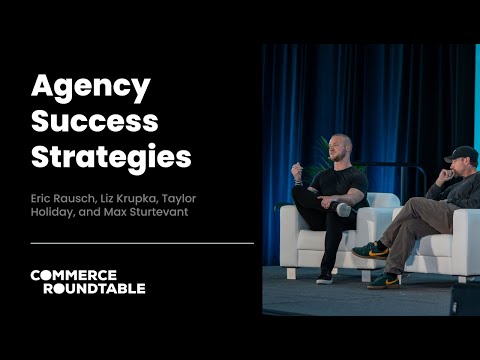
Eric Rausch, Liz Krupka, Taylor Holiday, and Max Sturtevant discuss the operating decisions behind healthy agencies: client communication, service expansion, hiring, culture, and incentives.
Eric Rausch, Liz Krupka, Taylor Holiday, and Max Sturtevant discuss the operating decisions behind healthy agencies: client communication, service expansion, hiring, culture, and incentives.
For ecommerce founders, marketers, and operators working on leadership & operations.
Speaker roles and platform examples reflect the session’s original context. This is an archived conversation.
Use communication to explain decisions and business outcomes, not just deliver activity reports.
Read this part · 05:37 ↓Consider net revenue retention when deciding how to expand services.
Read this part · 10:10 ↓Align hiring, expectations, and compensation with the business you are trying to build.
Read this part · 24:56 ↓A quick editorial guide to the key ideas. Read the complete transcript below for the examples, details, and discussion in the recording.
Original recording on YouTube ↗The panel treats communication as part of the service itself. Clients need to understand what changed, why it matters, and what the agency plans to do next. Better reporting connects delivery to the customer’s business, which also helps reveal when expectations or the scope of work need to change.
Taylor highlights the limits of measuring agency health through client count alone. The dollars retained and expanded from existing relationships influence the growth foundation of the business. Service expansion should therefore create meaningful customer value, while taking account of the agency’s ability to deliver it well.
The speakers discuss global hiring, team integration, and different approaches to incentives. Clear expectations help people decide whether the organization fits them. Culture is described through the work and outcomes the agency prioritizes, rather than as a promise that every person or every employment model will suit the same business.
From the recording’s auto-generated YouTube captions, with filler words removed and paragraph breaks added for readability. Names, numbers, and wording may contain caption errors; refer to the recording for exact phrasing. Chapter links jump to the text below.
Original recording on YouTube ↗0:00The key is [music] how quickly can we identify when we're off course and course crack. So something for everybody every day and even ahead of that an expectation of the value of the thing that they're going to do and the ability to see it. Case studies are basically useless. I would ask how [music] you work. What is the expectation in the process and how do your people participate in that and then how can I be complimentary to it in a way that allows you to make the most of [music] this system that the agency has developed to serve its customer. As an agency owner, I am not in service to the SAS. I'm in [music] service to the brand. I love a SAS that can help me help make the [music] brand more money.
0:32Culture is a tool to service the business objective. I find that conflict with culture comes when [music] there's a misalignment between the attributes you source for and the expectations of what you're going to [music] do when they get there. And so, as long as you're congruent about those things in the front end, you'll have a culture that's the one you want. [music] Whether it's good or not is probably determined by the business results. The people are the product. So, you need the really talented people to stay in the company.
1:00Well, well, well. Four hot seats. This is the best way. You guys walked in the wrong thing. Now you guys are on stage and now you guys are stuck. So, you got 40 minutes with me. >> Hello, Nick. >> And you perfectly have the right names and everything. I'm going to start from left to right. Eric, all the way into Max. Who are you? What do you do? And what are you focused on, brother? >> the name is Eric Roush, co-founder of New Standard Collective, retention marketing for eight, nine, and 10 figure brands.
1:26I'm Taylor. I'm CEO of Common Thread Collective. We help brands drive predictable, profitable growth. Been at it for over a decade. I'm old. I'm Liz. I own Nomad Marketing. We're a retention agency and I've been in it for about 10 years. >> My name is Max. I run Well Copy Email and SMS specific retention agency. We work with seven to nine figure brands. A little bit newer than these guys. Been in it for about four years.
1:48>> It's a gambit. Similar services, different services. A lot of the people here in this audience on the brand side, other agency side,
1:56this is 2025 getting ready for Black Friday, Cyber Monday. In preparation for what's happening right now, what are the kind of conversations, Eric, that you're feeling that some of the brands are coming to you, problems we're trying to solve before we come into Q4? What are you seeing? >> it's a great question. The number one thing that we're trying to solve with every single brand, especially with like the Washington rule that just came out, >> which is what? Please tell us. basically kind of an iteration of can spam. You can no longer lie about the length of your promotion. you can't say that it's one day only when it's 4 days. You can't say extended if it hasn't already been extended. Like it's pretty much just a a a stricter rule of can spam to where you need to be truthful, which is great actually I would say as a brand. But as multiple brands do frequent discounts, everyone here who knows like if you do an extended sale, it typically crushes.
2:54So how do you find ways to leverage your revenue without using those levers anymore and just being straightforward? >> So you would say if if the sale ends in 4 days, you have to end it on that day. >> Correct. And you can extend it, but I would imagine your legal has to say it ends in four days. the the the law just came out I think a week ago. >> Wow. >> and then you probably have to do a new promo code. You have to show that it was already initially scheduled to end.
3:22You just can't be fugazi anymore. >> Yeah. It's probably better though because a lot of brands kind of leverage that to see if they can get revenue that they probably should have worked harder to get. >> Yeah. >> And again, you want to lock in your deals. You want to get your deliverability on point because you're going to be blowing up your your send volume. and you want to make sure that your content calendar from your social team to your paid team is all integrated. And you want to make sure that you're properly sending in smart time increments for all of them.
3:50>> Liz, what are you saying? >> I mean, if you're going to extend it, if you're going to extend it, just like add it as a new promotion or add I put legal copy on all of our emails. I force all of our clients to put legal copy at the bottom of them. that promotions are like can be changed and our lawyers have told us that that's good to go. >> Tay, when you do projecting about how Statlist integrates into like where your team should make be making actions, do you think there's a day-to-day execution from the marketing side that has to be done from a like acquisition has to fall in line to paid has to fall in line to email has to fall? Is there really something for everybody to do on a daily basis from the marketing side to support the brands? I mean, I hope so. If you're paying them to be there, they got to do something, right? I I think that so my core belief would be that every input
4:42has an expectation of value and you want that value to map to the expectation of the business and every day you want to see did the value I intended to create today show up, whether that's on an email, on an ad campaign, if no, what am I doing to course correct? And at this period of time, it's even more critical. So, we'll break that down from like daily most of the time to hourly during Black Friday, Cyber Monday. and really just trying to get clear on okay we have this email planned for the month okay that's intended to generate y amount of revenue so each expectation of value along the way well on day one was I ahead or behind of that expectation if I'm behind well the plan's got to change now right from the start and that ability to course correct I think is how you make sure you get where you're trying to go versus a plan is a plan is a plan and we don't ever pivot the key is how quickly can we identify when
5:28we're off course and course correct so something for everybody every day and even ahead of that an expectation of the value of the thing that they're going to do and the ability to see it.
5:37>> This this is an interesting question for me because there's a format that we all accustomed to on the agency side which is like I'm going to meet you on our day. >> We're going to talk about what we just did and then I'm going to see you next week when we talk again. >> It's the same report. It's the same deck. It's same overall. Do you guys have an opinion? I'll start over here with Max. I'm starting to lean that the reporting to the brand might have to be more and more bespoke to what it is that you guys need to talk about than just a simple here's creative performance, here's send performance, here's etc. Do you have a thoughts on this down the line?
6:07>> You have to have room for both. Like you can't just have like a target like just templated sort of like reporting to brands on a specific time. You need to have like some sort of that, but you also need to have like stuff to where you can be adaptable because like a lot of brand owners here like [ __ ] changes like that and you need to have a team who's going to be available for that and then be able to report on that. So like a new product launch coming out, a brand needs to know like how are different segments converting. You need to be able to, you know, have reports. You need to be able to have something that's templated where it's consistent and you can have something like that, but then you also need to leave room and leave like team bandwidth for the sort of like custom stuff that comes up. So, I think there's like a balance between them and it also depends on like the time of the
6:45year as well where like Black Friday, Cyber Monday, you really have to be like available for that stuff. >> What do you think, Liz? >> I think all of your agencies should be on Slack with you whether they want to or not. If they're trying to only communicate with you over email or if you're only trying to get stuff done in between meetings, it's never going to be [ __ ] efficient. Nope. >> So, you need to be able to message them.
7:04Then, you need to get a pulse update every week. And stuff does change. we have with a lot of our clients like we allocated slush campaigns every month. So basically we recognize that things are going to shift. So maybe they're going to need to run a flash sale this weekend and it's something that you just need to turn on and it might be something that you preapprove. It might be something that you can just like pull out of a hat or pull out of a bag. But if they're not being like adaptable with there you do have to have like some sort of both so that there isn't scope creep so nobody's surprised. And also I find that last minute mistakes get avoided if you can allocate these slush funds ahead of time.
7:42>> I got you. Taylor, what about reporting? Thoughts on this? >> Yeah, I I think this is the number one thing brands screw up. Like they try to force the agency to participate in their process. And I think the entire reason you're hiring an agency is for their process. and so you should evaluate that in the hiring process and you should decide if that serves your business. But if you ask the agency to divert their workflow into your workflow, you are going to cause a problem in their lives. it's like going hiring a trainer and then saying, "Oh, that's a great workout program, but I've got my own here. I'd like you to do this workout program." It causes a ton of problems. And so, I think what's an underappreciated part of the way you should hire an agency is examine their workflow. Not just case studies. Case studies are basically useless. I would ask how you work. what is the expectation in the process? and how do your people participate in that and then
8:32how can I be complimentary to it in a way that allows you to make the most of this system that the agency has developed to serve its customers. So it's really hard where a process and systems business where a fractional service provider it's not a secret. You're not the only customer that the people are working on and so in order to make that possible they have to work within a consistent set of rhythms and processes. If you ask them to step out of it just understand that there's going to be some consequence in their world that's going to make it hard for them.
8:58Eric, round me out. >> Yeah, Taylor's 100% correct, right? There's also this innate subconscious like mental switching that has to happen if you're switching from one ESP to another or for me, no, one ESP to another or you're doing data differently or each individual client has their own system, that also means that like no one can really cover for that CRM when they're out. If it's like, oh, I had this in my head or we do this or this is like this. If the agency itself is systemized from head to toe and every single account does things the exact same way, anybody can quit, anybody can leave, anybody can be sick and it's like great, I'll hop into the account. I know the exact process we do it and nothing's going to get missed. But if there's this innate knowledge that isn't transferred to each individual person, it's impossible to satisfy the client. This is something that we've been trying to think through because we we love the fact that we are known for retention. We
9:57also are good at acquisition and then are kind of good at CRO but then can do a little bit of creative. There's only one of you guys here that does most things. Everybody else is pretty specific in what it is they do. What do
10:10you think about service expansion? Right. Like something that I really believe is land and expand. You're great at one incredible thing. How do agencies grow? They grow few different ways. charge more, offer more services, or take on as many as humanly possible, right? Where do you see the wave of where agency is going? Because what happens is, is AI really going to eat the thing away? Are we going to lose our ability and our innate skill to manage the channels? What are you thinking about expansion of the agency space specifically? I'll start at Max, Taylor, Liz, Eric again at the end.
10:41>> Yeah, it's something I haven't really explored. I feel like it's the like that's something where I have the opportunity to. We work with over 100 brands right now consistently like on retainer and so everybody like that I'm talking to is like yo you got to crossell these people you got to do this but it's really tough like as an agency like if you really want to be like the premier sort of team like we just do ecom email and SMS that's what we're really good at in order for me to like want to expand and like keep my reputation cuz that's everything in the agency game like you got to really trust somebody to like scale up like you know if we were to like start doing like media or ad creatives or something like that. This is a classic story of you an agency starts off as one thing and they can do everything but they're not like exceptional at one of them. So that's like a path that I haven't really explored, but if like down the line like
11:23like sort of like some sort of partner who's like really good at like some sort of service and we want to partner up, I'm fully open to that. But I think that if people are just purely in agencies are purely just opening up services to cross-ell and upsell their clients, they're in it for the wrong reasons. >> Sure. >> I I I want to do all of those things. I'm going to tell you why. And and because I'm just going to tell you guys how the agency business model works.
11:46You're never going to really >> How many people are working with an agency right now? >> Okay, great. And brand owners, this is really important because you want to be in a mutually beneficial business relationship, right? Like we want to be beneficial to each other. Otherwise, you're not going to get any attention from me. If if me servicing you is not profitable for me, I don't want to do it. That's really waste of everybody's time. And if I'm not helpful to you, you want to get rid of me. So, this is helpful to understand. You're never the best agencies in the world at any sort of meaningful scale are not really going to be able to produce much more than like 75% logo retention in a year at scale.
12:18There's just a there's an upper bound to it. The absolute limits 100%. Nobody has 100% because businesses fail for all sorts of reasons that are far beyond whatever happens and you're going to fail at the service in some capacity. So if that's the upper bound, the the the god metric for agency is net revenue retention. So, not just logo retention, but of the dollars I made from you last year, how many of those dollars do I make the next year? Just like LTV for your business, but ours, it's net revenue retention. If you can get that to 100%, your agency grows really, really fast and you make a ton of money and you're worth a lot of money. That's like the base, very basic math because then your base foundation is growth and any new business is growth on top of it in the subsequent year. The only way to do that if you're not going to expand services is charge more money. But the market pressure is going the opposite direction. And then but the game is
13:08expand the service, sell to the existing customers that you have, grow the value of those customers over time, increase your net revenue retention, and that's how you build an agency. It's actually a very straightforward business model. But service expansion is, and I don't have to be better than everybody else. I have to be better than your alternative options. And so at first I might not be world class at every single thing that I do. But how do you get better at anything? You mess it up and you fix it and you mess it up and you fix it and you mess it up and you fix it and you mess it up and you fix it. And eventually doing that a lot of times you get better. And so the way that the the whole game is if I have a locked in customer who I have a great relationship with who I know the buyer, it's way easier to sell to them than it is to a net new customer I have no relationship
13:47with. And so that's why service expansion is so important for service providers because NRR is way easier to create than trying to get to 100% logo turn. >> Why why are you saying it this way is because of the experience that you just went through. Briefly share what just happened. >> Yeah. So we sold CTC. We we've been through the process of acquisition and valuing our agency. and so a lot of that was educational to me 10 years in of understanding, okay, when someone comes in to value this and they're going to do a discounted cash flow on future earning, what are the things they're going to care about? How are they going to assess the predictability of your business? How are they going to underwrite to a future value that allows them to be really confident in paying you a big multiple? Well, this is how they do it. They go, well, okay, you have this many customers next year. How many of them leave? It's an important metric. They care about it. And then
14:31what are those contracts worth to you in the subsequent period? And just like you guys care about LTV to CAC, so do we. And so all of these are the inputs to that output. And so if you want to build a big valuable agency, those are the metrics you have to care about. >> Well, and the biggest benefit there is like all you guys do retention. Like that is the sickest MR in our space. If you're really really good at email, it's really difficult to leave. If you're if you're a creative agency, [ __ ] that.
14:55>> The hardest case. >> Terrible. If you're just doing creative learn media buying, you're not going to be around very very long. But if you come into the ability to no paid, no acquisition. I'm interested about this layer that we have to start incorporating, which is like a little bit of layer of proprietary tech that has to kind of go on top of the agency because it needs to be a service. Look, there's a there's a I won't name the name in our space, but they went hard tech. They launched a bunch of videos on Twitter and now they're going services.
15:23We're already services. Why don't we add a little bit of tech to what it is you're doing? Have you thought about this yet, Eric? we do retention really well. We have thought about service expansion, but we also view ourselves as retention partners and not just email and SMS. So, we're not just optimizing for attributed revenue. We're optimizing for your retention as part of a holistic e-commerce strategy. And that means that we can then do maybe some more designs. We do designs in direct mail. Maybe that's more SMS. Maybe we dive deep into the data, right? What are you optimizing for as a brand? What are the levers that we can do for that? All of those are upsc.
16:08And currently, that's where we're making our bread. And the question then to pose to any agency owner is at what point in your ARR do you then look for expansion versus like I'm not there yet. I'm not good enough at my one thing. Why would I do multiple which is perfectly valid? Yeah. >> But if you're not really good at one thing, what are you expanding for? Just get better at that one thing. Raise your prices.
16:35>> Yeah, I feel the same way. I think that's that's so important to have the multi-ervices and it's also this is why the acquisition game is so important for other skills. So you they come out with like a built-in sales engine. What about
16:45recommending other apps and services from the agency standpoint? A lot of the guys here that you talk about from the SAS side, they love going to the agencies because they have a bunch of brands that they manage. What about the relationship of introducing new tech, new tech and new services when there is usually an incentive, right? We have either a kickbacks or lower services that we can kind of allocate across. Here's have any thoughts of introducing new tech to the brands? For instance, you have Clavio, you have Omnistan, you have Sentley, what what do we recommend and how often do you guys really go down those conversational paths to any of you?
17:15>> every time I talk to a tech vendor here or anywhere, they're always trying to partner with us. Their favorite sentence is like, "Let's run down your entire client list and see who you can introduce us to." >> Yeah. >> [ __ ] incredible. >> And as an agency owner, I am not in service to the SAS. I'm in service to the brand. Yeah. >> I love a SAS that can help me help make the brand more money. So, I tell the SAS vendor, "My job is to prove your SAS is not working, is not correct, is not incremental, and I am thrilled when I'm wrong and I can't prove it." Then I can go to the brand and say, "We vetted them. We grilled them. We looked at the data. This is incremental. We recommend it for you." if I can't prove them wrong or if I can't prove them wrong, I'm not going to introduce them to the brand.
18:08>> I usually offer to give the payouts back. Like, so if they're going to give me a payout, I'm like, I'll show you what the payout is that they're going to give me and I'll just credit it to your invoice to show you that I'm not here to just give it to the software company. >> Yeah. for softwares. For us, we always cover like if it's something like first like you run a cohort like if you have a software that you want to try or something, you run it for like a brand or two, see if they're down and we cover the cost and then once we like prove that like it's something that we want to roll out for other brands, then we can cover like the first cost and be like, "Hey, this is the ROI on it." And then it's like if it makes sense, then cool, let's do it.
18:41>> There's some of them that I do really think actually help certain tech stacks, but I don't think that I think just like agency isn't one sizefits-all. Like I have worked with brands who I'm like I just let a brand go 2 months ago that I was like honestly you should work with a freelancer. Like we're not your fit and I I hate a relationship that I don't like and that you don't like. Like I don't want to get on calls that are frustrating for both of us. And I think it's the same way with tech stacks. Like there are some that really help and there are certain brands or certain industries and there are some that just don't.
19:14>> I have a question on talent. Are you guys primarily shopping talent state side, North America specifically, maybe South America? When early on it was like the democratization of people that could execute, they could come from any place and we found like the time zones are so important to servicing some of the brands we have, majority of them of which are North American based. You guys have any preference of talent and not just talent but talent to the specific role? Any thoughts or guidance or like you guys should go hunt here?
19:45It's a mixed bag for me. Like >> where where are you shopping at mostly? >> I mean I always try to go actually like through current employees that I'm impressed with first. Like who are your connections? Do you know anybody? And then if I like can't find anybody after months and months and months, then I'll maybe search like offshore. >> Yeah, that's offshore to you. most of my like anybody that I search for is in South America, but that's cuz like it's easy for me to communicate with them. But yeah, >> time zone too.
20:19>> Yeah. >> Anybody else? Anything unique?
20:21>> Our fastest growing portion is global for sure. we are I would love to never hire another person ever. That would be my goal. If I could grow the business without having to do it, but when we are hiring, our fastest growing part of our business is our global accelerator program. It's something we built for our seven figureure brands. and the talent at every role in every level is threatening every US FTE in the organization.
20:46>> Where are they coming from? Is it Latin America? Is this Pakistan? >> All over Estonia, the Philippines, India, Brazil, they are hungry. >> Yeah. >> They work their ass off and they are sharp. Something I think that a lot of
20:59brands need to realize as well is a lot of times like they'll start working with an agency and they want like a certain price point and it's like they want to pay they want to pay us they want to have US-based talent but they don't want to pay US-based prices. >> Champagne beer champagne prices budget on beer prices. >> Yeah. You want like a full US-based team, you're going to have to pay like double like triple the price on your agency. And so if you want like to have a lower price agency, you're going to be working with like people who are from different countries and like they're they they're hungry and they're just as just as good. Like a lot of like we have a lot of people like for us for example, they lived in the US or grew up in the US and then now they live in like another area. Like we hire a lot from Buenocitis, Argentina. And there there are a lot of people who spent some time
21:39in the US and you literally couldn't even tell. But we have a lot of brand clients that work with us and they find out that people that we're on our team that they're talking with are in Macedonia or they're in Argentina and they just have no idea. There's also certain positions that I feel like you can do that for and there are certain positions that maybe you can't or there are certain brands like similarly to what Taylor was saying when you're interviewing the agency you should ask those questions like am I if it's very important to you like I'm going to I need to have a native English speaker like I need somebody who's going to understand like memes happening right now and certain jokes or certain things then that has to be something that you guys transparently talk about >> and just understand that that comes with a price as well. you're gonna have to pay off for that.
22:21>> We call it the the no accent tax is what we like to call it. >> Yeah. The worse the accent, you're like, "Whoa, why am I paying this?" >> I don't know. Everybody on my team that has an accent scares me. They're like, I pay their bills and somehow they're like, "Liz, we need this from you." And I'm like, "You're right." >> Okay. >> I'm getting any Anybody have any questions for four agencies that can't go anywhere? Name and what you do?
22:45>> Use your big boy voice. Hello. cool. I'm Sean, co-founder and CEO of Alia. We do popups, right, for ecom brands that have lower optin rates. We typically double it. It does well. I think some people on stage could attest to that, too, that it does quite well. So, >> I actually can say that I thought that you guys were full of it and you're not >> goats. >> Yeah. So, it works. It works well. My
23:12question is around creating good company culture with offshore teams, right? I think I mean I run a tech company team of 18 people. Half of them are offshore. Like any really good tactical tips on how to make those folks feel like they really are part of the team and like give them a great experience as employees. I'd love to learn more about that. I'd I I mean majority like we're like 60 65 employees and majority of them are overseas and I'd say we have a really strong culture. one of the things just like showing that you care like for example all this summer I just spent four months I got back here on Saturday visiting all my different team members.
23:50I met up with like 30 all across Europe just meeting up with them staying literally at their houses and everything and then everybody sees that and it's just like holy [ __ ] this is like a CEO and founder that actually cares about me. We're paying we do random like we just on Fridays we'll give everybody a bonus like hey go get drinks on us and then I'm flying out and meeting with all these team members and then like in January of this year I was in South America. So little things like that where you can show that like you actually care like a lot of these people that working at they were working at companies that did not care about them.
24:18It's like a we're just going to hire this cheap contractor overseas. So if you can just like show that you care and do like the [ __ ] that doesn't scale, that's what like builds culture and it's infectious and then everybody else in the company sees that and then they just build off it. So it starts at the top and just doing the [ __ ] that doesn't scale, that's what it will build the culture. >> I spent time this summer with an employee who's in Mexico and she was really taken aback that I took the time to go down and hang like just hang out with her for a week and get to know her better on a personal level like you would do with any of your employees in the United States.
24:54I think yeah I think culture is a
24:58tool to service the business objective and so one of the things I I think has been helpful for me and we've been in such a journey of this if you listen to my podcast about we're with Andrew Ferris where I talk about selling the company you can hear a little bit more of this journey but we've changed our culture so much and right now it's a lot more clear that we're here to help our customers make money and the customers are at the center of the culture not the employees and us and people that big transformation information. What it allows you to do is be really clear with the people you're bringing in about the expectation. Allow them to opt into participation. You'll find people who want that thing. There's all sorts of different things for everybody. If they don't like it, they can leave. If they like it, they can choose to participate in it. and that clarity and simplicity of we're here to deliver great service. We're here to make a bunch of money and we're here to do that
25:43work and it's going to be really, really hard and it's going to take a lot out of you and the expectations are going to be really, really high. Some people love that. And if you find the people that they will love that, you'll have a culture of that thing. I find that conflict with culture comes when there's a misalignment between the attributes you source for and the expectations of what you're going to do when they get there. and so as long as you're congruent about those things in the front end, you'll have a culture that's the one you want. Whether it's good or not is probably determined by the business results >> or you Yeah.
26:11>> Yeah. >> Eric, any wide words? Well,
26:15>> I believe that Taylor and CTC have a very similar culture to us. We hire what I would consider dogs. And I interviewed them in a way that vets that. And my favorite quote to someone coming on to New Standard is, "If you say you a dog, go on, be a dog then." And that means when you come in, I expect you to produce from day one or you're gone. >> Hell yeah. My my favorite quote is, "Thanks for leaving Common Thread.
26:48Join me. Go." >> My name is Chris with Fresh Chili, but I just launched an organic social media agency. >> Love all the brand owners becoming agency owners. Welcome to the light. >> Big topic. I did agency brand and now I'm back to agency. I'm excited. >> But everyone just like you guys going to be world class. Want to be the best at what we do. What's the cap table look like as we get down and I can't handle and service
27:17every client myself? >> Cap table like as in like who's on the ownership side or >> Yeah. How do we how do we how do we give out equity? How do we grow it, you know, as we expand? I mean, I think you kind of alluded to this on operators podcast and definitely just like to know like what that looks like. And Shaq obviously you can chime in too, man. like 100% love to know what this looks like as >> three to five years down the road.
27:42>> I have yeah I have so much of thoughts so your your capail is a life force and you want it to forever point into your business. So rule number one is no one gets to leave with the equity. So anybody who gets it you have a mechanism to get it back built into whether they buy it whether you they're gifted options it never leaves the company. It's a force. It points into the entity. That's like rule number one. Two is that you're in a human service business right? The people are the product. So you need the really talented people to stay in the company. Okay. There's there's sort of a trope about CTC like Nick's a byproduct of this where we've had some of the most talented people in the world used to work at CTC and for a while that was like a badge that I wore.
28:21I thought it was cool. All it is is an utter failure in leadership. I did not create enough of a financial opportunity to keep Nick Shackleford working for CTC. His market potential exceeded the job and rule that I could create for him here. Okay. that's true of a bunch of other people that have come and gone, but it's not true anymore. We keep our people now. And part of that was we gave them opportunity to own portions of the company. When we sold CTC, 50 people made more than six figures. That's like really cool. And it's exemplary of why we're able to compound the value of the agency over time is because the people don't leave. and that's a hugely important part of making a service company better over time. And you're going to have to financially incentivize those people if they get really good because their market opportunity will grow and someone will pay them more money than you. So if you can't do it on a pure cash basis, pay them salary, then
29:08you've got to use equity to do it. But just make sure one, I think people should pay for equity. That's a lesson I've learned. We we were in ESOP as well. So we had an employee stock ownership program. People didn't pay for that equity. and it wasn't nearly as impactful as moments where we allowed people to write checks because the the beauty of of ownership is you get the power of both risk and reward. They're both equally important. So, let's talk over a drink. I can give you lots of lessons from screwing this up over time, but it's critically critically important in a human service business, I think.
29:39>> What about the rules? What about the roles that would get it? Like >> the roles, sorry. The roles. So, like my COO gets X points. >> Yeah. Yeah. What roles? Because you're not like, "Oh, my head designer just got X." >> Yeah. Yeah. >> It's different when they're buying >> role based. >> No, I don't think I think people people have different desires out of their life. Some people want cash, some people want equity. I think that they're different relative to the thing. But what what I think about is that the perfect distribution of the capital or of the of the cap table is a perfect alignment with value creation. The same thing with your salaries. Like if you wrote every salary down in your company in a list from top to bottom and you assigned like who's most valuable to least valuable, perfect harmony would be that those things are in perfect alignment. It's almost never the case.
30:22But you should try to make that so. And so whether in our business there are there are employees who might be individual contributors but manage such a large book of business that their value literal financial value of the organization is higher than my VP of finance. Like you could very easily make that argument. So I just want at the end of the day the commiserate realization of value to be aligned with the creation of value. So I think as best as you can to audit and assess that and then pay people accordingly and incentivize them accordingly and then see what they care about. Some people have debt and they want cash. They don't want equity and they need their life is different. So I think you just got to understand that part too.
30:55>> Some people want better time off or better work life balance. It depends on their the alignment with them like in the lifestyle that they're really trying to trying to build. I had an employee that I thought money would keep motivating her and it did nothing. Like the the more money that I threw at her, the more it felt like she was we were both just getting frustrated with each other. And I realized what she wanted was either better PTO or she wanted better work life balance or even for me to just like, you know, words of affirmation her. Like I think that there are some people that you could maybe throw a cap sheet at. I'm that person.
31:29Like I am you throw money towards me and I'm like absolutely but not everybody's like that. >> Fair. That's me. Two more questions. One more qu two this way. Perfect timing. Yep.
31:46>> Hey guys, I'm Ois head hunter in the space. so I wanted to know what are the top two or three time things where your time actually goes. So what do you spend your time on? I can go for me I drive all the business just through marketing. we do purely organic marketing. It's just through my Instagram, Twitter, and YouTube. so that to me is the highest leverage thing. It's the highest lever thing for the business. And so that's just what I and that's what I'm good at.
32:13So that's just where most my time goes. It's like four hours of my day is like content and sales. And so reviewing all the sales calls and the sales sales team, working with the working with the SDR as well. and then creating content just like literally just like part of my day is like scrolling Instagram and YouTube and being like, "Oh [ __ ] that's a good idea. Let me let me let me adapt this to my own." And so for me, like that's the majority of my time. And then on top of that, it's like team training. that's big for me as well. and then other than that, it's just like there's a bunch of other like [ __ ] that'll that'll come up just like the [ __ ] of the dayto-day that also you have to deal with and part of my day has to like be allocated to that.
32:49But the mo majority of my time is the most important thing which is content and then everything else like I try to try to delegate if I'm if I if there's somebody else I can give it to. >> I'm trying to think about my dayto-day. I guess training like a lot of strategic training. I have like a certain level that I want all of our accounts to be at and like a level of happiness that I want all of our clients to be at. And then guess creating content and talking to referrals and that types of stuff. Yeah.
33:19the week's biggest problem like is usually for me like usually the goal for the month is associated with a new business number or there's retention opportunity for existing customers. So it's that and then M&A those are the two things for me right now that are take up most of my time. it's client retention for me and it's making sure that my strategists and designers are doing such awesome things for the brand that any agency that slides into their DMs, this gets deleted.
33:49>> Hell yeah. Every time. Ray, close me up. >> hey, this is a question for Taylor. My name is Ray, one of the partners at Rahood Digital. Two-parter for you, Taylor. Real quick, I'd love to hear about your constraint of not hiring new people, but your people being revenue drivers. How you think about that now having got a lot of employees down to being super efficiently? >> Yeah. The answer is incentivize them to make money and they'll do more work.
34:15>> Yeah. >> It's like super super simple. Here's the truth. Most of your people dick around all day. Like just think about your day genuinely. Like it's so hard to be really productive 8 hours a day. So freaking hard. And I just found that like the primary problem between my operational capacity wasn't more people. It was a better incentive for them to work harder and the kind of people who were motivated that way. Now you'll find an upper bound there and I'm being somewhat hyperbolic and saying we'll never hire again. We will and we do. But the capacity I want to constantly find the upper bound of and like I just know I'm not at it. I know I'm not I watch these guys do these AI talks today and I'm like, "Oh, we suck. We're operationally wildly inefficient. Our people should be able to handle five times as many customers as they do. We have so much room to go." and that's not like that's like setting aside just the general like the humans are wildly
35:13distracted. There's a new puppy in my office. I spent 27 minutes petting a Bernadoodle puppy this week. >> Worth it. >> Like it's just the reality of life, you know? It's just like not that efficient. >> Okay. So, I'm gonna >> Did it make you happy? Go >> ahead. Go ahead, Liz. >> I'm sorry. No, I said did it make you happy? >> All right. So, I'm going off end it off with this, Taylor. So, with that part
35:35you just mentioned about forcing your people to see how much more they can handle. I'd love to hear this. I think it' be helpful for everyone in this room. How do you stress test that with your team to find new limits? >> So to be clear, I don't force them into any behavior. I give them the opportunity to opt into more. So there's a there's a baseline expectation of what it means to be an FTE at CTC, but there's no upper bound to it. So they all produce at wildly different levels.
36:02There's a minimum standard that you have to meet, but the best people make way more money than the other people. And so I think that's one thing. And then stress test is like and this is the thing I'm going to say this in front of brand owners and that's okay but failure in the service business is like critically important. Agency owners are way too precious about this idea of like reputation or failure. the key is that when you fail you go look at it and you fix it and you get better. And I think that the stress test of the upper bound means something's going to break, something's going to fail. And then you go look at it and you go why? What did we not do well? Where was there too much work? What was happening? And then you patch it up and you fix it and you improve. So I I think that the reality is what it means to break things in agencies. You lose customers. That's what it means. Yeah.
36:49>> And the way you get to be okay with that is you get great at demand. So you have an opportunity to get another rep and then you care a lot. So you fix it. You don't just go, "Oh, [ __ ] them. We're out of here. Move on." You go, "What happened? Why did we fail? Can we get it back? What could we do better?" And that just leads to compounding over time. You just get better over a decade. It takes a really long time. And you have periods where it's not perfectly linear. But so those are those are the things the way I think about stress testing it. But I'm just also now 10 years in sure we're not at capacity. Nobody can tell me that.
37:21Like I'm just too sure. I know our people too well. I know me too well. Like we just aren't perfectly efficient. There's just no way. >> The other thing about employees is like I for a long time thought I was doing them a favor. Like I always acted like, oh, like I should be like you should be inherently grateful to them, but you also have to remember you're paying for them for a service. They're doing a service and it's also up to them to say, yeah, I'm down for this service and I'm down for it at this like intensity or non-intensity that you need. So like it's up to them to rise and fall to the occasion. And sometimes things are a fit and they're not a fit. And it's okay if you guys, you know, decide that you're both out of fit or you are a fit together. feel that. Eric, Taylor, Liz, and Max, thank you guys so much for your time.
Join Commerce Roundtable in 2027 for focused learning and conversations with people working through the same challenges.