 26:24
26:24San Diego · 2026

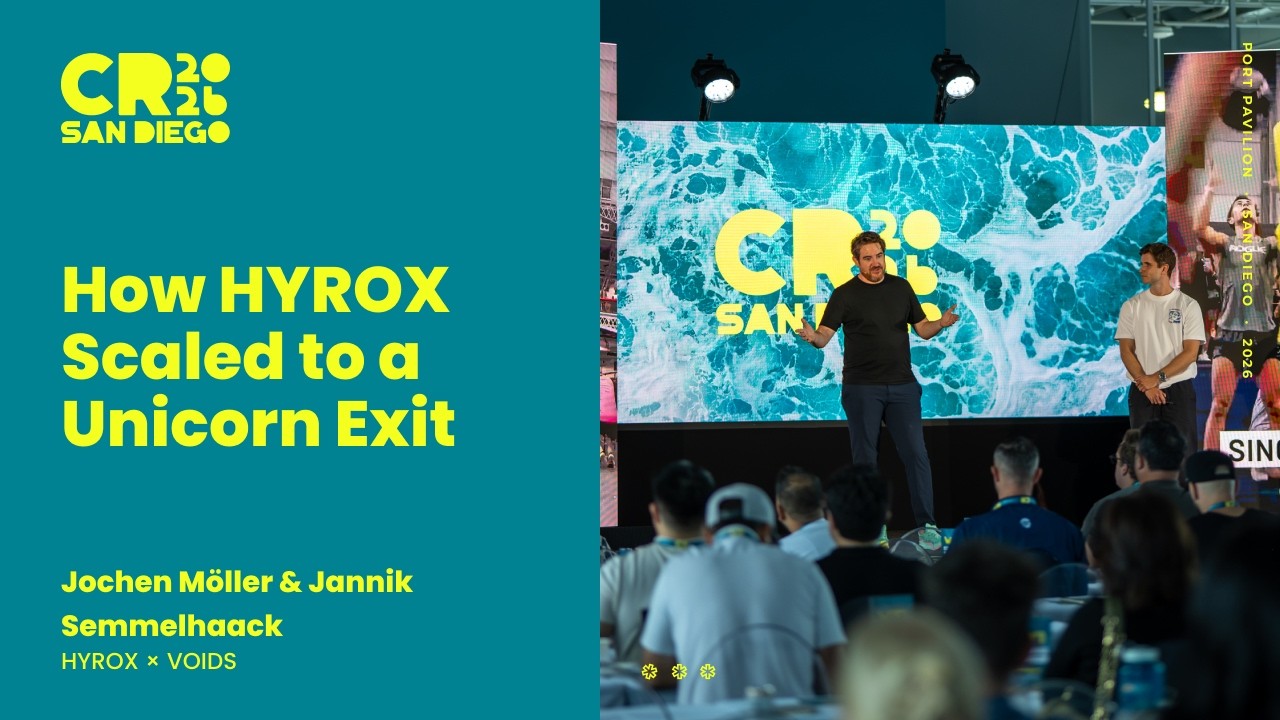
Jannik Semmelhaack of VOIDS and HYROX CRO Jochen Möller share how HYROX tackled merchandise forecasting, stockouts, and working capital as its global event business grew. Includes practical inventory planning lessons and audience Q&A.
Jannik Semmelhaack of VOIDS and HYROX CRO Jochen Möller share how HYROX tackled merchandise forecasting, stockouts, and working capital as its global event business grew. Includes practical inventory planning lessons and audience Q&A.
For ecommerce founders, operations leaders, finance teams, and marketers coordinating inventory, growth plans, and cash flow across channels.
Recorded at Commerce Roundtable San Diego 2026, including the audience Q&A. Business figures and results are the speakers’ reported experience. Chapter times follow the publisher’s YouTube description.
Speaker roles and platform examples reflect the session’s original context. This is an archived conversation.
Inventory in the wrong warehouse cannot serve the customer who needs it. Connect supplier lead times, central stock, and local replenishment.
Read this part · 11:04 ↓Bring revenue targets, cash constraints, marketing plans, and supplier commitments into one decision process.
Read this part · 18:44 ↓Correct historical stockouts, separate channels, and account for seasonality, launches, and product life cycles. Refresh the plan frequently.
Read this part · 21:28 ↓Use stock and demand signals to adjust purchase orders, replenishment timing, and marketing activity instead of treating the forecast as a report.
Read this part · 25:30 ↓Review January and February exposure immediately after the holiday spike, and evaluate shipment timing and faster freight against the demand you actually saw.
Read this part · 35:51 ↓A quick editorial guide to the key ideas. Read the complete transcript below for the examples, details, and discussion in the recording.
Original recording on YouTube ↗Jannik introduces a recurring problem: marketing and operations plan separately, leaving bestsellers unavailable while slow-moving products tie up cash. He frames availability, working capital, and the time spent buying inventory as connected outcomes rather than separate departmental goals.
Jochen describes how HYROX combined a consistent race format, gym affiliations, and an existing fitness lifestyle. Merchandise was intended to express that culture beyond the finish line. He reports roughly 60,000 merchandise items sold at a New York event, illustrating the demand that the operating team needed to support.
HYROX’s merchandising operation involved about 1,500 SKUs, more than 100 events across 35 countries, and a network of warehouses and traveling event setups. With apparel orders placed months ahead, products could be sold out in one location while available in the wrong warehouse. Jochen explains why spreadsheets struggled to keep up with that growth.
Jannik describes the conflict between ambitious revenue targets, working-capital limits, marketing campaigns, buying commitments, and supplier timelines. He recommends reviewing the current process, defining the desired one, and assigning an owner. A shared plan must account for those inputs rather than let each team optimize in isolation.
Jannik recommends correcting historical stockouts, accounting for seasonality and events, forecasting channels separately, handling launches with limited history, and considering cannibalization and product life cycles. He reports a 32% improvement in forecasting accuracy against HYROX’s manual plan, while emphasizing that weekly updates also matter because quarterly plans can quickly become stale.
The VOIDS walkthrough combines current stock, incoming orders, and forecast demand by channel. Lead times, order cycles, and safety periods inform replenishment decisions. Jannik connects those signals to practical choices: order more, move an existing purchase order forward or back, or adjust marketing demand to the stock available.
When HYROX expanded its event plans, the system identified a projected shortage in a key product. The team brought an existing Puma purchase order forward. Jannik attributes more than $320,000 in protected revenue to that decision. Jochen also describes time savings, released cash, and a stronger foundation for meeting demand across events and ecommerce.
Jochen explains HYROX’s ambition to become a broader fitness lifestyle platform while continuing to invest in its core events. The discussion connects merchandising infrastructure to that vision: growth needs the right people and operating structure as well as demand. Later Q&A emphasizes partner quality and relevance to the HYROX community.
The Q&A covers culture, athletic tourism, and brand partnerships before turning to holiday inventory. Jannik recommends reserving resources immediately after Black Week to reassess January and February stock, shipment timing, and whether faster freight is justified. He also describes weekly November reviews so teams can react to demand before the sale period ends.
From the transcript supplied by Commerce Roundtable, with filler words removed and paragraph breaks retained for readability. This source does not include paragraph timestamps. Refer to the recording for exact wording and the session guide above for chapter times.
The supplied transcript includes the replay sponsor message, event-specific offers, and audience Q&A. Brand names, figures, and other transcription variations are preserved from the source; refer to the recording for exact wording.
Original recording on YouTube ↗Hi guys. This is the story of one of the fastest growing sports brands on Earth, HYROX, and how we helped them to scale their merchandise business. And I'm really happy to welcome one of the earliest team members from 2018, Chief Revenue Officer, Jochen Moeller, who just arrived from Salt Lake City. Big welcome, Jochen.
All right. Nick and Jimmy were super picky on this topic. They said it has to be about life-changing content. So our idea for today is to show you how HYROX helped Nick getting into shape as a loving father and husband. No, just kidding. For today, we have a super simple agenda for you. We have one big challenge that all of you guys will know from brand side or agency side.
We have a solution to it and a business case that you can g- take home with you. And this challenge is something that I've seen six years ago when we scaled the Philips online channel from five to 40 million. The big problem that we had back then is that marketing and operations were in constant disalignment.
The one side didn't really know what the other side was doing, and as a result of that, we had so many bestsellers and stock-outs, and so many long-tail articles heavily overstocked. And I think in the end, this is something that we see with many brands that we work with today. They usually struggle with at least one or all three of these.
They oftentimes have too much in overstock, they have too many stock-outs, and they have too much complexity in their buying process. And this is something that we solve with VOIDS. Actually, it's all about maximizing availabilities, minimizing cash tied up in one-tenth of the time. And my colleagues back at Philips told me, "Hey, Jannik, you know, we do this for 10, 15 years.
Why the fuck should someone like you know it better than us?" But I'm super happy to show you that today we help around over 100 brands worldwide, forecasting a total three billion in net revenues, and this across all segments. Mostly brands in multi-channel areas such as wholesale, DTC, and marketplaces.
And today, I will show you how we have solved this issue, this challenge, for HYROX. So, Jochen, before we jump into the challenge, what is HYROX all about? So first, thanks for having me, guys. and like an amazing venue, amazing setup here. So big shout out to Nick and the whole team. so when we talk about HYROX, so HYROX at core is a race.
It's a competition. hopefully, some of you guys have heard about us, already. It's a combination of running and functional training. but when we talk about like a little bit about the why HYROX, I would like to like dive a little bit at the beginning of that journey with HYROX. So in twenty seventeen, a bunch of guys were like sitting together in Hamburg, Germany, and were looking at the sports market as a whole.
there was a lot of experience already in the sport event business and the general sport business. so they looked into like all kind of sports, and they, they have seen a big gap. at the beginning, it actually was a relatively small gap, and that was lying in the fitness area. and a little bit like to explain the picture, how we have seen fitness by that time is like if you imagine you would...
Like in everywhere in the world, there would be driving ranges. People, millions of people would try to get the best swing out of it. They would do it for years, but there would not be any course, any competition, any tournament out there. and if you see that picture, this is from our perspective exactly where fitness has been, ten years ago.
So it was literally like millions of millions of people training for the same thing, but they were not training for any kind of competition And if you see the general world of sports, then actually every sport out there, or almost every sport out there, is built on competition. So millions of people are running because we have a marathon, because they have a benchmark to do that, and the full industry was following that benchmark and that sport infrastructure.
And in fitness, it was kind of, if you define it as a sport, it was kind of exactly the other way around. so that was, like, that was the starting point for us to literally say, "Okay, let's give it, let's give it, let's try and do an event." So we did our very first event in Hamburg, twenty seventeen with around six hundred and fifty people.
Even sometimes I have to say that's this is the official number, and mostly it has been friend of us. but we looked at it, and we put a lot of money and a lot of effort in-into it, and then we realized relatively quickly, okay, that gap, what we have seen, is maybe even much bigger than we have thought.
it's not just an event what is missing. So there is already a full community in the gym business, but the roof is missing. The roof, the lifestyle, the culture, it's there. so we developed the brand of HYROX by a couple key principles. So first, on an event base, consistency. Every sport out there on competition base needs to have consistency.
So that is like something what was for us super important from the beginning until now. Everybody who is participating at a HYROX, wherever they are doing it, how-however long it will take them to finish, so they don't need to wait, and they all do exactly the same thing. So that defines the sports.
Second, you look where is my audience? So we fortunately Have a very nice angle for us, which is maybe also differently to most of the other brands out there in the last couple of years, which was not just the digital side, which was the gyms. So the people were already there. They were training, but they were just not sure for what they were training.
So... And they always needed to adjust their training, either if they wanna do a triathlon or whatsoever. So, and now, like, so we invented, like, an affiliation system. We got into all these communities, and we explained what the opportunities are. And third, and this is, I think, the most important piece, and especially also when we talk about our merchandising, strategy and also success, is every sport has its own culture, its own lifestyle, like something which connects and combines the sport as a whole.
So if you are a golfer or if you are playing tennis, you see the difference in the culture and the lifestyle whatsoever. So we did not build the lifestyle. That was there already. We were able to give that a roof, and that roof is from our perspective also HYROX, or as we call our sport, hybrid racing. So then fortunately, also in year one, we found one global brand, in that case with Puma, who believed these couple of people in that idea that we maybe be able to disrupt the fitness market as it is at the moment.
and still today, they are our biggest partner. And with that, we were from the beginning saying, "We don't just wanna create products which define someone as a finisher or which is, like, fully focused on the race and the race experience. We want to summon up the culture." So we literally, like, in year one, I explained that every day, like, we literally, like, we were kind of putting everything on blanks.
our CEO was by that time also our head of creative. but, like, we were co- from the beginning, like, really thinking, "Okay, we wanna really summing up that lifestyle and really giving the opportunity much more than just to say, 'Okay, I did finish it,' and open up the scale." And this also has led-- all these decisions has led to the number you have just seen, that we were able in almost eight years to bring our audience and our participants from six hundred, seven, six hundred and fifty to two million forecast for next year.
We just finished up our last season with one point two million. and also in, especially in the US, it took us some while actually. A lot of people don't even know that we are already in the US for six years. at the beginning, it was a lot of grinding. but fortunately also with everything what we have built, we now, especially with an event like New York, which was three months ago, we were able, like, to create one of the biggest event actually in mass participation in the US.
and then one thing also when we talk about, like, the merchandising part, to a little bit describe what-- how big the base is, we sold at the event in New York, s- around sixty thousand pieces of merchandising products, mainly focusing on apparel, footwear, but also nutrition, apparel, whatsoever. so that-- this is a little bit like where we are and where we are coming from.
I think the important piece is that we always said, "Okay, it needs to be all together." We cannot just focus on the performance part. We always need to align with the lifestyle part. And actually, I have to say that, like, I think Taylor is a very good example. Taylor, we don't-- we have never met, but I really appreciate that you are wearing a HYROX sweater, in your presentation earlier.
but it's, it's, it's actually showing exactly that example. -
All right. I hope you're enjoying the replay from Commerce Roundtable. I wanted to stop you for just 30 seconds and tell you all about the sponsor that made this happen. I see too many Shopify brands overpaying for big email tools and using only a fraction of their features. We're tired of complexity and never-ending price hikes too.
That's why Seguno Email is different. Lives inside of Shopify and uses your shop live data, not a synced copy of that. Plus, the integrations with Sidekick, ChatGPT, Claude, and Canva saves you time. And get this, Seguno is the only email app to win a Shopify Build Award. Sounds interesting, right? Switching is easy, and you get 20% off for being a part of the Commerce Roundtable community.
Link in the show description. Now back to your replay. So having said that, as you see, so HYROX is still a very young product, and we are absolute experts when it comes to an event and when it comes to building a sport. But Growing on that pace, what we are, which is potentially maybe one of the biggest, highest fasting-- fast-growing products, sort products in the world, which you also see in these numbers here.
With that, there comes huge challenges. So we, as I said, we have a lot of challenges which we are, like, easily to take. So, like, gym affiliation, for instance, is something easy to scale. The community is picking it up already immediately in all these different regions. we are now at a situation when we are launching a new market, like China, for instance, eighteen months ago, it takes us just a couple of weeks, actually, to have significant participants to have to let the c-community grow.
So that's, I wouldn't say the easy part, but this is, this is our bread and butter. So where that gets actually complicated, so is when it comes to merchandising. Because on the one side, here again, it's not our core business. Having said that, because we-- it aligns the lifestyle, it connects the communities, maybe even more than just the race experience, our growth on nutrition was even higher than our growth on participants.
So we were-- we are outpacing our net sales in that area. We ha-have for two years now a global, product range within Puma. Several other partners are joining our product license range. and with that, there comes a lot of headache and a lot of challenges. And one in particular, which I'm, like, super happy to explain, is our full inventory and, like, forecasting infrastructure.
to understand the full picture, just so at the moment, we are roughly, like, organizing thousand five hundred different SKUs. We have, we have had last season over a hundred events operating in thirty-five countries. and this all, we have a roadshow infrastructure, so we are operating globally at the moment seventeen roadshows, which are literally like going from event to event on twelve trucks.
Everything is in it. And we are also operating already, like, more than ten different warehouses for products, for inventory, for market assets, vice versa. We have-- We are, we are not a startup anymore when we talk about HYROX We are an absolute startup when it comes to HYROX merchandising on the one side, because again, this is not our expertise.
On the other side, I do think a very interesting picture is we are a startup which is on a rocket ship since three to four years. So-- And we are also, especially with our partner Puma, we are operating two collections a year. We have different turnaround timelines, which for the guys who have ever experienced connections to apparel and footwear, is like you have to invest minimum twelve months.
And you can imagine on the scale what we were growing when we were forecasting or even ordering products in the last couple years, we had actually no clue on what we actually need for an, an event or for maybe multiple events which are happening in twelve months. So-- And this is also like just as an example, as maybe a lot of startups, operating in these days.
So we tried over the last years, we set up a lot of spreadsheet. We tried also to look into all these numbers, trying to figure out, do we see certain things, what we can see, what we can adjust from a product, from a SKU perspective with all-- running all these different countries. But We were fully overwhelmed by the growth.
So, and that has already shown us that there is, on the one side, so much potential, and on the other side, and maybe a couple of you guys who have been to our events in the past have seen that already. Like, you come to ano-- our event sometimes on the second day, and there's just no product available anymore, or your sizing is not there anymore, which is like a super complex thing.
So s- to sum that up, we are, as HYROX, we have realized we are experts in creating our product, w-- to creating sports events, but not on really smart and forward-driven and advanced forecasting and inventory management. And this is a very, very special case. And fortunately, as I said already, like everything is built and developed from Hamburg, Germany, there was another guy living in Hamburg, Germany.
I got introduced around two years ago, I would say. So, and he, like, was coming to us and say, "Okay, I think I have some solution for you." So we were sitting together, having a coffee, and he pitched to me, us, to say, "I can help you guys." So at that ti-time was also, like, even like sometimes funny because I always like said, "Okay, we are constantly getting overestimated when it comes to our merchandising infrastructure," because maybe a lot of people would not even believe where we are at the moment.
Like, so the front side looks amazing. On the back side, it's chaos. So, and then we went through, analyze where we are, and this is just like a couple of examples that we said, "Okay, just on SKU base, we have certain even bestseller, which is where we are not really able to bring all the opportunities to life because product is just not there, sizing is just not there.
Or maybe the products are even there, but they are in the wrong roadshow, in the wrong inventory, in the wrong warehouse, and vice versa. And on the other side, also like a big, big risk already on overstocking. So here again, I, I, I have to say, like I remember even times when we were like sitting together, like looking at a spreadsheet and like, and I needed to approve a twenty-five million invest into products where we, at that time, didn't have any clue if we really have a selling market for these products in a certain area.
so-- And additionally to that, that costs also a lot of time And this is time what we as a company don't have. We have a lot of stuff to do, especially like really building the sports of HYROX, and we have literally like seen very often and in the analyze, with Jannik and the team that this is like, this is a missing opportunity, and we are also losing revenue opportunities.
And the scale what you have seen and what you have maybe also like realized in the last couple months, this is something where that number is terrible at the moment. If we haven't done anything, that number would be ten times in two years. so yeah, that was the moment where Jannik and his team Check it.
Supported us. So I think this is a problem that we see with so many brands and agencies that we work with. And for me, it's totally relatable, and I think the buying process is usually quite complex. So why is that the case? I think the number one reason that we usually see, not just for Hyrox, but with any brand that we talk to, is there are so many different stakeholders involved.
You oftentimes have the CEO saying, "Hey, let's make it two X, three X, five X next year." And then the CFO is like, "Yeah, but where the fuck is the working capital coming from for all of this?" And then you have the marketing team saying, "Hey, let's make a campaign next week. Let's promote all these great products.
Let's ramp up our ad spend." While the buyer is saying, "Yeah, guys, I planned all of this six months ago. How am I supposed to fulfill that? We locked in our plans." And last but not least, you have like suppliers, external parties, not always reliable, you know. They are like not even able to confirm an exact ETA with an exact P-PO.
And the outcome from this is that what we see making the right buying decisions is easier said than done. And it's also making a lot of sense because this process is oftentimes way too slow. What I see is that these update cycles usually take four to twelve weeks, and then on top of that, the underlying forecasting mechanism is usually quite simple.
And you have a very siloed process where the different stakeholders, the CEOs, but also the marketing plan-- demand planners don't really know what the other side is doing. And as Jochen has showed to you, this can cost you millions in euros, but also on the flip side, this can actually cost you your business if it's really fucking up.
In this case, one example, Bed Bath & Beyond. First, they had too little stock, then they had way too much, and in the end, they had to shut down three hundred and sixty stores in the US only. And just to summarize this once more for Hyrox, I think what brands really underestimate is the compound effect from, hey, have the right stock in place, have enough working capital to flip it faster and grow faster, and really grow in the end with one goal, which is simple.
We've done it one hundred times before. No overstock and no stock-outs. So how have we done it for Hyrox? I think there's a reason why ninety -nine percent of the brands yet are working in Google Sheets, Excel, or maybe even with a cloud setup. I get that. Why? Because most of them are like, "Hey, any kind of external party provider is not really understanding our business.
They don't understand our supply chain and how it actually works, so we have to customize it to our own needs." We take a completely different approach here, and I can really recommend you guys doing the same thing. Analyze your current as-is status and then exchange with the best practices in the market, hey, where do we want to get?
And what we also did with the team in Hyrox is we were asking ourselves who's taking the ownership of this process, so it actually works? So what did we find in the HYROX case? What we found is that the lead time in resupplying the products is really, really long. As Jochen mentioned, oftentimes it's six to twelve months, okay?
What this actually means, and I think many of you can relate to this, is that you need a forecast over that long time horizon that is actually stable but also accurate. And then in the end, making the right resupplying decisions when it comes to fulfilling your central stock, but also your child warehouses to fulfill the demand on the event races.
What does it mean for a Shopify brand? I think it's really, really similar to many of your cases probably. You oftentimes have a China supplier, and then you also resupply your 3PL warehouses, and these oftentimes fulfill the demand for Shopify, but also your own, so to say, wholesale demand. And last but not least, you still have to make accurate assumptions on what's the transfer volume I send from the 3PL warehouses now to my, for example, Amazon Marketplace.
And I think the underlying main message is obviously the forecast is the foundation for all these decision makings, right? But what we usually see is that demand forecasting shit in, shit out. I couldn't see worse data than for e-commerce brands. Why? It's super volatile and it's also really messy. Why is that the case?
Many brands we work with have a lot of historic stock outs on SKU level, and then the whole baseline demand is basically skewed. On top of that, you have a lot of tr-- short term trend behavior, a lot of new product introductions with short amount of data history and seasonal behavior. And then on top of this, you have outlier behavior coming from your Black Week or event campaigns.
And then to summarize this on top, multiple brands then don't only have a few SKUs, they have ten, twenty, thirty, forty, fifty. In the HYROX case, we have one thousand five hundred. You have multiple sales channels and multiple regions you have to fulfill. And then so many different stakeholders involved in the process that are not really working and collaborating with each other.
The result is you don't only invest a lot of time, but also the accuracy of these kind of decision makings is really oftentimes far off And basically, the unfair advantage that we bring here is that we do not only forecast a brand like Hyrox. In total, it's around over two hundred thousand SKUs for merchants worldwide.
That's basically more than the largest fashion retailer in Europe, Zalando. And I can just encourage you to, if you also want to build something in-house, challenge your whole setup on the forecasting side for these five angles. First of all, correct historic stock-outs, super important. If you have, like, historic stock-outs on SKU level and sales channel, adjust this, else you're always undershooting in your forecast.
Second, you should also adjust for seasonality and event behavior because obviously this is, always so easy to handle. Our engine does it from the scratch. Second, if you don't do it yet, forecast every single sales channel separately, because usually the demand per best sellers are differentiating per sales channel.
And then fourth, even products with a low amount of data history, they usually behave different. You have launch behavior, and then the baseline demand lowers afterwards. Last but not least, our engine also handles cannibalization effects and product life cycles because the best seller from last year, guys, doesn't have to be necessarily best seller from this year.
And what we've seen with the Hyrox data is they were, like, challenging us and saying, "Okay, how do you perform against us?" So what we measured is their own manual plan against ours, and what we achieved is a thirty-two percent higher forecasting accuracy. And what I usually say is, this doesn't really matter too much.
I mean, as a brand side, your forecast could be as awesome or as shitty as ours, but what we usually see is that this update cycle of the forecast usually oftentimes takes four, eight, or even twelve weeks. Some brands just do this once a quarter, and our system basically updates every single week. So what I can encourage you is really challenge your S&OP cycle, else you're always eleven weeks off in the quarter, okay?
And as a result from this, obviously, the forecast is just a foundation for better decision makings, right? But in the end, what are those kind of decision makings? It's what do I need to order, for example, from my supplier? And then if you have placed a PO, what do I need to push forward or backwards to be in perfect stock?
But also, the question could be to the marketing teams or you as an agency, "Hey, where can we actually allow to ramp up our demand, and where do we need to scale it down?" And we've brought it all together in one system, which is basically here, the overview of our system. You can see here, this is the heart of our system.
It's called the alert overview, and it basically br- brings together a lot of data, such as what do you have on stock, what is it going in, and what is going out per sales channel. And you can see it here as the exact example with Hyrox. What this basically allows you is to have a complete overview of, hey, what is my current stock situation looking like?
You can really customize the setup to your own supply chain considering, hey, what are your s- lead times on supply or SKU level? What is an ideal order cycle where we also consult you on? And what's an ideal safety per- period, so you're always not undershooting if there are short term demand spikes. And then result of this is that you get every single day the most accurate buying decision you can make to be in perfect balance without not having too much or too little stock.
And this system is just updated every single minute. The result that you can see also in a second is that our customers basically, for the first time, can balance out their stock in the sweet spot cycle, which is here the red and the green line. The red line is basically your safety period, and the green line is your order cycle that you want to fill up to.
But the beauty of the system is that these lines are scaling up and down considering the, so to say, sales dynamic you guys are running into. And the re- result is that you have millions more in free cash flow because you can ramp down your stock, as you can see here, without, you know, losing revenues because you are stocked out again.
What we do with any customer is we also analyze the last twelve to twenty-four months. Okay, how much revenue have you left on the table because you are actually not able to fulfill that kind of demand? And on the flip side also, we're analyzing how efficient is your current inventory management actually running.
And the outcome is obviously that, I mean, you guys could say, "Y- Jannik, this is not really rocket science," right? Making buying decisions isn't too tough. I think the difference here is that making the right buying decisions every single day, this is tough. And I give you one example. Jochen and the team decided this quarter in Q4 to ramp up their event counts.
Let's make more events. Let's make more money. Great. Any kind of brand that does this Pushing up sales is saying, "Okay, what does this really mean to my stock management process?" What your team was doing, they were updating all the event plans in Monday, updated everything, and what we recognized, not in days or weeks, but in minutes, hey, one of the most important bestsellers is running short.
Jochen is actually wearing it right now. And what we decided and what we saw is that they had already placed a big purchase order at Puma, and we were able to pull this purchase order forward to save in total over $320,000 on one single buying decision alone. Okay? Jochen, what does this mean for the entire HYROX company?
Yeah, coming back to the original numbers, what we have analyzed, when we met and when you guys were started, so we-- with the new setup, we are able, like, to save first significant time, with, especially with Jannik and his team. That is, like, really something. We have one leading person. We get the data almost on a daily note.
We can adjust, we can learn, and we can, like, really work on, like, much smarter and long-term forecasting. Secondly, for sure, it's freeing up cash flow already, and it's exactly what I said earlier. It's like stopping kind of like that ship from coming in a situation where it maybe gets critical for us from, from a free cash flow perspective.
And secondly also, with that, we are really able to eventually at some point really take all the demand that we are having. that stands for our events on site, which is still the main channel, but like also for the e-com, where, like, we are still, like, at the very beginning of our journey, but where we see that especially, like, on our bestsellers, this is where the business is going, and this is also helping us tremendously, like, to really work on a smart inventory management and also supply chain management.
Yeah. And then latest, like I know it's like super ambitious pictures here. but what we want to explain here or what, what we mean a little bit like... So this is, like this is one piece for us as HYROX and the sport of hybrid racing, where we say, "Okay, we need to build the structure now." It's, again, the next picture.
it's HYROX, like some very, important person in our company said that the other day. So like HYROX is like we are building the ship while flying. So this is like something where we, we are learning, we are adjusting, and fortunately, we are always looking for the right people. And I'm, I'm not even saying the right, like infrastructure.
It's like literally the people. We have learned one thing. We need to bring the right people in with the right commitment to really adjust. What I mean by that is what we think or what we are building here is much more than a sport. We think there's a big community, maybe the biggest community in the sports out there, and we-- and this is why that is one example we believe that HYROX can be the Air Jordan of fitness, which is maybe it already is.
But this is a potential. It's not just an event and not just a sport. It's a lifestyle and a culture. And secondly, also like with the example of Apple, we know we are not Apple, and we are not getting, close to Apple. But I think Apple did one thing very good. They were not leaning just to their one product.
They were understanding relatively early to say, to really build Like that full platform, we need to create also that culture, that community, like people who are believing us that we are not having one be- good product, that we constantly having the best products out there, which like are attached to that community as well.
And then last picture, maybe some of you have heard that, yes, there is some Olympic ambition. we will see, I ask or, or I answered already, it's not that easy to get there. but I do think, when I may be coming back in a couple of years to you guys, then we maybe can already d- put a mark behind that.
And what I find in general interesting... can I go back? Yeah. Yeah. so just again, for every business out there, so HYROX is also just one part of it. So this is, this is the actual number of daily memberships globally in gyms. So this is still super underrepresented in the market. So these are people who like defining mostly s- fitness as their sport.
Longevity becomes a big thing. Everything is now connecting. People investing much more in their o- own health than that was happening ten years ago. And this is like something where we say, "Okay, we wanna be at the pinnacle of that situation." If then they come to our event, perfect. If not, fine as well. So because we want to make people more active, and yeah So that's a little bit where, where we are.
And then I have to say a little bit like forced by, Jannik, I needed to open up our void. and like, so therefore, I was bringing two tickets. for the guys who knows HYROX already, like, tickets has become maybe our most, or- Rare asset ... best, yeah. Or, yeah, our biggest market. I'm always saying a little bit like the cocaine of fitness.
so if you guys want, like, come to the booth of voids. Exactly. The only quiz question that we have for you is, you need to answer one question. How fast did the HYROX in New York sell out? Come to the voids booth. It's just around the corner over there. You can win two tickets. You even can make some kind of choice on which kind of city you want to attend.
And, I have my ticket already, but before we finish this master class, one key le- message I want you guys to go home with, okay? And that's basically making the right qualitative buying decisions can actually make or break your brand. And in the end, it's also the difference between standing up there with a Jordan on HYROX or running to your bank for another loan, okay?
And let me summarize this once more to make it more digestible for you guys for a twenty million Shopify brand. What does it actually mean? On average, we cut down manual planning time by ninety percent. On average, we see usually seven figures in additional free cash flow, and by cutting down stock out rates by ninety percent, it should be usually in the seven figures of additional revenue.
And Nick was saying, "Hey, Jannik, this is a no-brainer for so many brands. Can you make it more accessible?" So, so for the first time ever, we are offering this for free for the Commerce Roundtable attending brands. Ten slots. The only thing that you have to come to us is at our stand after this master class.
Fourteen days onboarding phase, thirty days free trial. See you at the stand. And- I think, I think we have to talk. I want to have one of these spots. Yeah, yeah. Jochen wants this. And then three last things and notes. If you say, "This is not for me because my category can't be forecasted," I've heard it so many times.
We forecasted FC Bayern jerseys. Don't you worry. Second, "I don't have time for this. I don't have the resources." I get that, but we've helped brands scaling from five to forty mil with just three team members. And last but not least, "I don't have enough SKUs, Jannik. I only have a few." We have the largest, for example, collagen brand, Glow25, twenty SKU scaling worldwide across two continents, five fulfillment centers.
So see you at the stand. Ten slots available, and I wish you a great day. Thank you very much, guys.
So this is, I'm selfishly asking this question because The level of execution and the level of acquisition that you guys are just going underneath, there's been so much chatter and questions are like, what is going to change with how much money is being injected into the HYROX? Is there going to be a big change in culture?
Is it more things you're trying to do? That's a lot of cash, man. If there will be a change in the culture of HYROX? Yes. I would say absolutely not. So first, like, I think you cannot build a culture. Like, a culture is there, and, like, we-- the culture was there all the time. We were just like relate-- like we are-- we, we were connecting the dots.
And now, like we... And if, if, if you guys know our CEO, so we will put every dime, especially in our events still. This is what we did over the last ten years. So, like, because that was the one message what we always were saying internally is, we want to create the most badass events out there. And I think we, we've come some way, so we will, we will keep that way.
But for us, it's important that we, especially at the moment, and also when it comes like to merchandising and product licensing, that we always look to say what is really connected to our target group. So we don't wanna go that route, like to sell our brand out, like to like kind of everybody and on every product.
So it's really like what is interesting for our product, for our community, for our audience, and also where we can really build products. Because sport is defined by building and developing products for it. What was interesting when we first met was we talked about like athletic tourism. Yeah. Like the ability to be like, "I wanna go play sports, and I wanna go race in the beautiful-- in beautiful Paris."
Yeah. "I wanna go to Barcelona to do these things." Are you starting to see more people traveling and kind of baking it... Americans don't like to leave America. We, we joked about that yesterday. Yeah. But are you starting to see the market is opening up? People are traveling into various different countries to compete.
I would say it's not even like just starting, it's, it's, it's happening over the last, last five years. So I think like first that it tells a little bit, especially at the beginning, that HYROX is just like a very comfortable way to travel. differently maybe to an Ironman somehow, like I don't need to like close myself up for the len- last twenty-four hours before the race, and then after the race I can't move anymore for the next five days.
so like I can really connect that, like to see situ- situa- destinations, other countries, vice versa. But like also on the business side for sure, like what we have seen from our revenue when it comes to an athlete with our data, when we c- talk about travel, that is a completely different ball game.
So, like people are spending in the area of plus two thousand bucks- Yes ... in an average to get to an HYROX event, to got, get the ticket, to travel, to-- with everything around that. So that is huge. And like- Active traveling I think is something where I would always bet my money on. So, like, this is, like, s- super interesting.
And as you might know also, we have, first, our first cruise, which will, ship sail, in Mallorca- Wow ... in four weeks, I think. That's gonna be... It's like a fitness cruise, huh? Yes, yes. That's pretty, very, very cool. That's the full HYROX cruise. My last question I have for you, but then I have one more for Jannik, is when you're looking for brands to partner with to be on, I'm gonna say the HYROX platform, the platform of access to the brands because or brax- the access to people, who do you want?
What are you, what are you, like, looking for, for the attraction? 'Cause there's hydration, there's apparel, there's technology, there's- Food, beverage, like what, what makes most sense to be aligned with it? Do you have to look through it from a brand lens, or does it look through from, like, an economic lens? I think, I think, like, very good question because this is exactly where we are now also, like, for us as a company.
I think we have one great opportunity. Everything what we are doing from a, like, merchandising and product licensing perspective is not our core business. Our core business is the event. That brings us in the very luxury situation that we don't have to do something, but we want to do something. So-- And this is, at the moment, it's literally we are being out in the market, looking for the right products, which always fits our general value of HYROX, which is premium, and which is made for HYROX and hybrid racing athletes.
that don't need to be just for the event and-- or the training. It can be also in the everyday lifestyle, and I think there are amazing opportunities out there, but we will never, like, agree to a partnership when the product didn't hit any quality standards and also would, like, somehow doesn't feel right sitting in our community, in our audience.
So that's very important. I appreciate that. Thank you. And then, Janik, the final thing is, before-- Q4 is happening right now. Are people really thinking through-- Are they already-- should have already had all of their logistics and shipping and landing times? Is there anything that they need to do today before they go home, basically this week, to make sure that they actually can take advantage of a well-operated Black Friday/Cyber Monday moment?
Well, I think, optimizing stocks for Black Week, they will be too late, right? But what I would really encourage you to do is, block yourself enough resources just after that event because usually then you have to make the decision on, "Hey, are we running short in Jan and February?" And we see this again and again.
Brands are not prepared after Black Week, which is the most volatile week of the year, to then say, "Okay, do we need to ship faster? Does an air freight shipment actually make sense? And do we need to ramp up our stocks for Q1?" And I think that's the biggest bottleneck that you can have. But also, what we do with most brands is already starting from first of November, checking in every single week, "Okay, what of-- what kind of tr-trajectory are we in, and can we already place an order before the finish of the Black Week so we're just much faster and the restocks are popping in in December and Jan?"
Janik and Johann, thank you so much for your time, guys. Thank you. We'll see you later. Thank you. Let's go.
Join Commerce Roundtable in 2027 for focused learning and conversations with people working through the same challenges.