 48:13
48:13Austin · 2026

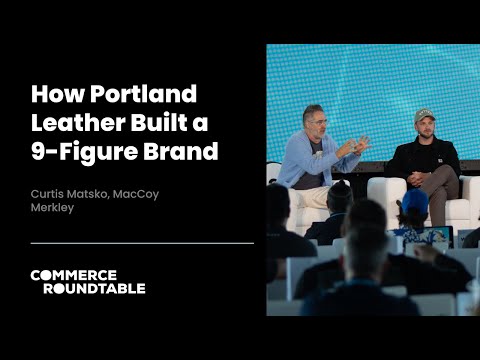
Curtis Matsko and MacCoy Merkley share the Portland Leather Goods story, including CEO–CMO collaboration, product choices, and the lessons behind an expansion they chose to stop.
Curtis Matsko and MacCoy Merkley share the Portland Leather Goods story, including CEO–CMO collaboration, product choices, and the lessons behind an expansion they chose to stop.
For founders and marketing leaders connecting product development with demand and repeat purchasing.
Speaker roles and platform examples reflect the session’s original context. This is an archived conversation.
Bring marketing into product planning before the assortment and price are fixed.
Read this part · 05:53 ↓Review product, price, and customer demand together instead of relying on a downstream handoff.
Read this part · 10:49 ↓Evaluate a new category through repeat behavior, returns, and cash needs as well as sales.
Read this part · 18:51 ↓Test the product’s relevance to existing customers before committing to the full launch.
Read this part · 22:53 ↓When a launch falls flat, question the product proposition before adding more campaign complexity.
Read this part · 27:16 ↓A quick editorial guide to the key ideas. Read the complete transcript below for the examples, details, and discussion in the recording.
Original recording on YouTube ↗The founding story leads into a central operating principle: shape the company around what customers want. Curtis and MacCoy contrast that with making something in isolation and handing it to marketing with instructions to find a buyer.
Their collaboration brings product and commercial judgment together earlier. The conversation is about what can sell, at what price, and why the customer would choose it. Marketing is therefore part of the product decision rather than a service called in after the decision is complete.
The speakers describe a relationship built around candid discussion of the product and business. Alignment means being able to challenge a direction before it absorbs more time and capital, while still moving quickly when there is a shared conviction.
The practical lesson is a process, not a personality match to copy. Create space for customer demand, production realities, and marketing economics in the same conversation. That gives each side more context than a handoff between separate departments.
The footwear example shows why a new category can look successful in sales and still be wrong for the business. The speakers discuss repeat purchasing, returns, and the money needed to support the category. Those factors changed how they assessed the opportunity.
They ultimately stopped the line despite substantial revenue. The decision illustrates the difference between proving that people will buy a product and proving that it is the best use of the company’s resources. Compare categories on the customer behavior and costs they actually create.
A product launch benefits from a clear understanding of what the audience already values about the brand. The discussion links successful merchandising to that familiarity, rather than assuming every new idea earns the same demand.
The customer’s experience provides a useful test: does the product offer the function, feel, or use they expect? A launch plan becomes stronger when that question is answered before building a large campaign around the team’s enthusiasm.
The speakers also describe a launch with extensive creative preparation that did not connect. They had become invested in explaining the material and the concept while missing what customers wanted from the product itself.
The lesson is that more education does not always solve a demand problem. Customers may simply prefer a different feel, design, or function. Treat a weak response as information about the offer, not automatically as proof that the marketing needs to speak louder.
From the recording’s auto-generated YouTube captions, with filler words removed and paragraph breaks added for readability. Names, numbers, and wording may contain caption errors; refer to the recording for exact phrasing. Chapter links jump to the text below.
Original recording on YouTube ↗0:00Marketing pulls the product. Marketing creates this. We let the customers create the demand. We take and [music] make them what they want. And very, very quickly, the CEO and my job is when we create that vision to say that's it. We're all in. We're doing it. We're going in. Here's the people. Here's the money. Here's [music] the focus. We're going to get that done. You're going to have product quality by vary by business all [music] over the place. And I think more important than the product quality is the actual value exchange of the transaction. If you are trying to huck at people for way too much, the value exchange falls apart. But you can have a higher lowquality product as long as that value exchange remains intact.
0:39[music] We listen. We take cues. And so we know what people want. Furthermore, we have 180,000 person focus group. And if [music] we ask, they will tell us. All we have to do is listen. We're live. We're good. We're good >> about public speaking to know that you never give a disclaimer that you're feeling poorly before you start or that you're a bad public speaker. So, I am feeling immensely better now that I'm up here talking to you guys. And we're going to change this up a little bit. I'm going to do this a little bit differently.
1:14And this right here is McCoy Mkeley. He is my chief marketing officer. If you are highly engrossed in large amounts of spend on DTOC, you know McCoy, he's the best CMO in the business. And I'm going to tell a little bit of the story about who the hell we are and our relationship and how this goes along. And I'm going to start this off by a little story. If you don't know who we are, Portland Leatherg Goods was started in my garage. We now do $200 million in sales a year. We have nine new stores going up this year. We own the largest leather bag manufacturing in North America and we started in a onecar garage in Portland, Oregon about 9 to 10 years ago.
1:58>> Yeah. Yep.
2:01>> Now, I'm going to throw a loop at everybody before I bring McCoy in because I have to I'm going to talk to five or 10 people in this room and I'm really serious about this. This is not for everyone. Five or 10 of you. I never had a drink of alcohol until I was 24 years of age. First night I ever drank, I blacked out. And I was told I was hysterically funny. Everybody loved me. But I don't even remember that first night. My life got worse and worse and worse.
2:28And then in June of 2012, I found myself in my car with 80 empty bottles of booze, two hospital tags on my wrist, and I was down to $100, and I was detoxing. I was just freaking out. It was 7 in the morning. If you're in Portland and you're an alcoholic, you know this. You can buy wine and beer at 7 in the morning. So, you got to make it till 7 in the morning. And I go into the convenience store at 7 in the morning.
3:03I hand him grab two bottles of wine. I handed him my money. I had spilled wine on it and it was pink. He said, "Dude, I can't sell you this wine. That's Monopoly money. That's not real money." And I'm shaking. I look horrible. He said I said, "Keep the hundred. Just give me two bottles of They're like $8 a piece. This is the worst wine in the world. please. He said, "I can't do it." I walked out a block away. I was trying to get back to my car. There was an AA meeting was called Eastside Sunrise in Portland, Oregon. I walked in and to this day, people come up to me and say, people burst into tears when they saw me. That's how bad I was. A gentleman who was 26 years sober went and bought me beer and sat me in the car and said, "Can you stay in your car while we get you help?"
4:03Now, the reason I'm telling you this is because happens in this world and everybody in this room knows somebody, whether you know it now or not, who has trouble with drugs and alcohol. And I'm going to tell you this. There is hope and the odds are against them. Does that make sense? There is hope and the odds are against them. I sat in my car drinking beer. Imagine this. If you know about AA, they won't. They say that alcohol solves nothing. And they went and bought me beer cuz I was so damn bad. They took me to this detox place at 7 one morning, tried to get me in, and the gentleman was really busy. So, he left me there to try it again, and I didn't get in.
4:49I was standing outside on the street in an area of town I did not know. I was freaking out. I was shaking. And the door at this detox center opened up. And a woman came out and grabbed me and said, "Honey, you don't look like you're going to make it out here very long." She ran that detox center for 25 years. She said never once in her life did she take someone off the street and do that.
5:16You had to go through the nurses, the forms, everything. She said, "I had a feeling about you." So when we talk about marketing and business and success and the world, you will always talk to me. And if you don't believe that magic works, you're crazy. If you don't believe that there is hope in this world, you are crazy. I got sober on June 6th, 2012, over 13 years ago. Thank you. I only say that story to say where was I at when I decided to start out Portland Leatherg Goods. So, I moved into a
5:55little house in Cellwood in Portland. I moved in because they had a onecar garage and I was starting to visit and see this young lady and she had a really bad job. But I said, "Your job is so bad. If you quit your job, I'm an internet marketing genius. I'll make us $100 million." And she said, "No, you're not. You're the laziest man I've ever met in my entire life. There's no way you can do this."
6:21I went and made a little leather journal. She quit her job and we started porting leather goods. Now, what we're going to do in this presentation is I'm going to talk to McCoy here. We're going to talk about five different times in our company where there was a decision that we had to make and what we needed to do. And I believe this, instead of creating a company worth hundreds of millions of dollars, if I had chosen any of those decisions the other way, we would have a really hardworking $4 million company and not 200 million. Right.
6:55>> True. >> So I always say that we're a marketing company. We are marketing first. I'm the CEO and Maverick here. If you know me, you know that McCoy Mkeley here, my nickname for him is Maverick. Maverick, what do you think of when I say we're a marketing company? We I mean, from day one, like especially your origin story, how you started the brand, like people traditionally start brands one of two ways. Like they sit around and they decide on an idea or a product that they think is going to sell, right? And then they go and order a ship a container from China. Fundamentally from day one port leather gets to been the opposite where you bought leather from a store like the raw material and then one by one crafted those things the product you craft that letter into something that somebody wanted like right now which I think is so fundamentally different from the way again most brands are started where they start with the idea. we started literally one by one cutting
7:49things out of leather because we had found a buyer for that. And so from day one that train of thought is consistent where we have shaped our company around what customers want rather than trying to cram down what we think is cool or we think is pretty like into their hands and make them want this. We start from the customer demand first and foremost. We were sitting in Austin one time and people came up to us and they said, "Hey, what is the key to the secret to your CEO working with the CMO. Why are you guys so successful? Because a lot of marketing guys in here that work for a bigger company or a CEO or someone who doesn't know what the hell they're doing, they will create a product and they will hand it to marketing and said say, "If you're so good, figure out how to sell it."
8:34And you're like, "Well, I'm good, but this product kind of sucks." Or, "I'm good, but that's not what I wanted." We do it completely different. We talk together and he comes and he says, "If you make this, I can sell this. Get me the right product at the right price and I can sell that." Is that how you see it? I mean, of course. Right. So, how many just because I see enough people paying attention. How many do we have any CMOs in the audience? Like, raise your hands. Two, three, four. Awesome.
9:04So, for the four of you, like you Oh, how many CEOs? Oh, this is boring. There we go. Thank you. I I thought I had a few more people show up for me, but that's that's disappointing. Okay, so and by the way, if you have questions during this, please let us know. If you're wondering how to work with a CMO or you're a CMO trying to work with your CO, please like let us know what questions you think would be helpful to answer. but I mean me as the CMO, like my job is like to keep the heartbeat monitor close and understand like the pulse of the business and where everything is going, not just in the day-to-day, but making predictions about the future. And so if your marketing expert, whether you're a CEO talking to your marketing expert, their job is is not like day-to-day execution. Whoever that head of marketing figure is for you, it's not just day-to-day execution. It's trying to figure out where the market is going.
9:50I mean, we sat here and we listened to Gary and Gary makes predictions about the future that if they come correct, you're much better on moving earlier. That's essentially what the CMO is focused on for his area of expertise. So it's not not ops or finance related but you need to make sure that like you are the source of knowledge and the source of truth and you can communicate that conversationally because no one can get as deep and as technical as you if you but you need to be able to communicate that conversationally to the CEO or whoever that figure is because they have to move much more than just you and much more than just that department. And so absolutely like I see that as a major part of my role and working with you is to get you to a sense of conversational competence about what I see in the market and where it's potentially going to go >> technically. What does that look like?
10:35I'm looking at reports. I'm like, what is my report? Is this an email? Is this a post-purchase survey? What is the technical communication and the style of presentation that Curtis needs to see to be like, I'm going to go fake. I'm going to go make this thing.
10:49>> Yeah, it's Well, okay. Okay. So, we're slightly different than a lot of other e-commerce companies because we own our own manufacturer, right? So, for us, this doesn't we don't just have a bright idea and put in a PO. We actually have to move and shape a 1,200 person operation to to make what we want them to make. And we've got that we've got that down good. It's great. but it's one, you have the you have to do everyday local management of your team and you got to make sure that they're absolutely exceptional in a way that allows you to look out into the future.
11:14And then when you're looking out in the future, you're essentially looking for I'd break it into two buckets, things I can control and I can contain these inside of my team and get them done now and things that I need help with. So Curtis, as a CEO, like he's the bridge between myself and something like an operations team. And so we're constantly plotting a year or two year in advance, what products do we think we need? Like what roles will they play? What do they look like? What do they feel like? but those are things that I can't do for myself and where I need like a collaboration or I need to again bring him up to speed so that he can make that motion happen in the other half of the company. So, let me tell you like one thing that we do that's a little different because we own our own manufacturing. So, I started in that garage and then we went in Portland and we took 2,000 ft in a 24,000 foot
11:58building. At the time, I thought that building was too big to have 2,000 square foot. There were only three of us, so I didn't know what I was going to do with that. Well, we ended up filling that space up, knocking down the wall, filling that space up, and going to 24,000 square foot. Right now, our manufacturing in Leon Wanowatau, Mexico is 280,000 square foot. Now, how does that work with marketing? Let's say I want to create a bag and Maverick wants to create a bag and he said, "Here's what it is. We want to make it in six colors." And I say, "Well, let's make it in 10 colors. Which ones are going to sell the best?" We don't know which ones are going to sell the best. If I was making that in the Philippines, I was making that in China, if I was making that in Vietnam, I would send a PO and they would try to get leather somewhere and bring it to the factory. And they would wait until they
12:51all had all 10 of those leathers before they would make it. Then they would make that up. They would put it on a boat. They would send it. And I would get that four, six, nine months later in Dallas, Texas. And then Maverick turns on an ad set and all of a sudden, wham, two of those colors sell out in a day. The rest just sit there. I want more of those colors. If I made in the Philippines, I have to then call them up and say, "Can you please make some more?" At the same time, our Facebook and our adsets are getting their kicked. Does that make sense? We're getting killed. We can now take a product and we can launch a product and when we need more we can put in an a peel, take the leather, check every hide of leather, put it through matt chomping where we cut the leather, match it, stitch it, quality control it, put it in a box, send it to Dallas, Texas in 12 to 14 days.
13:53So when we talk what this is is marketing pulls the product. Marketing creates this. We let the customers create the demand. We take and make them what they want and very very quickly. Now that way he can try not to ever turn those adsets off. Do you still have to turn off adsets? >> All the all the damn time. >> All the time. Would it be worse if we were buying in the Philippines? >> Oh, for sure. I sounds like a nightmare because as good as we've got and we directionally are usually accurate but we're we're never pinpoint accurate right we never like you know one to 3% off it's always 20 30% off so I mean we'll predict okay this batch of color is going to go well but there's always everything some sort of outlier that just completely takes off and taps out that we never see coming even you know years and years into this and hundreds of million dollars of revenue later we have a decent idea but we're never like
14:45pinpoint accurate our predictions So, one of the things that I find out is I'm always saying maverickisms, like wise things that he says. And one of the big turning things we had in our company is when co started, we went on to Etsy and we became a top 10 Etsy seller in the first year that we were on Etsy. We like blew we blew the doors. We we we had some hacks and we destroyed Etsy.
15:10And I said, "We're an Etsy company. We're going to handmake all of this in Portland, Oregon, and we're going to make our money on Etsy. And I hired this guy and he said, "That's stupid. We need to go on Shopify and sell to the real world." And what did I say? The no one believed for a second that you could, well, in the company at least, that you could run a.com and it would beat Etsy. Like, we fundamentally just didn't understand how to get people to the website and sell them things. Now, Etsy is like a marketplace. So this is like Amazon. So somebody customers on your marketplace typing in the keyword of the products you sell, right? So it's it's mostly demand capture and then switching our brains to demand gen was like unbelievable. We had no idea what we were doing. And I don't know it was a single a singledigit number of people in the company who when we looked at this $3.5 million Etsy company believed that the dot even had the
16:06potential given an infinite amount of time to be bigger than 3.5 million. like no one understood what this was fundamentally and that became like my job obviously and that created the first thing that I always say to people you need to spend more time in where you're going than where you are. We had all of these people handmaking goods on Etsy and he kept saying we need to go on Shopify and part-time on the side he was trying to make an entire business that we now want to make hundreds of millions of dollars.
16:35That was not a buyin. the CEO and my job is when we create that vision to say that's it. We're all in. We're doing it. We're going in. Here's the people. Here's the money. Here's the focus. We're going to get that done. That was one of the really big things. So, we're
16:51actually out there and all of a sudden COVID happened in 2020. But, we were still making all of our product in Portland, Oregon. And one of the most famous quotes in our company came about when Maverick and I went downstairs in the basement and we figured we had about how how much did we have in inventory? >> Yeah. Like we were we were pre-ordering at that point with no guarantee of delivery. Like we we're literally selling products saying Kickstarter style. If you ever bought something on Kickstarter, we're like we don't know if it'll ever exist, but if it does, we think it's two years from now and we'll mail it to you.
17:27>> Like that. Yeah. So he said the quote, do you remember the quote? >> I remember it, but I think you you say it. >> I become famous for stealing your quote. I say this all the time. >> Why me? Go ahead. >> He said, "Books will be written about people who got afraid and people who got bold. We need to go to Mexico and set up our own manufacturing." I put on two masks, flew into Guadalajara, went into Wanowatau.
17:53You want to talk problems? You couldn't set up a bank account because the banks were closed. You couldn't get a business license because the government was shut down. But we took five machines and pushed it against a wall and a guy named Fabon said, "Give give me a place to plug these machines in and I will make your products." We now make between 60 to 80,000 products a week in our manufacturing. If we had not done that, we would have been out of business. Think back to COVID. Think back when it was there.
18:26Everyone was saying, "What is going to happen next week? What is going to happen next week? What is and you're dependent on somebody else coming in and making a decision that possibly can save your business?" I do not like when other people are in control of my company, our destiny, all the people that we do, and all of our amazing customers. So, Maverick was a lynch pin in getting us to set that up. Then after a little
18:52while, we grew and we grew and we grew and we found out that we were one of the largest leather buyers in all of North America and we said, "We're going to try something new." And we decided to set up a shoe company. Does anyone know where most of the boots in North America are made? Leo in Wanowatau, Mexico. Who make who makes their stuff there? Does anyone know? Tacobus Thursday Ariat. If it's a leather shoe and it's made in North America, it is made in Leon, Mexico, where we have our operations. So, we thought we're going to be shoe people. We're going to start making shoes.
19:35Were we successful at selling shoes? We sold more than 400,000 pairs of shoes in 18 months and did around 40 million in revenue and shoes. Yes. >> and then what did we do? We shut it all down. We shut the entire thing down. And why? Because at the time money was hard and the economy was weird and everything was flippy floppy out there. And Maverick did some math and he said, "If I take a customer and I have them buy this particular leather bag in the next 12 months, we're
20:11going to double. The return customers are going to come back and if they spend 120, they're going to spend 240. If they buy a boot, they're going to come back and spend $150 or $160 because you already have a pair of boots. You don't need another pair of boots.
20:27And something else happened with shoes. Something called returns. So now you've spent all that glorious marketing money getting someone to buy your stuff and then they buy two pairs, put one in a box, and send it back to you. And all of a sudden, you have these shoes all over the place. you have skew problems, you have all of this. We shut this down and people said, "That must have been a problem. That must have been a failure of your company." Maverick
20:57said to me a couple weeks ago, he's a pretty smart guy. He said, "We need to have people stop saying that. We learned how to sell $40 million in shoes in 18 months. We know how to sell shoes now." Yeah. Well, I think the to to the point about one of the challenges like I face and one of the challenges with all of the work that goes behind that simple explanation is hopefully you know somebody at the helm of the marketing who can tell you the truth, somebody who can who can push in ways that you know you don't feel like at certain days and then obviously you can lean on each other in those opposing times.
21:35looking at data and breaking it down and trying to get down to like the ground for reality and explain. It's a really difficult thing to go to your boss and be like, "Hey, this massive investment of time and money and all of the days we spent thinking we were crushing it." I think that our time and resources is better spent somewhere else. and I remember vividly like working with the CFO to bring that decision like to go to your CEO and be like, "Hey, you know that new amazing thing we just started up and it's going fantastic. It's time to shut the whole thing the down, right? You you need somebody and I hope you have somebody if you're, you know, seeing as we're mostly CFO CEOs in the room here, I hope you have somebody that tells you that the truth of that and I hope that you you have somebody you can make feel safe enough that'll tell you the truth. because there's probably a lot inside your business right now
22:18that's holding you back or where you might have to go the complete opposite way and you know the not that it's you know pure speaking truth to power but like you better build a good relationship. you better be, you know, borderline friends with these people so that they feel comfortable telling you the truth because sometimes the right answer is in the most painful thing imaginable. We we spent so more time on those shoes and that product line than we than anything else for that past 18 months. And to shut it all down was very painful, but it was absolutely the right move. And I don't know what our company would look like today. I know I have a good idea of what the company would look like today.
22:52>> I think we have like just under 10
22:54minutes left for this conversation. I would love to hear a story of like when a launch went really well that marketing drove, what is a what does that launch setup and sequence look like? And then maybe a launch that didn't go very well and the learnings between those two specifically. >> Which one do you want? Good or bad? >> Wow. You just grab one. I've got two in my mind here. So say good. You're you're an energetic guy.
23:17>> Okay. So everybody, we have hero products and we have all our other products. A hero products is something you can put an adset on. You can spend tens of millions of dollars on that product and you can get new customer acquisition. In August, we had 44,000 new customers come in and buy our bags. And we know which bags they came in and bought. They came in and bought hero products. Two of our top three two of our three best sellers came out this year. The very first one came out in February. It was called the Koala.
23:50And we just had a really good feeling about that. We made a bunch of that stuff. We were got We had all the things set up for it. We launched it and we watched that first day a thousand 2,000. That thing is just killing it, right? So, we knew that we had everything prepared to keep making that koala and continue to make that. A couple months later, there was one I did not believe in. I tried to shoot it down called the Naomi. And I remember I had said no, we were not going to make it. I was at a store in our store and we have a store in Austin, Texas and I had one sample and I showed some people and a big group of people came around me and said, "I love this. I love this. I love this." I gave it to the store owner or that not the the store manager and she called me and she said, "Every time I wear that, everyone says they love that bag." We launched that one.
24:46Number three best seller we've ever had. I was not prepared. So we had to scramble. We had to get leather po start making upscale that and get it in. So now if you want to have ad spend the number one is the koala and number three is that Naomi one was launched in February one was launched in March or April and they absolutely kicked I saw one I didn't prep for the other one but because we have our manufacturing close we were able to like upscale that one and now it's a big seller. Mistakes all the time. Do you do you go email like a email launch to the list first? Do you segment it by like someone's bought a similar looking bag? Technically, tell me.
25:24>> It's t it's typically everybody, right? Like we're there's no such thing as too much returning customer revenue. And so like and these are like especially your loyalists too. So if you want to you want to segment these out that be my guess, but for the most part like we're pretty aggressive and like we hit most of the email list most of the time, especially our return buyers, right? Now, if you don't know, like if our brand, we have a 180,000 person Facebook group and the women in there who collect our bags are just they're they're nuts and I love them so much. They make my job way easier, but they are insane. And so, well, one and just like talking about how that those launches come to be and how a lot of our launches come to be is like we listen. We take cues. and so we know what people want. And like furthermore, we have 180,000 person focus group and if we ask, they will tell us. All we have to do is listen.
26:09and typically they're I mean most of the time we're releasing something especially to a lower let's say it's a product specifically geared at returning customers. They typically help make the decisions in like the colors it's available in and the shape of it and and the sizes and the name of it. So it's all with them in mind and so we hit them over and over and over again. >> Very cool. >> One of the things we used to do though is we would design all these bags and all these wallets and small goods and I would use the wrong verbiage. I would say which one do you like?
26:40Absolutely the wrong thing to ask people. What I've started to say is which one will sell better? And then I make them take it on the table from over here besteller to least seller. And then I bring in more people and I ask them and pretty soon you get some pattern recognition of what they think is going to sell better and what's going to sell better and what's going to sell better. So we use that. But I'm going to tell you for years and years I said which one do you like? Wrong question. Which one's going to sell better? And since we started asking that question, our internal focus groups of our employees has gotten much better. Much better.
27:16>> Okay. A negative one. And I'm going to go to QA from some of the CEOs, CMOs if they have anything. >> Absolutely. Okay. We'll keep it we'll keep it short. We we has been you're trying to understand like what our brand is. We're a brand who didn't like really set out at the beginning trying to shove any specific things down someone's throat. As we mentioned, we're a marketing company. We want to be adaptable. We want to mold around the demands of the market and the customer to a certain extent and obviously within bounds. and at one point, I think we just kind of had a fundamental misunderstanding of why people were coming to our our brand. And we're Portland leather, so it's pretty hard to separate what what we sell and what we do. We're a leather company. and you know where I'm going with this, which which line?
27:52>> No. >> Okay. So, we released a line called of our vegetable tan leathers. Now, if you're in leather culture, this is like cream of the crop. If you're a lot of the companies we grew up and grew past are small craft artisal leather brands and this is the stuff they use. It's the real deal. And so we of course thinking like, okay, we've got this nailed. We know leather. Let's go out and find the best stuff we can possibly find and bring it to our customers and they are going to sing our praises because finally we brought this extremely expensive craft leather. So mass market, so expensive. And so we called this line the Veg Tan line. And we launched it with peak expectations, like we're smart. We got this. We've got it all figured out. Get ready world to basically absolute crickets. They're just silence. Crickets. And unbelievable. We're We checked everything. Like something's got to be wrong. Instead of selling 3,000, 4,000, 5,000, I think we're at 121 the first day. And some of those were my mom. I
28:50mean, really, it was really, really bad. >> Why is a great question. I think we just fundamentally misunderstood what the customer want. We thought that they wanted like more craft artisal leather from us and they just wanted a good bag that happened to be made of leather. If you make it in leather, if I give you the choice of something or something in leather, it's intuitive. You take the thing because it has this air of luxury.
29:09It has this air of durability to it. And we thought, okay, we'll chase that to the extreme and then charge more for it. They were there was no value exchange there in paying more for the products. And in fact, that particular leather is way stiffer and thicker. So the bags had even less features. They were even less exciting. We try to create like a very great bag and if I handed it to a designer or you and I said make it better, you would start adding to it because there's nothing else to do but add stuff to it. It's very minimalist and understated and classic. And these were even more simple. And so I think we just missed the functionality. I think we missed the what our customers really wanted from us. And then we got higher on our own supply in the opposite direction. There was so much create creative fog around this project and what it was and we create it was the only line of products. We created full scale campaigns for multiple products
29:58and brochures and books and all these things and then flat and again if you know our brand we have customers who will literally buy anything and they wouldn't touch these products. So and we learned a basic thing about sales and marketing on some things people don't want to be educated. We're like, "Oh, let's tell you about why this leather is so awesome." They're like, "We don't care. Why does it say vegetable? Why does it not look like the other one? Why is it not soft? Why is it like we tried to like go too deep instead of great bag? Smells like leather. You're going to love it. Buy it." That's what people wanted. People thought veg stood for vegan. So, we had literally our own customers angry like, "Screw you, man. I thought we were this was real leather and here you're selling vegetable leather." And we're like, "No, wait, wait. What?" like never in our minds cuz we're so deep into this that we ever think people would not get it and they just didn't get it. So there
30:48you go. There's my pink.
30:49>> Okay, you got a any questions? You got a box there, right? >> I do have a box. She's running out. I have one question in the back and I'm going to come right into the question in the front right here. Thank you. Hands raised. Please tell me your name and your social security. >> Hey guys, my name's UJIS. I'm a head hunter in the broader e-commerce space. So earlier today, Ezra shared that it's the best promise that wins, not necessarily the best product. You guys are marketing first as well, but how do you think about the quality of the product and where does it go in your thinking about how you're going to build your company?
31:26>> We lucked out. we really lucked out. I I'm I like to take credit sometimes, but I'll be honest with you guys. I bought the very best leather to start off with and I made really simple bags because I didn't know what I was doing. So, it had to be simple because I didn't know how to design a bag, right? And what we found is there were people who wanted that real leather smell and look and feel and it just happened to be a huge market out there that we could scale into. So, there was so much luck in that. Also, I like to please people.
31:57I'm the youngest of four boys. So, when people would say, "I'd like this. I'd like this." When we started this first year, I was really trying to make everybody happy and it let us change the product into something they really wanted. We really really lucked out. Marketing first does not mean selling product. It means get in their minds and figure out what product at what price at what time is going to sell at what scale. Can it be a hero product? Can can you put adsets behind it? Is it going to be a a retention product that our people come and buy? Can it be in multiple colors? Where does it fit into our arsenal of what we're going to do? So, we are marketing first, but we still loved that people love our bags. And no matter like I think you're going to have product quality by vary by business all over the place. And I think more important than the product quality is the actual value exchange of the transaction, right? If you are trying to
32:53huck at people for way too much, the value exchange falls apart. and that but you can have a higher low quality product as long as that value exchange remains intact. So think about it this way. If you go to a restaurant and your meal is what you feel is underpriced and it's the best thing you've ever had, you will never shut the up about that restaurant. You want to take all your family and friends and bring them into this restaurant to have the same value exchange you have. They you love that.
33:16It's contagious. On the flip side, you go to the stuffy, pretentious, expensive restaurant and the food's weird and you hate it. You will never stop talking about it or at least just never go back. And so whether it's high or low quality is to me largely irrelevant. Obviously I'd like you to skew towards the high quality, but the value exchange is far more important. And then to the to the premise of promises, make the largest promise you can keep and absolutely nothing more. So make sure people know the full value of what you can provide to them. That's a good idea to amplify that, but never ever more. Otherwise, I don't know what your plans are for that customer when they buy the thing and the value exchange falls apart. What What are you expecting?
33:52>> We had a time, right? We had a great time where we made too much of something that sucked and I'm like, we got to sell it off to our people and we don't want to lose money. Don't lower it too much. And Maverick was like, our clientele is here for the next 20 years. Let's not them over and make them buy us out of our mistake, right? Like, don't make them buy us out of our mistake. We screwed that up. We take the hit. We take the loss. We don't pawn it off on our people. That was one that I fought him a little bit on, but he was right.
34:25>> Second row question. >> Hello. Hello. as I've been growing my company, I recognize that one of the most important things is as a CEO managing the team and particularly my reports CI CMO and COO and the relationship that we have. So, I just wanted to ask from both your perspectives, Curtis, what's the number one most important thing that you found has been important and and instrumental in the growth of your company in the way that you manage McCoy? And then also back from McCoy to Curtis, one number one most important thing that you've done to manage Curtis's expectations from your perspective.
35:04>> I don't I don't manage anybody. I'm just going to be honest right to you. I'm a horrible manager. I'm a coach. I'm energy. I'm vision. I'm Let's go do this. Let's find awesome people. I believe in you. You screwed up. Let's fix this. How do we get over that? All that rest of that there is like that's what he does. He's got all of these people and all of these levels and he has meetings with them. I just get up and say, "Yay, let's make this work."
35:33>> So, it sounds like you empowered him to basically do all of your visions that you've >> he all of his work. It's like, "Hey, I'll tell you how to do my homework. You got to just do this homework, though." >> Yeah. He empowered himself. I mean, he you guys don't know this. He started walked in off the street. He was a photographer and a great photographer, had a business. He was going to grow hundred million dollar companies no matter what, but he came in just to get out of the house. His wife wanted him out of the house for a little bit more time. Is that the true story?
36:04Yeah, >> it's true. Yeah, it was a wedding photographer. And to answer your question in reverse, Lester, you're got more to it. I mean, Curtis is a marketing mind. and so like one that makes my job way easier because it's not like speaking a different language that needs some sort of translation. I know that if I can get the mass of information down simple enough, I can communicate it to him and it has a chance of being received. And I think even that takes a lot of work. There's been certain concept that I've had to attempt to communicate over years with every different word in the dictionary and still it's still been hard. but we what especially like the first you know years growing up in port leathers as I mentioned I was a photographer I didn't have any marketing knowledge I sort of inherited my position by surveying him and finding out what he needed and playing to those strengths and in handling that corner and so we had you know plenty of things that
36:54needed attention in the business but if I could take this thing off of his plate which was you know fundamentally one of the most important things we are as e-commerce companies marketing first marketing departments it's not ops that dictates your your total revenue size it's typically demand which is generated by marketing. If I could take that off his plate and play to his not weaknesses but gaps and where his attention was focused, then I we could get much further. So, we, you know, Curtis will say, I'm not a systems person. I'm not a systems person. I always argue with him. So, I think there's a healthy balance of you like not agreeing with each other's perspectives on yourself.
37:23And I say, you are a systems person. Your systems are people. You have a good person. You put them in a corner, then you start to trust them and they do good work. Like, that is a system fundamentally. people. We need to finish
37:34up because Jimmy Sing here to Shaq. I'm going to say one thing for one minute. I started this talking about drugs and alcohol and somebody either you or people in your life that you've seen and I'm going to end it on this. What I found is I was never on social media until a year and a half ago. I started going on LinkedIn and people love the that I said, but the ones that really have changed lives is when I talked about this. It's been a long time ago. I don't talk about it that much, but we just flew 40, 50 people into Mexico for a week-l long birthday party for me down in Mexico. It was awesome. But all of my friends from the last 30, 40 years got together with Mariana and got together with Maverick and they told stories about when years ago. And one of the stories was my cousin saying, "I remember the phone ringing at 3 in the morning and it was Curtis and I know he had been in trouble with
38:29drinking and he said I didn't want to answer it." He answered it. You will have the chance to help somebody who has fallen down three or four or five times and deep in your heart you will say they're just going to it up again even if I help them right now. Does that make sense? They every time I help them they fail. The one thing he did was always pick up the phone and listen for a little while.
39:04And if you have the chance with somebody in need who helps you asks you, I would ask maybe think about it twice about maybe going out and helping that person. Thank you.
48:13 53:20
53:20 50:45
50:45Join Commerce Roundtable in 2027 for focused learning and conversations with people working through the same challenges.