 36:17
36:17San Diego · 2026

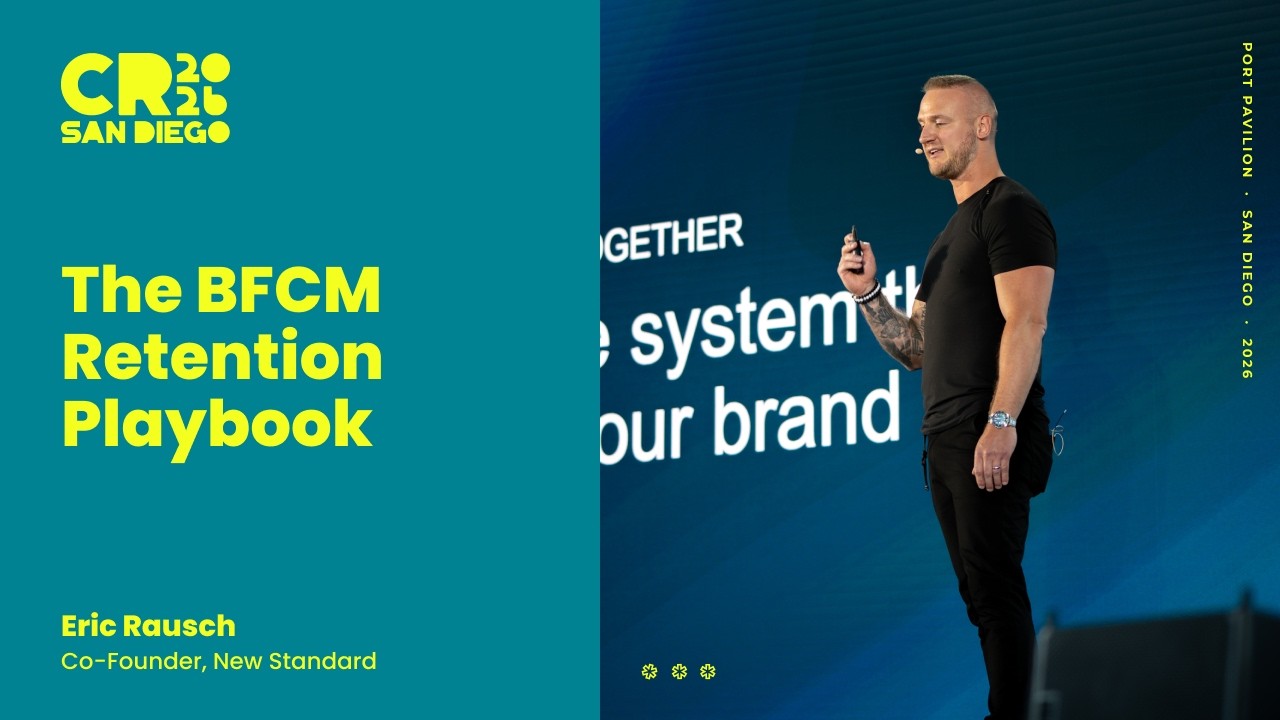
Eric Rausch of New Standard Co. explains four stages of retention revenue forecasting, from batch-and-blast emails to AI-assisted planning. Learn to predict campaign revenue, build a content calendar around your targets, and prepare for BFCM with approved contingency plans.
Eric Rausch of New Standard Co. explains four stages of retention revenue forecasting, from batch-and-blast emails to AI-assisted planning. Learn to predict campaign revenue, build a content calendar around your targets, and prepare for BFCM with approved contingency plans.
For DTC founders, retention marketers, lifecycle leaders, and agencies planning email and SMS revenue for BFCM and beyond.
Recorded at Commerce Roundtable San Diego 2026, including the audience Q&A. Examples and forecasts reflect the speaker’s experience at the time. Chapter times follow the publisher’s YouTube description.
Speaker roles and platform examples reflect the session’s original context. This is an archived conversation.
Give the channel a clear goal and the resources to pursue it. Ask how the team is pacing before the final days of the month.
Read this part · 02:25 ↓Compare actual performance with your estimate and use the gap to improve your understanding of campaign types and audiences.
Read this part · 09:08 ↓Use campaign history and known launches to plan toward the target. Prepare approved backup campaigns for shortfalls and skip unnecessary discounts when ahead.
Read this part · 13:08 ↓For content-led emails, compare engagement across audiences instead of judging every send solely by revenue. Adjust frequency where interest falls off.
Read this part · 28:24 ↓Give an AI-assisted forecast reliable history, channel targets, and current business inputs. Keep reviewing the assumptions and learning from misses.
Read this part · 22:35 ↓A quick editorial guide to the key ideas. Read the complete transcript below for the examples, details, and discussion in the recording.
Original recording on YouTube ↗Eric argues that retention deserves the planning discipline brands already apply to acquisition. Instead of treating email and SMS as last-minute revenue requests, he calls for clear goals, dedicated ownership, and enough creative and strategic capacity to build a repeatable program. His central question is whether the team can explain how retention is pacing against its target.
Eric’s framework moves through batch and blast, guess and check, divide and conquer, and AI systemization. The stages describe increasing planning maturity, not company size. He gives examples of large brands still relying on reactive sends and encourages teams to build the habits of the next stage before pursuing the most advanced system.
Sending to the entire list without a calendar or a revenue expectation can generate sales, but Eric says it gives the team little basis for evaluating performance. A campaign’s revenue is hard to call strong or weak without a prior expectation. The next step is to establish a prediction and a learning process rather than simply send more.
Before sending a campaign, write down how much revenue you expect it to produce. Compare the result with the estimate, then use that difference to improve the next prediction. Eric calls this measure, anchor, adjust. Repeating the exercise across campaign types and audiences helps a strategist learn the list, while recognizing that intuitive estimates alone do not yet create a complete monthly plan.
Start with an agreed KPI and turn it into a pacing target for the period. Use the campaign history developed in stage two to plan launches, reviews, promotions, and other sends against that goal. Eric emphasizes a shared marketing calendar prepared several weeks ahead so the retention team knows when launches and offers will happen.
Prepare and approve contingency campaigns before the team falls behind. If results are ahead of plan, the brand may be able to skip a discount; if results are behind, it can use an already prepared alternative. Eric also compares segment performance and buyer cohorts to understand which audiences respond to which content. Those comparisons inform targeting and send volume; they are not presented here as controlled proof of causal incrementality.
Eric’s advanced model combines channel targets, traffic expectations, an integrated calendar, and historical performance in an AI-assisted forecasting process. He stresses that the team needs to understand and defend the underlying inputs. Cross-channel communication and a feedback loop remain essential: review misses, identify missing information, and update the plan rather than assuming automation makes the forecast correct.
An audience question asks how to target useful content that is not primarily a revenue send. Eric recommends evaluating audience engagement and deliverability alongside the message’s purpose. Segment-level comparisons can show where interest drops off and help determine whether less-engaged recipients should receive that type of content less often. His numerical examples illustrate the discussion rather than establish universal benchmarks.
From the transcript supplied by Commerce Roundtable, with filler words removed and paragraph breaks retained for readability. This source does not include paragraph timestamps. Refer to the recording for exact wording and the session guide above for chapter times.
The supplied transcript includes the replay sponsor message and audience Q&A. Spoken examples, offers, and transcription variations are preserved as part of the original source.
Original recording on YouTube ↗Today we're gonna be talking about the four stages of retention revenue projections, what this means, and how you can go home and take actionable feedback from today to help you just make more money through your retention channels. Who the hell am I and why should you care?
I'm Eric Roush, co-founder of New Standard Co. My team is here four deep. You've probably met some of us already this weekend or this week. We do retention marketing for eight to ten figure DTC brands. You'll see some of the brands we work with in the next slide. I've been doing retention now for thirteen years.
I started at Chicago Tribune, fresh out of college. I'm a diehard Chicago Bears fan and espresso martini connoisseur. fun fact, if you guys follow me on LinkedIn or Twitter, I have a conference tradition that, technically somehow, some way has not been yet redeemed. So little teaser for you if you care.
Let's get into it. Why trust us? Why trust me talking? These are some of the brands that we work with on a day-to-day basis. Some of these brands we've been working with for three-plus years. They trust us to run their entire retention channel. They trust us to really drive the profits of their business.
What is the problem? Every brand prioritizes acquisition. Few brands prioritize retention. Let's unpack what this means It gets the scraps of the business. It's the designer that maybe I have some time left after I work on some paid ads. Maybe we give you a little bit of budget. It's the last slides of the WBR, weekly business review, that people kind of tune out for.
They don't really care. Everyone cares about acquisition. Ironically, even retention SaaS platforms follow this logic, but we'll talk about that at a later date. Here's the true problem. Black Friday is sixty days away. Some brands here, the founders are here, their acquisition channels are here. They're gonna say, "This is a retention talk.
I'm an acquisition brand. I don't really care." They're gonna tune out. Sixty days from Black Friday, they're tuning out. What's the solution? We should spend as much time, intensity, and rigor that everyone else spends on acquisition on retention. What does this mean? We should put proper resources to the channels.
It should become a reliable revenue stream that we can then predict and be proactive about. You need strategic experts to lead the channel, not just the founder who's strapped for bandwidth, who's working the last few minutes of his day. We need an email coming out, and it should have clear goals and people held accountable to hit those goals.
We've audited hundreds of accounts. We've worked with hundreds of accounts from six figures to ten figures, brands you've never heard of, brands every single person in here has heard of. There's still people in those brands who don't know what their goals are because leadership is not telling them what their goals are, and no one is held accountable to hit those goals.
So in sixty days for Black Friday, when your acquisition team is crushing, and you're all patting yourselves on the back, what you should be doing is focusing on the amount of people, of new buyers, repeat buyers, that are coming into your ecosystem, and you've trained and created a system that gets them to come back and buy and increase their AOV from their orders, and they keep buying and buying again.
You're turning them into loyalists and brand evangelists. You're not just stuffing a leaky bucket, which you would be if you had no retention channel. Why is this important? The future of your health depends on this. Acquisition is growth. Retention is profit. So some fun little questions here. Who knows what their target CAC is?
Raise your hand. Who knows what their target ROAS is? Who knows what kind of profits you need to properly order your inventory for twenty twenty-seven? Who knows who their meta rep is, first and last name, their Social Security number, how to call them, what their kids' fears are, every single thing about their meta rep?
Question number two, who knows who your ESP CSM is? Are you forecasting acquisition by the day? Some of our brands are doing it by the hour. Here's the real question you have to sit with if you're the founder of your brand: Are you forecasting retention revenue at all? It's Q4 coming up. Are you even thinking about it, or are you just focused on your acquisition channels?
Today, what we're gonna work on is solving this problem together, figuring out where you are in the stages of the life cycle journey, and figuring out what system works best for your brand and your bandwidth. These are the four stages. Let's set the stage. There's batch and blast. Everyone has heard of this.
They know what this is. Guess and check. Might not make sense, but it will in two minutes. There's a little gap here on purpose. You can't really do any sort of retention, projection, or revenue estimating until you're on stage three and stage four. Divide and conquer with segmentation science. You're leveraging AI with systemization.
But until you get to stage three, you can't really predict what you're gonna make in the month, the week, the quarter, the year. It doesn't matter where you're at in these stages. Every brand is at different places. Today, what I want you to leave with is the exact tactical and practical steps to get from stage one to two or two to three or three to four.
At stage four, there's like two percent of brands who are doing this. Very, very rare. We'll talk about what this looks like right now. This is what stage four looks like I imagine almost everyone in here is saying, "That's a pretty cool image. I don't do this at all for my brands. What the hell does this even mean?"
This is where we're going, but we need to get there first. So keep this in mind, we'll come back to it. What the hell is batch and blast? Everyone knows what this means, but what does this look like? You're sending to your entire list. You have no calendar, no strategy, no nothing. Your founder, whoever, is just like, "We just need an email to send."
That's it. There's no prep, there's no plan. So how do you get here? You start here. You do nothing. Who's ever seen Forgetting Sarah Marshall when he's trying to learn how to s- surf? And he's like, "You gotta do a little more than that." That's where you're at if you're doing nothing. You're leaving money on the table.
This is what it looks like, and this again is like a $80 million a year brand. They still do this. They send to their entire list. I don't have a laser pointer here, it would be cool. They send to their entire list. There's no segmentation science. They're just, "We need an email to send. Let's send it out."
Cool numbers, awesome numbers, but no way to predict really anything. So who does this? Probably 60% of the brands in this room. You might not know it, but you do. It's your infancy, you're strapped for bandwidth. You haven't really prioritized retention. This is the phrase that you've said as a founder, "We'll get to that later."
But you're sick of it. You wanna get to the next level. Why does this work? It provides a little burst of revenue. It fuels the mentality of like, we can get to this later. It answers the question again, are we making money with email? The answer is yes. If you're sending m-- if you're sending emails out, you're making money.
If you're sending SMSs out, you're making money. You then just ask yourself and say to yourself, "This is a problem that we can solve next week, next month, next year. Let's focus on acquisition." But why does this not work? If you don't hit your goals because you don't have a goal, there's no one to be held accountable for the strength of your retention program, 'cause there's not really a retention program.
So I don't know if you guys know this movie, but it's from Holes. You're tired of this. You wanna get to level two
All right, I hope you're enjoying the replay from Commerce Roundtable. I wanted to stop you for just 30 seconds and tell you all about the sponsor that made this happen. I see too many Shopify brands overpaying for big email tools and using only a fraction of their features. We're tired of complexity and never-ending price hikes too.
That's why Seguno Email is different. Lives inside of Shopify and uses your shop live data, not a sync copy of that. Plus, the integrations with Sidekick, ChatGPT, Claude, and Canva saves you time. And get this, Seguno is the only email app to win a Shopify Build Award. Sounds interesting, right? Switching is easy, and you get twenty percent off for being a part of the Commerce Roundtable community.
Link in the show description. Now back to your replay. Now we're in guest and check. This is intuitive-based retention marketing. Let's talk about what this means, and let's talk about how to get from level one to level two. It's so easy. You can do this tomorrow. If you're a founder, you can tell your retention team when you get home today, "This is what I want to see in the next week's WBR."
What does this look like? It's intuitive prediction. We'll talk about what that means. Now you're starting to get a cohesive mind meld with your team. You're now understanding this email will do X amount of money, whether that's a promo, whether that's a reviews email, whether that's a product highlight, a product launch.
Your team is guessing what is gonna happen on your email send. When you're in batch and blast, you're kind of like vibe coding. You're just shooting it out, you're getting some money, you feel great. How do you know if that revenue was good? If you send a product launch and you don't have any guesses on it, and it does eighty K, you feel great about it, but, like, what if it was supposed to do two hundred K?
Then the eighty K kind of tanks, right? But if it was supposed to do twenty K and it hit eighty, now you're feeling proud of yourself. You're like, "This email crushed." But if you didn't predict what it was gonna do beforehand with some historical data, you're just kind of doing nothing. So here's how to get here very practical.
If you're a retention manager, you can do this. If you're a founder, you can tell your team to do this. It doesn't matter the category. Tell your retention team, the next email campaign that you send, before you send it, guess how much money it's gonna make. It could be anything, ten dollars, five hundred K, twenty K, doesn't matter.
Predict what it does, send it out, measure what it does. Measure, anchor, adjust. If you thought it was gonna be twenty K and it does forty K, that's fine. Readjust. If you thought it was twenty K and it did twenty K, you're kind of a savant. I'm proud of you. You do this repeatedly until you get it right. For agencies, that's with every brand that you work on.
The strategist should know, when I send this out, this is roughly what it's gonna make. This is what this looks like. You're now-- It's the same slide for the most part as the last one, but now you're just intuitively predicting. This will do ten K. This will do five K. This will do forty-two K. But you're just getting better over time.
This is the same image. It's zoomed in if you can't see back there. All you're doing is getting an intuitive sense of your list. You're pushing and pulling segmentation. You're trying to figure out, like, what will this send do? But you still don't really have a goal, and you don't really-- All you're doing right now is just figuring out, like, am I on the right path?
If my boss asks me, "Are you sending-- Like, is this email gonna do fifty K?" You can say, "I know the exact email that we can send that'll do that amount of money," because you've historically measured it. So who does this kind of marketing? People who have a brand-new team, people who just hired an agency, people with senior email managers who are, like, kind of trying to figure it out.
You're in your growth phase, and you get asked this question a lot. You don't really have a goal, but your goal is, I want to beat last month, and I want to beat last year. So right now, we're in September. I want to beat August, and I want to beat September twenty twenty-five. That's kind of the brands who do this because they don't really have a set goal to aim for.
Why does this work? Revenue's flowing in more consistently. You're feeling good about yourself. You have just enough processes to, like, hit loose goals that you kinda know what they are but don't really know really. You can answer this question, we're gonna get to contingency plans in a minute, but you can answer this question when they come to you scrambling on the 27th of October, "We need 173K from retention channels this month.
Can you do it?" You go, "Yes, I know what to send over the next four days to hit this number that you just sprung on me two seconds ago, because I'm doing a little bit more intuitive marketing." But there's still no goal, and there's still no way to predict where you're going How do you get to level three?
Divide and conquer. What does this mean? And what does this look like? It's a clear target to hit, and it could be any KPI. It could be flow revenue, campaign revenue, revenue per recipient. It could be anything that the brand wants it to be. But now you know what your target is. It's first cohort repeat buyers, right?
It's win-back activations. It's whatever it is. Now you have a target that you can hit, and now you can project it. Because you've done intuitive-based marketing for some weeks, some months, whatever, maybe a year, now you have a little bit more understanding of push and pull segmentation, which we'll get to.
And now you have an intentionally built out content calendar from intuitive learnings from stage two. If you do stage two long enough, this is pretty easy to get to. And again, we are gonna tell you how to get from stage two to stage three is pretty easy. I know what number I need to hit and what I need to do to hit it.
If you can't say this as a retention agency, a retention marketer, or as a founder for your retention channels, you are in stage one or stage two, but we can get you to stage three. So how do you get here? Very easy. People do this on acquisition all the time. It's really not that hard. It's very intuitive.
This is my KPI. This is how many days in the month. I divide it by the days in the month. I know my number by day. And now because you've done the intuitive-based marketing, you know, generally, if I build my content calendar out, these sends are going to do X amount of money, which will hit me in X amount of goals over the course of the thirty days, right?
So by now, you know a reviews email is going to do twenty-five K roughly in revenue. You have that four times throughout the month. Amazing. You have a product launch. You generally can start predicting what your content calendar is going to do in revenue. And if any one of these sends does more or less than what you intuitively thought it was going to, all you're doing is just readjusting your stage two.
You're just going back to stage two. You go, "Okay, this one overproduced." Or you can start telling your founder or your VP of marketing, "This overproduced because this reason." So now you can get even better and more updated. You know each KPI range. And now because you have a target to hit, which has been given to you by someone in your company or yourself, you are now being held accountable to hit that goal.
And because you've done stage two long enough, you have the tools to be generally successful in getting here So this is what it means practically and tactically. This is a general October calendar. I know we're September twenty-second or whatever day it is. This is your campaign. This is the level. This is the segmentation that you know from stage two, what it'll do, when it needs to go for your KPIs.
This is your projected revenue. This is what it does. Obviously, this is future forward. And here's the kicker. Now you're working with contingency plans that you likely have never planned for before because it's been scramble. Now you can predict if, let's say October seventeenth, this sale doesn't do that well or we're b- we're pacing below what we need to, all we need to do is swap this review highlight for an already approved extended BOGO forty, and it's easy work.
Your designers aren't scrambling, your team's not scrambling. You just already have this mapped out. It's a very stress-free environment. You know that if I'm pacing above or below, I can pivot, and maybe you're pacing so far ahead that you're like, "I don't really need to do this thirty percent off flash sale at the bottom."
So just don't do it. You don't need to do it because you're already pacing ahead, so just don't do it. But if you were pacing exactly as needed, this would hit your goal. If you're pacing slightly below what's needed, the contingency offer, forty percent, will help hit your goal. This is what this looks like.
This is what an intelligent segmentation strategy looks like in practicality. We're gonna see an example in one slide of what this doesn't look like. This is a nine-figure brand, by the way, that still does this that we just audited. But this is what this looks like. And now you can push and pull about pure incrementality of let's just take down here, opens, right?
Okay, opens ninety, seventy percent open rate, cool, nine point nine percent click rate. This did three hundred and ninety K. That's pretty cool. So opens one fifty is a hundred and eighty K or whatever math that is more. It did slightly less but acceptable open rate, slightly less but acceptable click rate, and that made an additional eleven K.
Cool. Now you know and you can start segmenting your campaigns. A product launch gets these segments. A flow, a blog email gets these segments. When you do stuff like this... Nope, wrong one. When you do stuff like this, there's no intuitive learnings. You can't edit, you can't adjust. You're like, "Cool. Fifteen thousand for acquisition three sixty-five.
That sounds pretty dope." But what if acquisition one eighty cut eighty K of total recipients off this and you lost one thousand dollars because it did fourteen? That's a pretty good learning if I'm a founder who's very worried about my Klaviyo or Omnisend budget. That's a pretty important learning for me to know that I can improve my KPIs, reduce my send volume, and still hit my revenue goals You can also do cohort management.
Say one of your KPIs is I need first to second buyers increase. I need to increase my repeat purchase rate. Amazing. Now you're doing the same segmentation strategy for every single send that you're doing. And in general, let's say buyers click 90 does roughly six K. Amazing. That's awesome. Let's say tomorrow you send the same campaign or a new campaign, whatever, and this does twelve K.
Now you know that this campaign, especially if it's not a sale campaign, over-indexed for that very specific cohort. So now I know that they respond better to whatever content calendar that send was. And you can put that in your post-purchase. You can put that in your cross-sell, upsell. Now you're getting told what your individual buyer retention cohorts are responding to because you're establishing the baseline So who does this?
Brands with very strong internal reporting and goals. Brands with senior lifecycle managers who are dedicated to the channel. And this is the kicker here. This is nearly impossible for most brands seemingly in this room and in general. But it's also int-- it's impossible to get here unless you have your general website calendar, your integrated marketing calendar built out at least a month, right?
Three to four weeks. If it's not built out a week, how can I map out your content calendar when I don't know when we're gonna have sales, when we're gonna have launches or anything like this? This is the key phrase: Have your slides ready for the WBR on Tuesday, which means you are now doing integrated marketing.
You know what your other channel mixes are doing. I know what paid social's doing. I know what TikTok's doing. I know what SEO is doing. I know what organic social's doing because you have WBRs and you're communicating with each other. This is what this looks like in practicality. This is a live screenshot of a very large nine-figure brand that we work with directly, and this is all mapped out.
Everything is leveled. We know the exact count of the segmentation. We know who it's going to. We know it's when it's sending. We know who it's going-- what the sale is, who it's going to, when it is, all of these things. This is so easy when it's just like this because you know I need to hit two point eight million.
That means I need four level fives. That means I need six level twos. That means I need ten level threes. You can map this out and know exactly what this is gonna do in revenue. Why does this work? It solves finally for a very specific goal. You gave me a goal. You gave me a KPI. I know how many days in the month.
I know that on September thirtieth or thirty-first, who knows how many days in the month this is, I have to answer for the goal you gave me early in September, and I'm either pacing for it or I'm not. Which then goes down to this question that everyone should be, be asking all the time for every channel: How are we pacing?
If you are any brand that New Standard manages with a goal in mind, you can ask us this question, and our strategist will respond, "We are pacing seven percent above. We're pacing six percent below. We're pacing right on schedule. We're pacing five percent below, but we have a sale coming this weekend that'll close the gap.
We've already accounted for it. And should we be weak, we have a contingency plan ready to go, already approved." Hyper accountability. Why does this not work? It does work. It works very well. But what if you can automate it? Again, this stage works very easily and very well to map out your Q3, Q4, 2027 and beyond.
Just take the same month, make it the quarter, make it the year. You can map out anything you want if you are intuitively intelligent with stage three with historical data. How do you map it out? Again, company-wide calendar, crystal clear goals. You've done re-- stage three for enough times. You have contingency plans throughout the period.
You know what is being sent, when it's being sent, and what it should drive in revenue Amber's New Groove, who loves us. Now we're thinking stage four. This is like 2% of brands that we work with, and we work with quite a few nine-figure brands. So if you're not here, it's fine. Most people aren't here.
Aspiring to level three is great, but there is a level four, leveraging AI. This is what it looks like. If your name is Daniel Guerra, stand up Stand up. This is the man to talk to after this talk about everything we're talking about from here on out. He is our head of data at New Standard. This man lives, breathes, and sleeps this individual image.
He will blow your mind with his strategic data knowledge. He built this. Pretty cool. We also work with some tech founders. Ask him who it is. He'll tell you everything you need to know. But this is the future. This is what we're doing. We can help you get here. But if you're looking independently, you can see what does this look like?
An integrated marketing calendar and team that knows exactly who is responsible for what, what channels are performing, underperforming, or performing exactly as they need to, and they have a nonstop iterational process of did we hit goal, yes or no? And if we didn't, why not? And we are collaboratively working to solve why not and then fix the leaky bucket.
You have historically done level three. Now you have enough data to fuel your AI learnings because you can't just go that into it raw. But now you have, "I know how I arrived at these numbers, and I can defend them if you press me on any one of them." How do you get here? Tactical, practical, let's talk about it.
Very clear targets for each individual channel that everyone is responsible to hit. This is the first time where each individual channel is now part of this ecosystem. Now welcome to the world of integrated marketing and WBRs that for some reason many brands don't do. It's projected website traffic, multiple NCPs.
It's nonstop prompting your AI with new in- information. And you must be your own feedback loop. If things are going great, what is working? If things aren't going great, what did you put in that was broken? If it's not going great, it's because you didn't do it properly, and then you need to do a self-reflection of where did I create the gap in the system, and how can I fix it?
So now we have a very clear goal. We have a very clear plan on how to hit that goal because we're now using not intuitive-based stage three, very intuitive, intelligent systemization of AI data that's reading multiple channels, multiple inputs, and it's removed the human element from the output. This is now even further scientific data of, contingency plans.
If we're now at October thirteenth, twenty days, whatever, before we have to hit our goal and we're behind, this is what we're doing. This is how much it's gonna make. We're gonna get back to goal. We'll be fine. If we don't need it, we don't use it. If we're on October twenty-seventh, and everyone in here has asked their email team, "Shit, SEO is under target.
Paid media is under target. Email team, can you please send an email out?" Every single retention manager in here knows that that email or Slack is coming from their boss the last few days of the year Now we are planned for it. It's ready to go. Who does this? Expert retention strategists, almost nobody.
Brands who seamlessly communicate, I can't even begin to tell you how little brands communicate cross teams. They just-- the, the email team doesn't know what the SEO team is doing, which doesn't know what the paid team is doing, which doesn't know what the customer service team is doing, which doesn't know what the organic social team is doing.
But if I know what my paid team had for breakfast this morning, that means we're communicating with each other, and we know exactly what we're trying to get to. And now we're doing cross-channel feed integration of this is where this data is coming from. We know exactly what we've plugged in, but what are we missing?
Hey, paid team, we need to know your traffic goals for the month. We need to know when you're pushing and pulling your spend. We need to know what product launches are happening. We need to then fill our own gaps of last month, why we missed quota or whatever it is. Now we can keep adding new and new feedback into this to hit our targets.
Why does this work? This works because it's data-backed, and we can back it up. It's automated and systemized, so it slightly removes human error from it, and we can learn from human error. Hyper accountability from your team. Now every single person is responsible for the number that they're accountable for, and it answers your question of what is your channel's projected revenue as a month as a whole.
Why this does not work, again, not everyone is AI savvy enough. If you are at stage three, which any person in here and any strategist out there can get to without much trouble, time, and help. It's very easy to get to stage three if you just stage two for a little bit. Less time in the tactical, more time in the strategic.
It is impossible to strategically attest if you're not ahead because you're just working on execution of your campaigns. Now you can focus on flows, subscription, strategy, fun stuff. You can get the experts that you're paying to be experts to do expert-level work. So once again, any level you're at is perfectly fine.
There are many, many nine-figure brands still in stage one. It's not a problem if you're there. The problem is not moving to stage two, not moving to stage three, and when you're ready for the sauce, talk to my man, Daniel. He'll get you to stage four
I got you. Can everyone hear what he asked or you want me to just do a ten-second repeat? Yeah, no, you got to repeat that one. I want to send a lot of dope stuff to a lot of dope people in my list. How do I get strategically intelligent with, who I send to? Good summation? Dope. Great. this also wraps up, because again, your senior manager is responsible for this.
Do you want me to answer or do the thing over there? Okay. your manager's reporting to leadership, maybe it's you, and they're also worried about, like, KPIs that maybe aren't really important, like open rate and click rate and all those things, right? So the question is, what are they responsible for, and how can you get intelligent with it?
If the whole list is driving sixty-five percent open rate and a one point two percent click, right, bro science numbers, cool, send it to them. But now you're then working on, like, okay, what are my unsubs? But, like, your goal of a blog email is not necessarily to drive revenue, so you're not even really focused on, like, incremental revenue there.
You're kind of just focused on deliverability, because if you can't measure your incremental revenue or click rate or open rate because you're just kind of sending it to everyone, like, that's still fine if your KPIs deem it accessible. But if you're sending it, and let's say you had forty-two percent open rate and point four percent click, now I would say if you broke it up into the segmentation that we talked about, you can see, like, where the click rate drops off, and you would see that maybe your engaged one eighty to three sixty-five, like, really don't care.
And you think they do, but they just don't because the data's telling you this. Then you would create the same plan and maybe just do one blog content a month to those people and still target and hyper-specific so your deliverability is still open rate strong, KPI strong, revenue strong, 'cause you don't want to send your entire list to everyone.
I can get more into detail on you on that if you want. It's, it's one of the deepest responders, and I hate to do it to him like this- ... 'cause there's so much for-- he has to give you, and he just, he's fucking deep in it. I'm sending his ass to the back to, to-- because I already got a bunch of questions on already, and I appreciate you asking this.
I'm sorry to cut you off. I know how great this question- We, we planned this. We're good. Damn it. Thank you. But I want-- I got to give Eric a round of applause for delivering this effort, though. Thank you. Big round of applause. And crush it. Thank you. Thank you.
Join Commerce Roundtable in 2027 for focused learning and conversations with people working through the same challenges.