 38:20
38:20San Diego · 2026

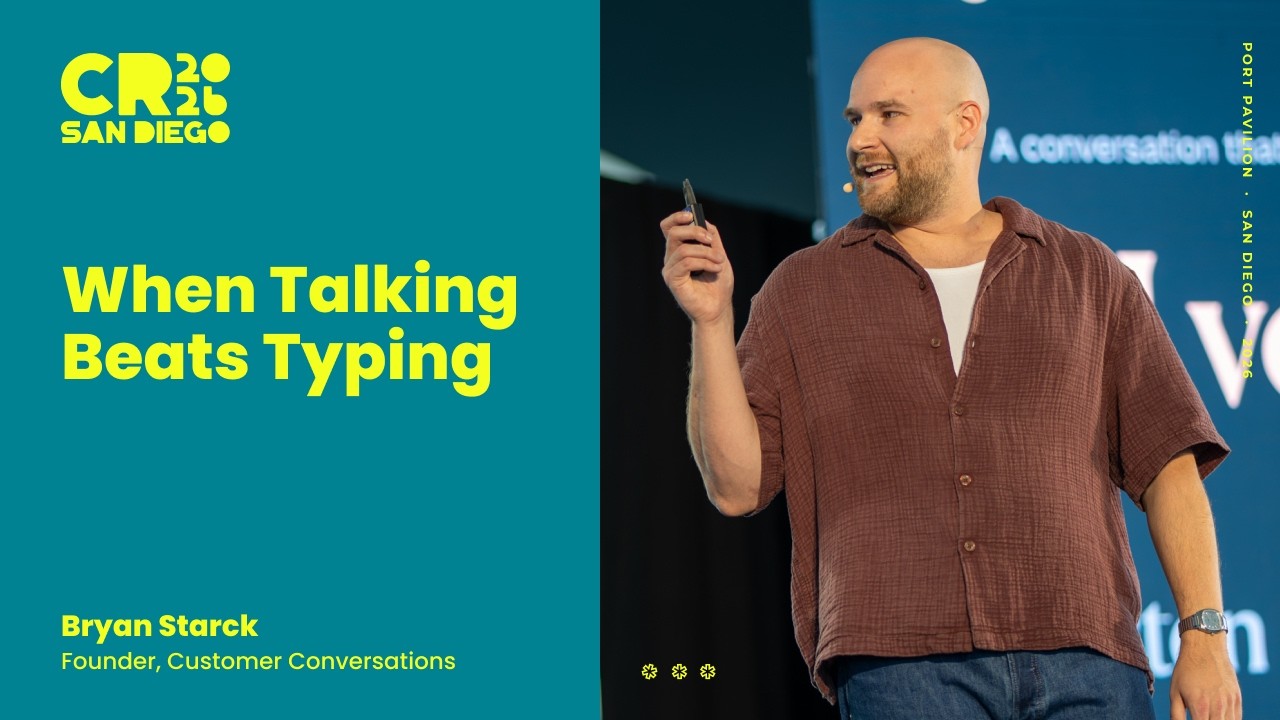
Bryan Starck shares three practical uses for voice AI in ecommerce: customer interviews, real-time support, and helpful sales conversations. Includes customer examples, a product concierge demo, and audience Q&A.
Bryan Starck shares three practical uses for voice AI in ecommerce: customer interviews, real-time support, and helpful sales conversations. Includes customer examples, a product concierge demo, and audience Q&A.
For ecommerce founders, retention marketers, and customer experience teams exploring voice AI for customer research, service, and conversion.
Recorded at Commerce Roundtable San Diego 2026, including customer audio examples, a product concierge demo, and audience Q&A. Results are Bryan’s reported client experience. Chapter times follow the publisher’s YouTube description.
Speaker roles and platform examples reflect the session’s original context. This is an archived conversation.
Explore vague responses to uncover the specific experience behind a cancellation reason or product complaint.
Read this part · 08:21 ↓Turn interview language and motivations into inputs for creative, product, partnerships, ecommerce, and customer experience.
Read this part · 12:42 ↓Look for recurring issues where an immediate conversation can prevent a simple request from becoming a larger problem.
Read this part · 14:46 ↓Use product information to build a prototype, try realistic customer questions, and refine its instructions before release.
Read this part · 22:28 ↓Offer voice alongside other channels and obtain explicit permission before using a customer’s words, name, or recording in marketing.
Read this part · 31:40 ↓A quick editorial guide to the key ideas. Read the complete transcript below for the examples, details, and discussion in the recording.
Original recording on YouTube ↗Bryan argues that talking often brings out more detail than typing into a survey, review, or support form. He introduces three applications for voice AI: listen to understand customers, resolve their problems, and convert shoppers through helpful conversations. Voice adds an option rather than requiring every customer to use the same channel.
Retention data shows where customers convert or churn, but it does not always explain why. Bryan describes how manual customer interviews produced valuable language and ideas but were difficult to schedule and scale. AI voice interviews became a way to explore those motivations across more customer segments and feed the findings back to the team.
Bryan describes interviews across new customers, VIP subscribers, and churned customers. In a sleep-product example, a follow-up question turned a vague flavor complaint into a specific bedtime friction: the sweetness made the customer feel they needed to brush their teeth again. Repeated flavor feedback helped the brand prioritize a new flavor, according to Bryan.
A college coach buying a safety product for his team revealed insights about appearance, gifting, emotional reassurance, and purchase justification. Bryan explains how the conversation could inform creative, ecommerce, conversion testing, partnerships, affiliates, and customer experience. Capturing the interview is only part of the work; relevant teams need to receive and use what it reveals.
Bryan presents voice support as a way to handle issues such as address changes before fulfillment, order questions, and subscription adjustments without a long email exchange. Real-time follow-up questions can clarify whether a customer wants a flavor or quantity change. He recommends looking for recurring, time-sensitive issues where a short conversation could improve the resolution.
Voice can support product selection, abandonment recovery, and win-backs by answering the shopper’s actual questions. Bryan shares a lapsed-customer interview incentive follow-up with a reported 20.3% placed-order rate. That example combines the interview, an earned incentive, and follow-up; it is not a controlled estimate of the impact of voice alone.
Bryan walks through a HexClad demonstration built from public product and support information. He gives the agent a clear job, tests a conversation, adjusts instructions, and demonstrates questions about the shopper’s cooking needs. He describes reaching a useful draft in about thirteen minutes while explicitly saying it would need further work before production.
Bryan suggests choosing one use case by asking where the business lacks customer understanding, where delayed support creates problems, or where a conversation could help a shopper buy. Customer clips illustrate positive experiences with clearly disclosed AI. He emphasizes giving customers the option to talk rather than disguising the agent as a person.
The Q&A covers product validation, voice alongside chat, AI disclosure, completion rates, and customer audio in marketing. Bryan says he does not have before-and-after CSAT data for these research conversations. He recommends combining interviews with other validation methods and describes asking explicit permission to use a customer’s name, words, and audio before repurposing it in ads.
From the transcript supplied by Commerce Roundtable, with filler words removed and paragraph breaks retained for readability. This source does not include paragraph timestamps. Refer to the recording for exact wording and the session guide above for chapter times.
The supplied transcript includes the replay sponsor message, customer audio examples, product concierge demo, and audience Q&A. Brand names, figures, and other transcription variations are preserved from the source; refer to the recording for exact wording.
Original recording on YouTube ↗What is going on everybody? It's great to be here with you today. If-- My name is Brian Stark, if we haven't met. And to, get us kicked off, I'd like to do a little exercise with you. I'd like for you to think about a product that you really love. Maybe it's your own, maybe it's something that you drink every day, it's a piece of clothing in your rotation each week, maybe just something you keep coming back to and buying over and over again, right?
So picture that product. Now, imagine that a good friend of yours comes up to you and they ask you what you think about it, because they're thinking about getting it for themselves. How, ... What, what do you like about it? What would you change? How'd you find out about it? Do you think it's a good s- fit for their situation?
You could probably have a pretty good conversation about that, right? And ten minutes, I would imagine, could go by pretty quick talking about that product. Now, the question I have is, if we were to transcribe that ten minutes of talking with a friend, how many pieces of eight-and-a-half-by-eleven pieces of pap- paper would that fill up?
Any ideas? Sixteen. Sixteen. Maybe if you're from New York, maybe. But, any other ideas? One, two. It would probably fill up about four pieces of paper. That's a lot of feedback. Now, imagine that that same friend, instead of asking you in conversation, they sent you a text, and they asked you to share your feedback on that product with them over text.
How much of what you had talked about in a ten-minute conversation would you personally be willing to type out in text? Ten percent? Twenty percent? If it was me, I'd probably be none of it 'cause I'd forget to text back. the crazy thing is that you would have had the exact same experiences, the same story, the same thoughts, the same opinions, but how we ask changes how much we get to hear.
And if you're like most people, you would have probably shared a lot more feedback, a lot more context with that friend in a real conversation than you would have texted. And the reason for that is pretty simple. It's that talking is easier than typing for most people. If you're anything like me, there's a, there's a reason why you spend most of your day now yapping into Whisperflow or into Willow Voice.
Like, I spend most of my day now working not at the keyboard. I'm talking. And the same thing is true for your customers. For most of your customers, talking is easier than typing. But even though we know this, we still ask our customers to give us feedback on hard mode. Want to share your experience about your brand?
Fill out this review. Submit this survey. Need help? Here's an email address. You can contact us there. Want help choosing a product? Maybe you have an on-site chatbot, right? But the truth is that how we ask, again, changes how much we get from our customers. And so all of these things are great, but what I'd like to pose for you today is that in addition to making customers type at you, that we consider giving them another option, which is let them talk.
And so that's why I'm so excited about AI voice. I really think that this is one of the most under-leveraged and unappreciated e-commerce AI applications. And today, I'd like to give you three places in your business where I believe this can make a really big difference. So one, it's listening to your customers better, understanding them.
Two, I think that you can use AI voice very effectively for customer service, for resolving their problems. And then three, it's convert. How do we give them the confidence to buy today? And my goal for this talk is very simple. So three things. One, I want you to hear what's possible with voice AI, because I think a lot of you probably are still thinking about this, based on your last experience talking to Geico like six months ago, where you were just yapping into a, a microphone saying, "Representative, representative."
And I promise you that it's getting a lot better than this, and I'll give you some clips where you can understand and see the difference for yourself. Two, I wanna give you a really practical place where you could start with voice AI. This is not that complex. There's definitely some technical knowledge needed, but I'm gonna show you an example of how you could actually build out an on-site product concierge for your store in just about 15 minutes.
And then number three, I'd love for you to walk away from this talk with at least one area of your business where you could identify where you could put voice AI to work. And at the end of this talk, I'm gonna give you a starter kit you can download, give it to your AI assistant of choice, and it'll walk you through, preferably on voice mode, what the best starting point would be for your brand.
All right. So before we get into the practical applications, I do wanna tell you a little bit about my story and how I'm up here talking about voice AI to, AI to begin with because, for the last five to six years, I've had the opportunity to run a retention and subscription consulting business called One Hundred Celsius.
And we've worked with some amazing brands, some of us here in this room, very serious companies scaling up, using subscriptions, smart operators, and we have lots and lots of data, okay? We can see what pages convert better or have a higher subscription take rate. We know where people are dropping off on subscription, where they're churning.
We see what they're saying in the cancel flow. We know what offers or funnels tend to produce higher LTV at three, six, nine, twelve months. But even with all this data, we still had a little bit of a problem, which is that we don't always know why they behave this way. We see what's happening, but we don't always know why.
And then based on that why, we don't really know what we should change or prioritize. There's 50 different things that we could test. Everything has an opportunity cost. But what is gonna give us the confidence to know what we should test next? So last year, my company and I, we started doing something a little bit different, ultimately very basic, but we started calling our clients customers.
And this was a very enlightening experience for me. if you've ever done customer interviews at any volume before, you probably have a good idea of how this went. We got amazing conversations, right? We got so much good insight, great customer language, really good ideas for retention, for the subscriber portal, great creative angles, all kinds of good stuff.
But the reality was that keeping these conversations going was absolutely brutal, right? If you've ever tried to do this, you know exactly what I'm talking about. Your customers don't wanna talk to you when you wanna talk to them. They wanna talk at, like, eight o'clock on a Saturday night or, like, seven in the morning on Sunday.
And it's really hard to get people on the phone. You have to cold call them. The people that you do schedule, you ultimately get, like, fifty percent no-show rates. And then you sit here with five to ten conversations that you've done, thinking, "Well, that sucked. It was really good talking to them, but I have no idea if those five to ten people were in any way representative of my larger customer base."
So it's hard. There's a reason why most brands don't do it. But that was actually what got me interested in voice AI to begin with because I started thinking, "Wait a minute. What if we could do these customer interviews that were so valuable, but we could use AI to do it and maintain a similar level of quality, but just do, like, a hundred X more of it?"
And it turns out that the answer to whether we could do that was yes. And that's why I am so excited about this because now every Shopify brand in here can actually has the opportunity to offer voice as a modality for your customers w-- to engage with you. So I wanna give you a, a three practical application buckets for how you could actually use this technology in your business.
We're gonna start with Listen. This is where Customer Conversations fits, my new company. And just for some context, we do at scale customer interviews using voice for e-commerce brands. So we're sometimes talking to fifty, a hundred, two hundred, five hundred customers a month, seven days a week, using voice, across all of the segments that you care about, VIP subscribers, churn customers, new customers, specific product feedback.
We recruit them over, email, SMS. We run the conversations, and then every single day, we're sharing the insights with teams so that we can extract all the great nuggets from those conversations and put them to use. And I wanna give you an example of how you can actually use these types of insights, specifically from voice conversations that you wouldn't really get in a type form or a post-purchase survey or a cancel flow.
One brand that we work with is a, fast-scaling functional pouch brand. And they wanted new feed-- they wanted feedback on their new sleep product. Flavor wasn't really cropping up in their cancel flows or their early Typeform surveys that they were sending. What was interesting is that when we started doing customer calls with buyers of this new product, flavor was coming up a lot.
It just wasn't coming up in the first responses for customers. We had to go one level deeper. So I wanna give you an example from one of the conversations that we ran so that you can see what this looks like, and pay special attention to how the voice agent was able to drill down on a vague answer and get at the deeper reason why this was, not a fit for him
All right, I hope you're enjoying the replay from Commerce Roundtable. I wanted to stop you for just 30 seconds and tell you all about the sponsor that made this happen. I see too many Shopify brands overpaying for big email tools and using only a fraction of their features. We're tired of complexity and never-ending price hikes too.
That's why Seguno Email is different. Lives inside of Shopify and uses your shop live data, not a synced copy of that. Plus, integrations with Sidekick, ChatGPT, Claude, and Canva saves you time. And get this, Seguno is the only email app to win a Shopify Build Award. Sounds interesting, right? Switching is easy, and you get 20% off for being a part of the Commerce Roundtable community.
Link in the show description. Now back to your replay. That's good to know. Consistent effect when you do use it. How about the honey lemon flavor? What did you think of that? It's okay. Not my favorite Not your favorite? What is it about it that doesn't quite hit for you? Is it the taste itself, the sweetness, something else?
I think a combination of the taste and the sweetness. maybe tastes a little artificial, and maybe 'cause the sweetness makes me feel like I definitely need to brush my teeth after using it
So it's okay, it's not my favorite. That's like the quintessential response you'd get in a cancel flow, right? It's like, "Yeah, it's too expensive. Ah, I've got too much product." But if I can go to the next slide, because specifically this call was a dynamic voice conversation, our agent was able to pick up on that vague answer and go one level deeper.
So it turns out that for this customer, "It's okay, it's not my favorite," actually means the sweetness makes him feel like he needs to brush his teeth after using it. And for a bedtime product, that's not a really good experience The answer to that was one level deeper, and we couldn't get that in a form.
And so over the next couple of weeks running these calls, flavor friction kept showing up, even from customers who really loved the product and thought it worked great. And these interviews gave the team a lot of confidence on the product side to start accelerating some new flavors. So, for example, the CMO said, "We accelerated the launch of a new flavor this year because of this data.
Flavor wasn't popping up in our cancel reasons, but the interviews made it undeniable." One other quick example. We work with a great brand. They sell a personal por-- portable safety product for women. And one of the VIP customers that we talked to pretty early on was a male college volleyball coach. It turns out that every year, he buys this product for every single player on his team.
And we had an amazing conversation, twenty-five minutes with this coach. He told us all kinds of great things. He told us about how his players were super fashion conscious, so what the device looked like mattered if they act-- if he wanted to actually have them wear it. He gave us some amazing emotional language about how he feels a sense of relief and satisfaction when he sees his players walking into practice knowing they have that extra layer of protection.
And he gave us a really interesting insight, which is that this product specifically is much easier to justify to the player's parents because it can't be turned against them. How much of that do you think we would have gotten in a review or a survey form? No, it probably would have been a very abbreviated version.
But because we were able to have a real conversation with him, we were able to create an amazing amount of ammunition that fed, like, six or seven different teams at this company, right? Imagine what you can do with that one conversation. The creative team now goes and starts leaning into team gifting angles and ads or other creative.
E-commerce goes and tests an advertorial. Why this product is better because it can't be used against you. CRO focuses on how it's carried, how good it looks. Partnership starts exploring coaches and team purchases. Affiliates, they go and recruit the coach and the team for content. And the CX or the suite suite, they now personally can follow up with a super VIP and create an amazing hospitality moment.
Okay, one conversation feeds eight different teams at the company. Now multiply that by a couple hundred, and you've got a really compelling new growth engine So that's listen. I think this is a really cool bucket, but it's one of three that I think is gonna be very transformative for e-commerce brands in the next couple of years.
Second one is resolve. This is customer service. This is your customers have a problem, and instead of forcing them into a written help, why not give them a phone number that they can call and get their issue handled in real time? Now, phone support is of course not new, but e-commerce brands have typically needed a pretty compelling reason to offer this for their store, right?
Maybe you are selling really high ticket products, and like tractors or farm supplies. Maybe you- your customers are much older, and they really want that phone support. And, we don't really do it always because it's just a lot of work, right? We've got to hire, we've got to staff the people to do it.
We're sometimes, we're dealing with accent differences. You have to train them on your SLAs. You've gotta cover nights and weekends. So it's a lot. And what do we do instead? Well, we just give them an email address to reach out to. And what happens here is that customers with immediate problems, often very simple problems, that could explain their problems in 20 to 30 seconds, they end up waiting for help, and simple issues with a simple resolution turn into bigger problems Now, there's a lot of great vendors out there that actually now offer AI voice phone support for customer service.
one that we hear a lot of good things about is called Flip AI, and they recently published a case study, for a beauty accessories brand that, like a lot of us, they have about an hour in between when an order is placed and then when it goes into fulfillment, where changes are a lot easier to make.
Now let's take a example of somebody who entered the wrong address at checkout or they need to make some other change. If they send an email and that reply comes too late, you would now again have a simple issue with a simple resolution that turns into a larger problem and creates a poor experience.
But what if instead of just email support, we also gave people a phone number to call? Now, she could call in, the agent right there on the line can check the order, can update their address, and confirm it's handled right there on the line. Again, if an issue can be solved quickly and easily over the phone, why make people wait in an email queue?
And I think that there's a lot of other-- so many other use cases where voice as a modality is gonna be a great fit for customer service. Subscription cancellation requests. "Can I add my order?" "Where is my order?" "Can I switch flavors?" I think a good diagnostic to think about where voice could potentially sit for customer service is two things.
So one, where do customers have recurring time-sensitive issues, right? Where waiting for an email response is gonna be a lot worse of an experience for them than being able to call up and get their issue handled on demand. Second, and I think this is very specific to voice, is where would a couple of in real-time follow-ups change the way that you resolve somebody's issue?
Cancellation for subscription is a really good example of this. you know, we have so much subscription experience, and what we see oftentimes is that brands will try to approximate the cancel flow in their customer service follow-up. So they'll have all these SLAs and, you know, somebody will say, "Cancel my subscription."
You'll respond back, "Why are you canceling? Is there anything we can do to help?" And you ultimately just kind of end up pissing a lot of customers off, right? But what if instead of just putting them into an email queue, we could give them a phone number to call, and then right there, we could create a dynamic cancel flow where somebody says, "Cancel, I have too much product."
We ultimately find out that they have too much product because they tried three flavors at checkout and only liked one of them. So they don't need a cancellation, and they don't need a delay. They just need a flavor adjustment or a quantity reduction, right? So I think that there's gonna be so many more applications for this in customer service.
Really, really compelling use case. Okay. So we talked about listen. How do we understand our customers better? We talked about resolve. How do we solve their problems? Now let's talk about convert. The big idea here is scaling up the availability of a helpful sales conversation for your shoppers. Now As marketers, we do our best.
We are thinking about hyper-personalization. We're thinking about how do we segment our messages, how do we line everything up? But if you think about it, all of the hyper-segmentation and the personalization that we do as marketers is ultimately kind of just trying to approximate the experience of walking into your local store, there's somebody behind the counter, and they just say, "Hey, how you doing?
How can we help you today? What's going on in your life? What are you looking for?" It's very basic. And u- until now, we haven't really had a tool that could effectively approximate that experience in real time. But now we do. And with voice, we can scale up these helpful sales conversations across the board.
There's actually, another company here at Commerce Roundtable, Outcraft.ai, and they do this. They focus on cart abandonment, win backs, conversions. Definitely a good, a good one to take a look at. But a couple examples of how this could play out. So imagine, I want-- We can talk about abandonment, right?
Every marketer's favorite thing. We've all sent, we've all sent emails like this before. "Had your eye on this? Get twenty percent off." Or, "We miss you. Come back, get twenty-five percent off." And these are all great, right? Like, abandonment, it works. But like ninety, ninety-five percent of people don't come back.
Well, what do you do then? Do you know a good salesperson that just keeps slamming discounts at you? No. Like, a good salesperson would not just hit you with offer after offer. They would actually try to find out what was holding you back. And so maybe a better way to handle abandonment might look something like this.
"Still deciding? Let's talk about what's holding you back. Get fifteen dollars off your next purchase in exchange for doing a five-minute conversation with our AI product guide. Let's talk." They click a button, they go to a little page, they enter their phone number, click Call me now, and they have a great conversation, right?
Five, ten minutes go by. The concierge helps them figure out what's gonna be the best fit for them. That handles any objections live on the call. And then either on demand via text, via email, follow-up, they send the, the discount and a link to check out, right? This is possible right now. And imagine what that could do for the conversions of the people who get to opt into this.
I know this works because even at customer conversations where we're explicitly not really doing sales calls, right, we're doing customer research interviews, our incentive delivery flows still typically turn into the highest converting Klaviyo flows in our clients' accounts. This is a protein bar brand, and we were interviewing lapsed customers for them, so people that hadn't come back in three to four months.
Look at the placed order rate on this follow-up flow, 20.3%. This is like five times higher than the conversion rate of their abandonment flow or their welcome series. And it's not even with-- it's without even trying to sell them. This is just a combination of the pre-frame, getting people talking five, ten, fifteen minutes about the product, an incentive that they now feel like they've earned.
They've done something to earn this incentive, and then just a simple follow-up, "Hey, go ahead and use it." So I really believe this is a super compelling use case. again, already some really good vendors you can look at. But now I want to show you an example of how we could bring this to the front end, right?
So we don't have to wait for people to abandon cart or to fail to come back. What about if we could create an on-site concierge that helps people figure out the right product for them while they're still shopping on your store? So I promised at the beginning of this talk that I would give you an example for how you could set this up in about fifteen minutes.
Eleven Labs, they're a great company. They're what we use to build our voice agents off of. And they recently, literally just this last week, they come, came out with this company called Reception.ai. And that's the whole point of it, to help companies build on-site product concierge, appointment booking, things like that.
But there's some really cool applications for e-commerce. So I wanted to test it out. I went to their website last week. I signed up for a trial, and I thought, "Let's see how quickly I could get to a workable first draft of this." And so I picked a brand that we all know and love, Hexclad. I signed up for a trial, and I put their website into the, into the onboarding box, and then I hit Continue, and that was the simple first step Two, three minutes later, the, the AI algorithm did its work and came back with a surprisingly good first draft.
It had scraped a hundred and forty-nine products from their site. It had taken fifteen public pages, and it had done a lot of back-end wizardry of things that I hadn't even considered, like, you know, scraping some FAQs and public support policies, et cetera. So, like, three minutes in, really good first draft.
Then all you gotta do is go give it a job. So in this case, I said, "Hey, I want you to be an on-site product concierge for Hexcloud. I want you to have helpful conversations with customers who call in and guide them towards the best product for their use case." So find out how they cook, find out about their family, where are they coming from, what types of things are they looking for, and then guide them to the right product for them.
This is about five minutes in. and then basically all you gotta do is just try to talk to it, see where it fails, and then make some tweaks. So I did one call. It was pretty good. I went in, tweaked the instructions a little bit. I updated the model, and then I had a second call at, like, literally thirteen minutes from signing up for a trial.
And here's what we got. I wanna play the first minute and a half or so of this exchange and pay special attention to, how this agent was able to ask me some diagnostic questions to help recommend the right product
Hi. I'm an AI product guide for this Hexclad demo. What can I help you with? Hey there. so I'm trying to figure out what to buy from Hexclad. I've been-- You have so many different products, and I know you have different sets and different pans, and I'm feeling a little overwhelmed. Could you maybe help me figure out what would be the best fit for my situation?
Happy to help narrow it down. Are you mainly stocking a kitchen from scratch or looking to add a piece or two to what you already have? So we have, kind of a full set of pans and pots, but they're old and they're like non-stick. We're feeling pretty concerned about forever chemicals and just, looking for a cleaner option.
So I am considering just completely overhauling my kitchen and with all of our pots and pans, but a little bit concerned about how expensive that would get. That makes a lot of sense. A full swap can add up fast, so a bundle is usually the better value than buying pieces one by one. A couple of options that come to mind, the hybrid pots and pans set twelve piece at six hundred and ninety-nine dollars, which covers most everyday cooking, or if you want just the fry pans first, the hybrid fry pan set with lids six piece at three hundred and ninety-nine dollars.
Roughly how many people do you usually cook for? And do you do a lot of stovetop to oven cooking or mostly basic stovetop? It's not bad for 13 minutes in, right? You wouldn't put that into production without doing anything to it, of course. But I just want you to see that this does not take a rocket scientist to spin up something that's workable for your brand This is a really, really cool application.
I think if you're looking to get started with voice AI, this might be a good place to start. So, we've talked about three buckets: listen, resolve, convert. Where should you start? Well, I ultimately believe that, you could probably find opportunities in each one of these buckets if you run a brand. But a couple of diagnostic questions to help you figure this out.
So one, listen. What decisions are we making? What tests are we prioritizing? What investments are we making without really understanding why our customers behave the way that they do? Great opportunity for listen. Resolve. Where do we have recurring customer service moments where waiting for help oftentimes turns simple issues into a bigger problem, and where a couple of on-demand, in real-time follow-ups could change the way that we resolve their problem?
And then convert. Where could a helpful conversation give someone the confidence to buy and the confidence to buy today? So I'd pick one use case, get started, see how it goes. But there's probably one question that I think a lot of you are still asking, an elephant in the room that I don't think we've fully put to bed yet, which is basically, are my customers actually gonna enjoy this?
And I would forgive you for thinking that they wouldn't enjoy it because a lot of us have had pretty negative experiences with voice AI if we've been-- if we've tried it through, like, you know, a travel agency or your wireless company. And none of this is actually exciting if it's just gonna give your customers another frustrating thing to deal with, right?
So I just wanna leave you with a handful of clips from customers at the end of our conversations describing how the experience went. Give it a listen No, Sam, I think that you are one of the best AIs I've ever spoken with, and I wish you a very great rest of your day I appreciate it, and you are a great AI agent
You are a very sophisticated AI, and you've responded very, very, very nicely I would say you sound like a nice person, but since you are a AI, tell the company thanks for the opportunity You know, this, this, knowing that you're an AI just absolutely blows me away Yeah, I love seeing those. Clearly all of these people know they're talking to an AI, right?
We're not trying to hide it. It's all disclosed. And yet, at the end of these conversations, they're still thanking the company for the opportunity. Talking is easier than typing for most people. That's just the truth. But for ages, we've only given people the option to engage with us and share with us by typing.
And that's why I think that we get clips like this every single day from customers who have never been invited to engage with a brand this way before and really appreciate the opportunity to verbal process, to share their feedback, to have a twenty-five-minute conversation with a company that they love or one that they have some constructive feedback for, instead of just being directed to a feedback form.
So I would really encourage you, not only could this be beneficial for your business, whether that's in listen, resolve, or convert, but it could also be something that your customers really appreciate that you offered. So guys, thank you. I, have that AI voice starter kit that you can download. So if you want to, figure out how this could apply to your business, go ahead and scan that.
give that file to your AI assistant of choice, and, it'll walk you through how to get started. One quick closing thought. So if you remember back to the beginning, you'll remember how much feedback you would have shared in a transcribed ten-minute conversation and how much less you would have shared by texting.
There's so much gold in the stuff that you wouldn't have shared, right? The stories, the new ad angles, the hooks, the emotional language. Your customers have all of that too, just locked up in their brains. You're just not getting it right now because you're not asking this the right way. So I would encourage you, give them the option to talk and go get that gold.
Thank you very much.
Hey, camera guy, throw that box to this guy in the front Catchbox on the right Check, check, check, check Yes. Can you hear me? Louder. Go louder. Check, check. There you go. Good. do you have any data on CSAT scores prior to, and after implementation? You know what? We don't- Rep- repeat the, repeat the question back, please.
yeah. So we asked do we have any data on CSAT scores before and, and, after implementation. You know, not... frankly, not really. we, we typically ask NPS, but we're not really tracking CSAT in the same way just because these are more research conversations, not super tied to their customer service. but what I can say is that the vast majority of people that do these engagements and these conversations with us, it's either, like, neutral to positive, and it's only a small group of people that have an issue with it, it being AI.
But yeah. S- so the... It's funny because the people that are, like, commenting and complimenting the AI, for sure, like, 40, 50, 60 plus. Yeah. Right? Like, I think the... This, this is the thing that I go back and forth on in this specifically is will it act companion-like? And, like, will, will the brand... And I, I'm, I'm trying to debate this across some of the brands that I'm close with is, like, will there be, will, will there be real relationship built with my AI customer service person from people that have, like, maybe bought from me a couple of times?
It's gonna get pretty one-to-one, right? Right. I feel like, I feel like where this is going is gonna get weirdly one-to-one. Yeah. And I... what, what makes me nervous about doing so, 'cause we, we have an AI, like, autoresponder on o- one of our brands, and I'm like- Dude, that's not real. Like, I know it's not real.
Like, I'm watching it happen in real time, but it's serving them, it's answering questions, and it's not deceiving. Like, it's not saying or trying to be like Susie from Breeze or Susie from this. It's just, like, having a real conversation. Right. And no one really asks the questions. How-- Where do you feel about this?
'Cause you're obviously seeing a lot more shit than I am. Yeah, yeah, we, we've had some interesting e-interactions, people asking to take our interviewer out to dinner. You know , like some, some really interesting things. - What? Yeah, yeah, really. It's-- You know what? It's crossed the uncanny valley kind of, right?
Like, it's really, really good. It wasn't that good eight months ago, but it's getting good, and it's only getting better. - Yeah, read the, read... You can go top to bottom on those. Some of those questions. Yeah, so I mean, I, I feel a little bit... Here's what, here's what I'll say. There's a lot of people that haven't had somebody to listen to them in a long time.
That's a good point. Right? And if you can offer that to them, and it's a helpful thing for your business and for them, this is a great modality. So you want me to go through these? Yeah, go ahead, man. Okay. Mary: "Is there AI voice support agent platform that can not only answer the customer questions but also send them the link to the right products to purchase?"
Yes, definitely. Even some here at this event. I, I mentioned, you know, like Flip AI and some of these other ones that you can look into. Outcraft, Consio, Callsy. There's a number of services that, will not only do the technology for you but actually help you with the service and the setup. Dope. - Steve, yeah, you can go one by one
yeah, how do you, how do you recommend testing... Oh, yeah. How do you recommend testing a new product before committing to an MOQ order? Customer interviews, surveys, pre-sale pages, pre-orders, something else? I mean, kind of as much of it as you can, right? I think that, surveys, y- we... I think pre-sale, pre-orders, these are really great, right?
Can you just get somebody to buy it and pay money for it? Great indicator that this is gonna do well. Surveys are awesome, too. You can cover a much wider ground, but you sacrifice a little bit of depth, right? You get a lot of surface answers. You get a lot of, "Would you be interested in this, yes or no?" You get yes, and you're like, "Okay, how much confidence does that give?"
And so I think that customer interviews is oftentimes the missing piece. we try to do it, but then we talk to five to 10 people, and we're like, "Well, I don't know if that actually is representative." But if you could talk to two to 300, now you have a lot more confidence directionally. Well, plus if you're doing this is, like, the be- the best use is when it's talking to your subscribers.
Like, that's, that's when you and I started talking about it- Right, right ... and you're like, it's mostly applicable for those that are either just about to... like, they've just canceled, or they've been with you for a long period of time. Like, why are you with us? 'Cause then you get to start building it. 'Cause what, what I've started to learn is, like, you have, like, outer s- outer signal persona building, and then that's, like, customization of who's coming through.
Right. Then it's layered on top of, like, calling the customer so then you can validate, like, this is what it, the data says who my potential avatars are. Mm-hmm. Then this is actual information and data from my real customers, and you kinda, like, have to, like, put it together, and then I can start building ads or pages- Right
or concepts. Right. Right. Exactly.
Yeah. -huh. Yeah So much better And it's so nuanced. It's also very nuanced too. Well, and it's just like you... I mean, verbal processing is just like you are gonna get so much more of the useful stuff, right? The stuff that like what's gonna go on to become, you know, your top-performing static ad in the ad account.
It might just be like a throwaway line that somebody says in ten minutes into a conversation, right? But right now, like, there's no systematic way for most brands to extract the value from the conversations and the qualitative research they're doing, nor, like, share it with every relevant team. And so I think that that's kind of the missing piece.
It's not only doing the conversations, but extracting the value and then syndicating it across the org. Go ahead, hit that top one. Does voice AI replace? Yeah. Does voice AI replace chat support on the site? If not, isn't that going to give too many options to the customer and reduce interaction? Yeah, I mean, I think, you know, I don't think it necessarily needs to replace it.
I think it could work in tandem. I like the option of-- I like giving people the option to choose whatever they wanna do best. So, like, I would actually imagine, like, a little widget, you know, that's like, "Hey, chat with us or rather just do a call and talk to somebody or talk to our, to our product rep.
click here and then enter your phone number." So I think that there's a way to do both. They, they serve kind of different use cases, different types of people. Not everybody's gonna wanna engage with the chat, just like not everybody's gonna wanna go in-- gonna wanna talk to AI. All right. do you see a high noticeable drop-off rate at the moment you disclose that it's an AI agent?
Yeah. So of all the drop-off moments, that's the one that is the most prominent, right? it's actually a lot less than you would think, though, because we do a, a really good job. I think it's a lot of how you structure the warm-up sequence. You know? So it's like you disclose it, it's AI, but then you just get them talking, right?
You ask them some easy questions, you design the flow of that conversation to, ... And the, the questions you ask in the confirmation to kind of get them over the hump, and then once they're in the groove of the conversation, most people complete it. We actually see a, about a seventy-five percent call initiation or, like, call initiate and get past that first moment to completion rate.
So of-- If you get past that, about seventy-five percent make it all the way through a five, ten, fifteen-minute conversation. Brian, start. Oh, yeah, hit it. We got one more? Is there a way to leverage this stuff for, like, voice reviews? Yeah, absolutely. But where would you put it? Where would you put the voice reviews?
On the ads, like, "Listen to what our customers say about the-" Oh, that's, that's a great- Yeah, yeah ... that's a great idea. Or voiceover ads, right? Too, yep. Yeah. Right. Like, you know, you, you use customer language that's been consented, and then you put some B-roll under it, and you slice it up, and it's a really cool, high-converting ad creative.
I feel like you could do, like, AI cartoon, and you'd be like, "This is a real customer and a real voice." Yeah. And then they're just- Like, you're watching, what are the claymation or you're watching just a not real human do it, but it's still a real human voice. That makes it totally- Yeah, like a great, a great use case is for a lot of our clients, we do five-star review follow-ups.
So somebody that leaves a five-star review on the store, we send them an email or a text afterwards, and we're like, "Hey, listen, thank you so much for giving this review. We know that this review box can't hold all of the feedback that many of you would like to share. So if you'd like to share more, here's a great option to do that."
And then we'll get 5, 10, you know, 20, 30-minute conversations, and at the end when we ask them, "Hey, would you be okay with us using your first name, your words, your audio in marketing?" Eight times out of 10 they say yes, because they're really happy. So then you can take those, they're consented, and then use them however you want.
Hell yeah, dude. Yeah. Thank you, Brian. I appreciate your brother. All right. Appreciate you guys.
Join Commerce Roundtable in 2027 for focused learning and conversations with people working through the same challenges.