 42:13
Austin · 2026
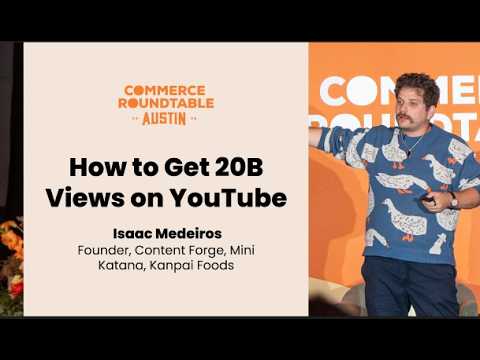
Isaac Medeiros shares lessons from building Mini Katana’s YouTube audience. He covers hooks, audience fit, content funnels, and ways to connect organic attention to commerce.
Isaac Medeiros shares lessons from building Mini Katana’s YouTube audience. He covers hooks, audience fit, content funnels, and ways to connect organic attention to commerce.
For ecommerce founders, marketers, and operators working on creators & social commerce.
Speaker roles and platform examples reflect the session’s original context. This is an archived conversation.
Evaluate whether viewers stay to watch and whether the content holds their attention.
Read this part · 04:01 ↓Build awareness, education, and conversion content that works together.
Read this part · 06:24 ↓Use a distinctive content advantage and measure commercial impact beyond views.
Read this part · 13:09 ↓A quick editorial guide to the key ideas. Read the complete transcript below for the examples, details, and discussion in the recording.
Original recording on YouTube ↗Isaac explains why the opening of a Short matters so much. A video needs to stop the swipe and then sustain attention. He pairs those performance signals with an understanding of the potential audience, warning that enormous reach is less useful when it comes from people who have no connection to the product.
Different videos do different jobs. Some introduce the brand’s world; others explain products or help someone decide to buy. Isaac describes a flywheel in which organic reach supports later conversion. Platform-specific discovery behavior also matters, so a successful distribution strategy is more than posting the same clip everywhere.
The VRIO framework asks whether content is valuable, rare, difficult to imitate, and supported by an organized operation. Isaac connects that defensibility to brand relevance. Post-purchase surveys and YouTube Shopping provide additional ways to assess commercial impact, while AI can accelerate execution without supplying the central creative idea.
From the recording’s auto-generated YouTube captions, with filler words removed and paragraph breaks added for readability. Names, numbers, and wording may contain caption errors; refer to the recording for exact phrasing. Chapter links jump to the text below.
Original recording on YouTube ↗0:00All right, David. You're good. >> Yes, sir. >> Thank you, guys. All right, so question before I start, who's made a YouTube video before? Personal or business? Very small sample size. I always start with that question because it's it's funny how little exposure brands usually have to organic YouTube, despite it being the biggest channel to reach net new audiences on the planet. Like YouTube just has more reach than TikTok. It has more reach than Meta, [snorts] and it has more reach than television now, too. It's not even competing directly with the other social networks.
0:36It's competing with television head-to-head.
0:41a little bit about me for background. 5 years ago, I started a brand called Mini Katana, and I had the bright idea to basically sell letter openers that look like samurai swords on the internet. The domain name was minikatana.com because you know, they look like little katanas. and long story short, the business worked. And I went the traditional route of advertising on Meta, did a lot of statics, and it worked so well, I maxed out my credit cards, begged all my friends for money, and bought a lot of inventory.
1:13Unfortunately, to no one's surprise except myself, Meta banned the ad account and said I was selling weapons.
1:18I was pretty desperate, and in my desperation, I started making TikToks. I was an early consumer to the app. this was very late 2020, so it was during the pandemic, and I had become addicted to the scrolling, and we got a sale on our first three videos. I was like, "That's That's interesting, right?" Like, I didn't even put a link in the bio. Like, I just said minikatana.com. It was a really crappy video, but I made another video and sold out the entire store, and we were in business.
1:49Everything I do today is a very extreme version of that. 2021, I spent that year scaling on We went from one to 1 million followers, grew the business to our $2 million in revenue, and then year two
2:02the actual story begins because we launched on YouTube. Now, this was a big exercise in patience. You can actually see the history. This is the entire channel's views throughout main channel views throughout this whole history. On the left there, you can see that I actually tried launching earlier and got nothing. Like the views were so tiny that you can't even see it on the chart, right? And what happened was I had really two false starts before the third one picked up.
2:29And I relaunched it with a creative team. I hired a ex-YouTuber. We hired creators, and we were in business. This went on to become a top 100 global YouTube channel just by raw viewership month over month. 22 million subscribers over 40 over 3 years and 15.8 billion views by the end of 2025. Most importantly, it generated a lot of GMV through the life directly attributed post purchase post purchase surveys and YouTube shopping. I also went on to do the same playbook, but I had the bright idea to syndicate all the content and to a Spanish dub.
3:04This was pre-AI. I hired real humans to dub all the content. I know, crazy. You can now use AI for that, which is exactly what we did with this channel before I sold the brand. I did the same thing with a candy brand that I launched in mid-2024. This one was interesting because we weren't actually promoting things to go to a website. We were trying to direct traffic into our retail partners like Target. And you could actually see a one-to-one correlation when we went viral on YouTube, you see sell-through spike for that week inside of Target.
3:32And just for good measure, last year we entered a partnership with a travel company. They wanted to go viral doing off-the-beaten-path type content. Basically, they they have top destinations as Japan and Spain, Europe, etc. So, we launched with them with two two teams, one in Spain and one in Japan, and we did 9 million in the first 30 days. Now, I've launched a lot of other channels, but I'm not going to spend the time talking about this. We're just going to rush through the deck and then we'll go into Q&A.
4:01But, I want to talk about high-level the things that we look for in content, what I think makes a winning channel, and things going on in content this year that are really interesting. The first one is the biggest the biggest metric to channel success on YouTube for short-form strategy is easily your state-to-watch rate, right? And all of you're familiar with this. This is called the hook rate on Meta, or this is called a swipe rate. On YouTube, for whatever reason, they want to be original and call it a state-to-watch rate.
4:30On the top here, on the top right, this is real data from a channel. You can see that 78.6% state-to-watch, meaning the audience chose to stay to watch past the first 3 seconds at a 78% rate, resulted in a 10 million-plus view video. And a 63.2% resulted in a 1 million-plus view video. You can probably guess if it's under 50%, it kind of just flops. If I If I go look at a YouTube channel and I see that this metric is actually healthy and it's reaching that new audience, I think you have a viable channel and you're testing really good ideas. Next thing to work on is retention, right?
5:04But, this is a test of how good your ideas are. And if it's not If it's not hitting above 50% consistently, you should probably go back to the drawing board.
5:12The second concept I want to talk about is content having TAM. We all talk about product, and we all talk about services having a total addressable market. Content actually behaves in the same way. Media behaves in the same exact way. The highest TAM content possible is mass entertainment. And this is important because you can actually extrapolate out concepts into mass entertainment, but I'll get into that in Q&A. The biggest two notes here is is that it's more valuable to have people that are in your niche, aka be big in your niche, than have views of irrelevant audiences.
5:50That means if you're running a cooking brand you're going to want to reach people who are interested in purchasing that product which might be people running kitchens at home as opposed to everyone else, right? this is important especially important post 2022 when social graphs meaning how social media platforms recommend you content to individuals shifted from who you follow and your friends to be interest based. You've all experienced this when you log on to TikTok and you spend an hour scrolling it feels like the algorithm knows you.
6:19It's because it's gauging your interest based on metrics and it's putting you in brackets.
6:24Talking about my next concept content flywheels and content funnel. Just like any other form of marketing organic content has concept of awareness, education, and conversion. Right? On a brand new channel you're actually going to focus mostly on awareness because you're trying to drive audience in. But this is stuff that reaches net new viewers. everyone here knows that you know, you see somebody's maybe you're on Twitter and you interact with a really annoying account like you comment and you like the the tweet and now you're stuck seeing that person for the rest of the day. Right? That's the algorithm basically bringing you into their funnel.
6:59Middle of funnel is educational. So most of your brands here already make this kind of content. It's product stuff. even if the content is bad most brands still make it. And bottom of funnel is objective oriented. at Mini Katana what we do is throughout most of the year we'd actually make only top of funnel awareness. Meaning if you go look at the channel and sort by most popular we make very funny entertaining videos for everyone to see.
7:21And then when Q4 approached during end of Q3 we start loading up a middle of funnel and then during Q4 itself we do like salesy videos. Like we're having a sale. Hey, here come check it out. Gary Vee talks about this a lot. You give give give give give and then you get to do a take. Right? If you want to succeed with organic content you can't just ask for the sale. You need to actually give some sort of value that makes your content worth watching.
7:45This in practice, there's two brands that actually do this very well that most of you probably know of. Graza, on their Instagram, they make beautiful recipe content, memes and trends featuring the product. This is their top of funnel. Rhode uses a a little hack. they use Hailey's personal posts as their top of funnel. Middle of funnel might be creator tutorials or product-focused carousels. And bottom of funnel is team and product content tied to specific objectives.
8:10Maybe their objectives maybe they're promoting a pop-up, a giveaway, etc. Another way to think about it. On the right here, this is just a chart we have from [clears throat] one of our strategy decks. everyone moves through this cycle, right? They don't know your content exists, they've seen your content at least once, watch your content regularly, now they're die hard fans. Your goal is to get people all the way to the right. And this feeds into your funnel as well. You want people to start start at the top of awareness and then get to knowledge and then get to conversion. This also looks suspiciously like YouTube's metrics.
8:42If you look close into YouTube analytics, this is taken from a real channel. suspicious number. new viewers, casual viewers, and regular viewers. There's this percentage split down there. So, YouTube is actually measuring this for you and show you in analytics what matters. A healthy channel will have a really good mix of all these. If I go into a channel and I notice that there's not a lot of new viewers, I'll immediately start recommending them making top more top of funnel content. You're just not bringing enough people in. If there's not enough regular viewers, you're not doing things for the super fans of the channel, you need to do more of those.
9:12this was supposed to be a video, but this is a PDF, so that's messed up. but Isaac, my niche is boring. I say this to people, no niche is boring. The driest niche on the planet, any B2B niche is not boring. Only scripts and how you shoot the content and how you post-produce it is boring. That matters a lot. This was going to be a video of my friend Jared Orkin with Activate Talent, which is he's in the most boring thing imaginable, staffing.
9:39Right? And he made we we we wrote a script for him where we explained how the Skype founders offshored engineering talent because they were so broke and leveraged that engineering talent to build Skype and then exit it. Right? And that script went on to do 20,000 views and he just started on LinkedIn. 20,000 views within his ICP, which is like founders, managers, etc. and marketers. 20,000 views is a lot for a very business-heavy audience on LinkedIn. And again, it's because the content isn't boring. It's interesting for the audience that it's intended for.
10:12another concept that we like to talk about is people will ask, "Hey, >> [snorts] >> I'm a brand. Should I be making long-form? Should I do a podcast? Should I be making short-form?" The answer is almost always short-form. And the simple reason is syndication. Now, there's some other strategies you can run with long-form. I'll get into those as well, but generally speaking, one very viral short-form video may perform everywhere. Right? It might flop on Instagram, but it might do well on Facebook. It might do well on Twitter. It might do well on YouTube, etc. etc. etc. So, short-form just provides us ton of leverage. I think the other thing for everyone in this room is that short-form also equals stuff for the ad account. And that can also even be done in post-production if your team is savvy enough. You can add CTAs to the content.
10:58this is just my opinion, a general opinion on platforms in general. for TikTok, TikTok is not really an organic platform. And I started on TikTok, so I I still love the platform, but it's an affiliate platform. You've all seen Brock present. I don't know if he's in the room right now. Instagram, most content discovery happens in the DMs. That's a very important note because if you're trying to crush discovery on Instagram, that means you optimize for share rate. That's the most important possible metric on the platform.
11:29Snapchat, lowest value imaginable audience, young and for some reason very Arab. It's like the number one platform in all the Arab countries. LinkedIn, this is actually a really easy platform to win on because everyone Who here's on LinkedIn? Okay. You know what I'm talking about. It's all AI. Right? It's like crazy it's all AI. It's all bad. Everyone's low effort, which means if you make videos, guess what happens? It's refreshing. Effort, right? So, it's really easy to perform in B2B on LinkedIn if you're good at the video.
12:02X.com comments and engagements, articles currently ripping, brand new feature. Pro tip for everyone here. Every time a platform releases a new feature for organic content, YouTube just released multi-streams for mobile, if you focus on that feature, it generally gives you a giant push because they want to incentivize adoption. I made my career by being early to short-form. Other people here made their career by being early to TikTok Shop Affiliates, etc., etc. Facebook, heavily underrated. Let me explain why. Old people.
12:33>> [laughter] >> They spend money and they have attention spans. So, if you make content optimized for those people and you reach them, they will spend money on your products. YouTube, reaches everyone and everything is about watch time. You hear long-form stuff, people talk about click-through rates, the thumbnails, stay to watch, yada yada. Really what the platform is optimizing for is how much people are enjoying the content, how much value they're getting out of it, and that objective is watch time on the platform.
13:00Right? Threads, video doesn't really perform here based on my experience. It's young, also I don't really know that platform. I kind of hate it. I'm a Twitter boy.
13:09this is a framework we like to use on brand new channels or existing channels related to analyze their content. It's a VRIO VRIO analysis. There's valuable, rare, inimitable, and organized, right? This This an example for a real luxury travel company that I got on a call with and just did this live for them on valuable truth-telling about luxury travel combining relatability aspirational visuals to luxurious vibe. High audience trust plus broad appeal. Rare. You want to be rare on the feed.
13:43Most travel channels focus on aesthetic phrase. We add critical feedback. We raise the rate authentically. People want to follow people and not brands so we need to be authentic. Differentiates instantly from other travel influencers. Can't always be politically correct. Inimitable. Inimitable is the most important one on this chart. Why? Because of AI. You can't be easy to copy with your content strategy. You want to be unique on the feed. Unique places and emotional reactions are real can't be copied by AI or B-roll channels. Well, there's a typo there.
14:12Emotional emotes protect the brand and organized. Consistent three criteria format regionally seasonal tie-ins winter Denver summer Malibu fall Vermont. Scalable structure repeatable viral series. And if you look at any of my channels we actually repeat ideas over and over again. And then we leave room in for testing that new ones. So you want to have that organization that back end that lets you scale and test brand new ideas.
14:36So everyone's like, well, YouTube shorts are great but how do you attribute organic revenue? YouTube shopping is a thing. It's just not talked about a whole lot in rooms. I think TikTok shop is a lot easier to set up and on YouTube the threshold to get listed as a brand that can list on your own videos is like 500 subs and a ton of watch time. But once you unlock it you can actually tag products directly inside of short form videos just like this. That's a direct product tag right there.
15:04And you can also tag it on long form. This leads to a ton of directly attributable clicks. I think this is a period I'm not sure the months but for this period it was 1.8 million on mini katana channel across a few hundred videos or so. And that's the clicks.
15:20A a on reach maxing versus view maxing. Earlier on I touched on this. You're better off becoming bigger in your niche than becoming big in general. and the best example of that this year of an outside outcome, who's heard of TVPN? Not everyone. Okay, that's why I put it in. TVPN is a podcast, more like a live stream really, where you know, it was kind of boring, honestly. And and and it was made for tech bros.
15:46That's why it was boring. Like it wasn't made for us. They would bring on founders, founder of Airbnb, maybe the C founder of a16z, Marc Andreessen, and they would just yap about tech all day long. And this podcast, like if you look it up on YouTube, you can pull up your phone and look up TVPN, 5,000 5,000 views an episode organically. So to opening eye for 300 million. Why? Right? That's That's a crazy number. It's because they niche maxed against the most valuable possible civil audience imaginable, tech founders. They made a piece of media for one group of people that resulted in a very sizable outcome.
16:22The point I'm making here is, you don't necessarily have to pull giant viewership numbers like many candidates to be super valuable. You can target one core audience that you really want to hit and make content against them. Tie into my original point on content being recommended based on interests. You target with your creative. It's just like Andromeda. You target with your creative. So if you make a video for a tech bro, it'll get served to a tech bro.
16:49AI and content. I have three slides about this because I figured everyone's obsessed with AI, why not? this is a screenshot taken from my my my Slack agent. I have a Slack agent that lives inside all my Slack channels. I think the way I think about AI is it's not really good at novel ideas. But it's really good at being incredibly helpful against executing things faster and faster and faster. This is a very high-level use case, but it summarizes everything on a day-to-day basis. And if you want to get a tool like this, I use something called Victor, getvictor.com.
17:27It lives inside my Slack and it just provides me a daily summary of everything going on in every single channel. And it's more comprehensive than this, but I took out all the private bits. AI content part two. So, this is a screenshot from Freepik. I know you can't clearly see it because it's very small. For some reason, Freepik has the best Does anyone use N A N? You want to know what that is? So, Freepik built that for video.
17:52And it's really, really good. you can generate workflows for specific use cases, but you can't make the whole product. What I mean by this is in this specific workflow, we have to generate three thumbnails every single day against 30 videos a month. It's a lot of thumbnails. Right? This is for a news channel. Now, what we do is we plug in our video at the beginning, entire transcript. We get Opus 4.6, whatever, 4.7 Claude to analyze it.
18:22And then we get directives to generate thumbnails. And then the right there you can see a fully finished AI thumbnail. It's pretty darn good. we then pull designers to finalize the final product. Doesn't look like a big deal, but when you add in a ton of these automations over time in content operations, this saves you hours and hours of man time of labor time every single day. things AI are bad is bad at. I think AI is not good at writing very outstanding content ideas.
18:49You can use it to start the brainstorming process, but you need do need to have a human being who's a strategist or very creative, talented creator to come in and finalize the idea to make it execute well. AI tends to lean into the average, which is what it's trained to do. And for specific use cases like Claude code coding, that's very, very useful. But you don't want average results for your content, you want outsize results.
19:13and I and I think the last point is AI is not popular with consumers. Like if you go to a college campus and you go around asking for a opinions on AI, it's very negative. There are two assassination attempts on Sam Altman in the last 30 days. And like if you go look at the comment section on TikTok, you can guess what it looks like, right? Point being, don't have it be used for out-facing use cases. Consumers should not be able to tell you're obviously using AI.
19:38this is my last two slides. And I added this in last minute because I'm on Twitter and for some reason the tech bros recently discovered what clipping is. I don't Has everyone seen this? And they're obsessed with it. They're like, "Wow, what is this magical thing?" You know, you can clip a podcast. And this happened practically because partially because of TVPN where they would like pick the best moments and clip them out of the episode and distribute them across the internet. So the tech bros are like, "Wow, this is a super valuable thing." Well, it's been happening since 2015 with theme accounts, right? but it's an important concept. If you choose to do things that are longer form, Who knows Clavicular?
20:18Or Speed? Or IShowSpeed? So if you look at their actual viewership numbers, you can look at this report on the right here that shows viewership numbers of the actual streamers versus how much clipping generates. The streamers themselves don't have a lot of viewers. Like you tune into Clavicular stream and you're like, "This guy's pulling 50,000 concurrent viewers. Why is he so famous? Why is he so famous? This is like This is not a lot of people." Well, it's because he's clipping.
20:43They do They do clipping campaigns where they go out and pay people at a $1 CPM as an arbitrage to take the best moments out of the live stream and distribute it across the internet. Most of you have never seen a Clavicular live stream, but you've seen a Clavicular clip. And that's a very important distinction.
21:00That's the rest is Q&A and I'd like to rush through it because this tends to generate a lot of questions. Nick, do you How do you How do we handle this typically? >> We wait. We let you get your your your your QR on. We get that one. And then I think the biggest problem is or at least not a problem. I think the where I would like to steer the conversation with the audience from the brand perspective the commit This is This is why I wanted you to talk about it is from the brand perspective to do this by yourself internally it's just something that doesn't happen.
21:31You built this for Katana, you built this for yourself, and then you realize, "Holy I actually can need to continue to do this for others potentially." Why aren't brands able to do this for themselves? >> Well, most of you don't start by selling weapons. >> True. >> But I think more importantly it's not the highest leverage channel for early if you're early. Like candidly, like >> Who Who does Yeah, who should be doing this then, I guess?
21:56>> I think as a brand, it's when you start Let's say you're growing. And you're starting to feel the pressure of CPM slowly rise, and you can you can tell that your top of funnel isn't filled up. Like you can feel it because your cash starts to rise. I think that's when you start to have thinking of your organic distribution, right? I'll give you a story. I have a friend Matt and Meredith. They run a brand called Boardwalk. Does anyone know this brand?
22:20Okay, we have one. Nice. We have two. Boardwalk is unique because 3 years ago they came to me and they're like, "Isaac, you know, we have a very low AOV product and we need to figure out how to sell it better or we've been trapped at a low seven-figure. And last year they cracked political humor comedy. They sell stuff to one audience on the left side and they make fun of the other side. It's so successful that like Ben Shapiro will react to their clips and be mad about it, right? Like it's really successful.
22:51Anyway, you can imagine what that does to their top of funnel. All their ads have to do is close the the deal with their audience now. And they're at a run rate of eight figures in like a year and a half. So like that's that's why I imagine could use content the most. If you're looking for content for ads, that's a different story. And if you're looking to get started and scale, I would focus on direct response as a easier lever to pull. That's why nobody does it.
23:12>> It's just an investment that like you have to be at the correct scale before you even try to do it. >> Yeah, it took them 6 months. Took them 6 months to get a hit and they really tried, but once they got going got going. >> Yeah. Even outside of just organic growth, because this is Meta keeps talking about and actually last year Gary even said this on stage for us. He goes, "Organic first organic leads let organic leads to paid scale."
23:39Do you believe this? Even though it's not necessarily always on the YouTube side, but do you believe this in terms of the landscape of what paid media growth needs? >> I think yes in two ways. The first way is we have partners who like they'll take an organic video. And by the way, organic I think organic and paid are the same thing in theory. Like if you think about the content structure, it's a hook, there's like a story and then there's a CTA. With organic content the CTA is follow me or like me or give me more attention. With an ad the CTA is buy my stuff, right?
24:11So, like, in theory like if you have a really good well-oiled machine, you should be able to rip or an organic video and rework it into an ad. And you're getting stuff for your Meta account directly. I think the second way is you know, the same way I described Boardwalk. Intuitively, it makes sense like for a platform like Meta to incentivize it's cheaper to advertise for people that have a larger organic audience to begin with.
24:33I think an extreme example of that is actually Feastables when they first running DTC ads they're like at a $2 CAC or something crazy. But that's a very extreme example. >> Because a lot of us is like if you're going to launch a brand new brand, say you're this is primarily to Meta. You're going to launch a brand new brand, you actually like want to run so that you get engagement on the page and that you're consistent on Instagram so that you're able to get lower CPMs.
24:54>> Yeah, I think that's a that's a starter of a I mean, you don't have to have a whole team either. Like most founders are just camera shy, but I don't think there's a reason to be camera shy. You could just get on camera and make your own ads, make your own apps. Brock is a great example of being successful doing that. >> Cool. Any final questions for I got one in the back. I'm going to throw it to you. Is it Would it Was there one over there or no?
25:14>> Yeah, this one right here. >> Got it. Go ahead. No, no, I got you.
25:21>> Love what you said so far. Can you hit back on clipping real quick? I mean, I can I know I can go and chat GPT this a little bit more, but I'd love to hear like straight from you what I mean, taking organic content or even like more professionally shot stuff and clipping and like I don't know. Could you just expand on >> That's my bad for not adding it last minute, but on a high level, clipping is very useful for specific types of content. So, like podcast, personal brand. So, like let's say you are a founder and you're like, "I'm going to start a podcast for my brand." In this context, you're basically just going to take the best possible moments of that, and you're going to go to these clipping communities and do a CPM arbitrage and pay them to clip your content and distribute it across the internet. It's like a sci-op. Like it feels organic, but it's really not. It's a campaign to give you mass awareness very cheaply.
26:07>> I I've tried to navigate this a little bit right now cuz I do think it's a great way to get a ton of assets and a little bit of like distribution from ads or distribution from like organic channels, and I've ran into two issues. One, they're an audience that was built like it's like a a third world creator of these channels that is trying to push into the United States. And so, it's like Pakistan, India, and Thailand, and Eastern Europe that are like trying to just monetize fake channels by getting on some of in some into some of these communities.
26:42I haven't found a great team that's been able to be like, "Hey, like we have really good state US-based accounts that are willing to do a lot of retweets and pushes around this." Other than on Twitter for specifically SAS businesses. So, like for us, like we're kind of all like screw like if you seen every single new app or SAS launch on Twitter recently, it's basically one major video that just get pumped by a couple other people.
27:06And that's it. But but I haven't been able to find this on Instagram or or Facebook or anywhere else. >> That's because all the best content creators have their own teams. >> True. >> like they're hiring high schoolers basically at a very cheap rate to do this on the side. Like that's it it's just like I put it in there because it's how most of the new personalities all the AKA all the live streamers are getting really famous very fast.
27:28>> Well, I mean where did it originally originate? Andrew Tate. >> Andrew Tate. >> This is the first person who really pushes aggressively is Andrew Tate who did a massive clipping campaign to build get more kids to do >> how he did it? >> No, I'd love to know. >> He he had his course. That's that's how he monetizes his course seller. And he basically would pay his community like 15-20% of the course fee to incentivize the community.
27:52And I don't think it was on purpose. It just led to a massive affiliate clipping campaigns. And then he would double down and give them internal seminars on how to do it. Right? And this is how all the best communities are run, too. >> It's like a version of TikTok shop affiliates, except you're just like just doing content. >> Yeah. What one thought real quick. So, for clipping, do these all need to be unique then in order to like not be the same video? It's just slightly >> Not necessarily. You're just gambling.
28:16It's like the algorithm lotto. Like that's why that works. Like if you it's a thesis of like a thousand small accounts getting more reach than one big account. >> If you really put the frame it is similar to having a lot of micro creators versus just one or two major bets or like a Kardashian, you're just like hoping that that the saturation of the volume will equal something. And nowadays like you're the likelihood of you going viral from a post or just getting more views than others is like shots on goal. And so you it's a theory of the more I can find if not I Biggest takeaway from being here is like I think more people should be investing a full team effort towards the TikTok team. Like TikTok takes more than just one person to grow. And I also think distribution of content, which is again the hardest thing to solve.
29:04Isaac, oh, question in the front. Throw it all the way up here. Oh, fumble. >> I don't know if I think I'm missing something. Clipping as in other profile owners are distributing the content? Or clipping as in cutting up your podcast into many different chunks and going from the same channel? >> The act of clipping like in a in in this context is third parties cutting up your podcast in its best moments and distributing it across the internet. You can of course clip your own stuff and distribute it on your own accounts. You just won't get a lot of reach.
29:41>> Got it. Okay. Great talk. hey, if I want to start
29:51that YouTube channel in an entirely like the organic part, what's like the minimum cost that I can get this cuz you said it took 6 months for these one guys to start getting a hit? So, how can I go to my investors and be like, yeah, okay, it's it's going to take this much at the minimum and that's going to be the runway that which we're going to have to do this? >> I think you're thinking of it the wrong way. You should not think of it, oh, I'm cracking YouTube. You should think of it as I'm elevating everything I do with video.
30:19Because you're on Twitter, right? Like I know you're on Twitter. Okay. So, let's say you did a >> I put it back up. Like can you use that as more of a better example? Does that help that? Sorry. >> Yeah, that's a visual representation of that. let's say you're you're you're on Twitter, right? You launch a podcast. Like yeah, sure. It may take a minute to rev up on YouTube and I can get granular about the tactics there, but it'll instantly get distribution on your Twitter or page and in your LinkedIn.
30:44And now you're buying more credibility with your audience. Another dirty secret is like if you bring a guest onto a podcast, they now love you forever. So, guess what? It's good for, you know, B2B, at least. It's really good for that, too. That's why you see a lot of people running B2B guys having podcasts. It's actually a sales tool. >> Cool. Thanks. >> Isaac. >> Oh, yep. Go to him. Throw it throw it that way. >> Really?
31:07>> Oh, >> for a B2B channel, for example, I wanted to do want to do a launch a course for subscription masterclass, effectively. How to start a subscription business and scale it. what would be a good tool for building trust with brands as far as channel, like long-form? I'm thinking long-form tutorial videos that are hey, here's exactly you know exactly what you're getting and to build trusted the fact that you know what that we're talking about.
31:40Now, what would be the good channel for that? Because B2B, you said link LinkedIn would be a good a good channel, but >> short clips. >> I think for B2B, the best channel bars down is always LinkedIn. Like it literally like it's people's jobs. Like people log on You know what the earliest the biggest peak time in a day for LinkedIn usage is like 9:00 a.m. Because people are literally logging on for their jobs and it's the only social network you can log on during work and not get in trouble.
32:06Like Like you passively log on you're like you enjoy it secretly, you know, but you can't get fired for it. so, I think I think like if I were doing anything, it's just easier to pick up traction on LinkedIn. That's not to say I wouldn't necessarily make the content and make sure it's distributed on YouTube and try to get traction there. >> Okay. And for longer-form content, if you wanted to do like hour-long tutorials, just have it on YouTube, host it there, and then clip it for LinkedIn?
32:33>> Yeah, I mean, if it's made for a very specific kind kind as long as you edit it well and craft it well it will land with that person, right? >> Yep. >> Like that's what you're describing like it's made for maybe the 100 people versus 100,000 people. >> Correct. Yep. >> All right. >> Awesome. Thank you for asking so many
32:47questions all day dude. I really appreciate you truly. Isaac, thank you for closing me out brother. >> Woo! >> [applause and cheering]
42:13 33:56
 32:18
Join Commerce Roundtable in 2027 for focused learning and conversations with people working through the same challenges.