 50:45
50:45San Diego · 2025

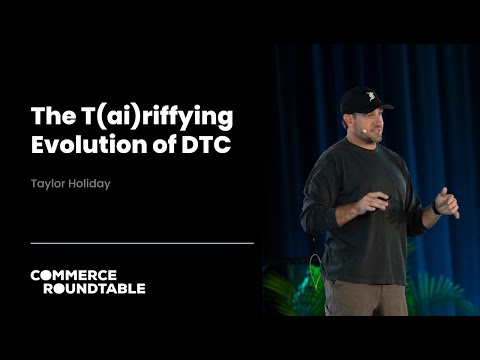
Taylor Holiday connects marketing decisions to cash, contribution, customer-file health, inventory, and the ownership objectives that should guide an ecommerce growth plan.
Taylor Holiday connects marketing decisions to cash, contribution, customer-file health, inventory, and the ownership objectives that should guide an ecommerce growth plan.
For founders and growth leaders who need marketing targets that reflect the economics of the business.
Speaker roles and platform examples reflect the session’s original context. This is an archived conversation.
Review cash and contribution alongside revenue when assessing the growth plan.
Read this part · 01:21 ↓Track active customers and acquisition quality to spot pressure before returning revenue declines.
Read this part · 08:16 ↓Align marketing targets with the owner’s actual liquidity and business objectives.
Read this part · 13:04 ↓Include inventory age and cash needs when deciding which products and offers to promote.
Read this part · 21:37 ↓Build forecasts around planned actions and review the gap between expected and actual results.
Read this part · 25:09 ↓A quick editorial guide to the key ideas. Read the complete transcript below for the examples, details, and discussion in the recording.
Original recording on YouTube ↗Taylor uses a business case to show how changing capital costs, acquisition performance, and customer behavior can reshape a company. A top-line view alone can hide the pressure building underneath.
The talk asks marketers to understand how their decisions affect the rest of the business. Acquiring customers, buying inventory, and paying for an organization happen on different timelines. Those timelines influence whether reported growth also creates a healthier company.
A large existing customer base can support revenue while new-customer acquisition becomes less efficient. Taylor describes that as a lagging problem: the business may appear healthy for a period because earlier acquisition is still paying back.
The active customer file is therefore a useful signal to monitor. Look at whether it is expanding or contracting and what that suggests about future returning-customer revenue. A current profit figure does not automatically mean the next period is secure.
Taylor asks owners to be explicit about what the business is intended to accomplish. Building toward a sale and distributing cash can create different priorities and scoreboards. The rest of the team needs to know which objective it is serving.
Without that clarity, marketing can optimize a target that does not match the owner’s needs. A revenue goal is not enough by itself. Explain how the company intends to create value and what tradeoffs the team is prepared to make.
Inventory age, product margin, and cash affect which marketing actions are useful. A business may need to recover money from stock rather than optimize every campaign against the same acquisition benchmark.
This requires looking beyond the advertising platform. A plan that appears efficient in the account can still leave too much cash tied up in products. Finance, operations, and marketing need a shared view of the constraints so the campaign calendar serves the business.
Taylor describes forecasting with the expected impact of specific marketing actions: launches, emails, messages, and changes to the site. That creates a daily expectation the team can compare with what actually happened.
The value is not pretending every forecast is exact. It is making the assumptions visible enough to learn from them. When performance differs from the plan, the team has concrete actions and expectations to investigate rather than only a monthly target it missed.
From the recording’s auto-generated YouTube captions, with filler words removed and paragraph breaks added for readability. Names, numbers, and wording may contain caption errors; refer to the recording for exact phrasing. Chapter links jump to the text below.
Original recording on YouTube ↗0:00Who's an owner in here? Okay, this is your job. Nobody else gets to do this one. Only you get to decide why the business exists. What it exists to do. And I'm telling you, this is a problem in here. It's not in here, it's in here. Does your business exist to make you feel cool? Does it exist to give you a cool experience every day that you show up to? I don't care what the answer is, but you got to get clear and you got to get your organization aligned around it.
0:27And the right question to actually ask, I think, is how do you plan to create liquidity for your shareholders? I think this is actually the right question about a business objective. And in e-commerce, there's really two answers. You're either going to sell the company, which probably means that you're playing a P&L game, you're trying to build TTM EBITDA, or you're trying to distribute cash, in which case you're playing a balance sheet game. Two different scoreboards, two different objectives. Those are really the choices. Maybe you could come up with a third. I'm being a little bit pedantic, but you get the general idea. You've got
0:54to get clear. Can you hear me? Sometimes when I come to these place, I try to walk around and hear the audio, and it was a little on edge. So, Aaron Orendorff, can you hear me? Look at him, he's right there, he can't hear me at all. Aaron, all right. I'm Taylor, I'm the CEO of Common Thread Collective, and I'm excited today to tell you a story. And the story involves a client of mine, a new client
1:21just started with us. and the story starts in this chart. This chart is what we would refer to as a cohort-specific marginal value by customer over time. That's a lot of words, it just tracks how much money did we make for every customer that we acquired over time. and this is the state of the business when it came to us. And what do you notice? It's a lot of negative customer acquisition. in fact, if we were to turn these into dollars, it's $2 million of negative contribution in the process of acquiring customers. That's not very good capital allocation. Not exciting at all. In fact, when I talked with the CEO about it, this is what he said to me when we were reviewing this chart. He said, "Looking at this chart, it's amazing we are still in business.
2:08And we've been profitable all but one year." I respond. I say, "I agree. It's because you have so many customers to offset it. It never would have worked if you were smaller." He responds, "Man, 2020 and 2021 were the golden era, wasn't it?" I said it was fake. retail literally shut down. it was a black swan event that will probably never happen again. But I want you to recognize this idea that for him it was the golden era.
2:35It was a period when everything in his business was working and he was making a bunch of money and acquiring a ton of customers. but in reality, what was happening is that he was experiencing growth subsidized by excess capital. And this isn't going to be novel to any of you. You're all aware of what happened, but there were three forms of excess capital creation in this area that has led us to an insidious problem today. The first was venture capital.
2:59I don't know why these all say one, but here we are. Venture capital obviously came into our industry at record levels. Second, there was really cheap debt. And on top of that, a bunch of risky lending models that got built on top of it. And then third, the one that gets talked about less that really was pure excess capital creation was hyper-efficient new customer acquisition fueled by inflated demand. When we were the only game in town and all of retail had shut down, all of a sudden we all thought we were really good at marketing.
3:28and we were celebrating building really cool businesses. but then, what happened from there is that all the money left. First, the venture dollars. In that in 2021, there were five billion dollars in venture capital that flooded into our industry. It's all gone. It's down 97% off of its peak in 2021 to basically functionally zero today. and that on the debt side, we had a two-year period starting in March of 2020, which is the start of COVID, until March of 2022, where interest rates were at a 30-year low. They were about 3% at the Fed level. And what that meant is that on top of that really cheap government debt, there was a bunch of these folks that showed up. Now, this isn't a knock on the availability of, lending partners like this. Some of them are really useful and important in our industry, but what it meant was that they were arbitraging cheap access to the cost of capital on their side to provide you risk-free variable rate loans. which with no personal
4:28guarantee felt like an awesome way to build my business. And as fast as connecting your ad account, having them run a little model and providing you a check in 24 hours, it felt like literal magic free money. turns out lending off the back of your ad performance is a pretty risky way to lend money. It doesn't work out great, but they've, since recovered somewhat. But on top of that, we've also seen a perpetual decline in the efficiency of new customer acquisition. So, this is just AMER, which is a metric we use to define new
4:56customer revenue divided by ad spend, and you can see it just is on a perpetual downward movement in the efficiency of acquiring new customers. simultaneously, while it's becoming harder to acquire those customers, you're actually having to discount more to do it. So, this is, I think, one of the best indications of the health of consumer demand that, our industry can have, and it's basically our pricing power. Is what do we have to do to convince customers to buy product from us? And if you see, going back to 2021, we had to do very little discounting. We were, hot. Things were cool. And every year since then, we've had to discount a little bit more, and a little bit more, and a little bit more in order to do that. And that's partially because of a lot of different factors, some of which are mass amounts of competition that have entered virtually every space in our industry as it's matured. but also, the other dynamic that's really interesting is that you'll hear a
5:48lot about inflation as a problem in the United States,
5:53but our industry, it's really important to understand is deflationary. Have you guys ever seen that chart where they show you inflation and it's like college prices, medical care, and then televisions, right? And it's like the reality is, unfortunately for us, our industry doesn't actually benefit from ability to pass the cost of our industry onto the consumer. There's too much competition. There's somebody willing to take less margin than you that drives the price down perpetually. And I had this theory, and so I went to the guys at Particle. I don't know if you know them. They do some really cool work around tracking product pricing across our industry. And I said, "Hey, I want to look at the average price of all the products in your database over time for the last 2 years to see if we're experiencing inflation effects at the consumer level or if that's just happening at the cost of goods level and we're not actually able to equally pass that on." Because that discount rate thing for me was triggering this idea
6:42that, "Shoot, we might be experiencing pressure on the cost of goods side as well." And when you look at this, that's exactly what happens is that the average price of a consistent set of products over time goes down. Now, that shouldn't be that's not rocket science, but it is important to understand that we don't see in our industry inflation moving the price of products up. and in fact, if you the one on the left is the same set of products. And then what brands try to do is that when you get a new product to introduce, then you try and move the price up. So, the column on the right is the average full price of new products introduced by brands in that period. And you can see inflation actually hit a high in the in Q3 of 2022. And so, you see there was an attempt to pass those costs onto the customers, but pricing pressure just drives it right back down. There's too much competition. Y'all don't have that much pricing power. It's just a reality.
7:32So, the end result is a really, really nefarious environment. There's no venture debt or there's no venture financing. The cost of debt is through the roof, and media efficiency is down, and your gross margins under pressure. Holy that sucks. That's a really
7:46hard environment that we exist in today. But all right, this is a well-worn story. We're aware of this now. Why are we talking about it today? Why is it becoming a problem now for a lot of these brands that grew up in COVID? And the reason is this chart, okay? This is what I refer to as a net active customer graph, okay? And your active customer file is representative of the customers that are still within a window in which they are likely to purchase from you.
8:16For most brands, it's around 100 days. If a customer doesn't rebuy within 100 days, they're highly unlikely to purchase again. We would call those customers lapsed or churned customers. And so we're tracking all the time the relationship between customers that you add, new customers, and customers that lapse or churn. And that net change represents the change in your active customer file. See, brands make this mistake where they think their customer file grows up into the right forever.
8:43And every day I get new customers, my customer file grows. But the reality is most of those customers are gone and they're never coming back. and they are dead to you. You don't own them, you don't possess them, and they aren't going to purchase from you likely ever again. And so what happened was this is a really big business. You can look at those numbers in terms of the amount of total active customers that they have to get a sense of this is one of the largest stores on Shopify. And you see during COVID, if you look at like March of 2020 through let's say November of 2022, there's a massive run-up up into the right. The customer file just keeps growing and growing and growing and growing and growing, and the size of your active customer file is the best predictor of your future returning customer revenue.
9:29It's a leading indicator to how much money you'll make off your returning customers in the future. And so what this means is they were able to subsidize declining growth for a very long time and remain profitable. So as your new customer acquisition chart starts to look like this, there's a decline, the business impact actually isn't felt for a while. Because you're spending a lot of money to keep acquiring customers, and even if it's a little negative, the profit
10:00you're making off of this giant customer file from all those customers you just created is propping up the business. And so if you go back to that text message, the CEO said, "We've only been unprofitable one year despite losing $2 million in the process of acquiring customers." This is a lagging problem for big businesses. For many, many months they've been able to offset this problem. Despite the fact that they're spending more money than than ever to acquire this last tranche of customers.
10:28But the gig is up. The decline in efficiency over time has reached a point where as they stare out into the future, they realize we're going to die if we keep going on this trend. Something has to change. And the problem with change is that the impetus for change is often a consequence. Something bad has to occur before we're willing to change. We will convince ourselves endlessly that we're going to make it right before we will make all the hard decisions that go into right-sizing businesses coming off of this trend. and unfortunately some people don't make the decision. They never do. And so we are living in a wake where we're see a cascade of a lot of businesses that have not made the change and have gone bankrupt. And it's happening now as a lagging indicator to all the flushing out of that excess capital. It's working its way through the system, and suddenly now brands are having to deal with driving their own profitable growth.
11:22And every time I meet with one of these clients, and we meet with a lot of them, this quote springs to mind. So W. Edwards Deming isn't a composer and an economist, a smart dude, and he has this phrase that I've come to love which says that your system is perfectly designed to give you the results that you're getting. And every time I meet with one of those brands, that's my experience. Your system is perfectly designed to give you the results that you're getting. And I see a lot of these brands. When 2023 CDC made a decision to move up market, and so we work with a lot of big eight-figure stores that grew up in COVID. So, they come to us with this problem all the time.
12:00And to give you a sense of the scale of the problem, cuz I know some of this may not be personal to you. We went In COVID, when COVID happened, we walked out of our office with 60 people. We went from 60 people to 200 people in 18 months. And the demand was insane. It was like we were just catching fish in a barrel. Aaron was making all this cool content. It was just new customers endlessly. We did more new customer revenue last month than we ever have in the history of our company.
12:24Because this problem is so real for such big businesses. And the reality is that the systems that they designed weren't actually bad systems. They were right for what they were trying to do. They once worked, but today they produce something worse. Today, they produce conflict, confusion, and complacency. And this is the state of all of these businesses when they come to me. And they conflict exists in a very specific area. It has to do with ownership misalignment, and it's rooted in the cap table. If we go back to the introduction of all that capital into our industry, the problem with capital when it shows up is it takes something from you in exchange.
13:04It asked for equity. It asked for a position on your cap table, and it now has an incentive. An incentive that's driven off of the value at which they gave you that money. And the problem is the company's not worth that anymore. And so, inherent built into all these cap tables all around the industry, and this is just a graph to illustrate the general principle, is there's conflict into the system where you have an investor who wrote a check at a value that doesn't exist anymore, and a founder who's go has maybe never gotten paid a dollar of liquidity out of it that would love to turn the business into a cash-flowing enterprise, and that VC that's sitting on the board is going, "-. No, no, no. We're not going to be distributing any capital cuz we have to go clear the hundred million dollar valuation that I wrote a check for."
13:50Or, worse, maybe the founder actually took secondary. They got paid. Maybe the founder got a few million bucks in that deal. And now there's a preference at twenty million dollars where they wrote the check, and the company's actually worth less than that. And so, despite the founder owning eighty percent of the company, his equity's actually worth less than the preference, and he's showing up to work every day or she's showing up to work every day and going, "I'm working to try and get back to zero. Why would I want to keep doing this?"
14:16And so, you have this problem where everyone was in founder mode and excited, and now it looks a little bit more like this. where you have some of these founders that are like, "I don't want to do this anymore. Like, my company's upside down or all of my employees have options that are underwater, and I've got this venture person that wants me to build a hundred million dollar a business. I can't distribute capital to myself. I'm going to like sort of work at this."
14:37And they're kind of zombies. They don't really have the incentive to go do all the hard work that's required to make this business scale. And we see this all the time where at the very root level, at the governance structure, whether it's the shareholders or the board, there's a conflict between the incentives of the organization to make the decisions they need to become the kind of business that could be really healthy. The other problem. Oh, man. no one has any idea how to allocate their media dollars.
15:04It is like, despite having more tools than we've ever had to try and make this
15:08decision, it's utter complete confusion. We are like square smack dab in the middle of the midwit meme right now. Like, every conversation we get on, it's like, "Okay, how are we doing this?" And it's like, well, my first party rocker box data feeds my triple L dashboard powered by my Northbeam Apex MMM which triangulates our post-purchase survey data into a predictive prescient model. I swear to God, it's like 17 spreadsheets to make a decision on this ad, and they all have a different number.
15:36And you're like, how do I decide what I'm going to do? And it's the most confused and and and it's in the system design, which we'll talk about in a second, but it is it is chaos how hard this has become to despite more resources than ever. And the end result is that spend is going down. People don't know what to do with their media dollars. And there's it's so there's inefficiency at the scale that they're at, there's confusion about the allocation, and Meta is like the gold standard. It's actually the channel that still is producing year-over-year growth at really strong levels, like 26% year-over-year spend growth is really a huge number on the base that they're working from, but the real confusion lies here. Google is an utter disaster.
16:14Nobody has any idea what to do with PMax. If you think you know what to do with PMax, I I think you're lying. And we could we could argue about that later over a beer, but this is the most confusing ad product ever created in human history. It is like utter confusion what people don't know what to do with this. And the end result is people are just pulling their money out of Google at an alarming rate.
16:32Now, I don't know how much we matter, the e-commerce industry, for Google's overall business, and they've got self-driving cars and AI and all the things, but in terms of e-commerce money, they are losing wallet share fast. People don't know what to do with this product. the third problem is that these organizations are incredibly bloated. They're small businesses now, but they move at the speed of enterprise. I swear to God, we get on every call and it's like this. Oh, Jesus.
16:56It's like, who are all of these people on this call? And you go around and it's
17:00like, hi, I'm Jamie, I'm the Criteo channel manager, and then I'm Ricky and I I run the Pinterest channel, and then I'm Mikey and I'm over here, I do Pinterest and I do affiliate, and they just go around the call, and everybody's managing their own channel, and then you get on a call with them and you're like, all right, Mikey, tell me about Pinterest. He's like, oh, I'd have to get on the phone with the agency.
17:15It's like, what the hell, you don't even do anything? And what happens is that these organizations literally design a conflict of interest where it is now Jamie's job to find some attribution tool that says that Pinterest works. And she's going to show up to every meeting and she's going to fight for her life to convince you that Pinterest works. And I promise you, one of the tools will say it. She'll find a post-purchase survey, she'll find an MTA solution, she'll find an incrementality read that says in that says Pinterest works and everyone will go, "Okay, I guess Pinterest stays on."
17:45And it all just keeps going. And meanwhile, the bank account's like this. And they're just disassociated from each other because nobody at we introduced all these proxy measures of success. And meanwhile, the amount of money we're making per customer just keeps becoming negative. But yet, somehow we can validate every decision that we're making on the spend side. And the end result is we have unrealistic goals, we have wasteful media spend, we have a bloated OPEX, and slow action. And here's the thing, I don't actually blame the people. They didn't build bad companies, they built companies for an era that doesn't exist anymore.
18:16There weren't unrealistic goals, there were top-line revenue growth goals, and everyone was unified. And there wasn't wasteful spend because nobody was measuring waste, it was revenue-generating spend. Right? And then the bloated the the giant OPEX was we were going to the moon, there was about to be a thousand employees. I lived this life. There was a 20,000 square foot office and a really cool thing and all this stuff. That's where we were headed. We were going to double every year. Toby said so, Zuck said so. Right?
18:42So, I don't blame anybody. They didn't make the wrong decision. It's hard to contextualize how crazy that time was. We all thought it was real. We were becoming China. E-commerce was going to be 50% of retail. Right? You guys were there, that's what happened. But it turns out that's not the case today. And so, the system is just designed wrong. And it needs to be redesigned. So, what do we do? How do we solve it? at CTC, we have this phrase that we're
19:07obsessed with and it's profitable growth equals strategy raised to the power of execution. We can't disassociate these two things. They're both equally important. Strategy and execution. I realize what it is. That's not my font. Okay, that's what was bugging me why the spacing was weird. Strategy raised to the power of execution. You need both. You need great strategy and you need great execution. And execution is really the key. It's the thing that makes it exponentially better.
19:32So, the question then, if we're into algebra, like we are at my house. My wife is a middle school math teacher. She teaches a lot of algebra. So, we got to solve for the variables here. So, what makes a great strategy? Well, good news is is that this is a well-worn topic by a lot of smart people. One of my favorites is a gentleman named Richard Rumelt. He wrote a book called Kernel of Great Strategy, and he says this.
19:53A good strategy must precisely diagnose the problem being solved. It must set a guiding policy that will address that problem and propose a set of coherent actions that will deliver the policy. So, we have three things to do. We have to build We have to identify the problem we're solving. We have to build a plan and we have to execute against it. Very simple. So, step one, the business objective. Who Who's an owner in here? Okay. This is your job. Nobody else gets to do this one.
20:23Only you get to decide why the business exists. What it exists to do. And I'm telling you, this is a problem in here. It's not in here. It's in here. Does your business exist to make you feel cool? Does it exist to give you a cool experience every day that you show up to? I don't care what the answer is, but you got to get clear and you got to get your organization aligned around it. And the right question to actually ask, I think, is how do you plan to create liquidity for your shareholders?
20:48I think this is actually the right question about a business objective. And in e-commerce, there's really two answers. You're either going to sell the company, which probably means that you're playing a P&L game. You're trying to build TTM EBITDA. Or you're trying to distribute cash. In which case, you're playing a balance sheet game. Two different scoreboards, two different objectives. Those are really the choices. Maybe you could come up with a third. I'm being a little bit pedantic, but you get the general idea. You've got to get clear.
21:13And I'll give you an example how this affects me, your marketing partner, okay? your confusion creates ambiguity for me that makes me think you're I'm that I'm bad at my job when I'm I'm not. so here here's the reality. This chart, okay? on the left axis we have contribution margin per unit. On the right axis we have total contribution dollars. And the boxes are intended to represent
21:37inventory age. Anybody ever seen like an ABC system for managing inventory age? Like in 0 to 60 days it's A grade, 60 to 100 it's B, and then when it ages to a certain level it's C grade, right? Well, marketing actions should have a relationship to the age of inventory. And so what I often will describe for people is that if you gave when you first give me inventory, I should sell try and sell all of it at full price with zero CAC.
22:03That usually means emailing your existing customers and seeing how many of them will buy it. That's the way to maximize the marginal value of every unit. So if you gave me a goal and you said, "Taylor," and this people do this, I'm not kidding, they say, "Your goal is a profit percentage." I say, "Okay, if you say so." All I'm going to do is step one. Full price zero CAC, sell it to your existing customers, and I'm going to come back and I say, "Here, there's your maximum marginal value percentage per unit." And you're going to go, "Oh no, no, okay, dang it, that's not what I wanted. What I wanted was maximum total dollars."
22:33And I say, "Okay, cool, no problem." And then I move across my cycle to the star cuz the star is the point at which the marketing action down below becomes no longer profitable. So I move all the way down the marketing action
22:45moving through as much as I can of every piece of it until I reach the point where I don't make any money anymore taking action, and I stop. Because at that point I would start deteriorating the P&L. I would start reducing contribution dollars. And I bring it back to you and I say, "Here you go. Maximum total contribution dollars." And then they go, "Well, but wait, I've got all that inventory and I need to turn it back into cash. So, I actually need you to to sell it all so I can get cash to buy more inventory." And I go, "Okay, that's a third game. Now we're trying to maximize cash. And if I'm trying to maximize cash, I move all the way out to the last star, which is eventually I liquidate the inventory at below full price at the largest discount possible to turn it back into whatever cash I can to get it back and going." And in all honesty, I think the game should be free cash flow. I think that's the
23:27game that most of you should play. But regardless, you have to tell me which one you want to play if I'm going to support you. And this is how it shows up in the ad account. I will never build a liquidation funnel in your ad account ever unless you tell me we're playing a cash game, in which case I will absolutely build liquidation funnels for your aged inventory to get it off of your balance sheet because here's another secret, you're all lying on your balance sheets. Your inventory isn't worth full retail on day 700 after nobody bought it.
23:54So, it's time to turn it back into cash. We've got to do that. But if that's not the objective you've given your growth marketing lead, your head of marketing, anyone else, you're going to build conflict. I saw this at the biggest company in the world, okay? The big one of the biggest retailers in the world, Ann Taylor Loft. We worked with them for a long time. And their organization just fought with each other constantly because what would happen is the media buyer had a KPI related to ROAS.
24:16And the media buyer would make all the decisions to sell the best product because that got the best ROAS. And then all of a sudden there'd be a bunch of seasonal inventory that was about to leave, and the execs would come in and say, "Sell this thing." And they'd go, "If I sell that thing, I don't get my bonus." They'd go, "No, sell this thing." And then they would have to do it, and then they wouldn't get their bonus, and then they'd be pissed off and be like, "Well, it's product's fault that I didn't get my target." And the whole organization would just turn into infighting.
24:42Cuz it's conflicting goals around what the organization actually cares about, endlessly. Okay, so once we get clear though, cuz you're not going to do that. You're going to create a very clear financial objective. Then we have to build a financial plan that achieves that business goal. and here's another important step.
24:59The other thing I watch all of you do is you go, "Okay, I have a business goal. It's $10 million in EBITDA. Okay, so to get to $10 million in EBITDA, I need $40 million in revenue, and then my ad spend will be $20 million." And you just start
25:09constructing it as if you get to just build the future out of whatever you want. That's not how this works. You have to start your forecasting and financial planning from what is likely to occur. This is a modeling exercise where you think about the 50th percentile outcome. If you changed nothing, if you did what you're currently doing, what would happen in the future? This is what CTC usually steps in and does. We anchor people to the reality of their present state. This is what is currently true.
25:35Now, I don't stop there. We're not in the interest of just making you sad. We then want to build a bridge to what is likely to occur. Okay? But that bridge has to be built on marketing actions. I have to be able to identify the specific thing that is going to cause a change in the data. I can't just move numbers up. That's not how it works. I can't just make revenue appear out of thin air. And this idea, this is the fundamental idea.
26:02Action, reaction. Marketing action, money. Tying those things together in everything you do has an expectation of money, that has a clarity of the cost that should be attributed to it, and its impact on the business. And all increased revenue has to be assigned to an action. And here's another idea, all costs must be assigned to the revenue flow and contingent on realization. I've contributed to a problem in our industry. It's me, it's my fault. I told us that there were two kinds of costs, fixed costs and variable costs.
26:32And so what happened was, people started forecasting their OPEX as if it was immovable. Okay? The reality is the only fixed costs in your business, the ones that probably are long-term commitments and can't be moved, are things like leases or these SaaS contracts that these guys are getting you all into for a year. those you probably can't move that well, Aaron. I'm sorry. I love you. but the reality is the rest of them should be referred to as I'm introducing a new phrase here. You're going to see me hammering this soon. Contingent costs.
27:02The idea is that marketing production budget that you have slated for June only happens if you hit your revenue targets April through May. Now, that feels obvious, but you'd be shocked at how often marketing and leaders are like, "Wait, you're taking away my creative budget?" And it's like, "Yeah, we missed revenue for the last 4 months. It's contingent. They only happen in so much that we're on plan." and the plan is not incomplete until you display that your objective is achieved all the way through. Okay, that's the philosophical stuff. Now, let's talk about how we actually do it so that you can understand the level of sophistication that's possible in this kind of work to build a disciplined system for profit.
27:37I think a great financial plan is going to leverage three different kinds of models. The first model, and this is inside of our data platform Statlas where we have a planning tool, is a new revenue model
27:46that builds a relationship between spend and AMER. Spend, your budget and the efficiency of acquisition, retention, which is going to be a cohort specific LTV model, and then the third one, which is our newest thing called an event effect model. We're going to talk about that in a second. So, spend and AMER modeling, very basically, is just doing a regression of the relationship between your spend and your performance over time by seasonality. So, our business has tons of seasonality. Your performance in September is going to be different than January, then different than November.
28:14So, we're going to analyze all of that to build a relational curve between spending and efficiency for every month. And then we're going to allow you to make a choice. Again, business objective. Do you want to pick a point on that curve that optimizes contribution margin? Do you want to pick a point on the curve that maximizes revenue at break even? Do you want to pick a point on the curve that maximizes lifetime contribution margin? Or do you want to type in your own number? People like to type in their own number. But, the point is that all along the way there's some point at which the spend and efficiency relationship maximizes the amount of money you're going to make.
28:49That's the point that you should pick on that curve. So, that sets our media budget for every month. And this is just a very basic principle. This is like showing you rudimentarily how the math works. You're going to build a scatter plot of all that relationship. You're going to regress to an average. It's not going to be linear. It's probably going to be parabolic. But, the idea is that at every point on this line, if you were to take the Y axis of customer acquisition cost, there's some access of spend. All skipped it, but you get the idea.
29:13There's just a plot graph. This is very basic math. Don't feel overwhelmed by this. You can ask ChatGPT to do it. Upload your spend and efficiency by month for the all your life and ask ChatGPT. They'll give you one in like 7 seconds. Now, retention modeling, is very similar. It's also It's even easier. This is just looking at the performance of every cohort of customers over time and modeling out a prediction of the future performance of your customers. And this is actually the easiest part to be accurate about. It's subject to the least volatility of all businesses. You can be really accurate in predicting that part of your stack.
29:46And so, then you end up with your new customer revenue expectation, your media budget, and your returning customer expectation. But, generally speaking, this is where this falls apart is that it's disassociated from the actual events that you have planned in the future. So, the reason most forecasting tools out of the box don't work that well for
30:02people is cuz they fail to consider that the future's different than the past. And it's different based on what you have planned to do. And so, we've created what we called an event-based model where we started tying together all of your media performance to all of your marketing actions. So, in our database, what we've started creating endpoints for is we define marketing actions. And marketing actions are campaigns being launched, emails being sent, SMS being sent, product be being listed on your website, changes to your website, any API endpoint that we can assign as a marketing action, we can now begin to correlate and determine its relationship to revenue generation.
30:37So, we can start to decide the value of every marketing action that you do. And then when you go to build your marketing calendar in the future, okay, we can now have an anticipated value of every one of those actions. So when we build your marketing calendar, we know its impact on returning customer revenue on that day. When you launch a new ad, we have the expected value of every new ad that you create. And so that we can plan the future of that revenue. And the end result is every action has a corresponding expected impact. So we have You have this marketing launch, you have this product launch, you have this PR release, you have etc. etc. that we can look at and analyze as predictive.
31:12And that gets us to a daily expectation of spend in every channel, new and returning customer revenue every day for an entire year that all ladders back to the financial objective that you have. Okay. But we're not done there. That's not actually enough. We're actually going to go further because again, this idea this what I want you to leave with here is this idea that actions are the building blocks of revenue. Is that inside of your company, if you want to change your revenue, you need to do things. And really, ads, emails, and SMS are the atomic units of your forecast.
31:44If you want to move the money, create these things and send them out in the world. Every time you do, you produce some amount of money. And so I'll give you an example of how this goes even a level further. And we're at an email conference, so we can look at and determine how each of these actions has an expected value that can be modeled. So let's look at email. So all of you have an email calendar.
32:05But what none of you have in your email calendar is the expected value of every one of those emails that you send. If you did this, even if you just guessed, you just went and looked at last month and you went, "Okay, when I send that Tuesday newsletter, I get this much. Oh, okay, cool. I think I'll do this much next Tuesday." If you did it that simply, it would massively improve your business because what you would see is that the sum of that number equals your total expected email revenue for the month based on some expectation that you have for what that channel needs to produce.
32:37And here's the deal. People argue all the time about how many emails should you send? You know what the answer is? However many it takes to get to the number. That's how many you send. We don't miss target. That's the rule. If I can do it with four emails, then cool. I'm awesome. But if I need to send another one at the end of the month, I'm going to send another one at the end of the month because we don't miss target.
32:58That's the behavioral mechanism. That's the change in discipline. Everything has to be accounted for. And we do this now in the same thing with ads. Every campaign, every dollar, every day is plotted and realized. So every time I want to go to send those emails every day, the first of the month I send an email. How much money did I make? Whatever I thought the revenue was going to be, I see that I make more or less.
33:21And you know what? You can get off stage. I can't go over there. It doesn't matter. Hey, if I made less, you know what I do? I better plan another email. If I made more, cool. Maybe I can withhold that promotion. Maybe I can wait on that action and save it for when I need it later. Don't just do things cuz you wrote it in the spreadsheet at the beginning of the month. That's not how the world works.
33:39You don't have to do it. Do it if you need it. The same thing can be done with ads. Ads also, and this is the thing that drives people nuts. And I wish I wish we could get to a place where there's some consensus around this idea cuz it's like a very practical, easy idea. Every one of your ads has an expected value. You have so many ads that modeling the expected value of your ads is actually really easy. It sort of pairs very nicely into a log normal distribution where you can see that the vast majority of your ads produce very little value and a tiny percentage of your ads produce a lot of value, but we can model the expected value of every ad you create.
34:16And you know what that should frame up? The cost to produce that ad. You shouldn't spend more than the expected value of that ad. But every time you go to launch it, what do you think the business ad impact is going to be? Well, you can guess whatever number you want, but I can tell you what the expected value is with 95% confidence for most of your businesses. So, what that allows us to do is say, "Okay, if that budget that we got from our modeling tool says we need to spend $249,000, then I need to make 497 ads."
34:43And this is a missing data point in every business. How many ads are we going to net make next month? The amount of businesses that are like, "We make 20 every Friday." Why 20? Why Friday? Well, it's just the system we designed. And it's like, "Okay, so your system is perfectly designed for the result that it's getting, which is not very much." You want to make a lot of money? Make a lot of ads. Each one of them has an expected value. If you can produce an ad for less than the cost of its for less than its expected value, that's positive expected value. You can just send those infinitely into the ad account and make more money. I know that sounds crazy, but it really is that simple. Now, it's hard to get the cost of the production below that because it's actually the expected value of every ad is not very good. But, the idea is we get an expected number of ads, we plan those ads into every single campaign, every dollar, every day. Media
35:28buyers do the same thing. They come in, how much did I spend yesterday? Was I right or wrong? If I'm wrong, what action do I take to resolve it? And you know what? It works. They work to make it work. And here's the thing. Now, after all of that really cool modeling, here's the truth. The only thing I know about all of it is that it'll be wrong. It'll be wrong. Every number I guess at, and I'm better at guessing than most of you, will be wrong.
35:55Because that's what modeling is. It's not Here's the key. Here's the magic. This is my guy, George E. P. Box. He's inspired a lot of how I think about the world. "Since all models are wrong, the scientist must be alert to what is importantly wrong. It is inappropriate to be concerned about mice when there are tigers abroad. Importantly wrong. The reason you build a system is not to guess right. We're not winning a prize for guessing the marbles in a jar.
36:21We're trying to find out where we're wrong so that we can fix it. And you're going to be wrong all the place. But you've got to fix it. So this is what happens. Every day this email drops in the inbox of everybody on our team, everybody in the company, and it shows them exactly what happened yesterday across 35 metrics to expectation.
36:42And the areas that are red, your team member has to show up and tell you what they're doing about it right now. So that every day there's an expectation and if I'm missing the expectation, here's how I'm resolving the problem. Everybody aligned towards the primary objective, it's going to be contribution margin for us. And then when we're off course, we're solving it. And every day we're going to be off course. Every day in some way because it was never about being right. We make it right.
37:12That's the key to forecasting. You don't guess right, you make it right. You go send another email to ensure you hit the target. You go launch another ad to make sure you get to the spend that you need. And you work to make it work. And the end result is across over $4 billion in GMV that we forecast for CTC, we're about plus 3% to target across all those businesses. And that brand that I told you about when they came to us, right? And they hadn't made a dollar in many, many months in new customer acquisition and internally they didn't believe it was possible. They had sort of capitulated to the idea that we're going to allocate our budget against a Northbeam one-day click MTA and we're just going to move the budget to the best ad.
37:53Whether it was profitable or not didn't matter. We're just going to move it to the best ad. And they were losing lots of money. In one month, in one month, we've completely flipped their customer acquisition cost to where now they are making $12.44 on every customer that they order. This is as of September 22nd and we're going to do from a volume standpoint because I know there's going to be a a couple of folks on Twitter that are going to tell me that I'm just siphoning up the bottom of the funnel. We're going to do more customers in September by about 50% than they'll do in July. And this is the first time in the history of the company that September will be profitable.
38:27In 10 years. The company's existed. They've never made money in September. It's always been their worst month. Cuz they have a big sale in August. They have a sale in October, November. So September's sort of an off month. And every customer we acquire is adding $12.44 in positive contribution margin. And this business is going to cover their interest expense. So not only are they going to make operating income, they're actually going to make net income after paying and they're going to grow their bank account.
38:53And that's the point. This is actually the goal. So if you want to actually grow your bank account, then you need to make sure that your system is perfectly designed to give you that result. If it's not, you won't. Thanks. It's It's not easy. It's not easy making finance sexy. Why are we clapping? This is finance. This is what we're talking about. This is This is the This is the unique thing that you have about yourself, brother. And I'm so thankful that you were able to come here and share all these things cuz it's the story told, the lessons learned, and the way to go about this. I'll give two or three questions before Taylor steps outside and has conversations. Any core questions that are left Oh, catch that, bro.
39:36Hey, so I love the idea of whatever
39:38it takes hit the target. I'm just thinking about when you you know, you're working with clients or with brands or whatever, a lot of times they'll say things like you know, they don't want They don't want to send something or or they don't want to change something in order to hit their target. So just an example, let's say you're selling a jacket for $250. And as a marketer you suggest, "Hey, end of the month we're not hitting our targets. Let's send an email, free hat with purchase of a jacket." They're the brand is worried about devaluing the brand, you know, whatever, too many offers. So how would you respond to that as far as you know, on the brand side they're worried about devaluing the brand, but on the marketing side you need to kind of pull out all the stops to make sure you don't miss your targets. So, what has to happen is it has to go back to what's the goal.
40:22Sure. So, if I would just simply ask back, is the goal not devaluing the brand? And the answer is no, that's not the goal. The goal is to make money. Now, what happens is that when you start making money, now you get to decide on a different set of goals, too. But, in many of these cases, the reason that people come to us is because like they finally reach a point where they've realized they're going to die.
40:47And so, you don't you don't worry about devaluing the brand when you're going to die. So, that's part of it. Is that you reach a point. But, I would also just contend that we tend to overdramatize that overdramatize the impact on brand single marketing actions have. If we just like think about one email that has a 30% open rate and a 6% click-through rate and whatever, like the amount of people that you just interacted with versus your TAM is like this so inconsequential. But, we deal with this a lot. And what happens is there's all these internal motivations for decisions for people in different departments. And that's why I go, the root goal is I have to solve this at the at the at the level of the CEO and board founder such that that person is incentivized by the same thing I am.
41:27And if they are, then guess what? They want to send that email. So, a lot of times I'm fighting for the entire employee compensation that's like, "Hey, we all got to get paid on contribution margin." Including that creative director who's usually my nemesis, right? Like, that person has to get incentivized the same way because if it's different, then we're going to fight. It's all about money. If if that person makes money when I do the thing that makes the company money, then they're cool with it. If they don't, then they fight over all sorts of other things.
41:52Follow the money. Till the holiday. Thank you very much, brother. Thank you.
Join Commerce Roundtable in 2027 for focused learning and conversations with people working through the same challenges.